

Finance teams have spent decades trying to remove manual work from document processing, yet many companies still rely on surprisingly fragile workflows behind the scenes. Someone downloads invoices from email, renames files, extracts totals from PDFs, updates spreadsheets, checks approvals, and manually prepares weekly reports for management. On the surface, the software stack looks modern. Underneath, much of finance operations is still powered by repetitive human coordination.
That’s exactly why AI agents are becoming one of the most important shifts happening inside financial operations right now.
The real breakthrough is not simply AI chat interfaces. It’s workflow execution. Modern AI agents can read invoices, extract structured information, validate totals, compare purchase orders, organize financial records, and generate summaries automatically across multiple systems. Instead of acting like a chatbot that only answers questions, these systems increasingly behave more like operational workers capable of handling multi-step finance processes from beginning to end.
Finance teams are paying attention because invoices create one of the most painful operational bottlenecks inside modern businesses. Research around finance automation increasingly shows that AI agents are moving beyond isolated tasks into coordinated end-to-end workflows, especially across accounts payable, reconciliation, and reporting operations.
At first glance, the workflow itself sounds simple. A PDF invoice arrives, the system extracts the amounts and vendor information, categorizes the expense, and generates a report. But behind that seemingly straightforward process is an enormous amount of operational complexity that companies have struggled to solve for years.
Why Financial Documents Are Still So Difficult
Most people assume finance became fully digital years ago. In reality, finance is still deeply document-driven.
Invoices arrive in hundreds of different formats from thousands of vendors. Some are clean PDFs exported directly from accounting systems. Others are scanned paper documents with blurry text, missing fields, or strange layouts. Some contain detailed line-item tables. Others include handwritten notes, foreign currencies, unusual tax structures, or inconsistent formatting.
Humans are surprisingly good at understanding this chaos.
A finance employee can immediately recognize that a bold number labeled “Total Due” represents the payment amount even if the invoice layout looks completely different from the previous vendor’s document. Traditional automation systems struggled with that flexibility for years.
That’s why older finance workflows depended heavily on rigid templates and fixed extraction rules. If Vendor A placed totals in the upper-right corner, the system learned that location. If Vendor B used a different structure, the workflow had to be manually configured again. This worked reasonably well until companies started processing invoices at scale.
Once businesses reached hundreds or thousands of invoices per month, maintenance overhead exploded. Every layout variation introduced exceptions. Every formatting update risked breaking the automation pipeline. Finance teams ended up spending almost as much time maintaining the workflow as they did processing documents manually.
Modern AI agents solve this differently because they combine multiple capabilities into a single operational system. Instead of treating invoice extraction as an isolated OCR task, they integrate document recognition, language reasoning, workflow orchestration, validation logic, database lookups, summarization, and reporting automation together. The result feels much closer to operational intelligence than traditional automation software ever did.
A modern invoice-processing workflow usually starts when incoming PDFs arrive through email uploads or cloud folders. The AI system reads the document using OCR and contextual understanding, extracts vendor names, amounts, dates, taxes, and payment terms, validates the information against internal systems, and then generates structured financial summaries automatically. The important shift here is that the system is no longer simply “reading documents.” It is executing workflows.
That distinction changes everything.
The Shift From OCR Tools to AI Agents
For years, OCR was positioned as the solution for invoice automation.
OCR was useful, but limited.
It could convert scanned text into machine-readable content, but it struggled whenever invoice layouts became inconsistent or documents contained complicated tables and irregular formatting. Finance teams compensated by building additional rules on top of the OCR layer, which created workflows that were fragile and difficult to maintain.
The biggest problem was brittleness. These systems only worked under highly controlled conditions.
Modern AI agents operate differently because they reason about document structure instead of relying entirely on coordinates and templates. Rather than asking, “Where is the number located?” the system increasingly asks, “What does this number represent?”
That sounds like a small difference, but it fundamentally changes how document automation works.
Enterprise finance platforms are increasingly moving away from rigid rule-based architectures toward adaptive orchestration models powered by AI agents. Traditional OCR workflows usually stopped after extracting invoice text. Modern AI systems continue much further. They validate invoice totals, compare purchase orders against accounting systems, route approvals dynamically, flag anomalies, generate summaries, and synchronize downstream financial platforms automatically.
That orchestration layer is where things become genuinely transformative.
Instead of acting like isolated software utilities, AI agents begin behaving more like operational participants inside the finance stack.
Why Invoice Processing Became the Perfect AI Use Case
AI adoption often struggles in environments that are highly subjective or emotionally complex.
Invoice processing is almost the opposite.
It is repetitive, measurable, operationally expensive, and heavily process-driven. That combination makes it one of the strongest environments for AI workflow automation.
Accounts payable teams spend enormous amounts of time on tasks that do not actually require strategic financial judgment. Employees open attachments, copy invoice totals into spreadsheets, verify vendor names, route approvals, organize records, and prepare recurring summaries week after week. None of these tasks are intellectually complex, but together they consume massive amounts of operational time.
As businesses scale, the cost becomes enormous.
Finance leaders are increasingly interested in AI orchestration systems because these platforms automate entire workflows rather than isolated tasks. But the biggest benefit is not simply labor reduction.
It’s visibility.
Once invoice data becomes structured automatically, finance teams gain real-time insight into operational spending patterns. They can identify which vendors are increasing costs, where approval bottlenecks are forming, which invoices remain unpaid, where cash flow timing is becoming risky, and whether unusual spending patterns are emerging inside specific departments.
That operational visibility becomes incredibly valuable for growing companies.
From PDF Chaos to Structured Financial Intelligence
The deeper problem with financial documents is that PDFs were never designed for machine reasoning.
Humans understand meaning visually. Machines historically saw disconnected blocks of text.
That mismatch explains why document automation remained frustrating for so many years.
Modern AI systems solve this problem by combining multimodal understanding with contextual reasoning. Instead of simply extracting text from a document, the system interprets semantic relationships between fields. A modern invoice-processing agent can automatically identify supplier names, invoice numbers, subtotals, taxes, payment terms, currencies, due dates, line items, and purchase order references even when layouts vary dramatically.
More advanced workflows then compare extracted information against ERP systems or accounting databases before approvals occur.
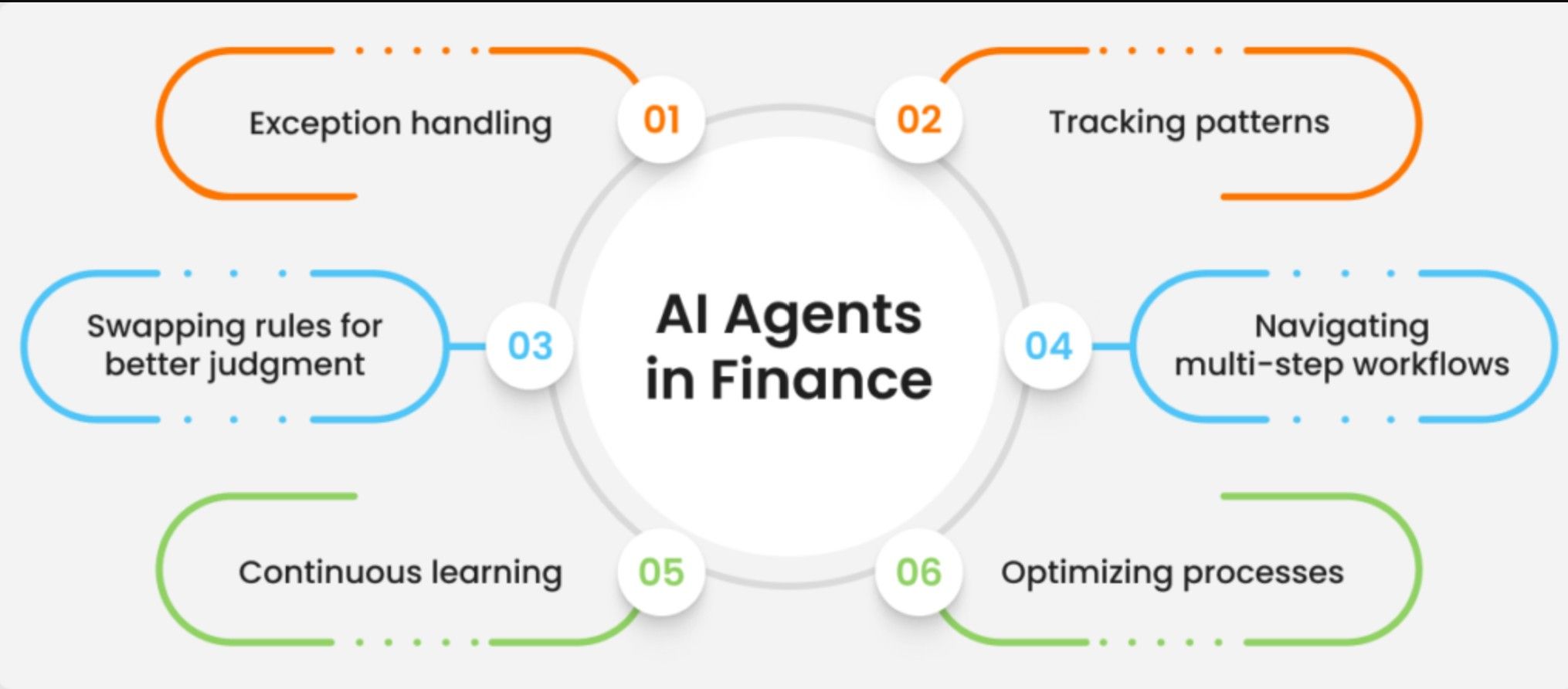
This matters because finance operations are full of small inconsistencies that create operational friction. Vendor names may appear slightly differently across invoices. Tax calculations may not match expected totals. Duplicate invoices may accidentally enter the system twice. Humans catch these inconsistencies through experience and contextual reasoning.
AI agents are increasingly being trained to do something similar.
The Weekly Reporting Problem Nobody Talks About
One of the most overlooked pain points inside finance departments is weekly reporting.
Management constantly wants updated operational insight. Executives want visibility into spending trends, vendor summaries, approval delays, liabilities, anomalies, and department-level expenses. The problem is that generating these reports manually consumes huge amounts of repetitive labor.
Finance teams often export spreadsheet data, merge records manually, verify totals, organize vendor categories, create executive summaries, and prepare presentation-ready reports every single week.
AI agents are becoming extremely useful here because they preserve continuity across workflows.
Instead of treating invoices as isolated documents, the system maintains operational context over time. That allows the AI to continuously aggregate vendor spending patterns, recurring expenses, approval backlogs, unpaid invoices, and sudden cost spikes automatically.
The workflow increasingly becomes continuous rather than manual.
Invoices enter the system, data is extracted automatically, validation occurs in the background, databases synchronize continuously, and management summaries are generated with minimal human intervention. Finance teams spend less time collecting data and more time interpreting it.
That’s a subtle but important transition.
Why AI Agents Feel Different From Traditional Automation
A lot of companies mistakenly compare AI agents to older RPA systems.
They are not the same thing.
Traditional automation follows predefined scripts. AI agents adapt to context.
That flexibility matters enormously inside finance because document workflows constantly encounter exceptions and irregularities. An old automation system might completely fail if an invoice layout changes slightly. An AI agent can often still infer meaning because it reasons semantically rather than relying entirely on positional rules.
Enterprise software vendors are aggressively investing in orchestration systems for exactly this reason. AI agents are increasingly positioned as workflow coordinators capable of handling multi-step processes dynamically.
A finance AI agent may read invoices, check internal databases, compare purchase orders, notify approvers, summarize weekly activity, update accounting systems, and escalate inconsistencies across multiple tools without constant human intervention. The key difference is continuity across tasks.
The system behaves less like a tool and more like an operational layer running across the finance stack.
Why Human Oversight Still Matters
Despite all the excitement surrounding AI agents, finance remains a high-trust environment.
And trust requires governance.
A hallucinating chatbot is annoying. A hallucinating finance workflow is dangerous.
Nobody wants an AI inventing invoice totals or misclassifying liabilities. That’s why the most successful finance AI systems rely heavily on bounded autonomy rather than unrestricted automation. Research into agentic finance increasingly describes the near-term future as supervised AI systems operating inside controlled workflows.
Human oversight remains essential for compliance, approvals, fraud investigation, audit readiness, and exception handling. The strongest finance workflows combine AI speed with human supervision instead of trying to eliminate humans entirely.
And honestly, that is probably the correct direction.
Finance teams are not looking for reckless automation. They want reliable operational acceleration.
Why Auditability Is Becoming Critical
One of the biggest emerging themes in AI finance workflows is auditability.
If AI systems participate in financial processes, companies need visibility into what the system did, why it made decisions, which data it used, where approvals occurred, and how exceptions were handled.
That requirement is fundamentally changing how AI finance systems are designed.
The best finance agents are not fully autonomous black boxes. Instead, they maintain detailed logs, preserve approval histories, track workflow actions, support review processes, and create transparent audit trails that humans can inspect later.
In many cases, that infrastructure becomes just as important as the AI model itself.
Small Businesses Are Entering the AI Finance Era Too
For years, advanced document automation was mostly accessible to large enterprises with dedicated engineering teams and expensive infrastructure.
That barrier is collapsing quickly.
Cloud APIs, modern language models, and workflow orchestration platforms now allow smaller businesses to build surprisingly sophisticated financial automations without massive technical resources. A relatively small company can upload invoice PDFs, extract structured data, generate reports, synchronize spreadsheets, automate notifications, and organize operational summaries using lightweight infrastructure that would have been impossible to build only a few years ago.
That democratization is one reason the AI finance space feels unusually active right now.
The tooling matured faster than many people expected.
Where EasyClaw Fits Into This Trend
One interesting shift happening across finance automation is that companies increasingly prefer flexible workflow systems rather than giant monolithic enterprise platforms.
Most organizations are not trying to replace their entire accounting stack overnight. Instead, they begin with smaller operational bottlenecks first. They automate invoice intake, PDF extraction, spreadsheet synchronization, approval routing, and weekly reporting before expanding further into broader finance operations.
That is where workflow-oriented tools like EasyClaw become interesting. Instead of attempting to replace accounting systems entirely, platforms like this can help automate repetitive document workflows across existing tools and reporting pipelines.
And realistically, this is probably how most businesses will adopt AI finance workflows in practice:
one painful process at a time.
The Bigger Shift: Documents Are Becoming Operational Systems
The most important thing happening here is not simply invoice extraction.
It’s the transformation of documents into operational infrastructure.
For decades, documents acted as endpoints. Humans read them manually and transferred information between systems themselves. AI agents are changing that model entirely.
Invoices are increasingly becoming triggers for automated workflows involving validation, approvals, reporting, anomaly detection, reconciliation, forecasting, and operational analysis. Multi-agent orchestration models are already being discussed as the future of enterprise workflow automation across finance systems.
And the implications go far beyond accounts payable.
The same operational logic applies to contracts, procurement, auditing, compliance, expense management, tax processing, and forecasting workflows. Anywhere documents create repetitive operational friction, AI agents are likely to become involved over the next several years.
Final Thoughts
AI agents for financial documents are not simply chatbots that can read PDFs.
They represent a much larger shift toward operational workflow automation.
The companies seeing the biggest gains are not necessarily the ones deploying the most advanced AI models. They are the ones identifying repetitive document-heavy workflows and gradually removing manual coordination from them.
Invoice processing became the perfect starting point because the pain is universal: too many PDFs, too many repetitive validation tasks, too much spreadsheet work, and too much time wasted generating summaries manually.
Modern AI workflows can now extract invoice data, validate information, coordinate approvals, generate weekly reports, detect anomalies, maintain audit visibility, and synchronize operational systems with surprisingly little human effort.
And we are still early.
Most organizations today are only automating fragments of these workflows. Over the next few years, finance operations will likely become increasingly agent-driven as orchestration systems improve and AI reliability continues to mature.
Not because companies want fully autonomous finance departments.
But because nobody wants talented finance professionals spending hours every week manually copying numbers out of PDFs anymore.