

Are you ready to transform your English grammar skills through systematic practice? The Verb “To Be” stands as the cornerstone of English communication, serving as the essential bridge between subjects and their descriptions. At PDF Agile, we’ve designed a comprehensive template that transforms this fundamental grammatical concept into an engaging learning journey.
This instructional guide will demonstrate how our meticulously structured template, combined with PDF Agile’s intuitive features, can accelerate your mastery of English grammar. Whether you’re a beginner building foundational skills or an advanced learner refining your expertise, this template adapts to your learning needs while providing immediate, practical application opportunities.
Why Start with Verb “To Be” Exercises?
The verb “to be” appears in approximately 20-25% of all English sentences, making it the most frequently used verb in the language. Our template recognizes this statistical significance and breaks down the learning process into digestible, progressive exercises. From simple present tense applications to complex perfect continuous forms, each section builds upon previous knowledge while introducing new challenges. The template’s logical progression ensures that learners develop confidence before advancing to more complex grammatical structures.
How Can Simple Present Tense Exercises Build Your Foundation?
The Building Blocks of English Communication
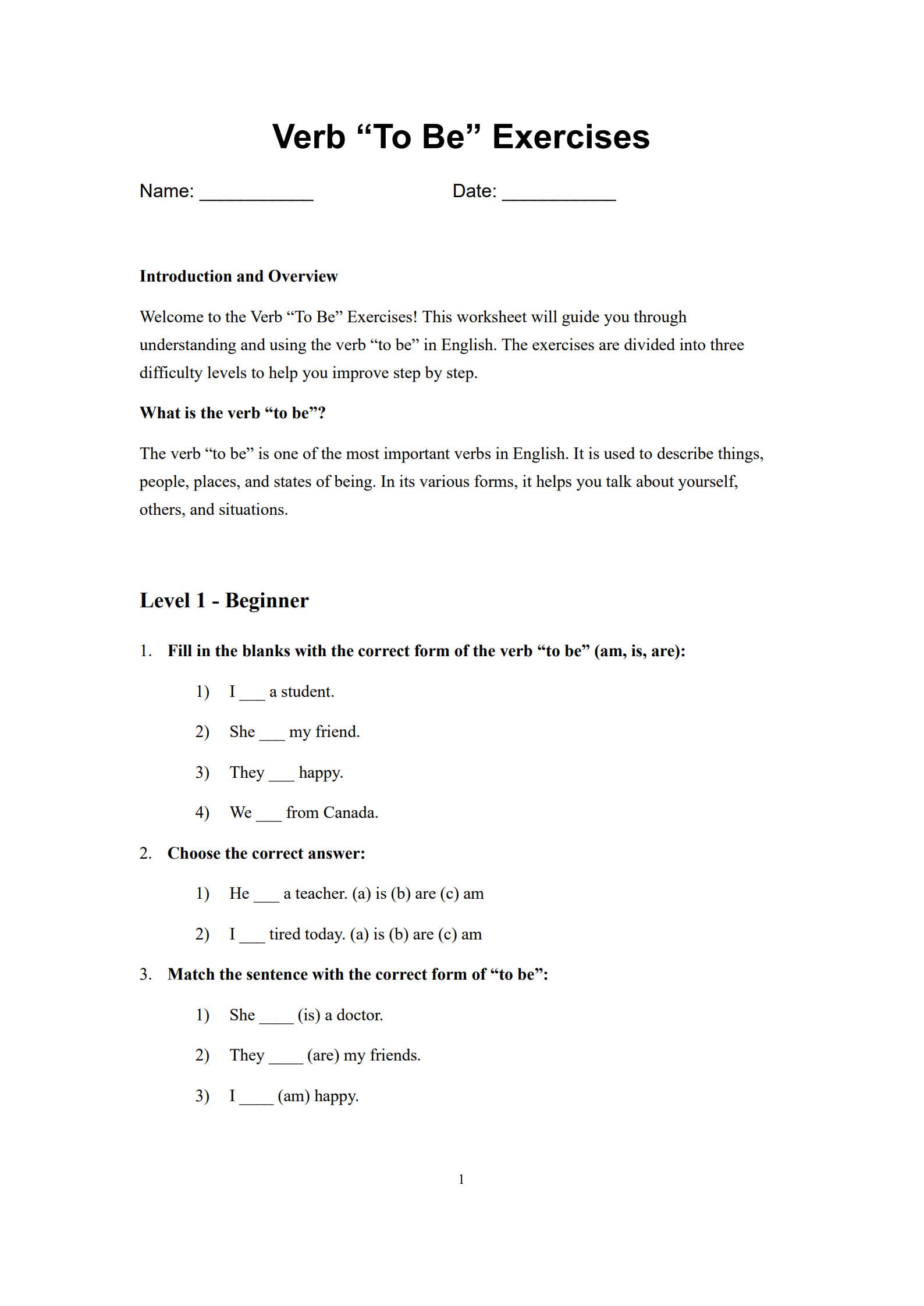
The simple present tense exercises in our template serve as your grammatical foundation. These exercises, like “I am a student” and “She is my friend,” may appear basic, but they establish the crucial subject-verb agreement patterns that underpin all English sentence structures. When you practice matching “am” with “I,” “is” with third-person singular subjects, and “are” with plural subjects, you’re programming the fundamental rules that will automatically guide your future language production.
Progressive Learning Through Structured Practice
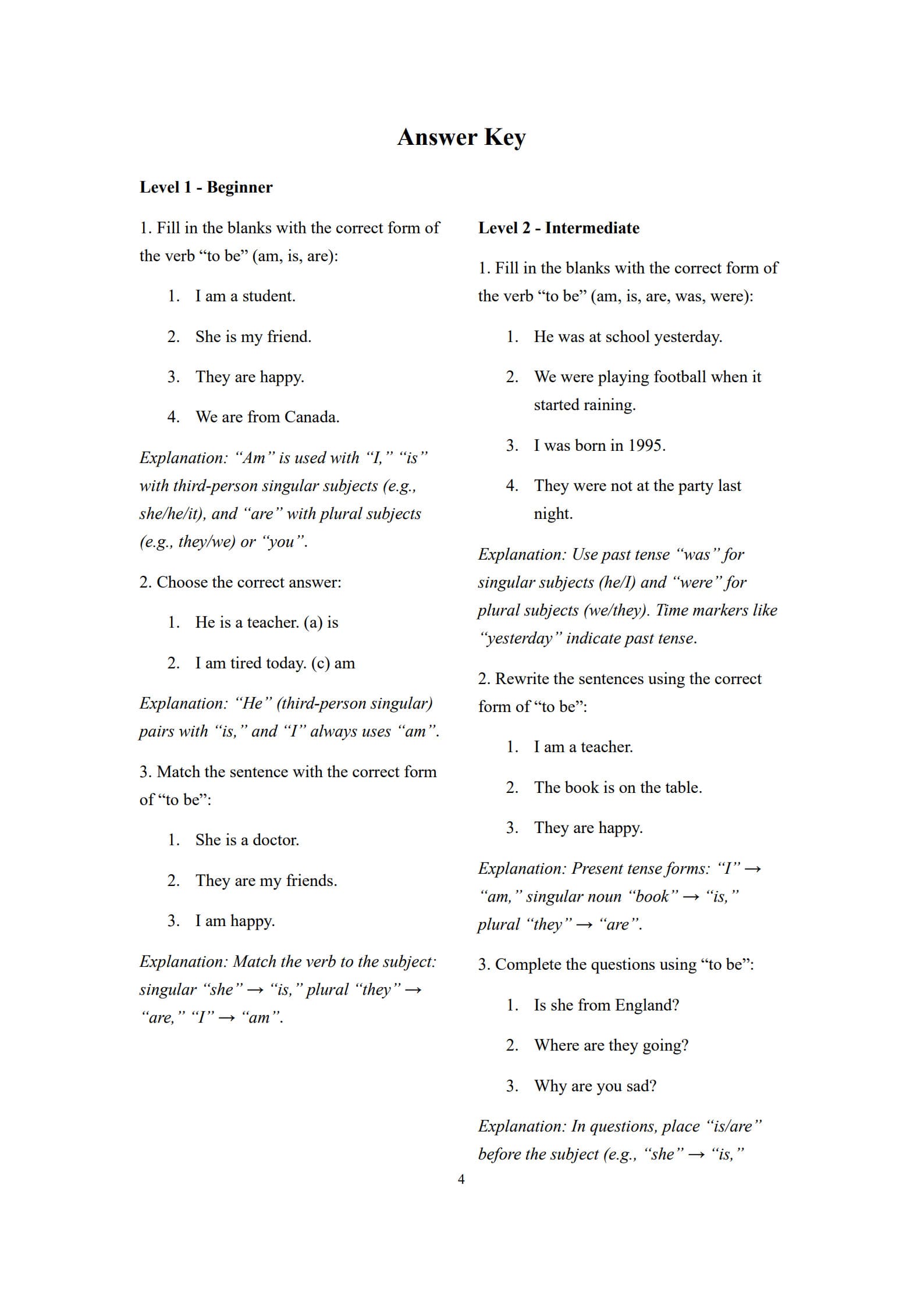
Our verb worksheets organizes simple present tense exercises into three distinct activity types: fill-in-the-blank, multiple choice, and matching exercises. This variety ensures comprehensive understanding through different cognitive approaches. For mathematical learners who appreciate systematic patterns, notice how the verb forms follow predictable rules based on subject characteristics. The answer key provides immediate feedback, allowing you to verify your understanding and correct errors before they become habitual.
Quick Reference Table: Simple Present Tense Patterns
| Subject Type | Subject Examples | Correct Verb Form |
|---|---|---|
| First Person Singular | I | am |
| Third Person Singular | he, she, it | is |
| Plural Subjects | we, they, you | are |
What Makes Past Tense Exercises Essential for Timeline Accuracy?
Establishing Temporal Awareness in Language
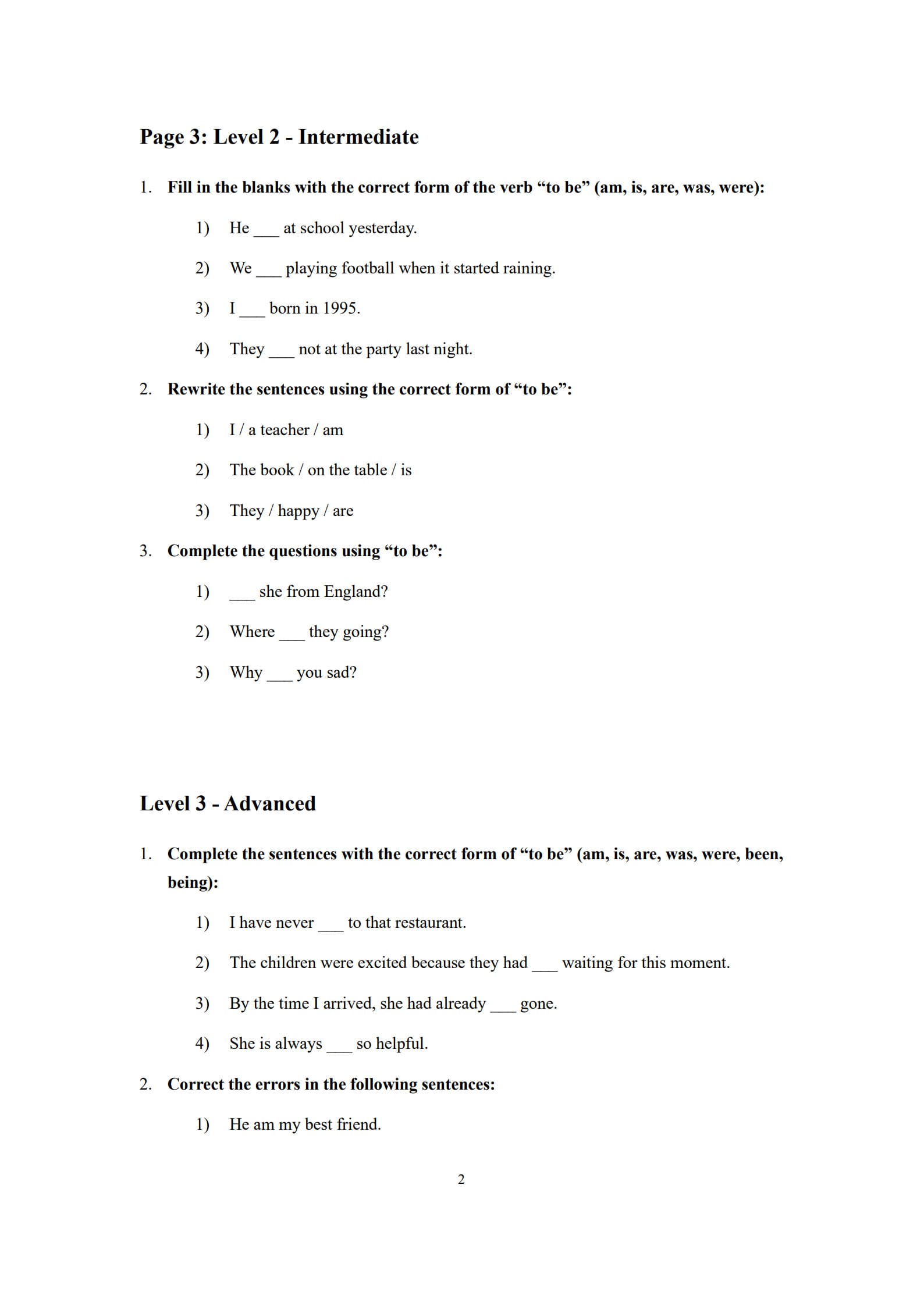
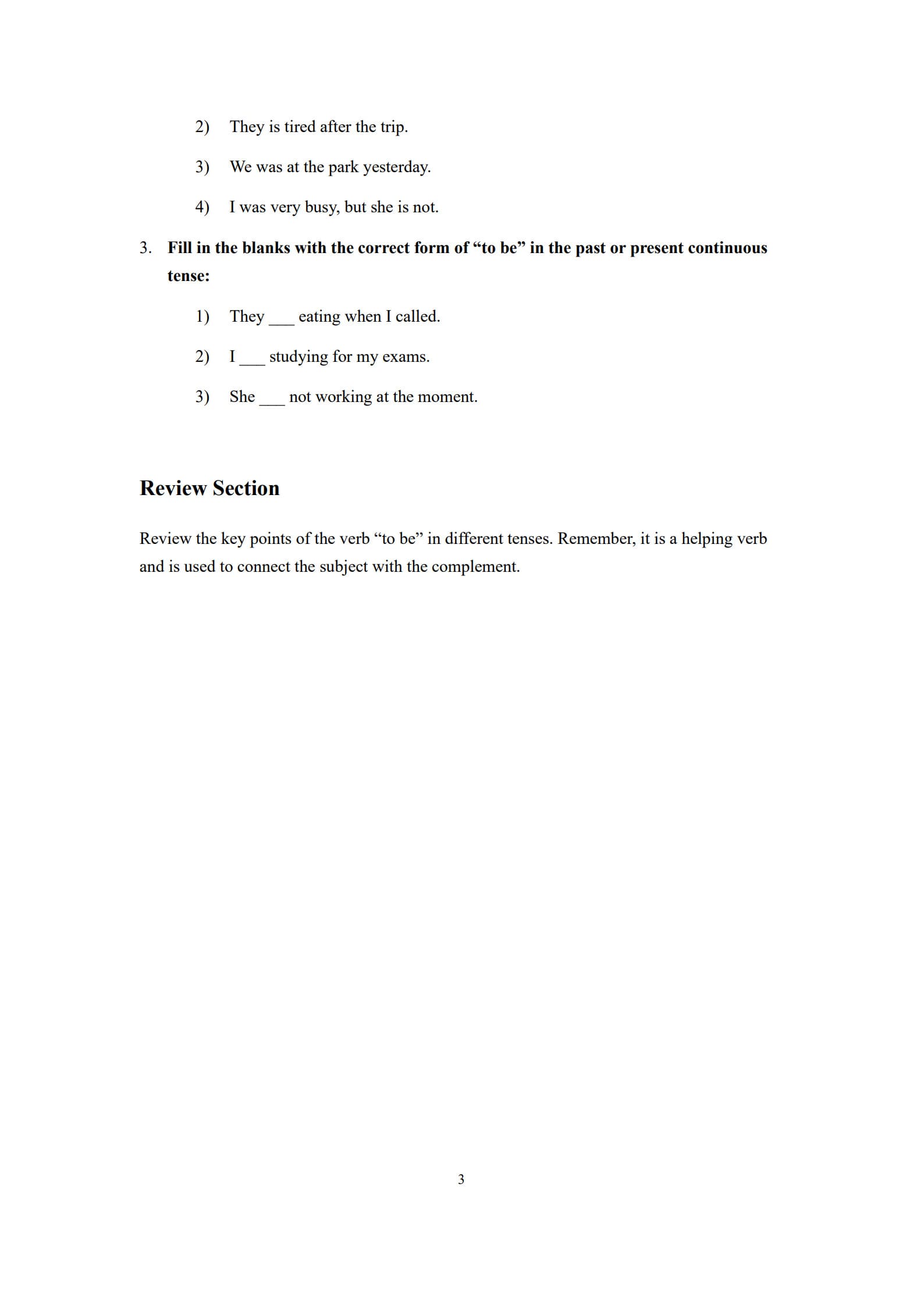
Moving beyond the present moment, our past tense exercises introduce the crucial dimension of time in language. Exercises like “He was at school yesterday” and “They were not at the party last night” train your brain to automatically shift verb forms when discussing past events. This temporal precision separates basic communication from sophisticated language use, allowing you to accurately place actions and states in their proper chronological context.
The Mathematical Precision of Past Tense Forms
For analytical thinkers, observe how past tense forms follow even simpler patterns than present tense: “was” for singular subjects and “were” for plural subjects. This binary system creates a clean, predictable structure that mathematical minds will appreciate. The template’s exercises gradually increase in complexity, starting with simple past statements before progressing to past continuous forms like “We were playing football when it started raining,” which introduces the concept of interrupted actions.
Practical Application Through Contextual Learning
Each past tense exercise incorporates time markers (“yesterday,” “last night,” “in 1995”) that signal the appropriate tense selection. This contextual approach ensures that you’re not merely memorizing forms but understanding the temporal relationships that govern their usage. The rewriting exercises further reinforce this understanding by requiring active construction of grammatically correct sentences.
Why Are Irregular Verbs Exercises Fundamental to Mastery?
The Exception Patterns That Define Proficiency
While the verb “to be” is itself irregular, its mastery prepares you for other irregular verb patterns in English. Our template highlights how “be” transforms completely across tenses (am/is/are → was/were → been), establishing the conceptual framework for understanding why some verbs don’t follow standard conjugation patterns. This awareness is crucial for advancing beyond formulaic language use.
Systematic Approach to Exceptions
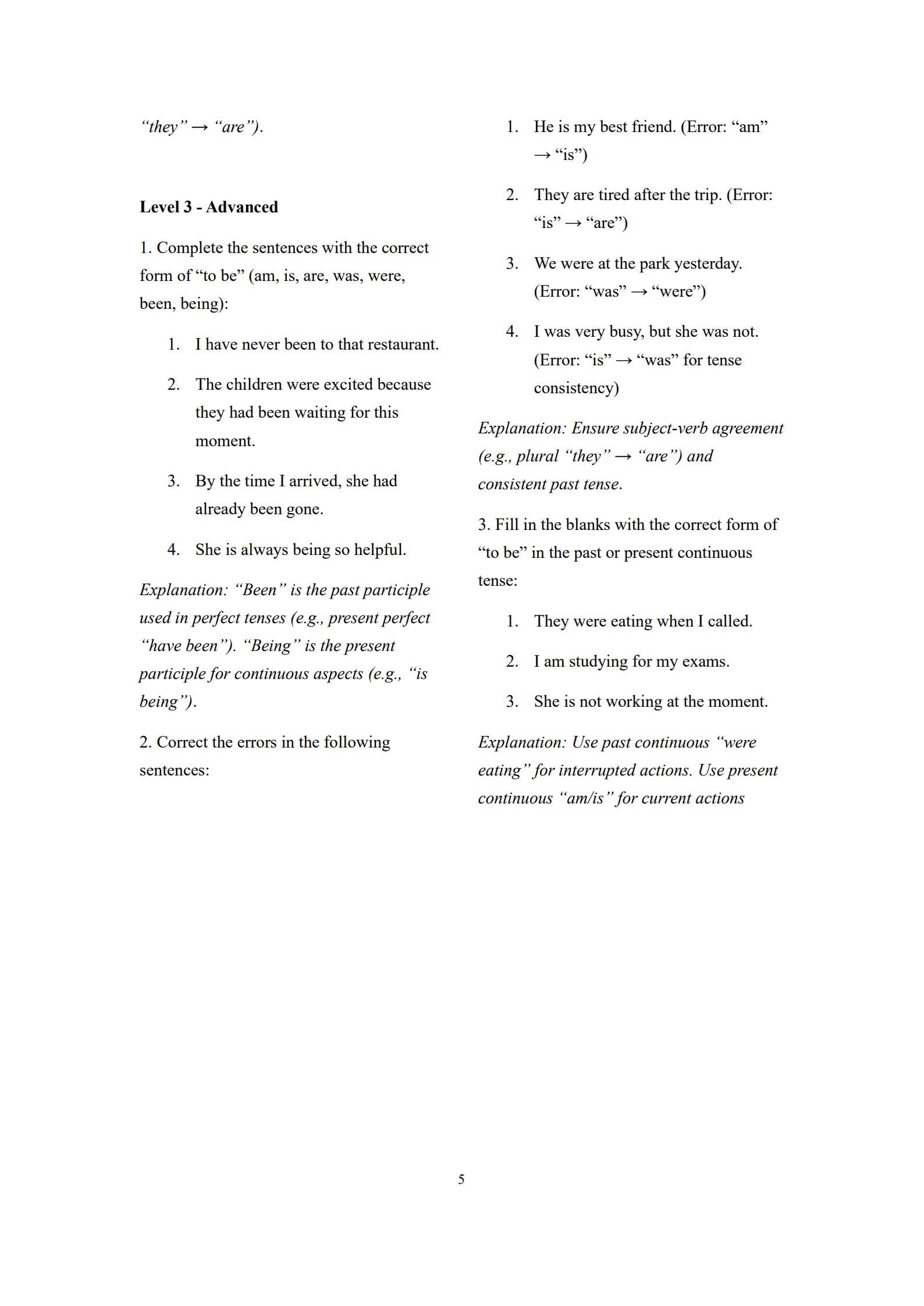
Mathematical learners will appreciate how our template treats irregular verbs not as random exceptions but as patterns to be memorized systematically. The exercises provide concentrated practice on these forms, ensuring that you develop the automatic recall needed for fluent conversation and writing. The error correction section specifically targets common mistakes, such as “He am my best friend” versus the correct “He is my best friend,” reinforcing proper usage through contrast.
From Recognition to Production
The template strategically moves from identification exercises (“Choose the correct answer”) to production tasks (“Rewrite the sentences”) to error correction. This progression ensures that you not only recognize correct forms but can produce them accurately in your own writing and speech. The review section consolidates this learning by summarizing the key patterns across different tenses.
Integrating Verb Tenses Exercises for Comprehensive Understanding
The Interrelationship of Time Frames
Our most advanced exercises demonstrate how different verb tenses interact within broader contexts. The template shows how the verb “to be” serves as both a main verb (“She is a doctor”) and a helping verb (“They were eating when I called”). This dual function understanding is essential for mastering English sentence structure and temporal relationships.
Practical Tense Integration Exercises
The template includes mixed-tense exercises that require you to select the appropriate form based on time markers and context clues. For example, distinguishing between “I am studying for my exams” (current action) and “They were eating when I called” (interrupted past action) develops your ability to choose tenses strategically based on communicative needs rather than memorized rules.
Tense Application Decision Matrix
| Time Reference | Aspect | Example from Template |
|---|---|---|
| Present | Simple | She is my friend |
| Present | Continuous | I am studying |
| Past | Simple | He was at school |
| Past | Continuous | They were eating |
| Perfect | Present | I have been there |
| Perfect | Past | They had been waiting |
How to Use This Template on PDF Agile: A Step-by-Step Guide
Step 1: Accessing the Verb “To Be” Exercises Template
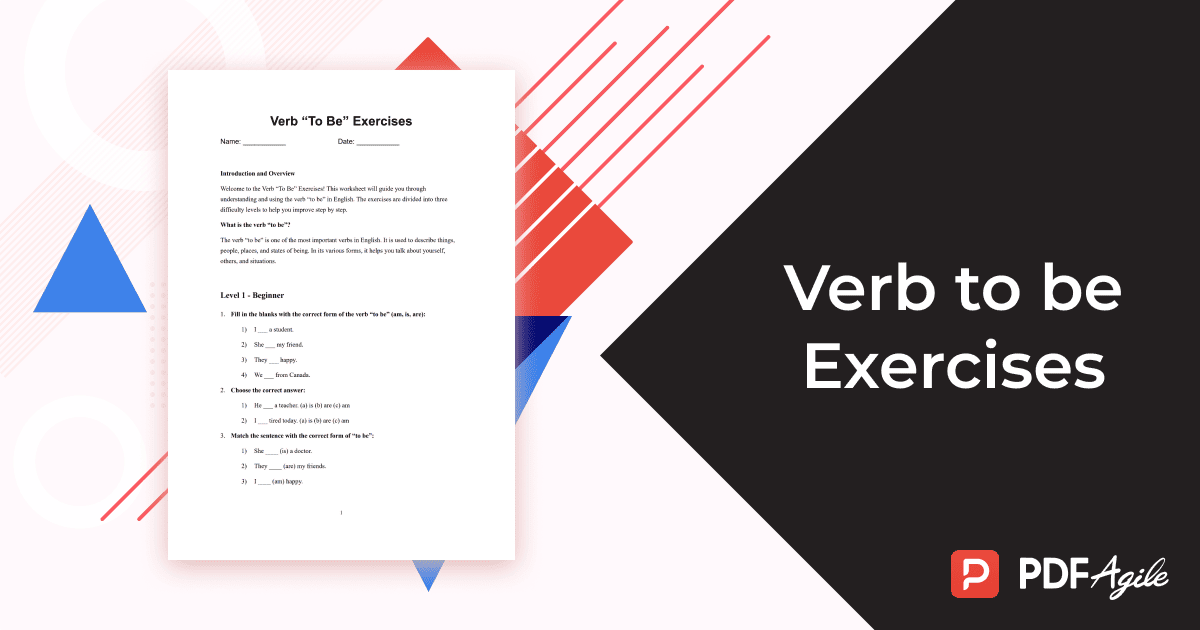
Navigate to the PDF Agile Template Library through our mobile app or web platform. Use the search function to locate “Verb ‘To Be’ Exercises” or browse the “Education” and “Language Learning” categories. The template features a distinctive design with clear level indicators (Beginner, Intermediate, Advanced) for easy identification. Click “Use Template” to create your personal copy that you can modify and save.
Step 2: Customizing for Your Learning Needs
PDF Agile’s editing tools allow you to personalize the template according to your specific requirements. You can adjust the difficulty focus by emphasizing certain sections, add your own examples using the text tool, or highlight key grammar rules for quick reference. The form-fillable fields enable you to complete exercises directly on your device without printing.
Step 3: Utilizing Interactive Learning Features
Take advantage of PDF Agile’s annotation tools to add notes, reminders, or additional explanations alongside exercises. The highlight function helps you mark areas needing further practice or particularly challenging concepts. For collaborative learning, use the comment feature to share questions with study partners or instructors.
Step 4: Tracking Progress and Review
Save your completed exercises with descriptive filenames that include dates (e.g., “VerbToBePractice_2026-02-04.pdf”) to monitor your improvement over time. Create a dedicated folder within PDF Agile to organize your grammar exercises systematically. Use the comparison feature to review previous attempts and identify persistent challenge areas.
Step 5: Sharing and Getting Feedback
Export your completed exercises as standard PDF files to share with teachers or language partners. Alternatively, use PDF Agile’s secure sharing function to grant specific access permissions for review and feedback. The digital format ensures your work remains legible and professionally presented regardless of the reviewer’s device.
Conclusion
With regular practice using this template in PDF Agile, you’ll develop the automaticity needed for fluent English communication. The verb “to be” will become an instinctive tool rather than a conscious consideration, freeing your mental resources for more complex aspects of expression. This template represents not just a collection of exercises but a strategic pathway to grammatical mastery—one that recognizes the interconnected nature of language learning while providing the structured practice necessary for tangible progress.