

If you’re looking to build a strong foundation in English grammar, you’ve come to the right place.
Our new Simple Present Tense Worksheet Template is designed to make learning engaging, effective, and effortless. Whether you’re a student mastering the basics or a teacher creating dynamic lessons, this template—used within the PDF Agile app—provides a structured, interactive, and professional approach to grasping one of the most essential verb tenses in English.
The Simple Present Tense isn’t just another grammar topic—it’s the backbone of everyday communication. From describing daily routines to stating universal truths, this tense helps you express yourself clearly and confidently. But let’s face it: memorizing rules alone can be dry. That’s why our template combines clear explanations with hands-on practice, instant feedback, and customizable features.
Ready to transform your learning experience? Let’s dive in!
1. What Are the Common Rules and Usage of Simple Present Tense?
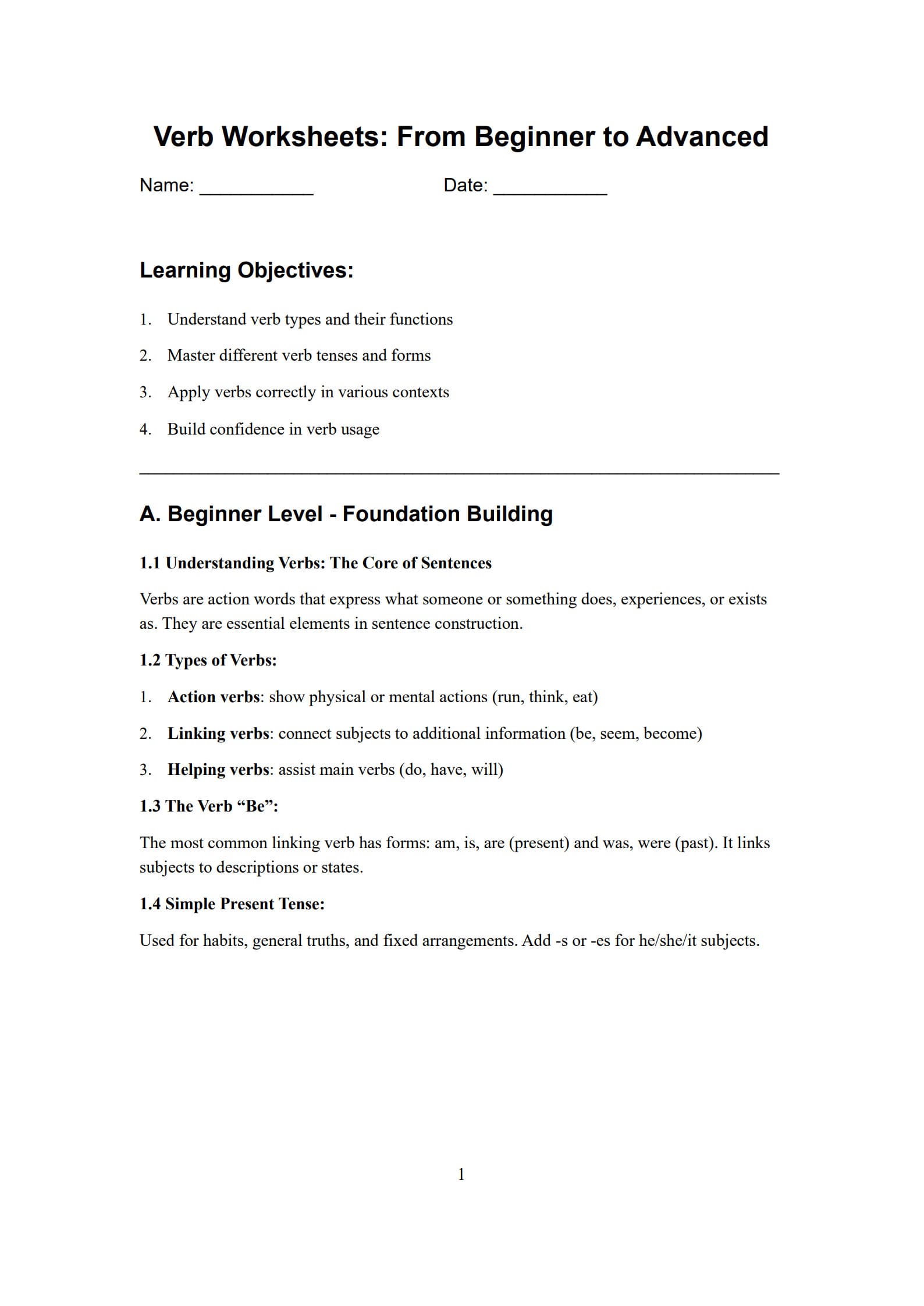
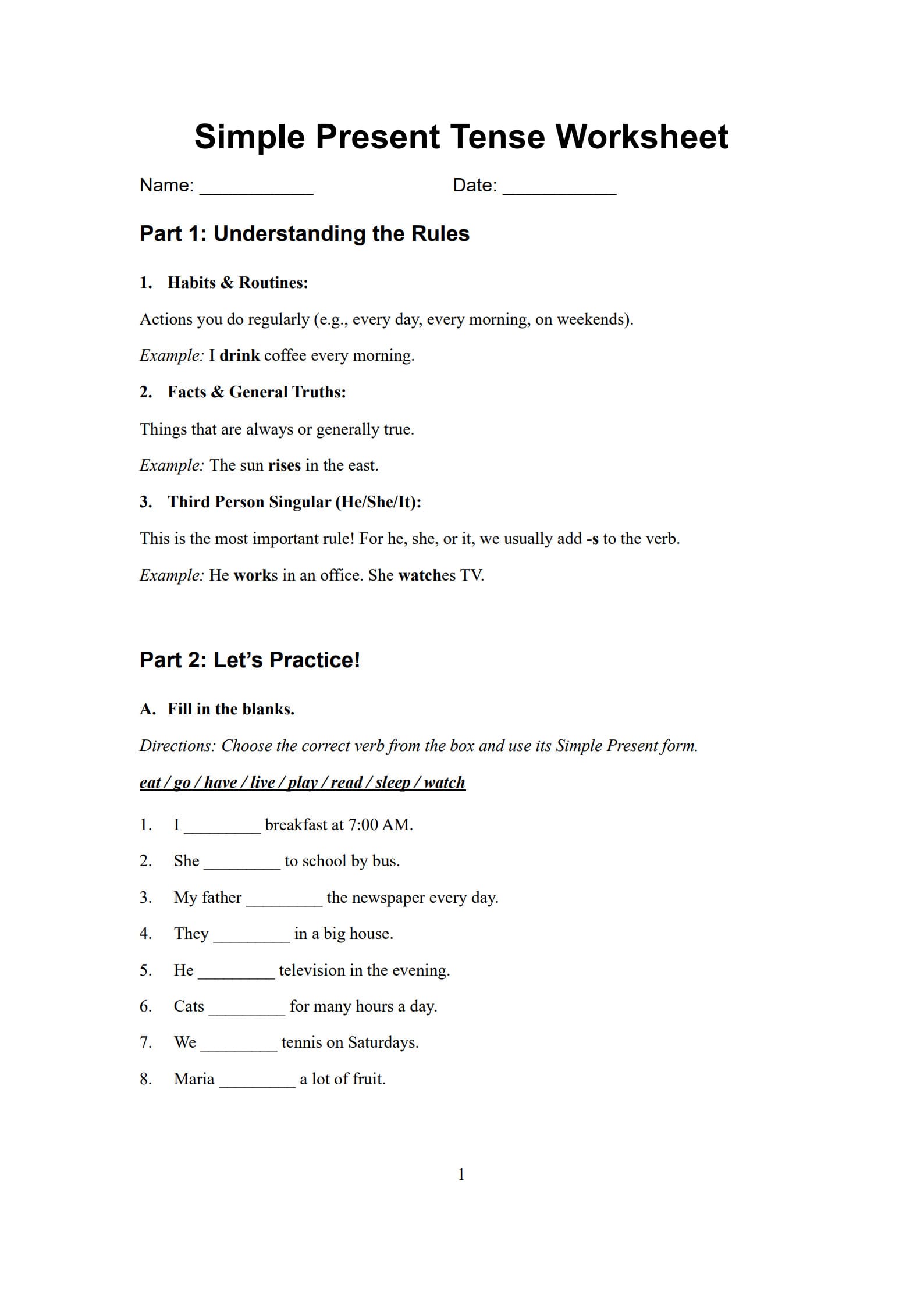
The Simple Present Tense is your go-to tool for talking about habits, routines, facts, and general truths. Think of it as the tense for “what is always or regularly true.”
For example:
- Habits & Routines: Actions you do regularly, like “I drink coffee every morning.”
- Facts & General Truths: Statements that are always true, such as “The sun rises in the east.”
- Third-Person Singular: For he, she, or it, add “-s” to the verb (e.g., “He works in an office”).
Why does this matter? Because without these rules, sentences like “She watch TV” or “They plays football” can slip into your writing—errors that undermine clarity. For instance, exercises like “She goes to school by bus” reinforce correct usage through repetition.
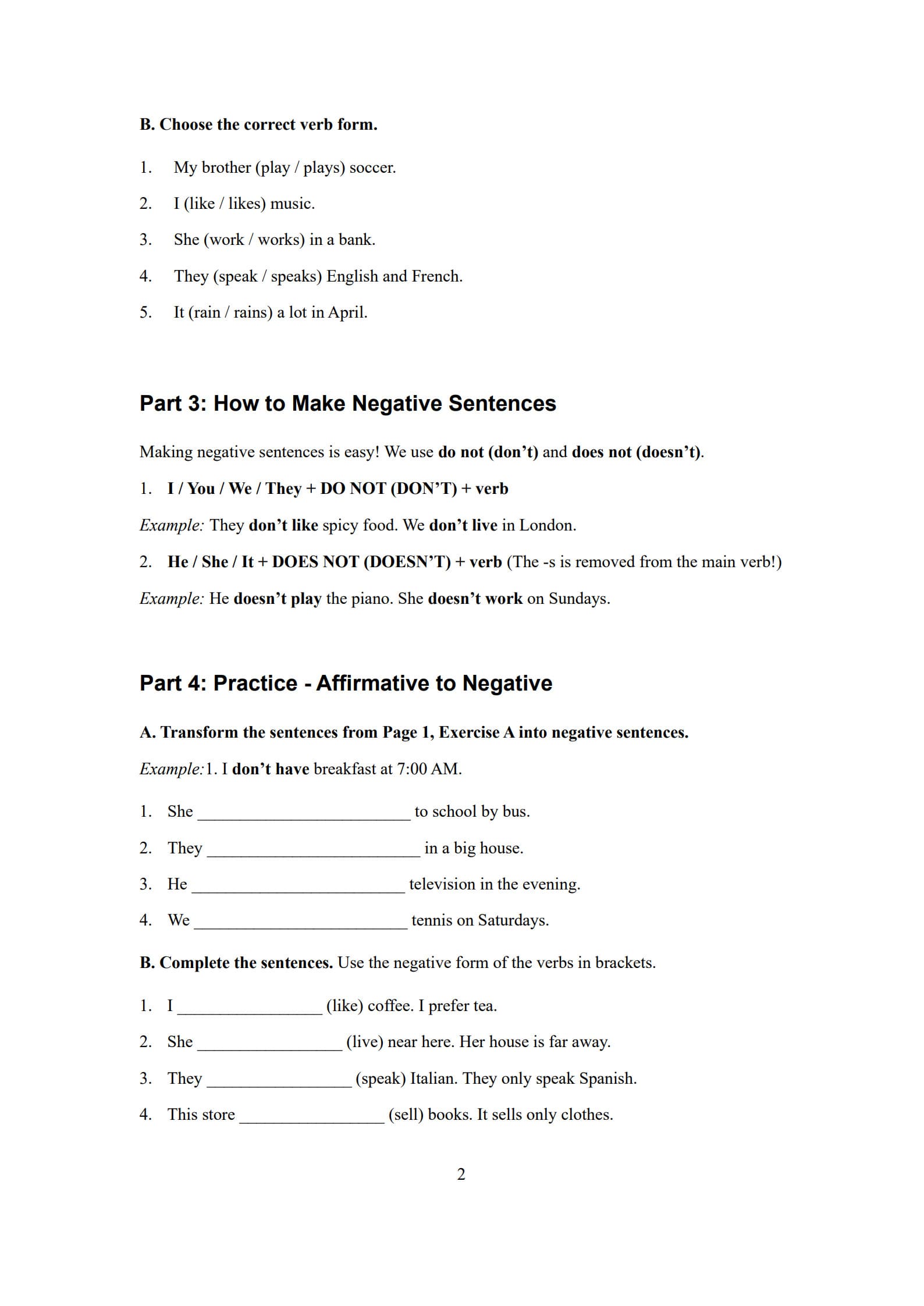
2. Make Negative Sentences with Simple Present Tense
Turning positive statements into negatives is a breeze with the right formula.
In English, we use do not (don’t) for I/you/we/they and does not (doesn’t) for he/she/it. Remember: when using “doesn’t,” the main verb drops the “-s” (e.g., “He doesn’t play the piano,” not “He doesn’t plays”).
Part 4: Practice – Affirmative to Negative section guides you through this seamlessly. Take the exercise “She goes to school by bus.” The negative form becomes “She doesn’t go to school by bus.” By practicing with examples like “They live in a big house” → “They don’t live in a big house,” you’ll internalize the pattern without rote memorization.
3. What Are the Spelling Rules of Simple Present Tense?
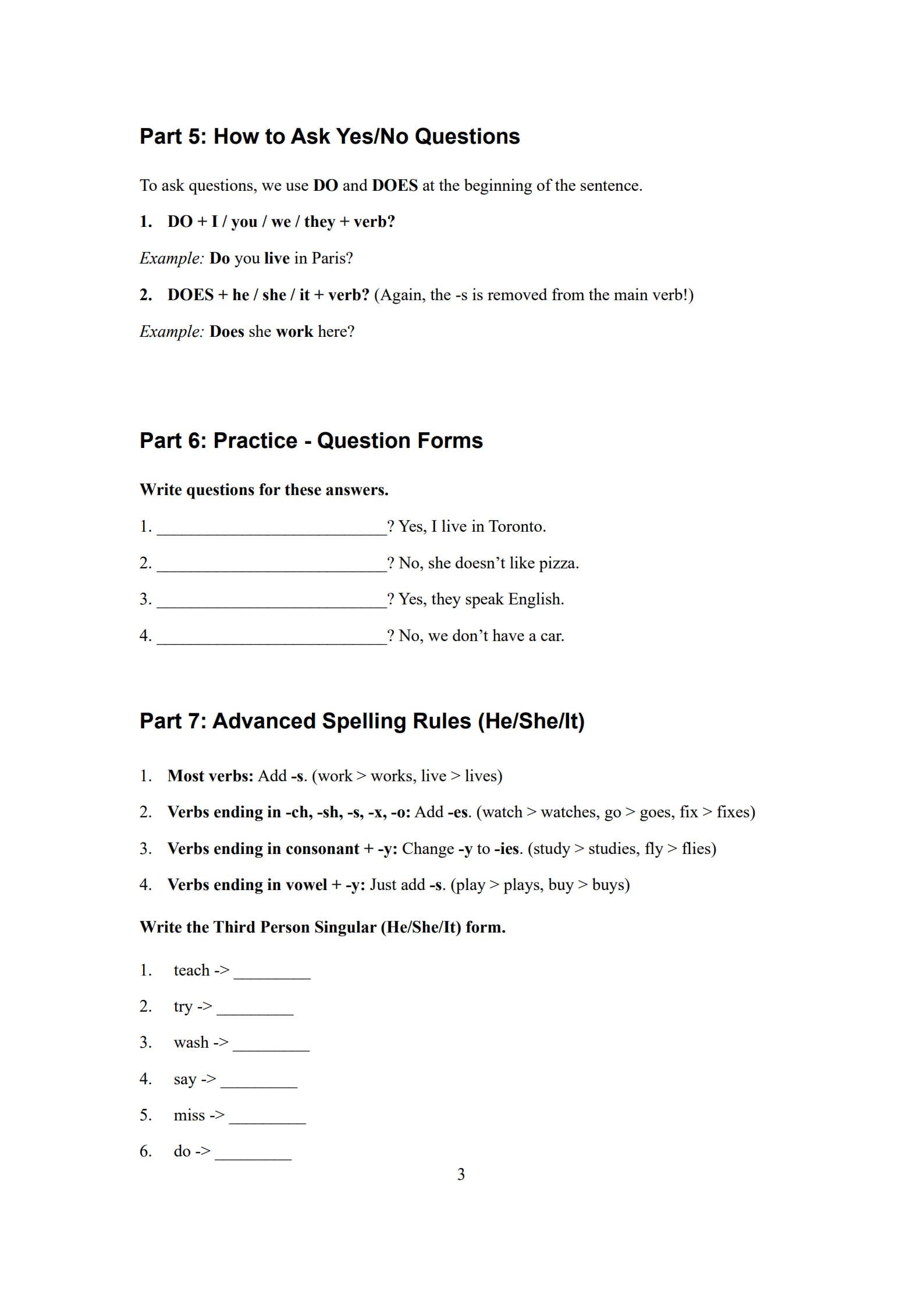
Spelling quirks can trip up even advanced learners. For third-person singular verbs (he/she/it), the basic “-s” rule has exceptions:
- Verbs ending in -ch, -sh, -s, -x, or -o: Add “-es” (e.g., watch → watches, go → goes).
- Verbs ending in a consonant + -y: Change “-y” to “-ies” (e.g., study → studies).
- Verbs ending in a vowel + -y: Simply add “-s” (e.g., play → plays).
Part 7: Advanced Spelling Rules present these patterns with exercises like “teach → teaches” and “try → tries.” This attention to detail ensures you’re not just correct but precise.
4. Ten Practices to Quickly Handle Simple Present Tense
Mastery comes through practice. Here are ten exercises inspired by our template—try them in PDF Agile to boost your skills:
1. Fill-in-the-Blanks:
Use verbs like “eat” or “sleep” to complete sentences
(e.g., “Cats _____ for many hours”).
2. Multiple-Choice Questions:
Choose between “play” or “plays” in context.
3. Negative Transformations:
Rewrite sentences like “He watches TV” into negatives.
4. Yes/No Questions:
Form questions from answers (e.g., “Do you live in Toronto?”).
5. Adverb Integration:
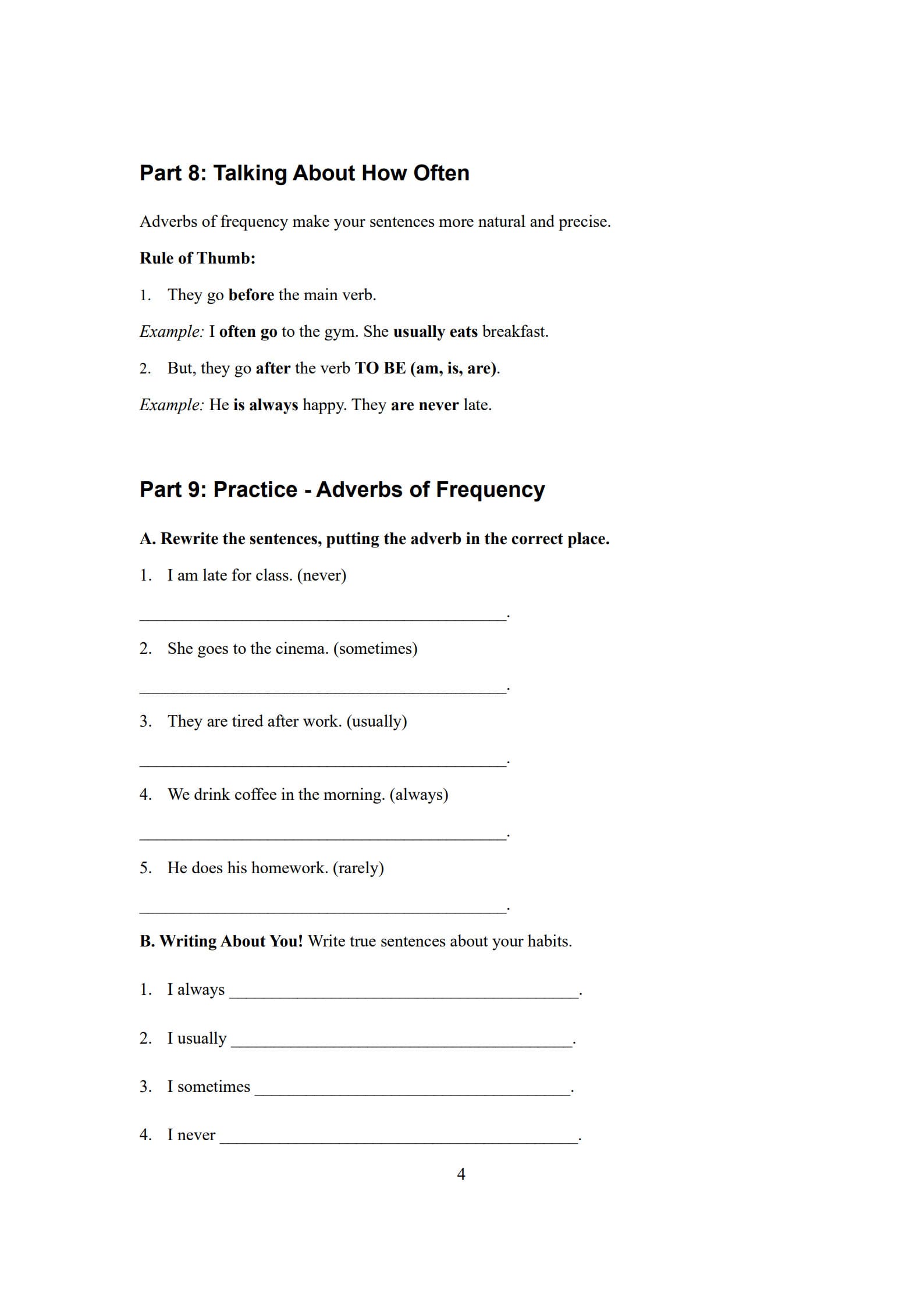
Add adverbs of frequency (e.g., “always,” “never”) to sentences.
6. Error Correction:
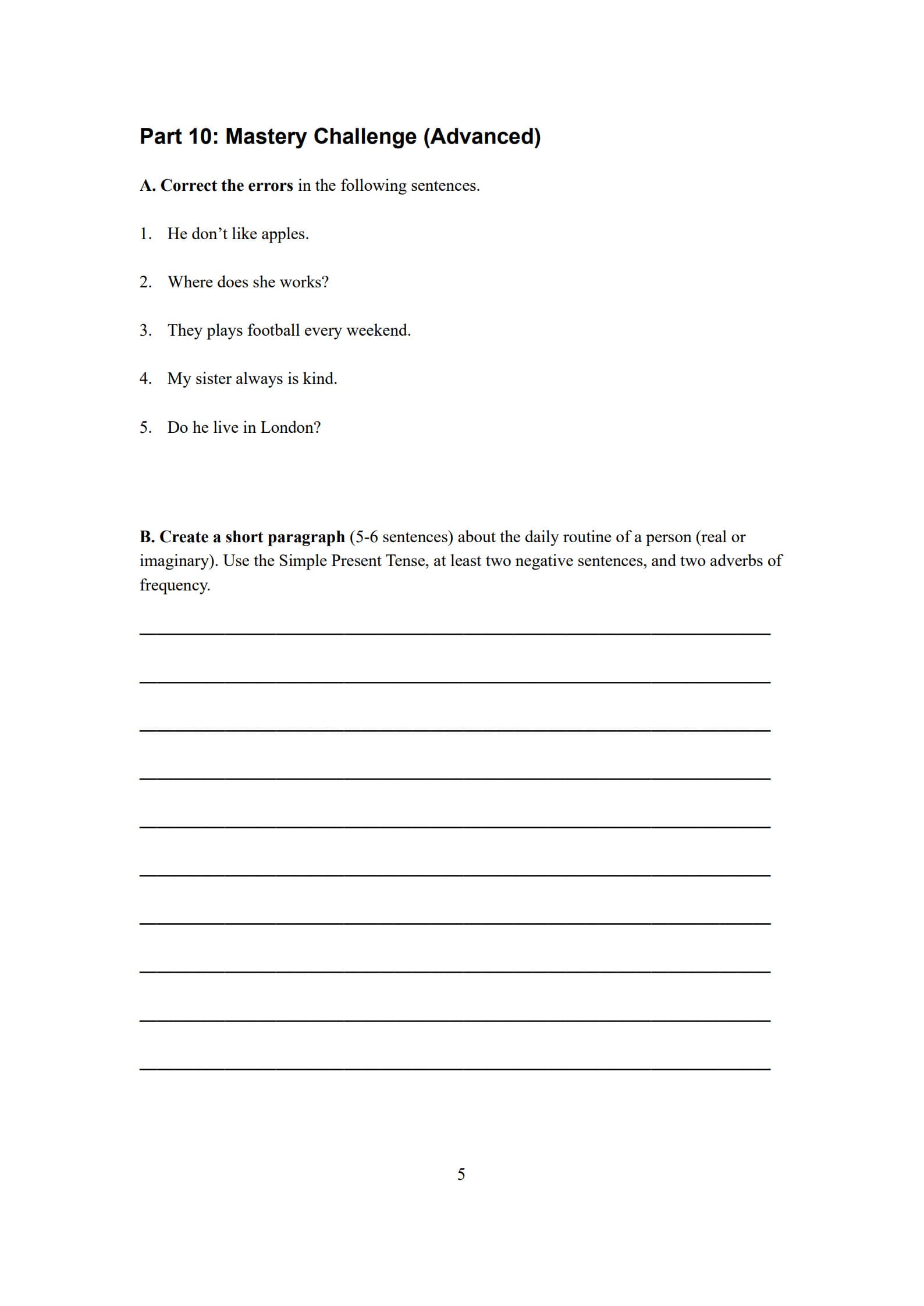
Fix mistakes like “He don’t like apples.”
7. Third-Person Spelling:
Convert verbs like “wash” to their he/she/it forms.
8. Paragraph Writing:
Describe a daily routine using negatives and adverbs.
9. Matching Exercises:
Pair rules with examples.
10. Self-Reflection:
Write about your own habits (e.g., “I always brush my teeth”).
5. Mistakes with Examples to Avoid
Even small errors can distort meaning. Here are common pitfalls—and how our template helps you sidestep them:
- Adding “-s” to plural subjects: Incorrect: “They plays football.” Correct: “They play football.”
- Misusing “do” vs. “does”: Incorrect: “Does she works here?” Correct: “Does she work here?”
- Misplacing adverbs: Incorrect: “My sister always is kind.” Correct: “My sister is always kind.”
Part 10: Mastery Challenge includes error correction exercises, turning mistakes into learning opportunities.
6. How to Use This Template on PDF Agile
Unlock the full potential of the Simple Present Tense with PDF Agile’s user-friendly tools. Follow these steps to customize and complete your worksheet:
Step 1: Access the Template in PDF Agile
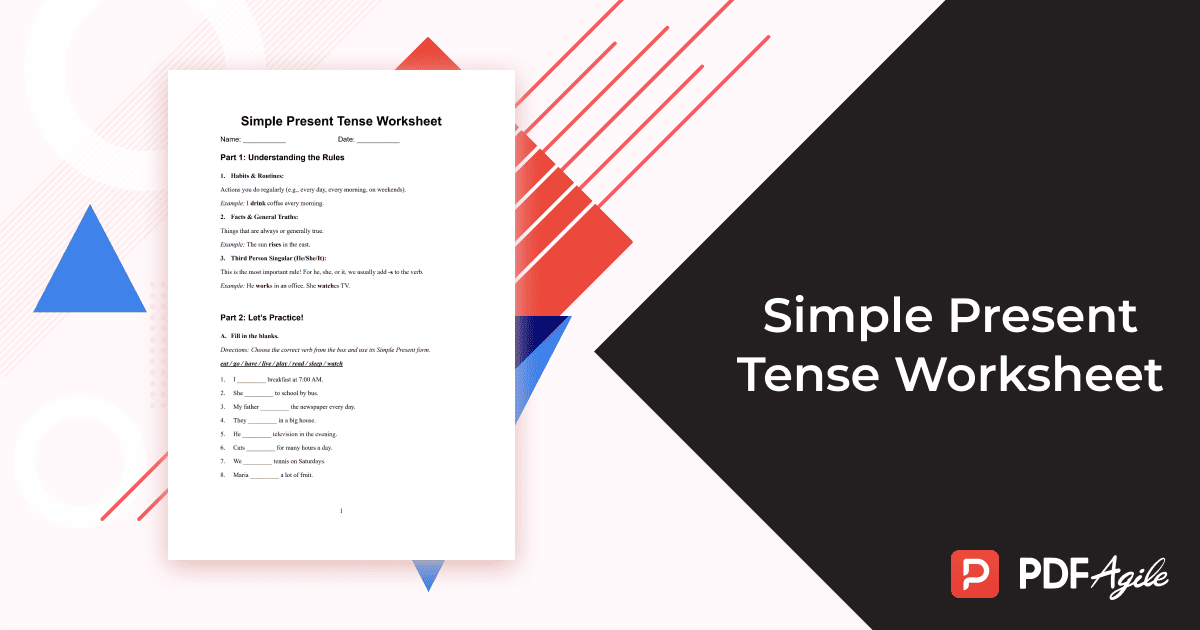
Open the PDF Agile app and navigate to the Template Library. Search for “Simple Present Tense Worksheet” and click Use Template. The pre-designed layout includes clear sections for rules, practice, and answers—saving you time while ensuring professionalism.
Step 2: Fill in Personal Details and Examples
Replace placeholder text with your own information. For instance, in Part 9: Writing About You, add sentences like “I always drink tea in the morning” to personalize learning. Use PDF Agile’s text-editing tools to highlight key points or adjust fonts for clarity.
Step 3: Complete Interactive Exercises
Type directly into blank fields (e.g., “She _____ to school by bus”) or use the dropdown menus for multiple-choice questions. The app auto-saves your progress, allowing you to work at your own pace.
Step 4: Review with Built-In Answer Key
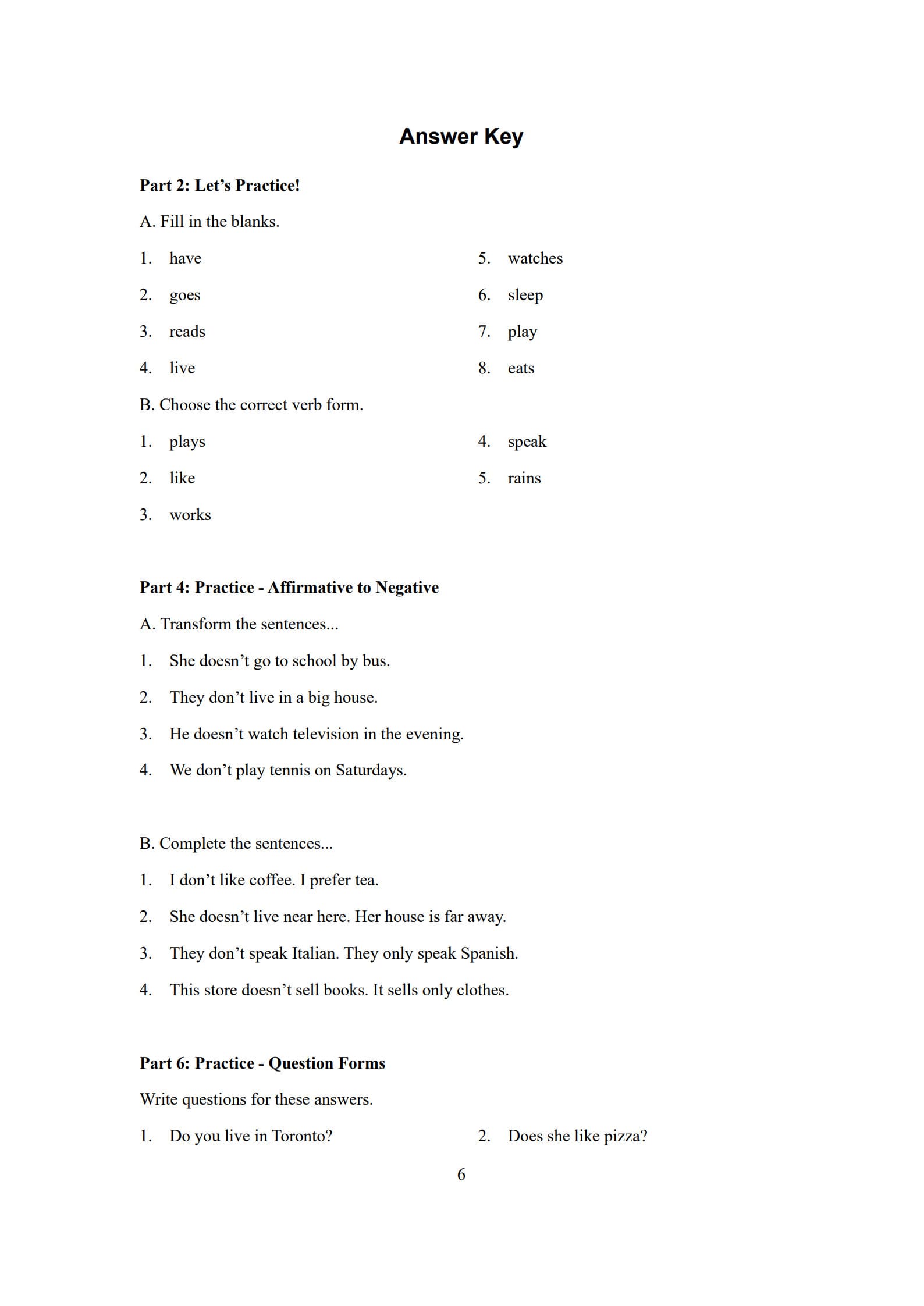
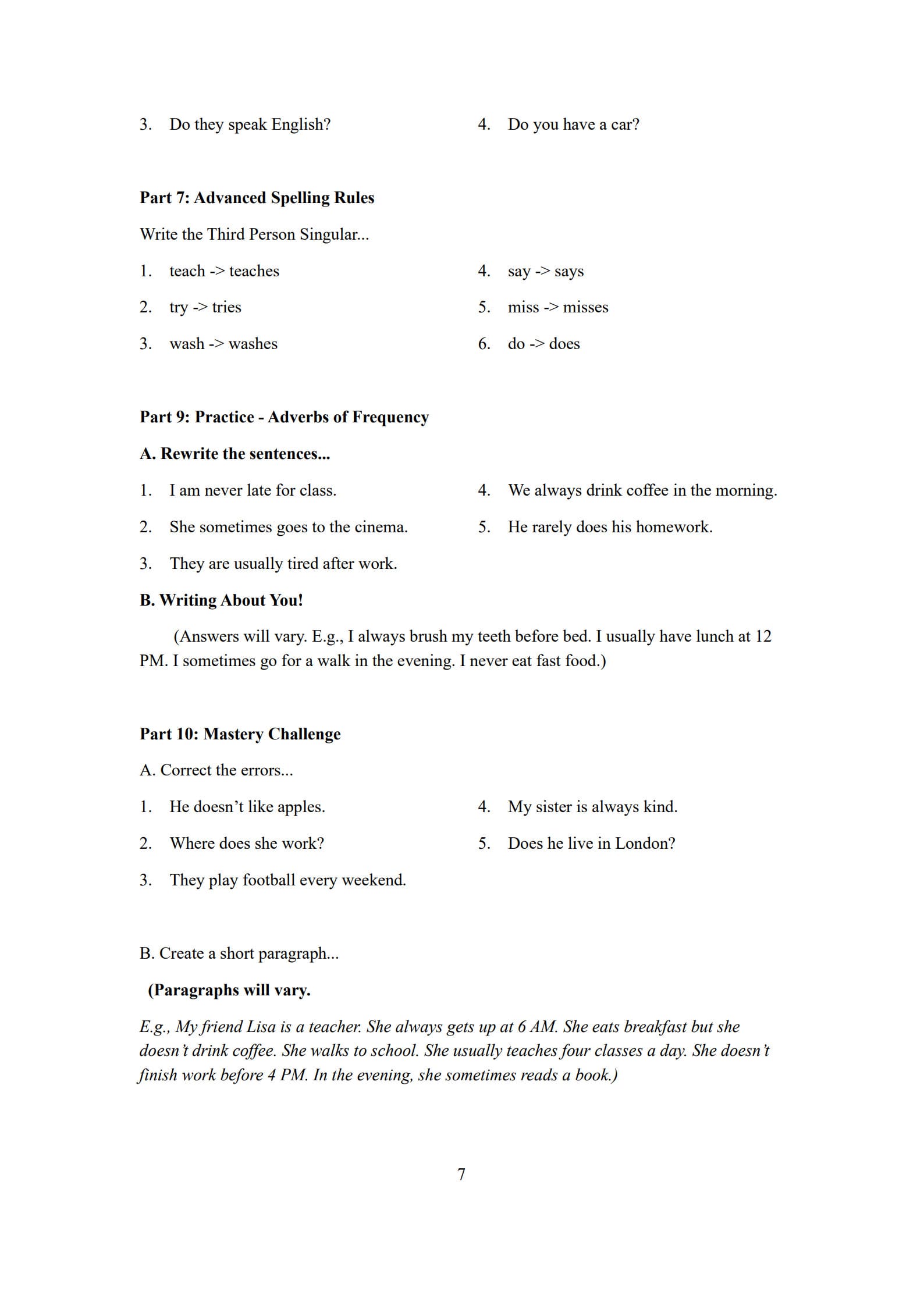
Compare your answers to the template’s answer key (included in Part 10). For extra practice, duplicate pages to create additional exercises—ideal for teachers designing quizzes.
Step 5: Save, Export, or Share
Save your completed worksheet as a PDF for offline review, or share it via email with classmates or students. PDF Agile’s cloud integration lets you access your work across devices.
7. FAQs About Simple Present Tense
Q1: When do I use the Simple Present Tense?
A: For habits (e.g., “I exercise daily”), facts (“Water boils at 100°C”), and general truths (“Birds fly”).
Q2: Why does the verb change for “he/she/it”?
A: This rule maintains subject-verb agreement. Without it, sentences sound unnatural (e.g., “She walk” vs. “She walks”).
Q3: How can I make negative sentences correctly?
A: Use “don’t” for I/you/we/they and “doesn’t” for he/she/it, followed by the base verb (e.g., “It doesn’t rain much”).
Q4: Can I use adverbs like “always” with this tense?
A: Yes! Place them before the main verb (“She often reads”) but after “be” verbs (“He is always punctual”).
Conclusion: Elevate Your English with PDF Agile
The Simple Present Tense is more than a grammar rule—it’s a gateway to fluent communication. With PDF Agile’s interactive template, you’re not just passively reading; you’re practicing, correcting, and creating. From spelling drills to real-life paragraphs, every element is designed to build confidence.
Don’t let grammar hold you back. Download the Simple Present Tense Worksheet today and experience how PDF Agile turns learning into an adventure. Whether you’re studying alone or teaching a class, our tools empower you to learn smarter, faster, and with lasting results.