

Welcome, language enthusiasts and dedicated learners! Are you ready to conquer one of the most essential building blocks of English fluency?
Understanding possessive pronouns—words like mine, yours, hers, and theirs—is crucial for speaking naturally and avoiding repetitive sentences. Instead of clumsily saying, “This is my book, and that is your book,” you can elegantly state, “This book is mine, and that one is yours.”
But mastering grammar doesn’t have to mean dull memorization. Here at PDF Agile, we believe in interactive, engaging learning. This template is more than just a document; it’s a structured learning journey from beginner basics to advanced proficiency!
Why Possessive Pronouns are a Game-Changer for Fluency
Possessive pronouns do the heavy lifting in conversation by replacing nouns to show ownership clearly and concisely. Our template begins by demystifying this concept with a clear reference table, just like the one below, which is built directly into the worksheet:
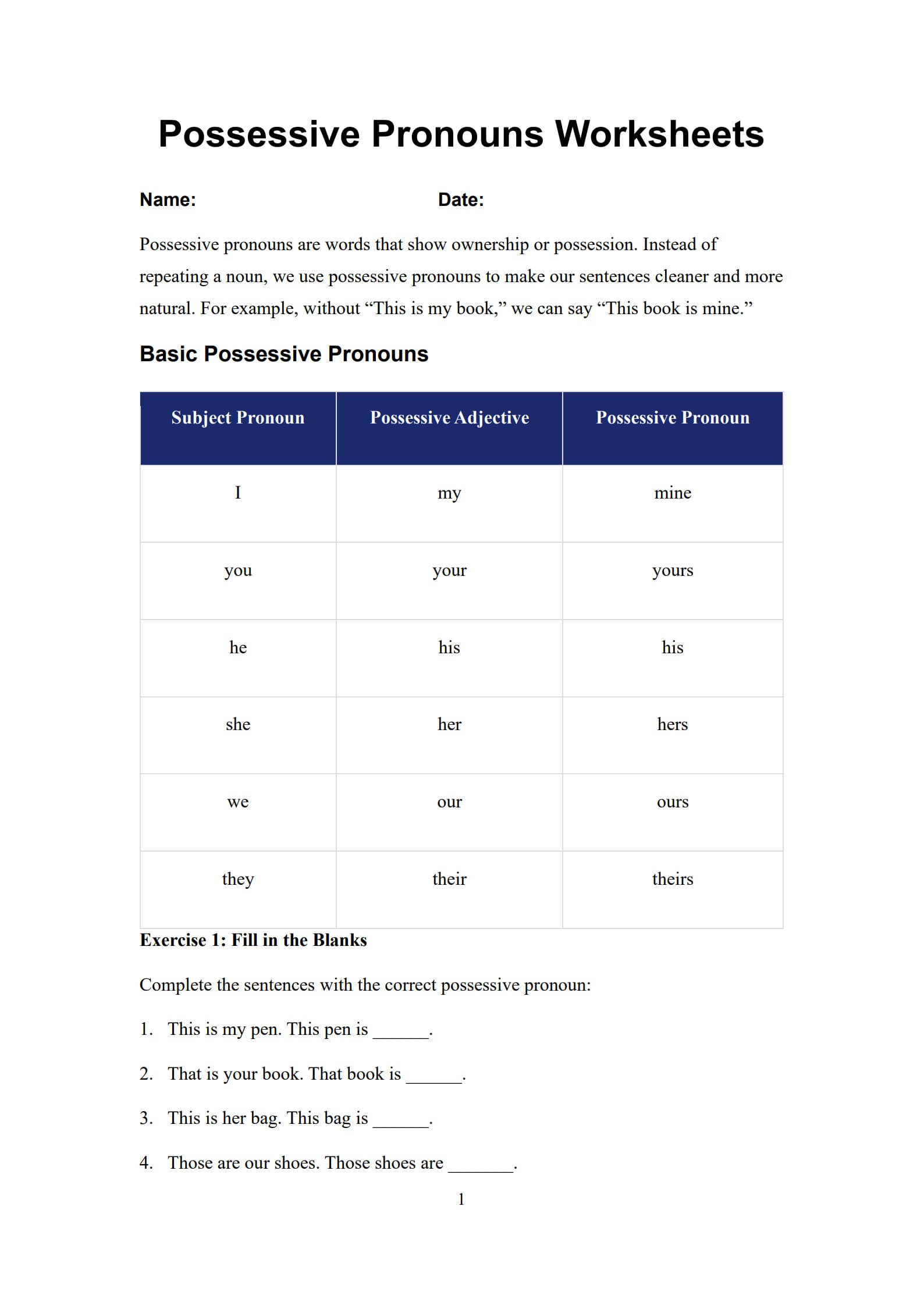
This visual aid is your cheat sheet, helping you see the connection between words like “my” (which comes before a noun, as in “my car”) and “mine” (which stands alone, as in “the car is mine”). By internalizing these patterns, you’ll sound more like a native speaker.
Different Levels of Learning Possessive Pronoun
Our template is thoughtfully structured into three progressive levels, ensuring a comprehensive learning path.
Beginner Level: Building Confidence.
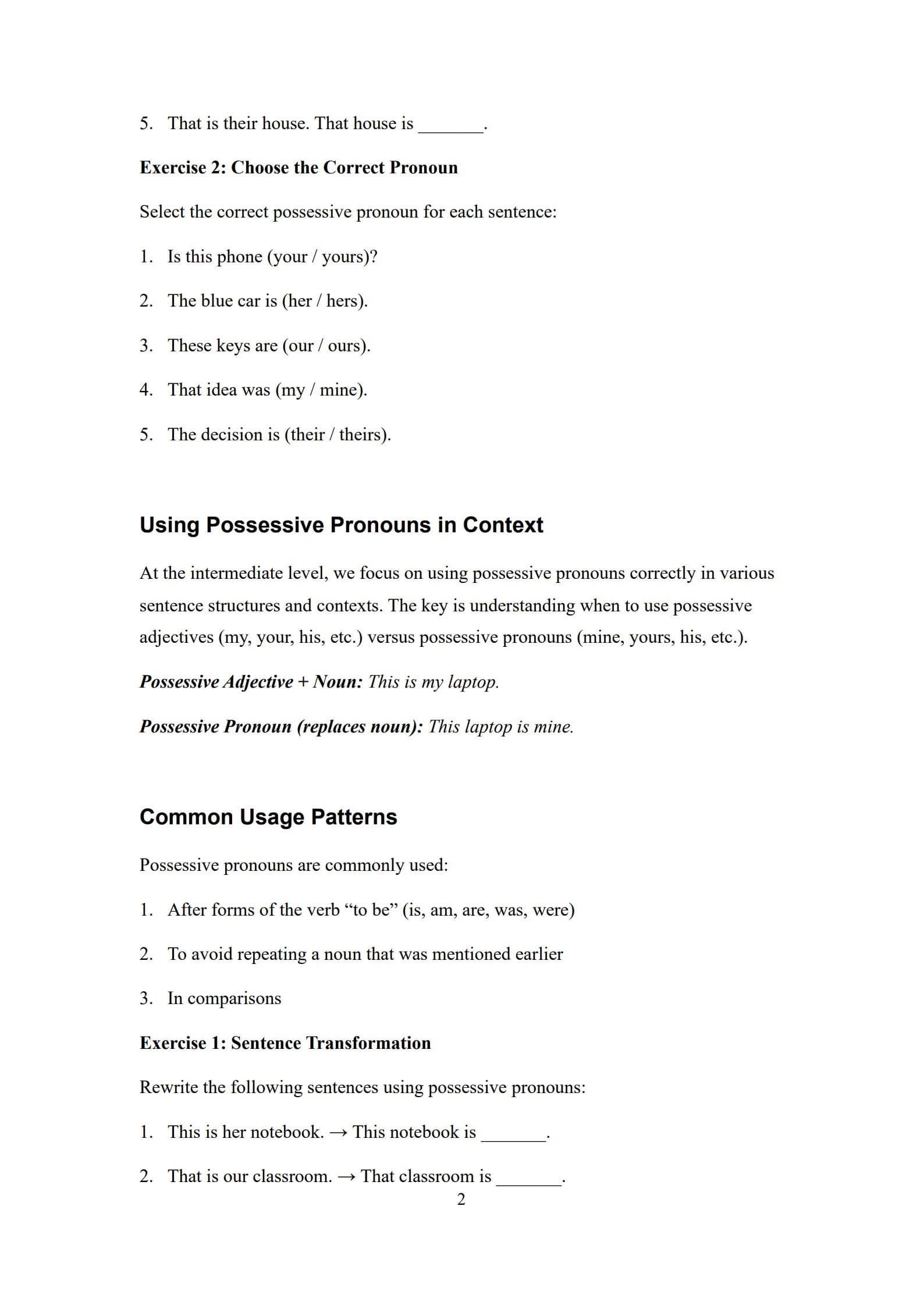
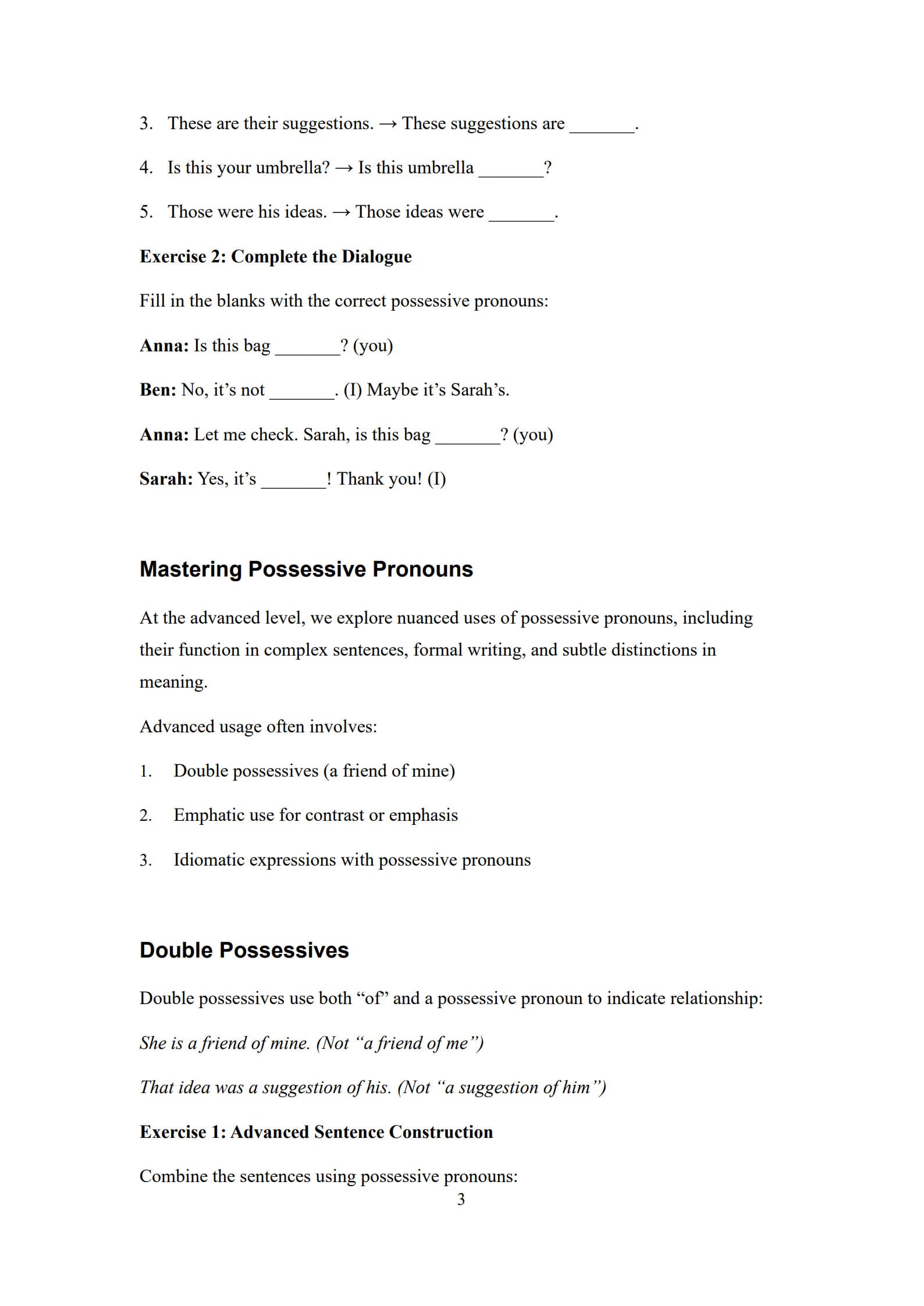
This section focuses on foundational exercises. For example, you’ll practice filling in the blanks: “This is my pen. This pen is ______.” (The answer, of course, is mine). Another exercise asks you to choose the correct pronoun: “Is this phone (your/ yours)?”. These activities build initial recognition and confidence.
Intermediate Level: Applying Knowledge in Context.
Here, you’ll move beyond simple blanks to rewriting sentences and completing dialogues. You’ll transform “This is her notebook” into “This notebook is hers.” You’ll also fill in a realistic conversation:
- Anna: Is this bag yours?
- Ben: No, it’s not mine. Maybe it’s Sarah’s.
Advanced Level: Mastering Nuances.
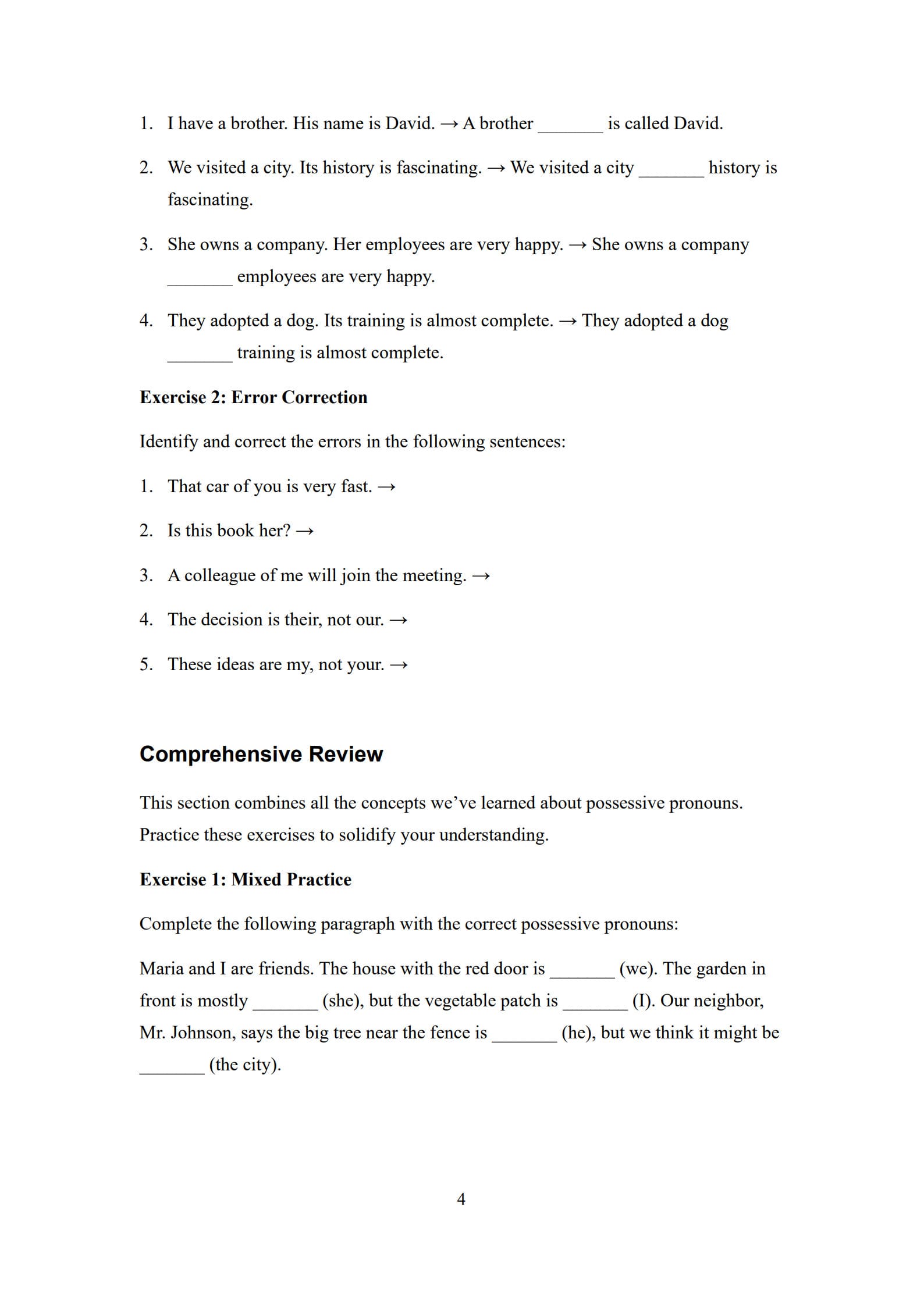
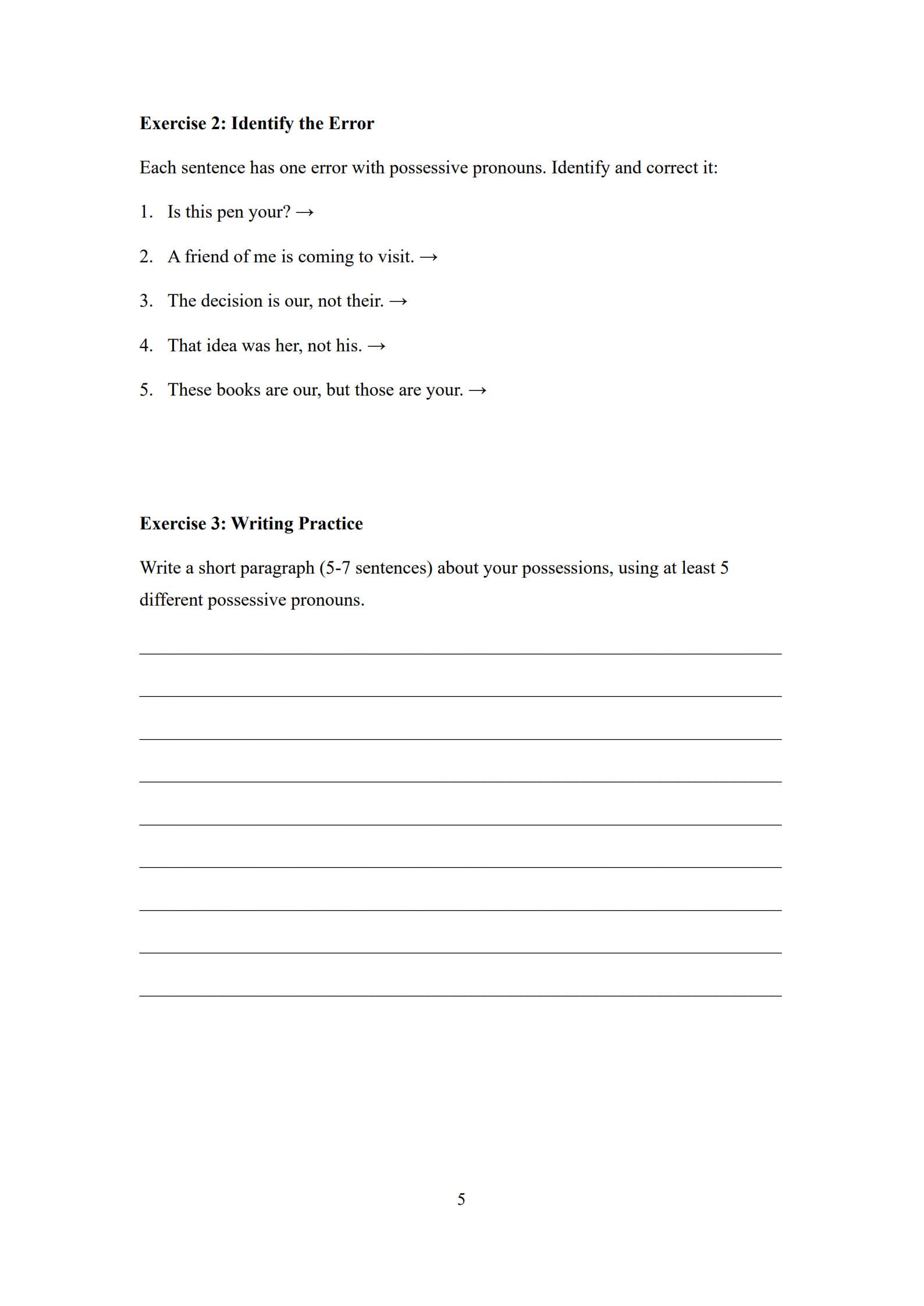
For learners aiming for proficiency, the template covers complex structures like double possessives (e.g., “a friend of mine”) and error correction. You’ll tackle challenges like fixing the incorrect sentence, “A colleague of me will join,” to the correct, “A colleague of mine will join.”
How to Identify a Possessive Pronoun?
Quick Guide: What to Look For
A possessive pronoun:
- Stands alone and replaces a noun (it isn’t followed by a noun).
- Shows ownership or belonging.
- Common examples: mine, yours, his, hers, its, ours, theirs.
- Watch out for look-alikes!
- Its vs. It’s: Its (without an apostrophe) is a possessive pronoun. It's (with an apostrophe) is a contraction for “it is” or “it has.”
- Your vs. You’re: Your is a possessive adjective. You're is a contraction for “you are.”
- Their vs. They’re vs. There: Their is a possessive adjective. They're is a contraction for “they are.” There refers to a place.
Exercise 1: Spot the Possessive Pronoun
Directions: Read each sentence quickly and circle the possessive pronoun. The first one is done for you.
- I forgot my book, so Sarah said I could borrow (hers).
- These seats are theirs; our seats are over there.
- Is this notebook yours or did it belong to the previous student?
- The dog wagged its tail happily.
- The project was a joint effort, but the final idea was his.
- We believe that the future is ours to shape.
Exercise 2: Possessive Pronoun or Not?
Directions: Label each underlined word as PP (Possessive Pronoun) or X (Not a Possessive Pronoun).
- You’re going to be late if you don’t hurry.
- Is this your backpack?
- The company celebrated its 10th anniversary.
- They’re going to the concert tonight.
- The decision is theirs to make.
- Their car is the red one parked outside.
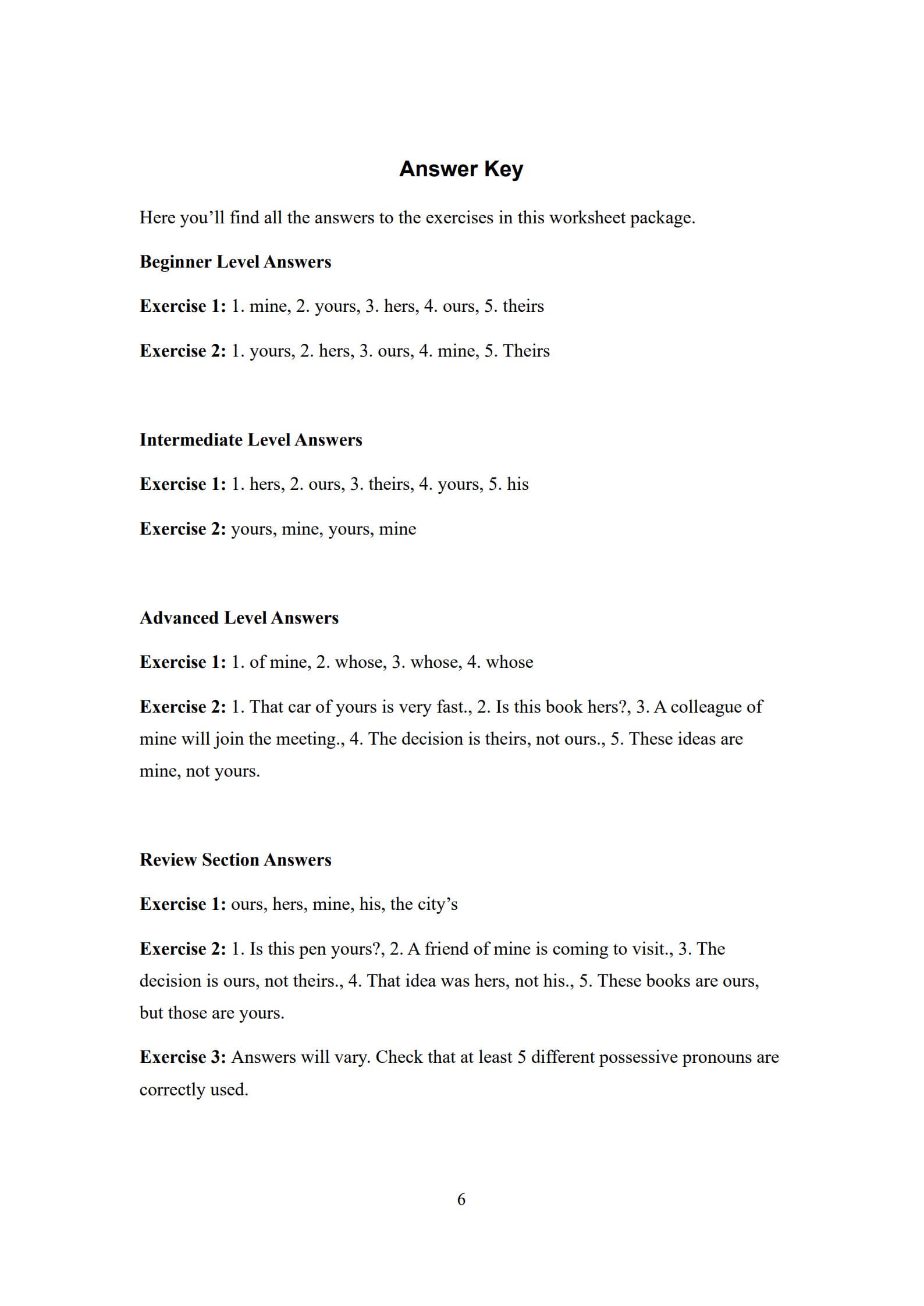
Answer Key:
Exercise 1:
2. theirs, 3. yours, 4. its, 5. his, 6. ours
Exercise 2:
1. X
2. X (This is a possessive adjective because it’s followed by the noun “backpack”.)
3. PP
4. X
5. PP
6. X
How to Use the Possessive Pronouns Template on PDF Agile?
Getting started with your personalized grammar coach is incredibly simple. Just follow these four steps:
Step 1: Access the Possessive Pronouns Template
Navigate to the PDF Agile Template Library on our website or within the app. Search for “Possessive Pronouns Worksheets” and click to open it. You can also click the “Use Template” button conveniently located on this page to launch it directly in the app. The template comes pre-formatted with clear instructions, exercises, and a professional layout.
Step 2: Complete the Exercises Interactively
Now for the fun part! The template is fully editable. Click on any blank space and type in your answers. Work through the exercises at your own pace, from the beginner fill-in-the-blanks to the advanced error correction. Use the annotation tools to highlight tricky sections or make notes for yourself. For instance, when you see the sentence “That idea was (my/mine),” you can simply click and type the correct answer, mine.
Step 3: Save, Share, and Practice Again
Save your completed worksheet with your answers. You can save a clean copy of the template to practice again later—repetition is key to memory! If you’re studying with a group, easily share your annotated worksheet via email directly from the app for a collaborative learning session. Teachers can fill out the template with examples and share it with their entire class effortlessly.
Pro Tips for Maximizing Your Learning
- Speak Aloud: As you type the answers, say the sentences out loud. This connects visual learning with verbal practice, improving your pronunciation and fluency.
- Create Your Own Examples: After finishing an exercise, use the same structure to write a sentence about your life. For example, after “That book is yours,” you could write, “This laptop is mine.”
- Focus on Your Weaknesses: Use the answer key to pinpoint persistent errors. If double possessives are challenging, use the template to create additional practice sentences for yourself.
FAQs about Possessive Pronouns
Q1: What’s the difference between “your” and “yours”?
A: “Your” is a possessive adjective and must be followed by a noun (e.g., “your bag”). “Yours” is a possessive pronoun and stands alone (e.g., “This bag is yours.”). Our template’s exercises are designed to drill this exact distinction.
Q2: Is it correct to say “a friend of me” or “a friend of mine”?
A: The correct form is always “a friend of mine.” This is called a double possessive and is a key concept covered in the advanced section of our worksheet.
Q3: Why do I need to practice if the rules seem simple?
A: While the rules are straightforward, using the correct pronoun quickly in conversation requires muscle memory. Our interactive exercises provide the repetitive, contextual practice needed to move knowledge from your conscious mind to your instinctive speech.
Conclusion
Mastering possessive pronouns is a significant step toward English fluency, enabling you to communicate with clarity, precision, and confidence. With PDF Agile’s interactive worksheet template, you have a powerful, flexible, and engaging tool at your fingertips. It adapts to your learning style and provides instant feedback, making efficient and effective grammar practice not just a goal, but a reality.
Don’t just learn grammar—experience it. Click “Use Template” now and embark on your journey to mastering possessive pronouns today!