

Have you ever struggled to choose the right verb tense in a conversation?
Do phrases like “I have been working” or “If I were you” leave you confused?
Verbs are the engine of English sentences, driving meaning and clarity, but mastering them can feel overwhelming. Whether you’re a beginner learning action words or an advanced learner tackling subjunctive mood, the journey to verb proficiency requires practice, structure, and the right tools.
In this article, we’ll explore how verbs work, highlight key exercises from the template, and show you how to use it seamlessly in the PDF Agile app. Let’s turn verb confusion into confidence—one worksheet at a time!
1. Why Verbs Matter: The Heart of English Communication
Verbs do more than express actions; they shape time, mood, and meaning in your sentences. Think of them as the storytellers of English.
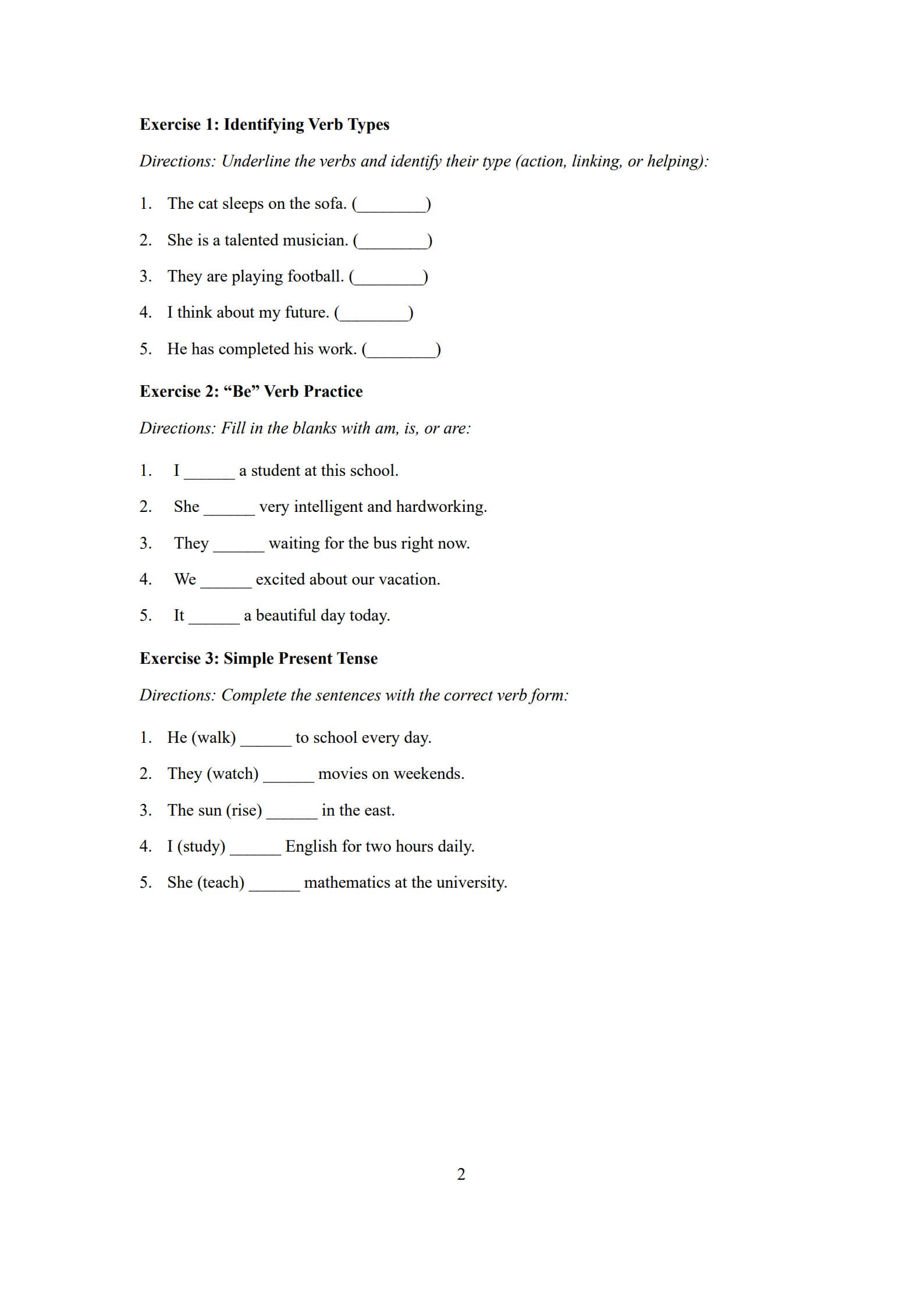
For instance, in the beginner exercise, a simple sentence like “The cat sleeps on the sofa” uses an action verb (“sleeps”) to paint a clear picture.
But verbs can also link ideas, as in “She is a talented musician,” where “is” connects the subject to a description.
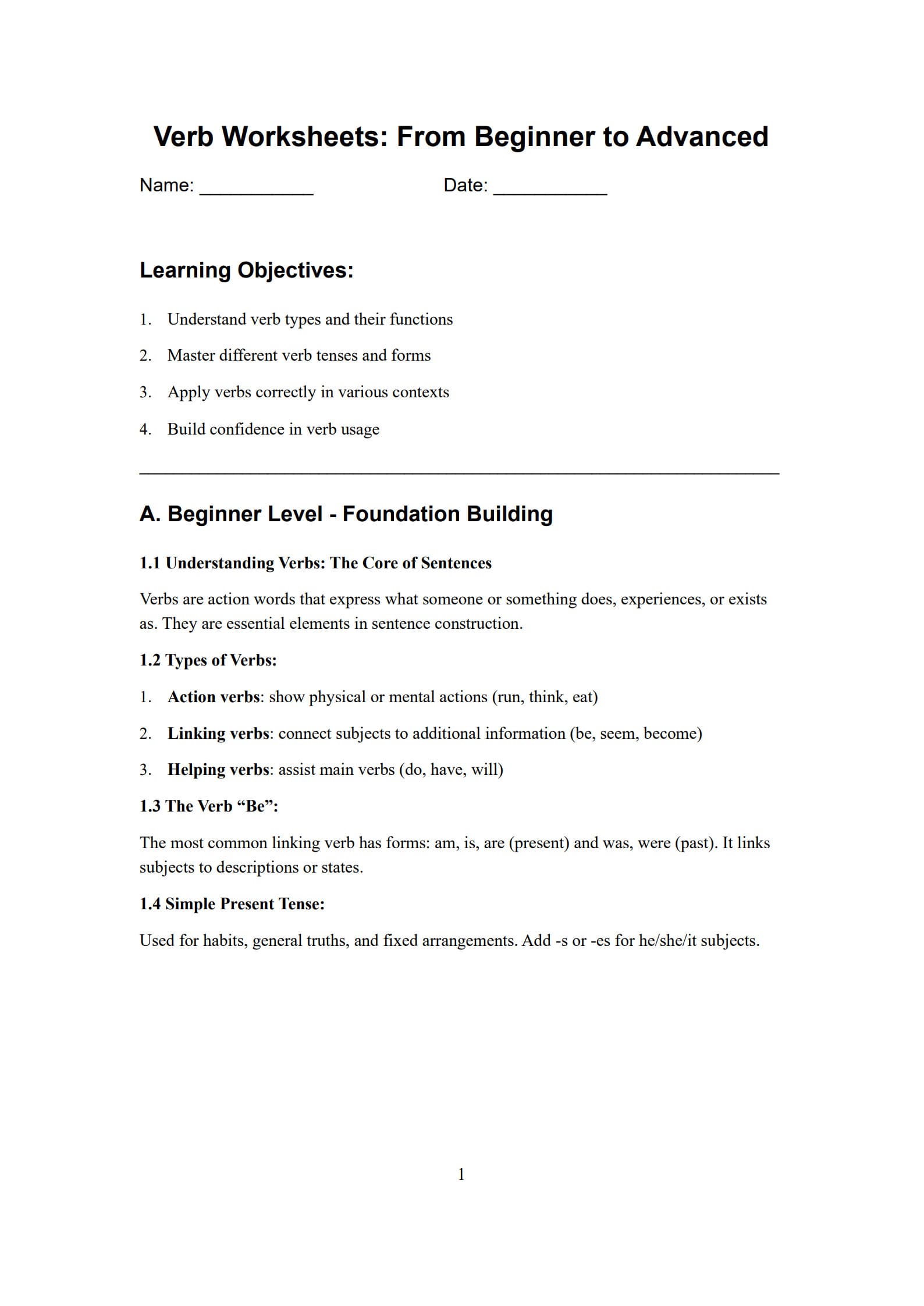
The PDF Agile template breaks this down intuitively. It starts with verb types—action, linking, and helping verbs—so you understand their roles. For example:
- Action verbs: “They are playing football” (physical action).
- Linking verbs: “He seems tired” (connecting state).
- Helping verbs: “She has completed her work” (supporting the main verb).
Why does this matter? Misusing verbs can lead to misunderstandings, like saying “I am thinking about my future” (correct) versus “I thinking about my future” (incorrect).
The template’s exercises, such as identifying verb types, build a solid foundation. As one exercise asks: “Underline the verbs in ‘The cat sleeps on the sofa’—is it action, linking, or helping?” This hands-on approach makes learning sticky and fun.
2. Conquering Tenses: From Simple Present to Perfect Forms
Mastering tenses is like learning to navigate time in English. Our worksheet breaks it down into a clear, progressive journey.
Beginner: The Simple Present (Habits & Facts)
- Use it for: Daily routines and general truths.
- Worksheet Example: “He walks to school every day.”
- The Rule: For he/she/it, remember the -s: “She teaches mathematics.” The worksheet drills this with fill-in-the-blank exercises to build muscle memory.
Intermediate: The Simple Past (Completed Actions)
- Use it for: Finished actions, often with words like “yesterday” or “last week.”
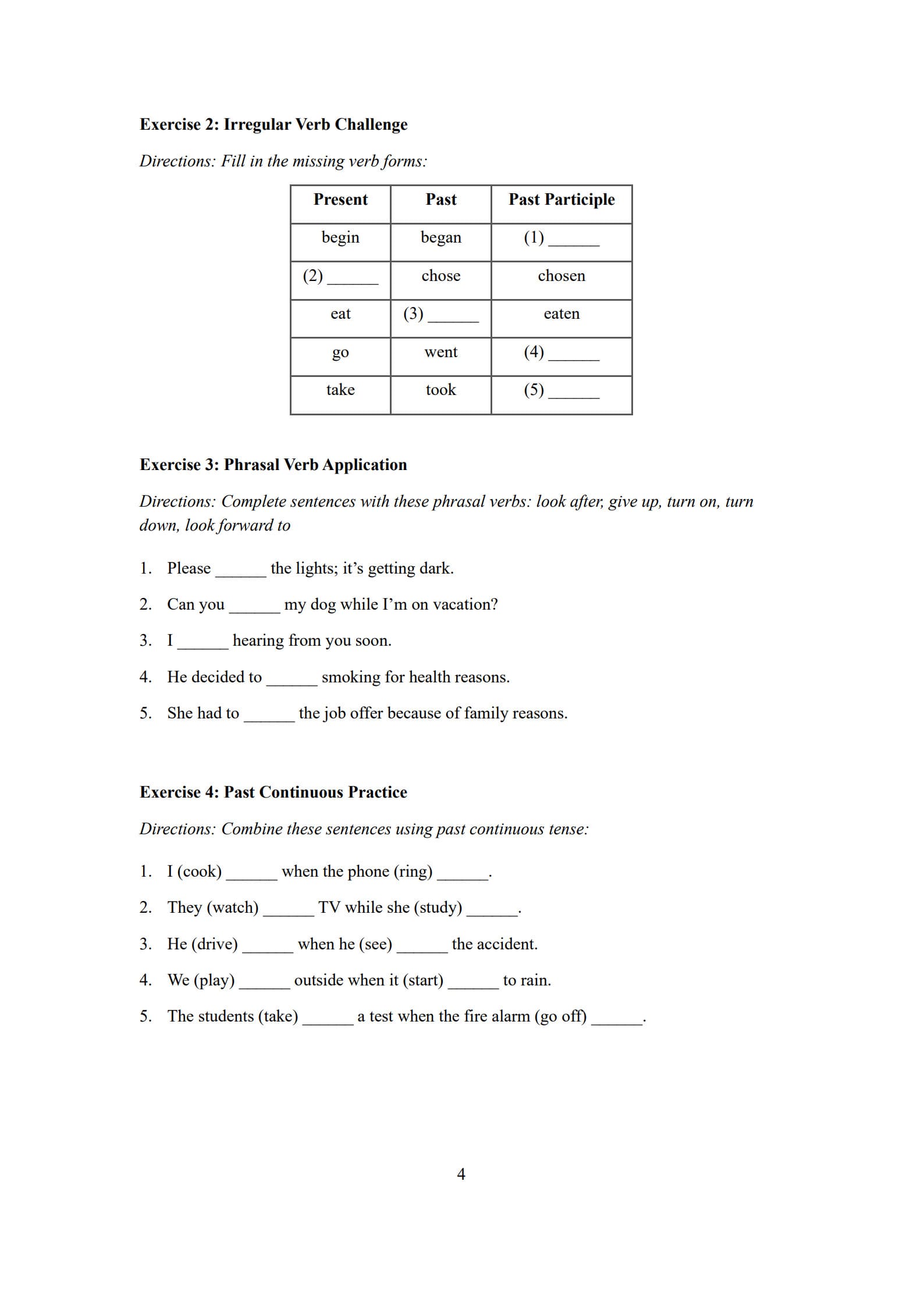
- The Challenge: Irregular verbs! They don't follow the “-ed” rule.
- Worksheet Practice:
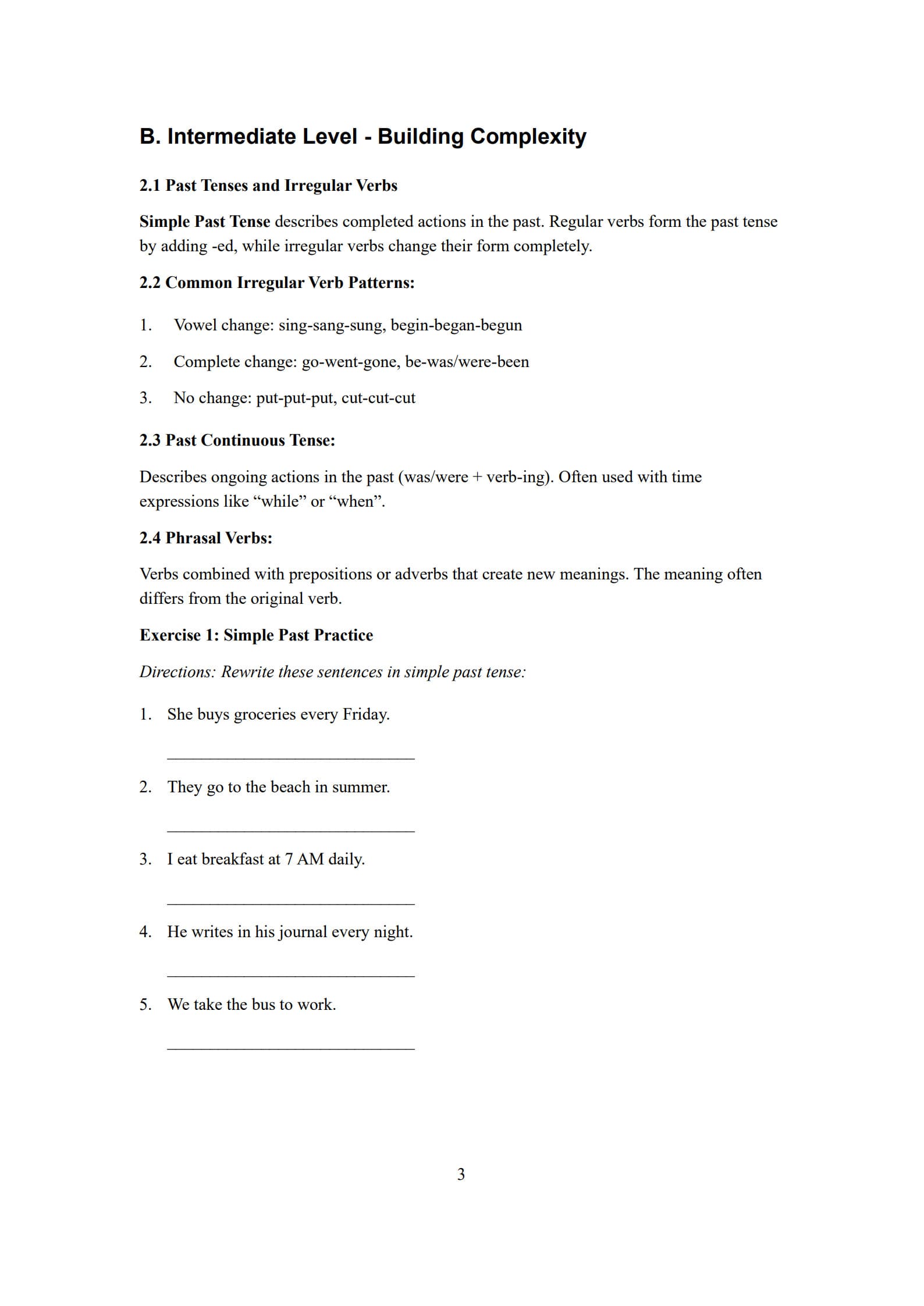
Rewrite the sentence: “She bought groceries last Friday.” (from “buys”)
Fill in the table: What's the past participle of “begin”? begun.
Advanced: The Perfect Tenses (Connecting Time)
- Use it for: Linking past actions to the present or future.
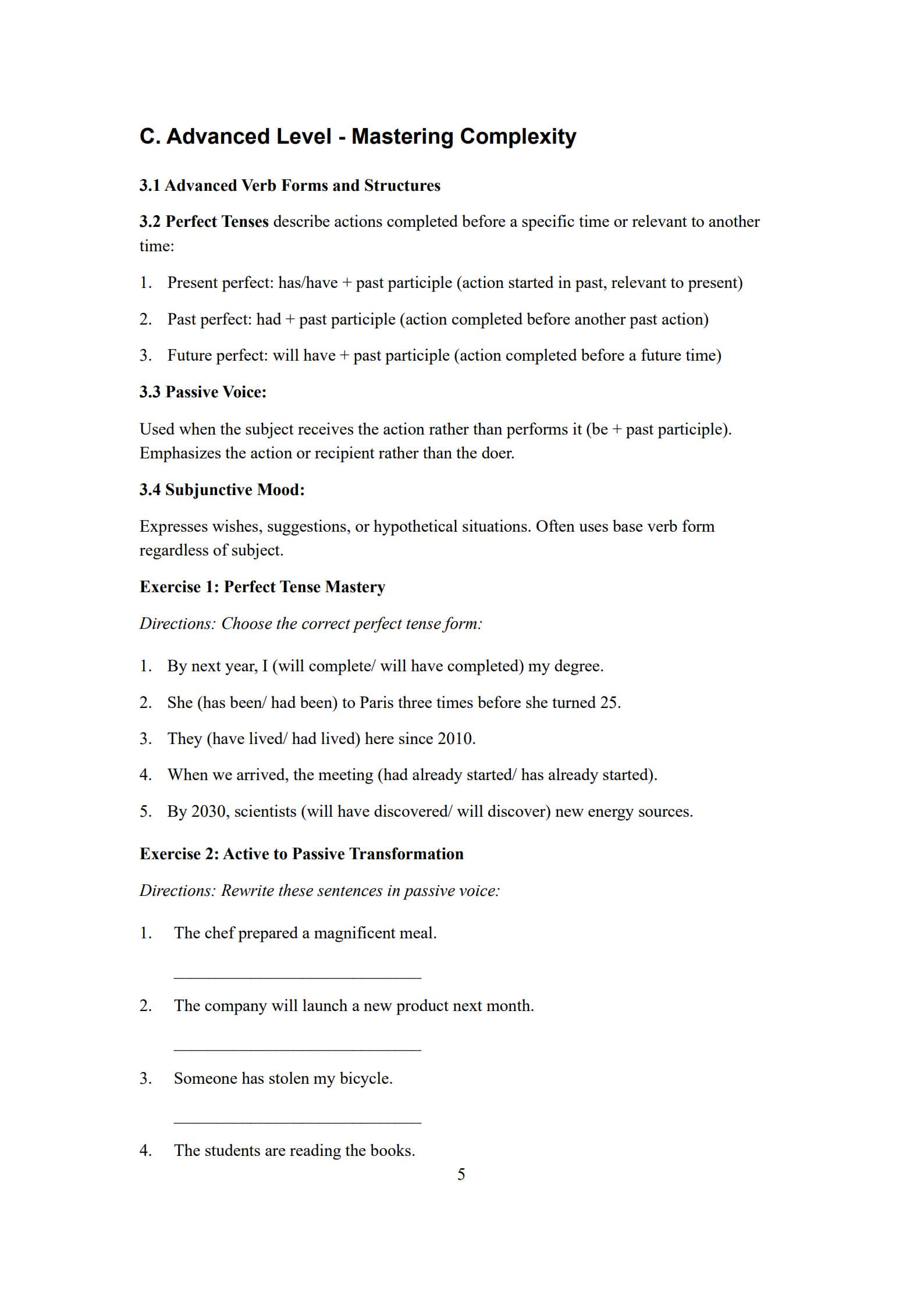
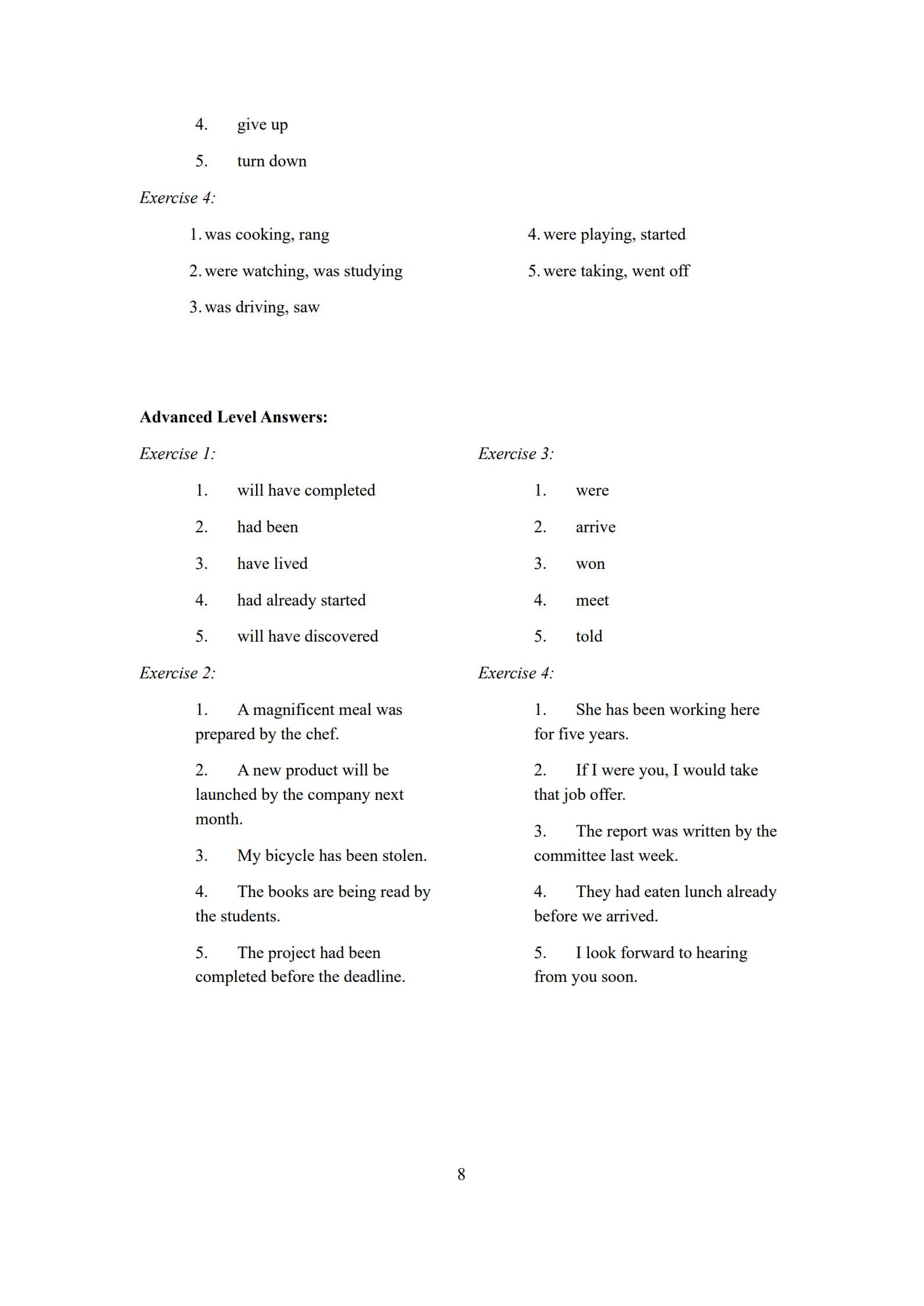
- Worksheet Example: “By next year, I will have completed my degree.”
- Watch Out For: A common error the worksheet corrects:
“She have been working here since five years.”
“She has been working here for five years.”
How the Template Helps You Master This:
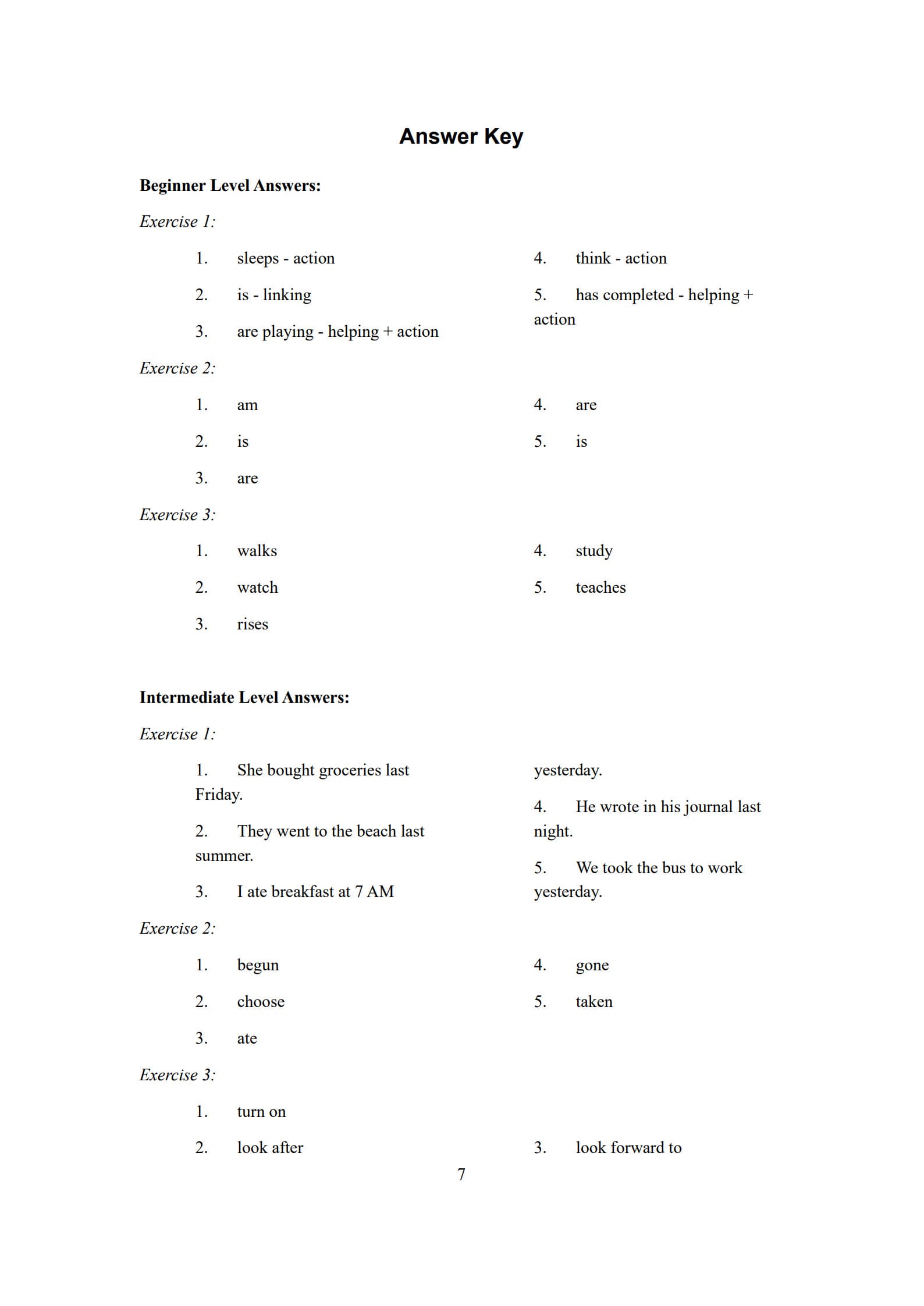
The worksheet provides immediate practice for each level, from basic conjugation to complex sentence correction, with a built-in answer key for instant feedback. It turns a complicated topic into a series of achievable steps.
3. Mastering Tricky Areas: Irregular Verbs and Phrasal Verbs
Some verb topics seem designed to trip up learners—but with smart strategies, you can master them faster than you think.
Intermediate: Conquering Irregular Verbs & Phrasal Verbs
Directions: Irregular verbs don’t have to be a memory battle.
Strategy:
- Vowel-change groups: sing → sang → sung | begin → began → begun
- No-change verbs: cut → cut → cut | put → put → put
Quick Quiz:
What’s the past form of “choose”?
Answer: chose
Directions: Phrasal verbs become clear with context.
Worksheet Exercise:
Complete the sentence: “Can you ______ my dog while I'm on vacation?”
Answer: look after
You’ll practice that “turn down” means reject, not lower something—making your English sound natural, not literal.
Advanced: Navigating Passive Voice & Subjunctive Mood
These structures are essential for formal and nuanced English.
Passive Voice shifts focus to the action or result:
- Worksheet example: “The report was written by the committee.”
Subjunctive Mood expresses wishes or hypotheticals:
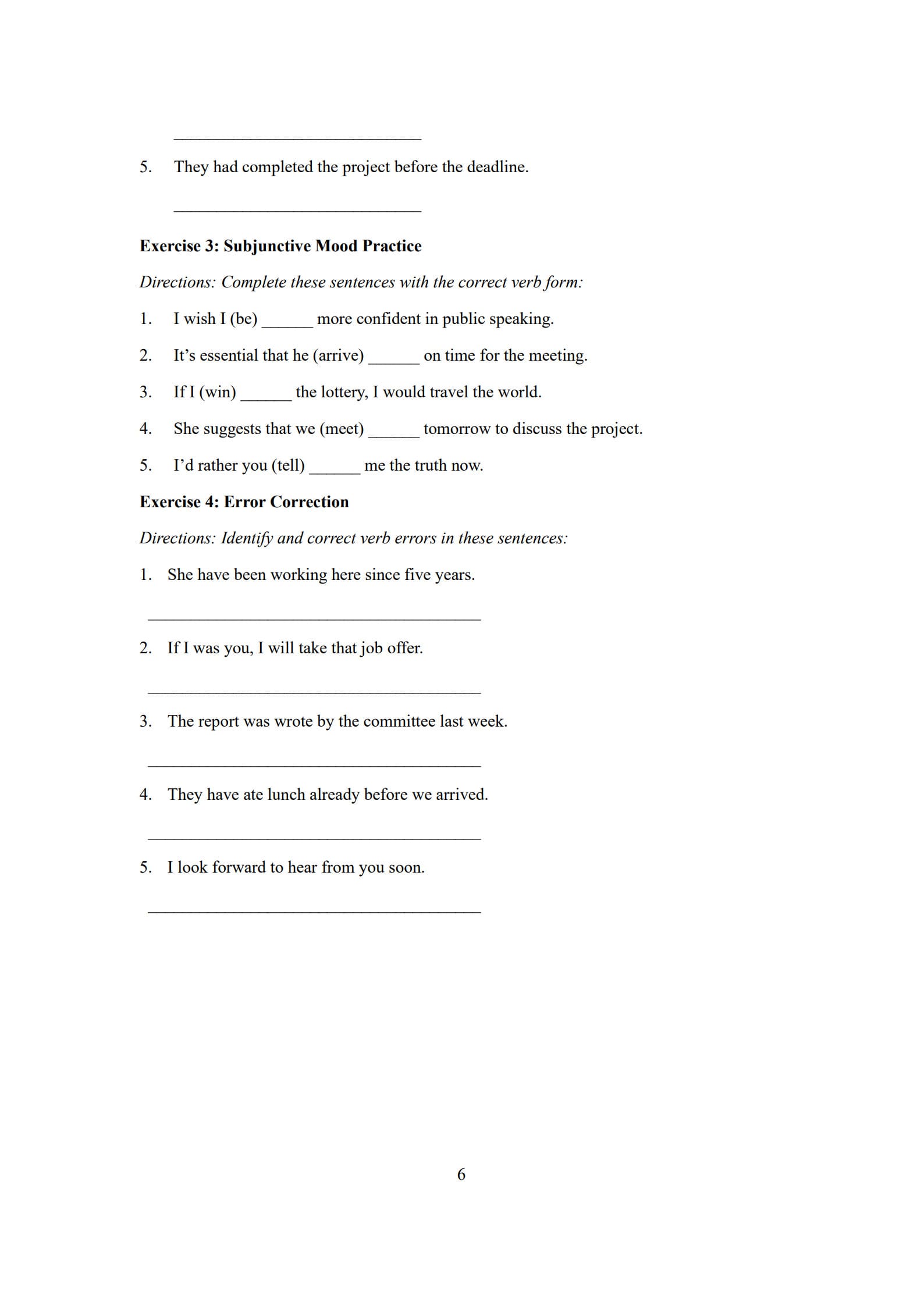
- Worksheet example: “I wish I were more confident.”
Error Correction from the Worksheet:
- × “If I was you…”
- √ “If I were you…”
The template includes targeted exercises to transform confusion into clarity, helping you advance from correct grammar to confident expression.
4. Putting It All Together: Real-World Practice and Avoidable Mistakes
Learning verbs isn’t just about rules—it’s about usage. The template’s exercises simulate real life, like writing a story using past tenses or giving advice with the subjunctive. For example, the advanced section includes a creative task: “Describe a past event using perfect tenses.” This bridges theory and practice.
Common mistakes are addressed head-on. The template’s error correction exercise flags issues like:
- Using “has ate” instead of “has eaten.”
- Confusing time expressions (e.g., “since” vs. “for”).
- Forgetting the base verb after “did” in questions (“Did she like?” not “Did she liked?”).
By practicing with the answer key, you’ll develop an eye for detail. As the template emphasizes, “Don’t try to learn all irregular verbs at once!”—a tip that reduces overwhelm.
5. How to Use This Template on PDF Agile
Using the Verb Worksheets template in PDF Agile is quick and customizable. Follow these four steps to accelerate your learning:
Step 1: Access the Template in the PDF Agile App
Open PDF Agile and go to the Template Library. Search for “Verb Worksheets: From Beginner to Advanced” and click “Use Template.” It’s pre-formatted with clear sections, from verb types to advanced exercises, so you can start immediately.
Step 2: Complete the Exercises Digitally or in Print
Fill out the template directly on your device using PDF Agile’s editing tools—type answers into fields like “Fill in the blanks with am, is, or are.” If you prefer handwriting, print it and work offline. The structured layout guides you logically, such as beginning with “Identifying Verb Types” before moving to “Phrasal Verb Application.”
Step 3: Check Your Answers with the Built-in Key
After each exercise, refer to the answer key included in the template. For instance, after tackling “Simple Past Practice,” verify your sentences against answers like “She bought groceries last Friday.” This instant feedback helps you learn from errors without external help.
Step 4: Save, Share, and Review Your Progress
Save your completed worksheet as a PDF for future review. Use PDF Agile’s share feature to email it to a teacher or study group. Revisit challenging sections, like the irregular verb table, to reinforce memory. The app’s cloud storage keeps your work secure.
6. FAQs
Q1: Is this template suitable for all proficiency levels?
Yes! It’s divided into beginner, intermediate, and advanced sections. Beginners can focus on “be” verbs and simple present, while advanced learners tackle subjunctive mood. The answer key supports self-paced learning.
Q2: Can I use the template on mobile devices?
Absolutely. PDF Agile is optimized for iOS, Android, and desktop. You can edit on the go and sync across devices.
Q3: How long does it take to complete the worksheets?
It varies by level, but allow 1-2 hours per section. The template is designed for bite-sized practice—try one exercise daily for best results.
Q4: Are there examples for business or academic English?
Yes! Exercises like passive voice (“The report was written”) or perfect tenses are great for formal contexts. The template uses universal examples, but you can adapt them to your needs.
Q5: What if I make mistakes?
The answer key provides explanations, not just answers. For instance, it clarifies why “I wish I were” is correct for hypotheticals. Repeating exercises solidifies learning.
Conclusion
Verbs are your gateway to fluent English, and with PDF Agile’s Verb Worksheets template, mastering them becomes an engaging journey. From action verbs to advanced structures, this template offers a clear path to confidence—backed by practical exercises and instant feedback. Don’t let verb tenses hold you back; download the template today from the PDF Agile app, and start speaking with precision and clarity.