

Welcome to PDF Agile’s educational resource center, where complex mathematical concepts transform into accessible learning experiences. Our specially designed Percentage Worksheet template offers a comprehensive journey through percentage calculations, from basic conversions to advanced real-world applications. This meticulously structured resource serves as both a learning tool and a practical exercise platform, perfect for students, educators, and lifelong learners seeking to strengthen their mathematical foundation. The template’s progressive difficulty levels—beginner, intermediate, and advanced—ensure a smooth learning curve while challenging your growing skills. With clear explanations, practical examples, and varied problem types, this math drills worksheet makes percentage mastery achievable and engaging.
Why Start with Basic Percentage Concepts?
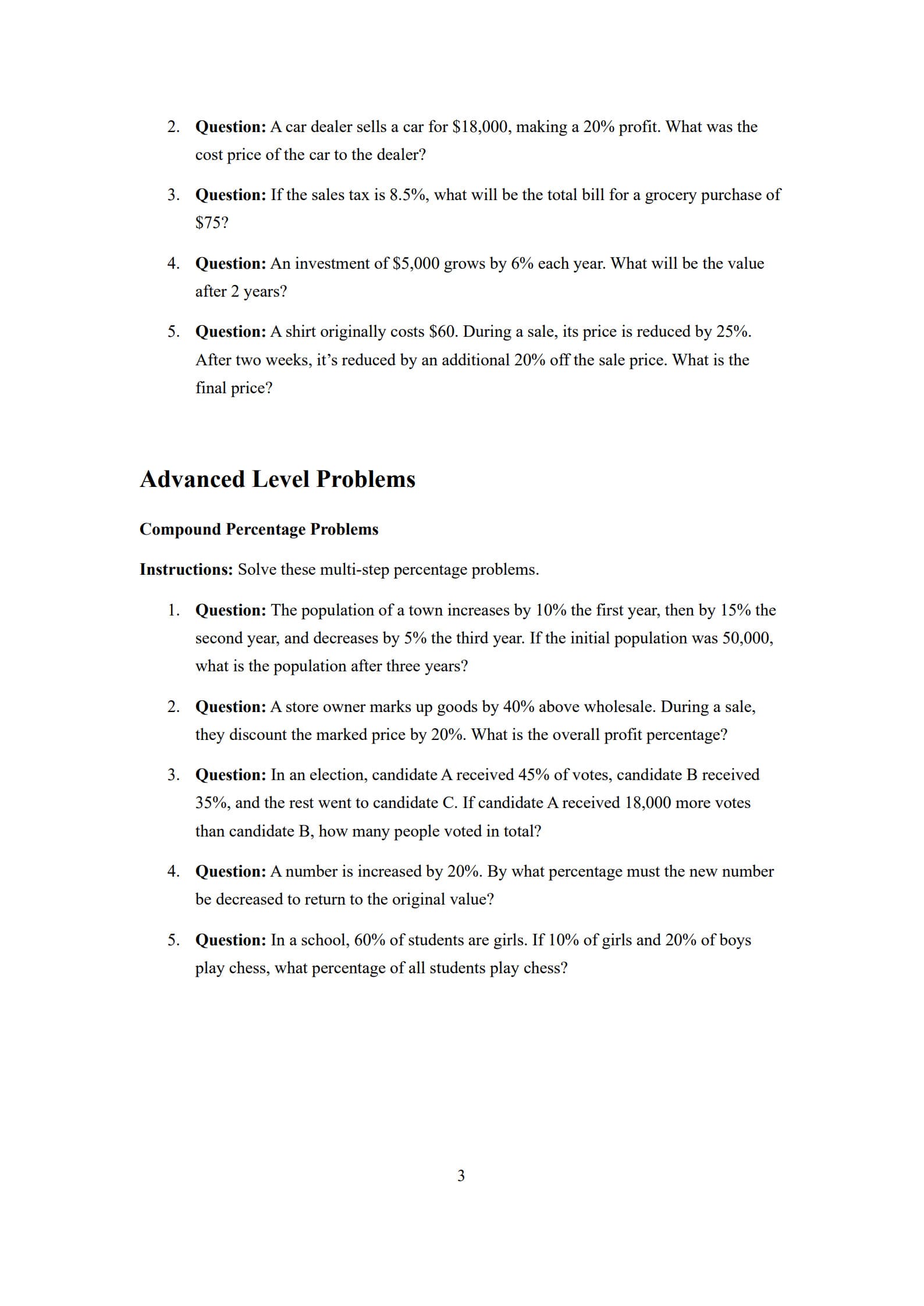
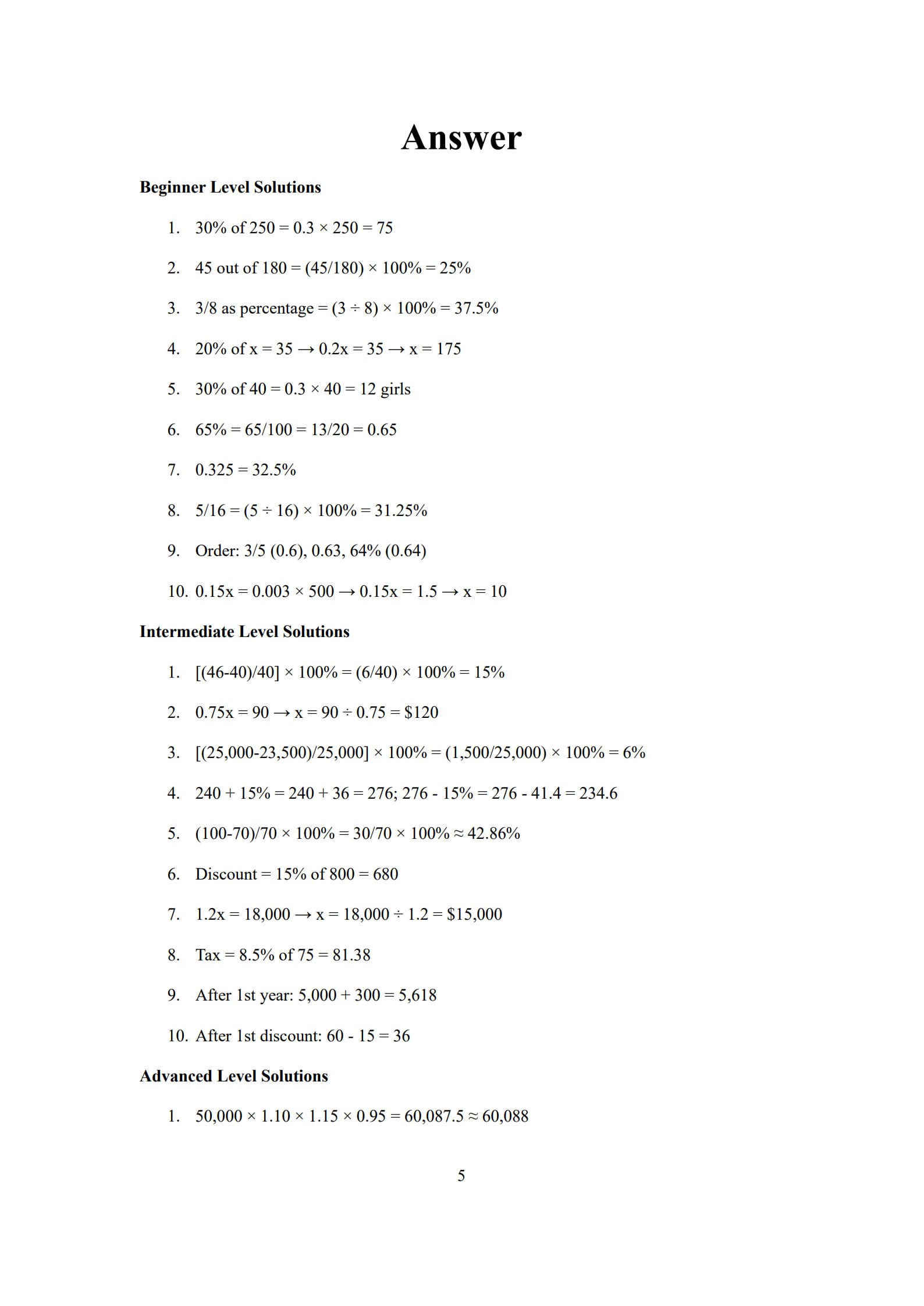
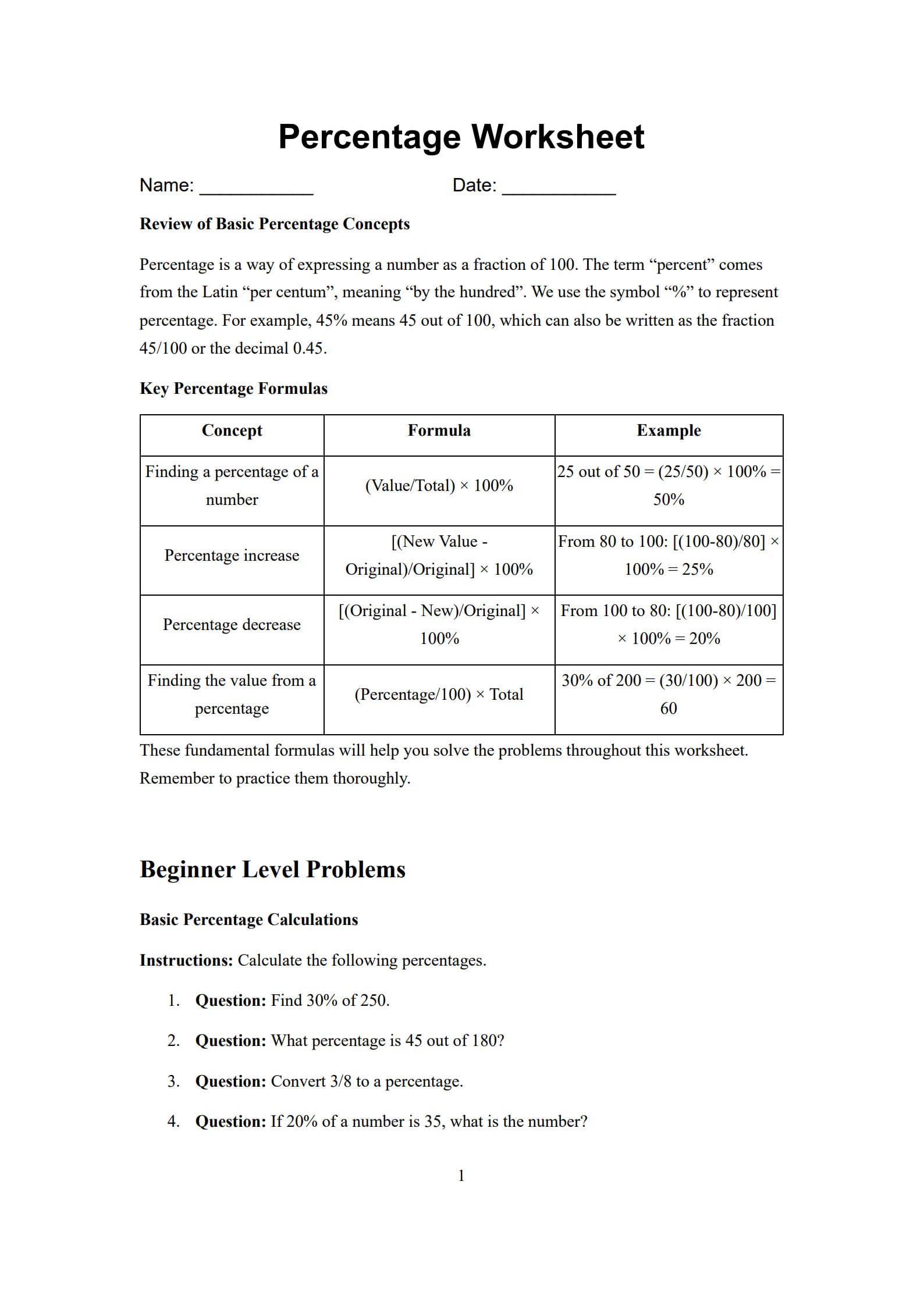
The worksheet begins with fundamental percentage word problems that establish crucial mathematical foundations. These initial exercises demonstrate how percentages represent fractions of 100, using relatable scenarios like “Find 30% of 250” or “If 20% of a number is 35, what is the number?” This approach helps learners connect abstract percentage concepts to tangible numerical relationships.
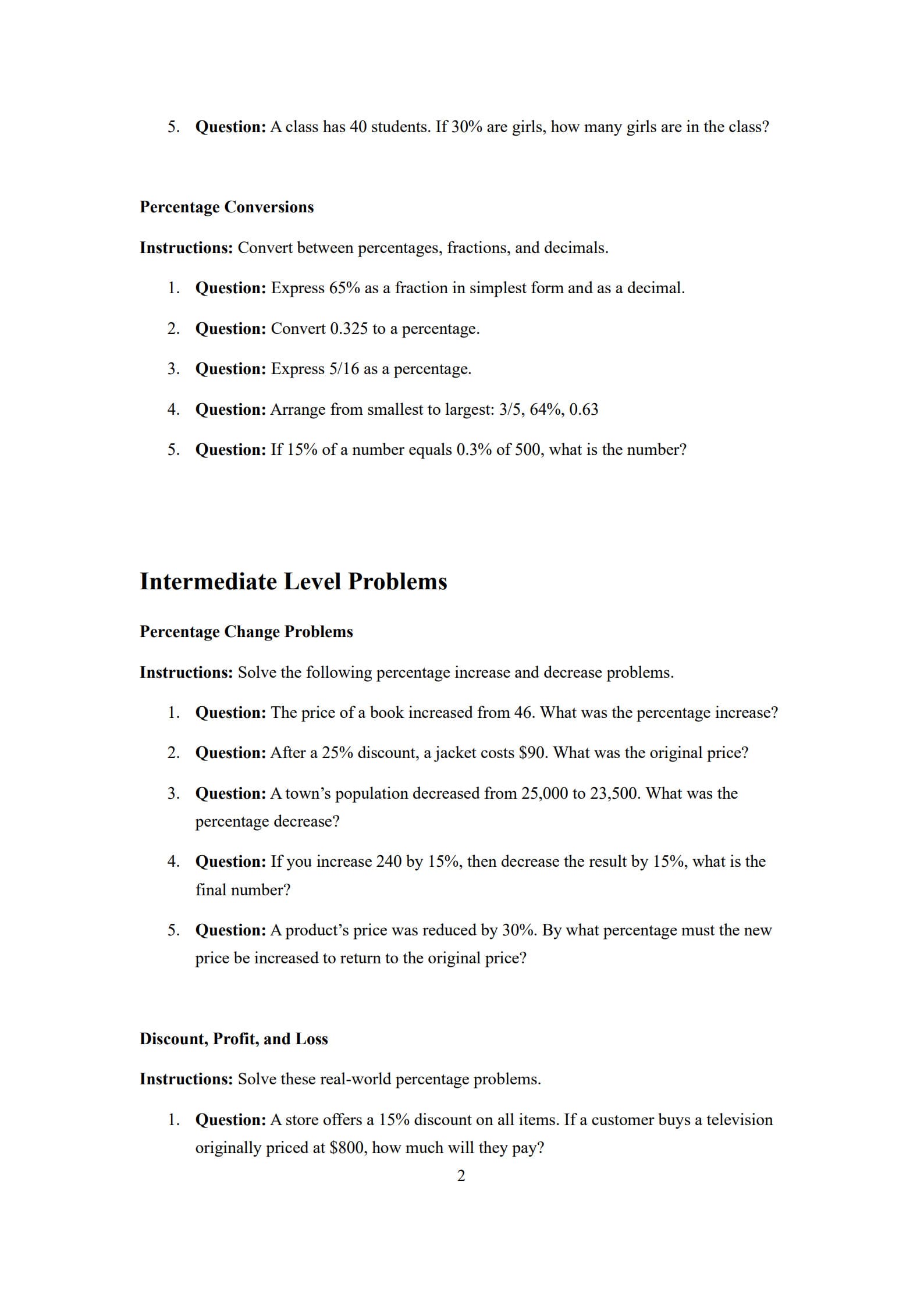
The conversion section bridges different mathematical representations, asking students to “Express 65% as a fraction in simplest form and as a decimal” or “Convert 0.325 to a percentage.” These exercises develop mathematical flexibility—the ability to shift between percentage, decimal, and fraction formats seamlessly. The arrangement problems, such as “Arrange from smallest to largest: 3/5, 64%, 0.63,” reinforce comparative thinking and numerical sense.
Each problem builds upon previous knowledge while introducing new challenges. The worksheet strategically progresses from simple calculations to multi-step reasoning, like the problem where “15% of a number equals 0.3% of 500.” This gradual complexity increase prevents cognitive overload while ensuring continuous skill development. The logical sequencing allows learners to recognize patterns in percentage problems, developing problem-solving strategies they can apply to unfamiliar scenarios.
Practical Applications: Fraction Decimal Percent Worksheets in Contexts
The intermediate section transforms percentage concepts from abstract exercises to practical tools through fraction worksheets, decimal worksheets and percent worksheets. Students encounter realistic scenarios like price changes (“The price of a book increased from 46”) and population statistics (“A town’s population decreased from 25,000 to 23,500”). These contexts demonstrate how percentages operate in daily life, from shopping discounts to demographic changes.
The discount, profit, and loss problems provide particularly valuable real-world applications. When students calculate that “after a 25% discount, a jacket costs 75 purchase”) and investment growth problems (“$5,000 grows by 6% each year”) further strengthen the connection between classroom mathematics and financial literacy.
These applied problems require more than computational accuracy—they demand careful reading and logical reasoning. The worksheet challenges students with layered problems, such as determining “by what percentage must the new price be increased to return to the original price” after a 30% reduction. This develops reversible thinking, an essential mathematical skill that strengthens conceptual understanding beyond rote calculation.
Advanced Percentage Challenges: Compound Problems and Statistical Applications
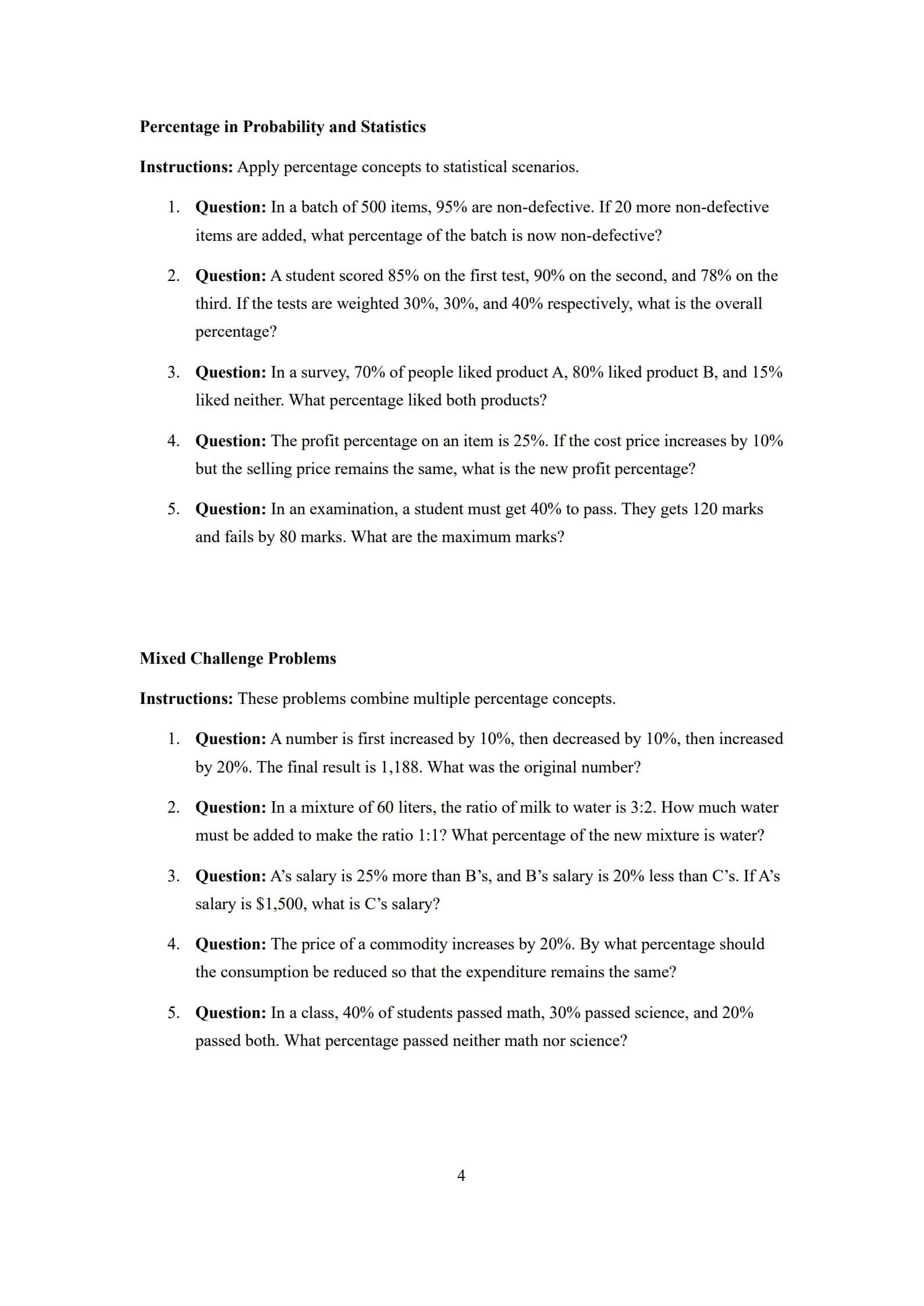
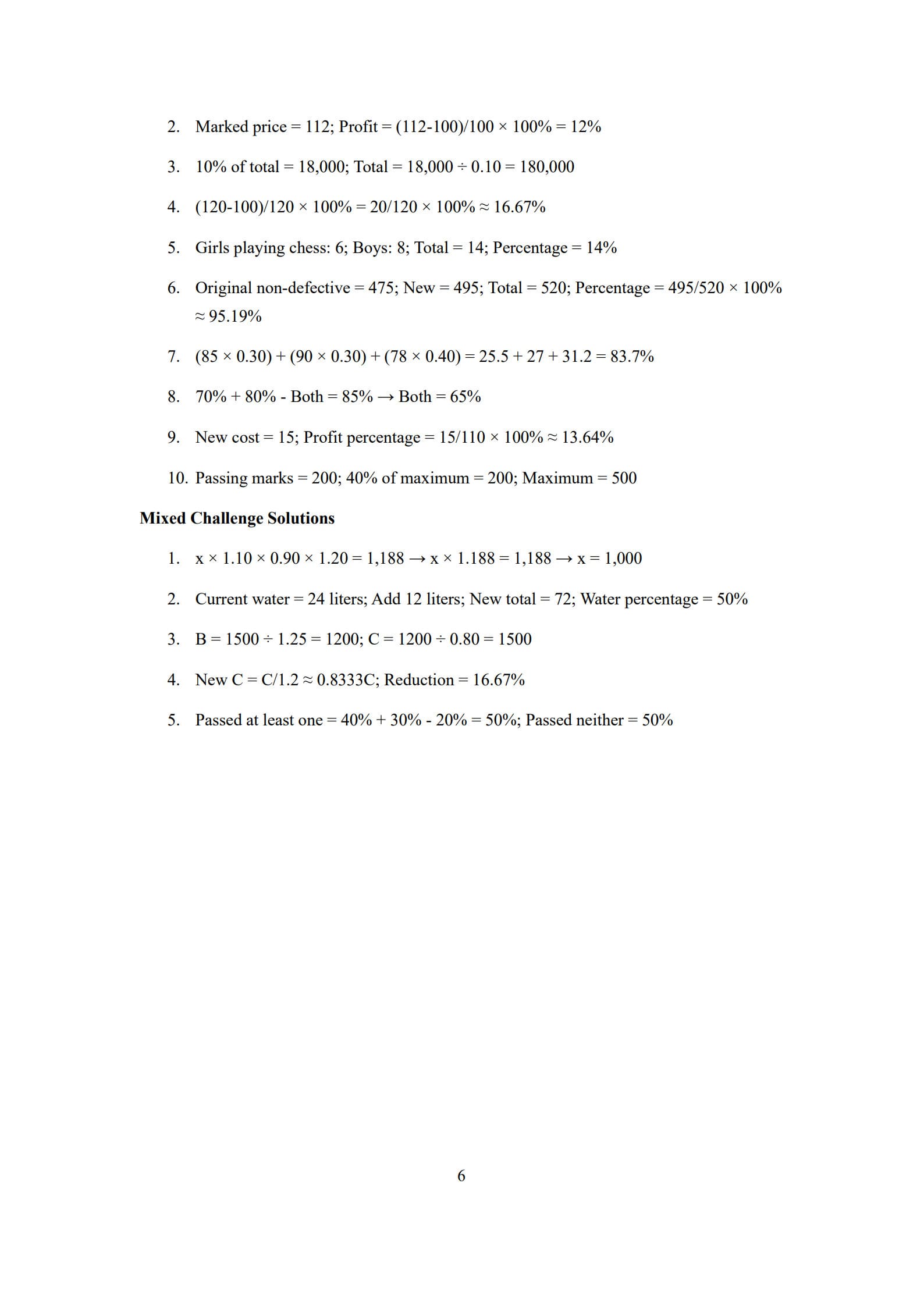
The advanced section introduces compound percentage problems that require multi-step reasoning and careful sequencing. The population change problem demonstrates this complexity beautifully: “The population increases by 10% the first year, then by 15% the second year, and decreases by 5% the third year.” These exercises teach students to handle sequential percentage changes correctly, avoiding the common mistake of simply adding percentage changes.
The statistical applications section connects percentages to probability and data analysis. Problems like “in a batch of 500 items, 95% are non-defective” introduce percentage concepts in quality control contexts, while survey analysis questions (“70% liked product A, 80% liked product B, and 15% liked neither”) develop set theory understanding through percentage frameworks.
Key Percentage Formulas Reference Table
| Concept | Formula | Example from Worksheet |
|---|---|---|
| Finding a percentage of a number | (Value/Total) × 100% | 25 out of 50 = (25/50) × 100% = 50% |
| Percentage increase | [(New Value - Original)/Original] × 100% | From 80 to 100: [(100-80)/80] × 100% = 25% |
| Percentage decrease | [(Original - New)/Original] × 100% | From 100 to 80: [(100-80)/100] × 100% = 20% |
| Finding the value from a percentage | (Percentage/100) × Total | 30% of 200 = (30/100) × 200 = 60 |
Strategic Problem-Solving: Mixed Challenge Percentage Word Problems
The mixed challenge section represents the pinnacle of the worksheet’s design, combining percentage concepts with ratio, algebra, and logical reasoning. These problems require students to apply multiple mathematical skills simultaneously, such as the problem where “a number is first increased by 10%, then decreased by 10%, then increased by 20%” to reach a final value of 1,188. This develops the ability to deconstruct complex problems into manageable steps.
The ratio and percentage integration problems are particularly effective for demonstrating mathematical interconnectedness. When students determine how much water to add to a mixture to change the milk-to-water ratio from 3:2 to 1:1, they’re not just practicing percentages—they’re seeing how mathematical concepts work together to solve practical problems. The salary comparison problem (“A’s salary is 25% more than B’s, and B’s salary is 20% less than C’s”) further reinforces this integrated approach to mathematics.
These challenging problems teach valuable lessons in perseverance and problem-solving strategies. Students learn to approach complex problems methodically, checking their work at each step and verifying their solutions. The worksheet provides immediate application opportunities for the formulas and techniques learned in earlier sections, reinforcing the cumulative nature of mathematical learning.
How to Use This Percentage Worksheet Template on PDF Agile
Using PDF Agile’s Percentage Worksheet template transforms percentage practice into an efficient, organized learning process. Follow these simple steps to maximize your mathematical development:
Step 1: Access the Percentage Worksheet Template
Navigate to PDF Agile’s Template Library and select the “Percentage Worksheet”, and click “Use Template”. The template comes pre-formatted with clear sections, instructions, and answer keys, saving you preparation time while ensuring comprehensive coverage of percentage concepts.
Step 2: Customize for Your Learning Needs
The template’s modular design allows easy customization. Focus on specific areas like “percentage word problems” or “fraction decimal percent worksheets” by selectively hiding or highlighting sections. Adjust difficulty levels by concentrating on beginner, intermediate, or advanced problems based on your current skill level and learning objectives.
Step 3: Interactive Practice and Immediate Feedback
Utilize PDF Agile’s annotation tools to solve problems directly within the document. The digital format enables easy erasure and retrying, encouraging experimental learning. Reference the answer key section to verify your solutions immediately, reinforcing correct methodologies and identifying areas needing improvement.
Step 4: Track Progress and Save Versions
Save multiple versions of your worksheet to document your learning journey. Compare early attempts with later work to visualize improvement. The digital format makes it easy to revisit challenging problems periodically, ensuring long-term retention of percentage calculation skills.
Conclusion
PDF Agile’s Percentage Worksheet template represents more than just a collection of math problems—it’s a carefully crafted learning pathway that builds mathematical confidence through structured challenges. By working through these exercises, you’re not merely memorizing procedures but developing a genuine understanding of how percentages function across various contexts. The template’s progression from basic conversions to complex multi-step problems ensures comprehensive skill development while maintaining engagement through practical applications.
The true value of this resource extends beyond academic achievement. The percentage word problems, fraction decimal percent worksheets, and calculating percentages worksheet sections collectively build quantitative reasoning skills applicable to everyday decision-making, financial planning, and professional contexts. As you master these exercises, you’re equipping yourself with mathematical tools that yield lifelong benefits. Whether you’re a student preparing for exams, an educator seeking effective teaching resources, or an adult refreshing essential math skills, this template adapts to your needs while maintaining rigorous educational standards.
Remember that mathematical proficiency develops through consistent practice and thoughtful engagement with challenging material. PDF Agile’s interactive platform combined with this comprehensive percentage worksheet creates an ideal environment for building lasting mathematical competence. Embrace the journey from percentage novice to confident problem-solver, one well-designed problem at a time.