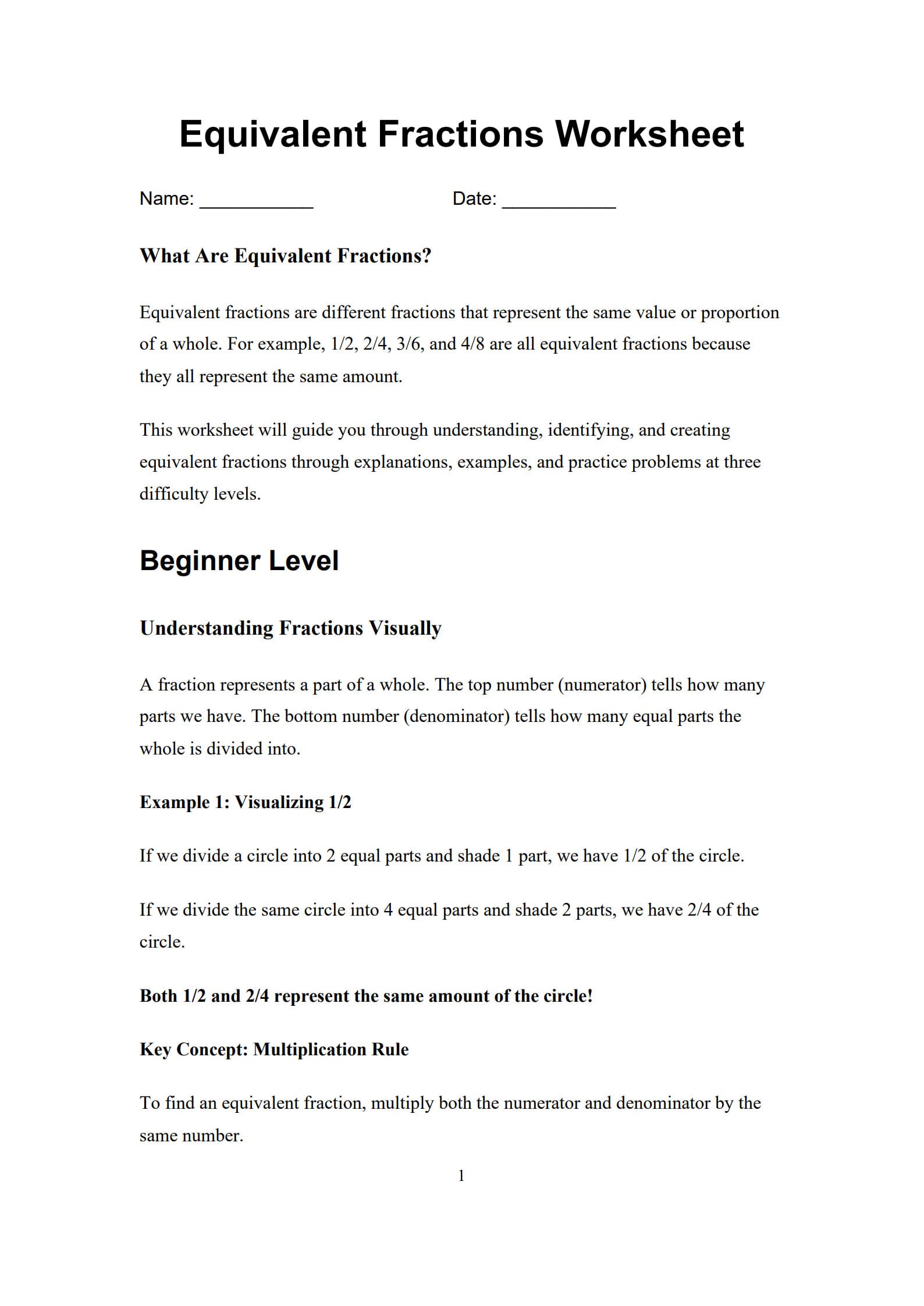


Fractions are the building blocks of mathematical literacy, yet many learners struggle to grasp concepts like numerators, denominators, and operations. PDF Agile’s Fractions Worksheet template transforms this challenge into an engaging, structured learning journey. Designed for students at beginner, intermediate, and advanced levels, this template offers a progressive approach—from identifying fractions to solving real-world problems. By integrating interactive exercises and clear examples, the template turns abstract concepts into tangible skills. Whether you’re a teacher, parent, or self-learner, this guide will show you how to maximize the template’s potential using PDF Agile’s intuitive app. Let’s dive into the world of fractions and unlock mathematical confidence!
Why Start with Fraction Practice? Building Foundations Step by Step
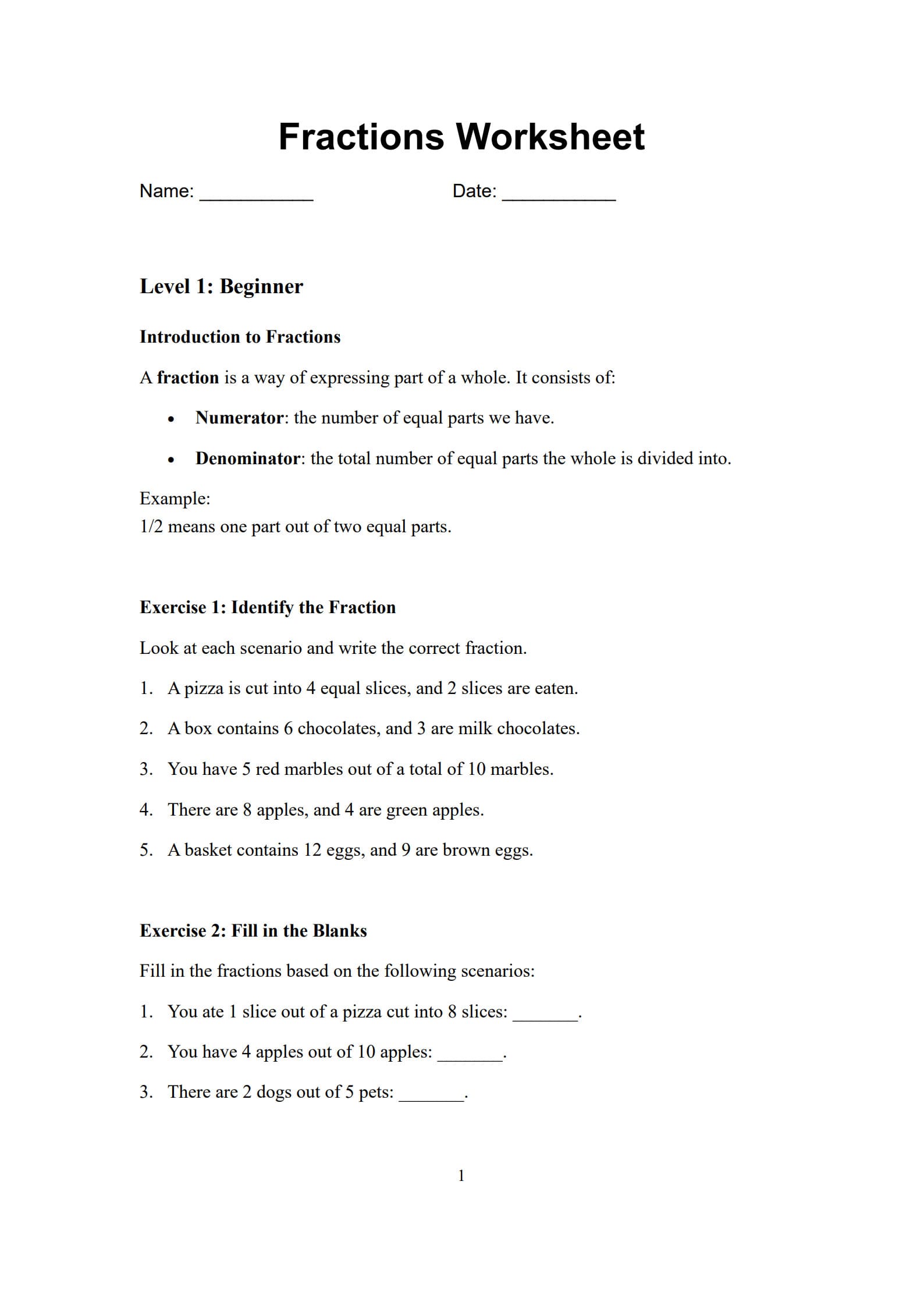
How do you make fractions relatable? The Fractions Worksheet template begins with real-life scenarios—like pizzas, chocolates, and marbles—to introduce core ideas. For instance, Exercise 1 asks learners to identify fractions in contexts such as “2 slices eaten from a pizza cut into 4 equal slices.” This mirrors the template’s emphasis on visualizing parts of a whole, a critical first step in fraction practice. By grounding theory in everyday examples, the template reduces anxiety and encourages curiosity.
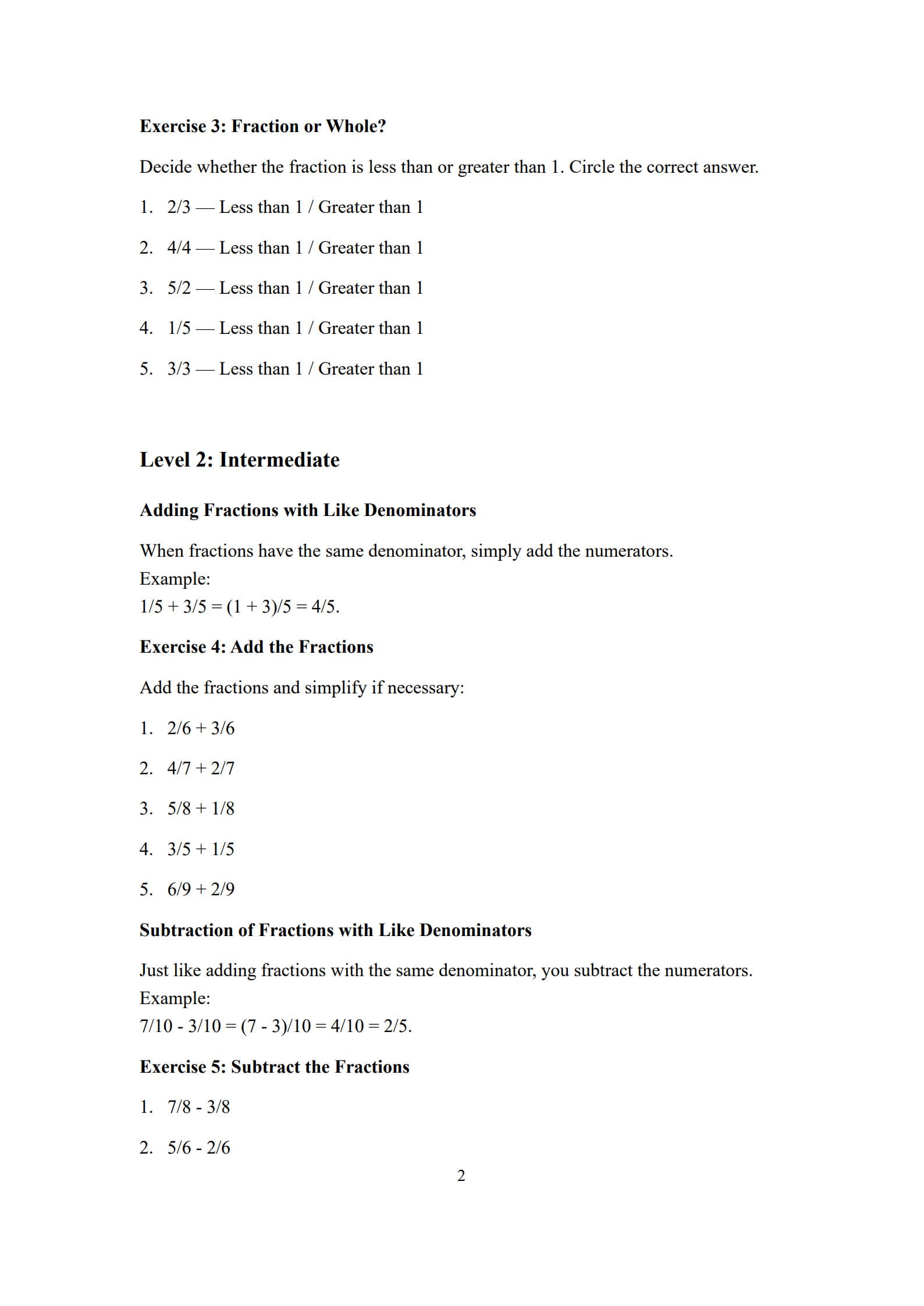
For beginners, Exercises 2 and 3 reinforce basics like writing fractions and comparing them to a whole. When learners circle whether 2/3 is “less than 1” or “greater than 1,” they internalize the meaning of numerator and denominator relationships. PDF Agile’s template ensures this foundational fraction practice is neither rushed nor overlooked. Each exercise scaffolds skills, preparing users for more complex tasks like adding or multiplying fractions later. The key is progression: mastery at one level unlocks confidence for the next.
How Do Adding Fractions Worksheets Simplify Complex Operations?
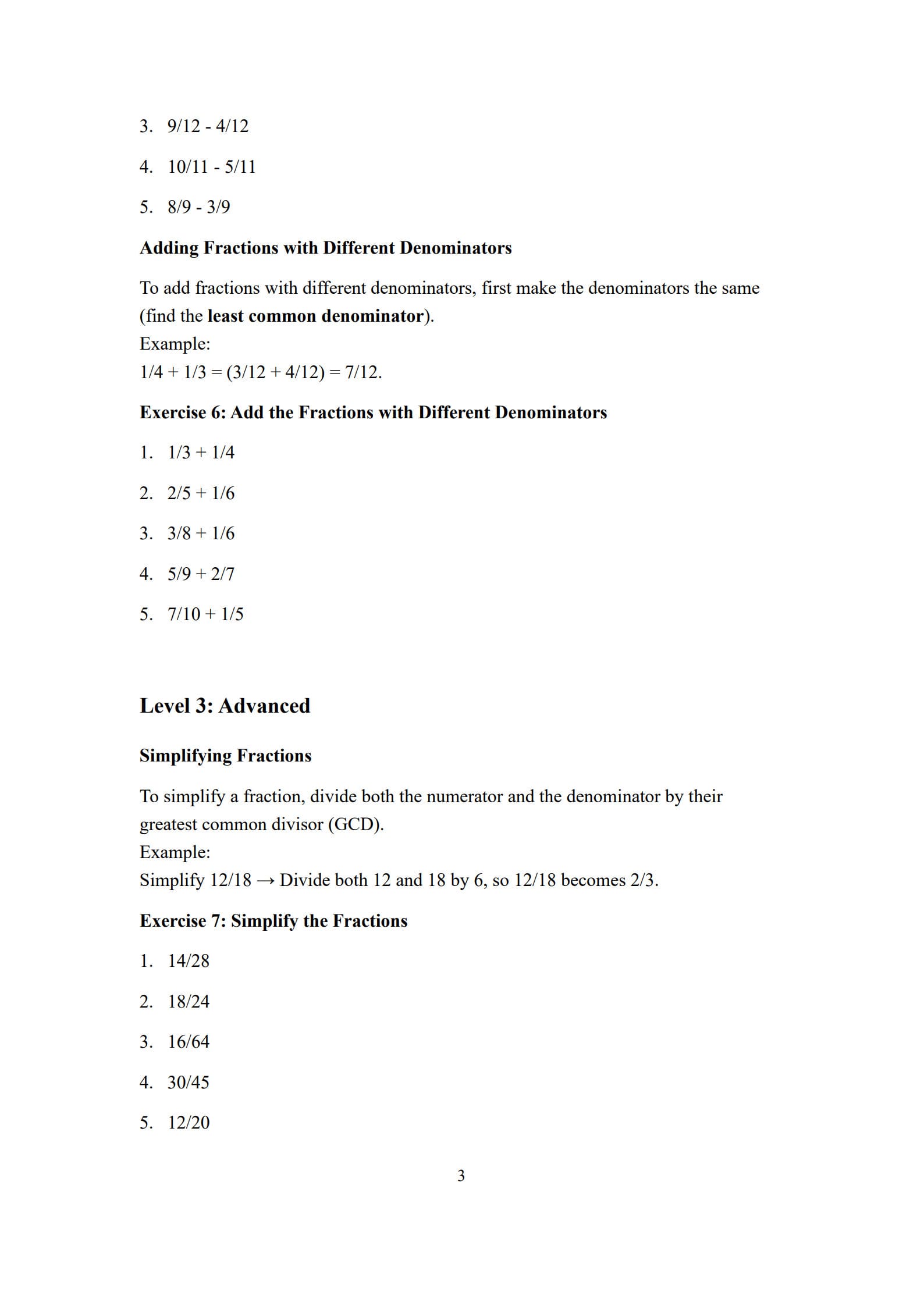
Adding fractions worksheets are where theory meets practice. The template’s intermediate section (Exercises 4–6) breaks down addition into manageable steps. For like denominators, Exercise 4 demonstrates simplicity: 2/6 + 3/6 = 5/6. Here, learners see that only numerators change, making the process intuitive. But what about different denominators? Exercise 6 introduces the least common denominator (LCD) method, as with 1/3 + 1/4 = 7/12. By comparing these approaches, the worksheets highlight versatility in problem-solving.
The template’s strength lies in its graduated difficulty. Users first gain confidence with straightforward exercises before tackling nuanced cases. For example, after adding 5/8 + 1/8, they advance to 3/8 + 1/6, which requires LCD calculation. This sequencing—supported by clear examples—ensures learners don’t just memorize steps but understand the logic behind them. Adding fractions worksheets in PDF Agile thus serve as a bridge from basic concepts to advanced applications.
Comparing Fractions Worksheet: From Simple to Advanced Techniques
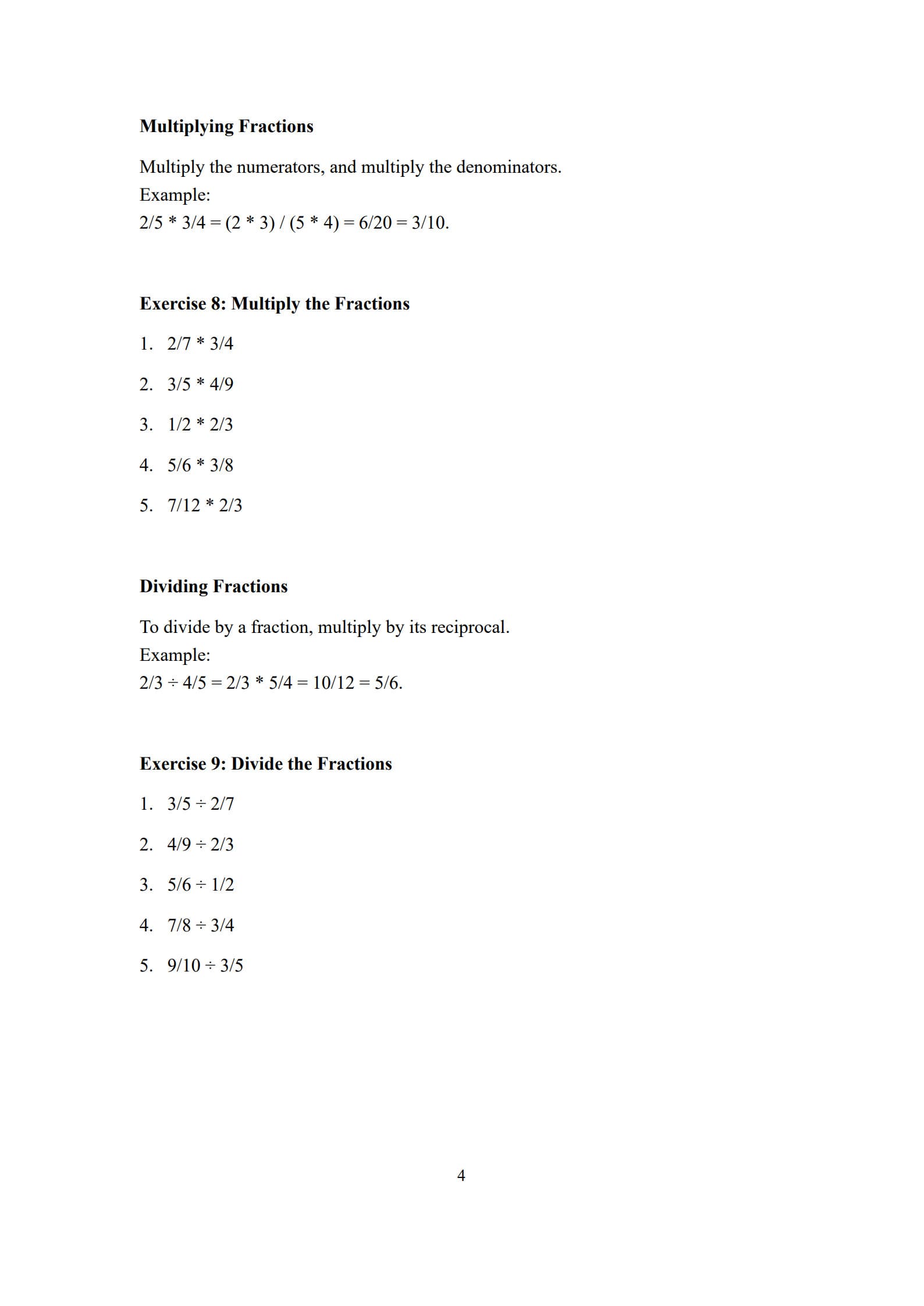
How can learners determine which fraction is larger or smaller? The template addresses this through direct and indirect methods. Exercise 3 (Level 1) introduces comparing fractions to a whole—e.g., deciding if 5/2 is greater than 1. Later, Exercises 7–9 incorporate comparison indirectly through operations. For instance, simplifying 14/28 to 1/2 reveals equivalence, while multiplying 2/7 × 3/4 yields 6/28, which can be compared to other results.
To illustrate progression, the table below summarizes how comparing fractions evolves across levels:
| Level | Exercise Focus | Comparison Method |
|---|---|---|
| Beginner | Fraction vs. Whole (Ex. 3) | Using benchmarks like 1 |
| Intermediate | Addition/Subtraction (Ex. 4–6) | Implicit via common denominators |
| Advanced | Simplification/Multiplication (Ex. 7–9) | Cross-referencing results |
This structured approach ensures learners develop a holistic understanding, moving from visual estimates to precise calculations.
Multiplying Fractions Worksheets: Turning Complexity into Clarity
Multiplying fractions often intimidates learners, but the template’s advanced section (Exercise 8) demystifies the process. Using real-world contexts—like recipes or measurements—it shows how multiplication applies beyond the classroom. For example, 2/5 × 3/4 becomes (2 × 3)/(5 × 4) = 6/20, which simplifies to 3/10. The worksheet emphasizes simplification, linking it to earlier exercises on GCD (Exercise 7) for reinforcement.
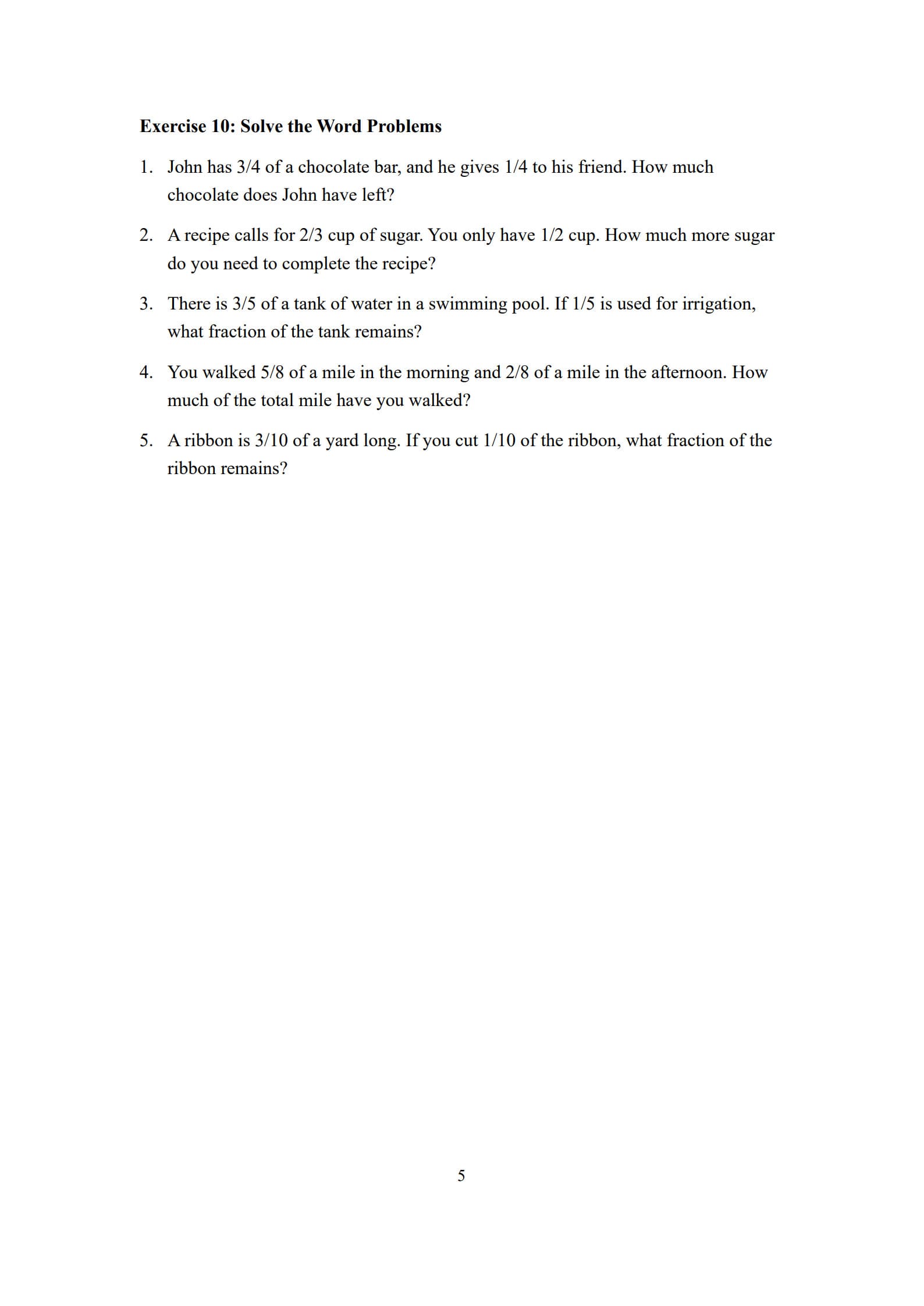
Similarly, dividing fractions (Exercise 9) uses reciprocal multiplication, as with 3/5 ÷ 2/7 = 3/5 × 7/2. By presenting multiplication and division together, the template highlights their inverse relationship. Word problems (Exercise 10) then integrate these skills—e.g., calculating how much chocolate remains if 1/4 is shared from 3/4 of a bar. Multiplying fractions worksheets in PDF Agile thus blend procedural fluency with critical thinking, ensuring learners can tackle both abstract and practical challenges.
How to Use This Template on PDF Agile
Unlocking the Fractions Worksheet template’s full potential is simple with PDF Agile’s user-friendly app. Follow these steps to customize, practice, and share:
Step 1: Access the Fractions Worksheet Template
Navigate to PDF Agile’s Template Library and search for “Fractions Worksheet.” Click “Use Template” to open it directly in the app. The pre-formatted layout includes exercises, examples, and answer keys—all ready for editing.
Step 2: Customize for Your Needs
Personalize the worksheet by adding your learner’s name, date, or specific instructions. Use PDF Agile’s text tools to highlight key sections (e.g., “Adding Fractions Worksheets” or “Multiplying Fractions”) for focused practice. You can also adjust difficulty levels by omitting or repeating exercises.
Step 3: Solve and Annotate Interactively
Complete exercises digitally using the app’s annotation features. Draw circles around answers, type solutions, or use the highlighter to emphasize steps. For teachers, adding hints or feedback is easy with comment bubbles.
Step 4: Save, Share, and Print
Export the finalized worksheet as a PDF for printing or digital sharing.
Pro Tips for Maximum Impact
- Scaffold Learning: Start with Level 1 exercises before advancing.
- Incorporate Real Examples: Use the template’s scenarios (e.g., pizzas, tanks of water) to relate math to daily life.
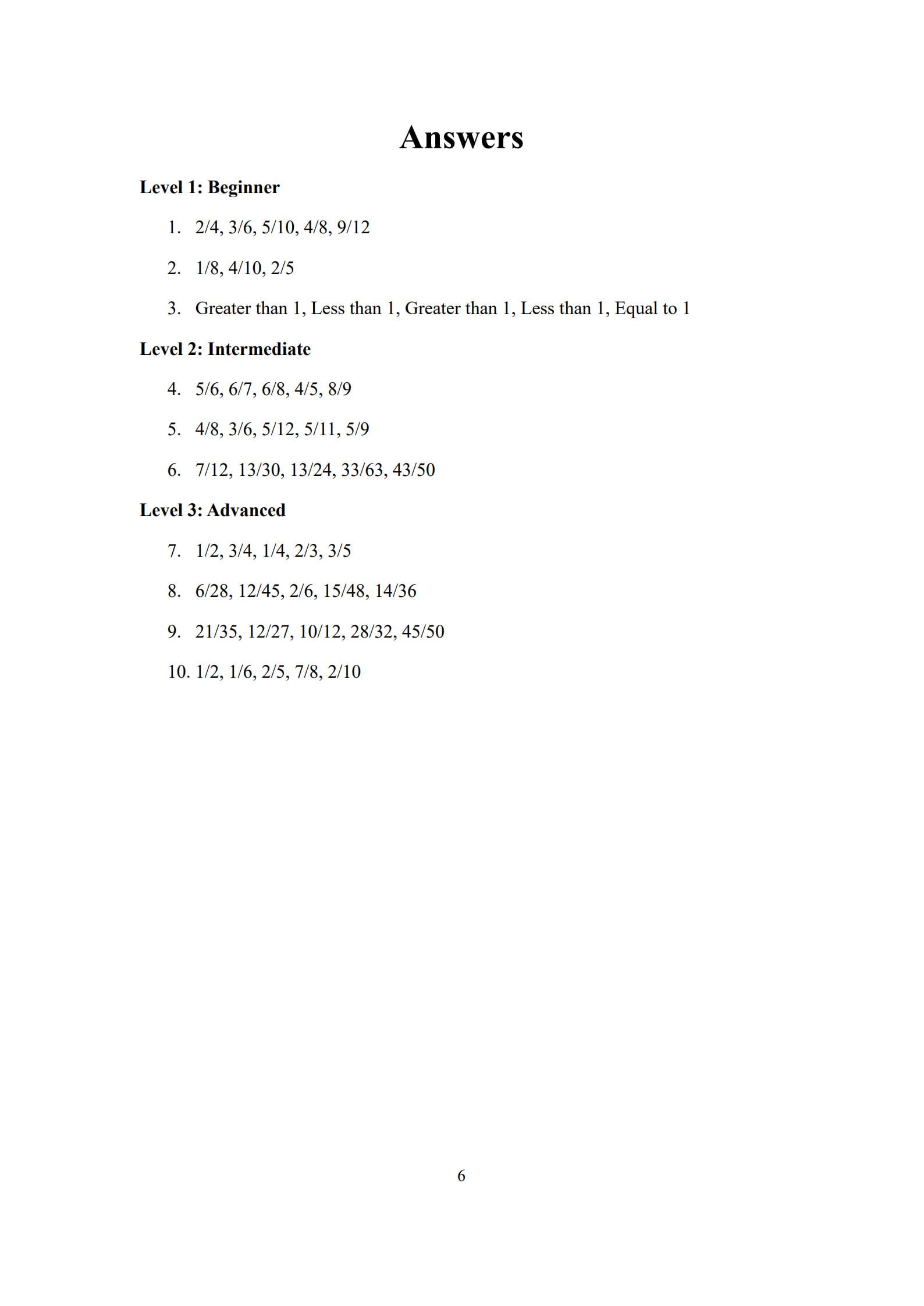
- Review Answers Together: The included answer key simplifies grading and self-assessment.
Conclusion
The Fractions Worksheet template in PDF Agile is more than a static PDF—it’s a dynamic tool for transforming fraction anxiety into mastery. By integrating foundational fraction practice, adding fractions worksheets, and advanced topics like multiplying fractions, it caters to diverse learning paces. The template’s logical progression—from identifying parts of a whole to solving word problems—ensures no learner is left behind.
Moreover, PDF Agile’s customization features empower educators and students to adapt the resource for individual needs. Whether used in classrooms, tutoring sessions, or self-study, the template fosters confidence through clarity and repetition. As learners engage with exercises like comparing fractions or simplifying results, they build skills that extend beyond math into logical reasoning and problem-solving.
Embrace this opportunity to make fractions accessible and enjoyable. With PDF Agile, every exercise becomes a step toward mathematical fluency—and every learner discovers the power of breaking down complexities into manageable parts.