

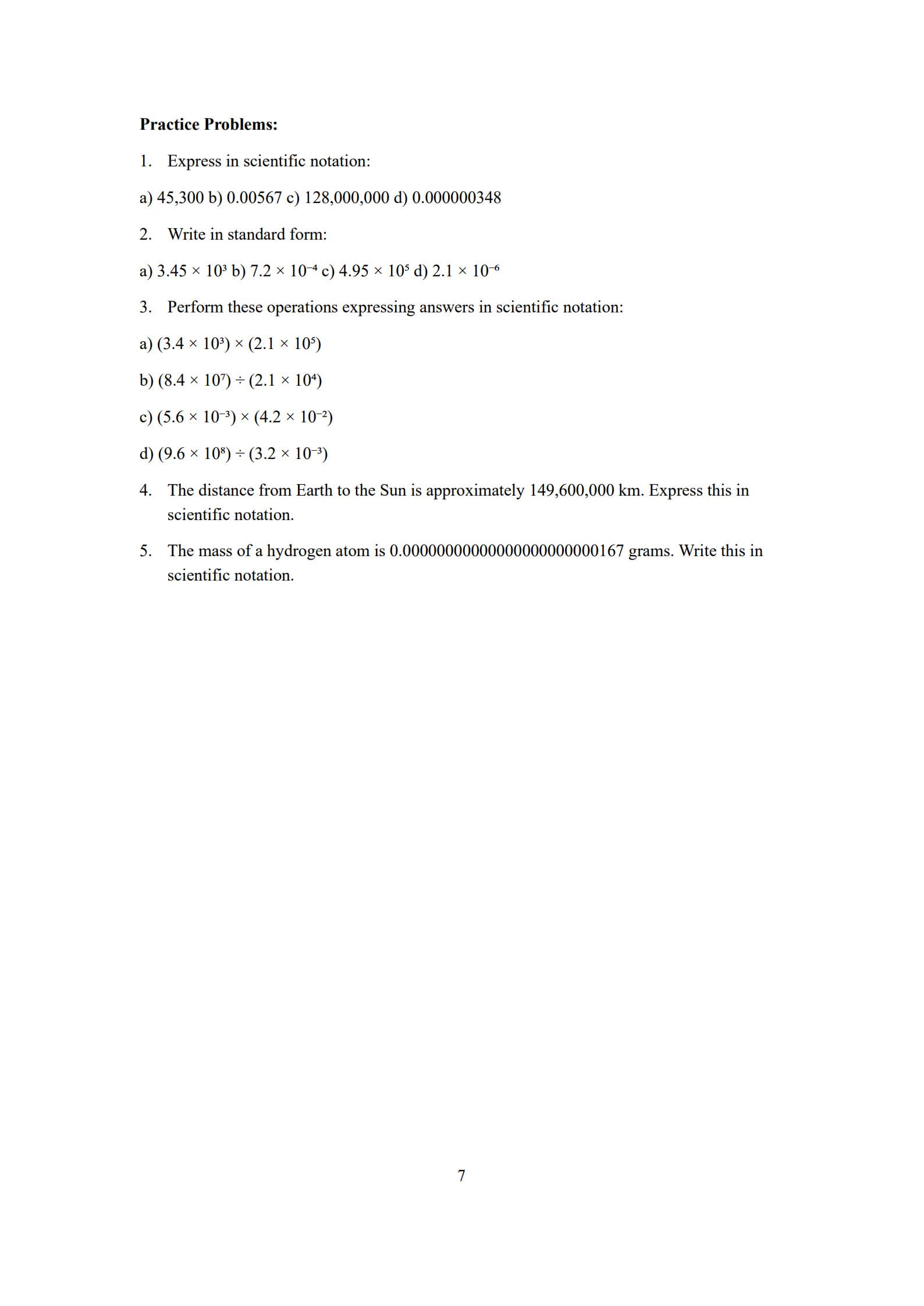
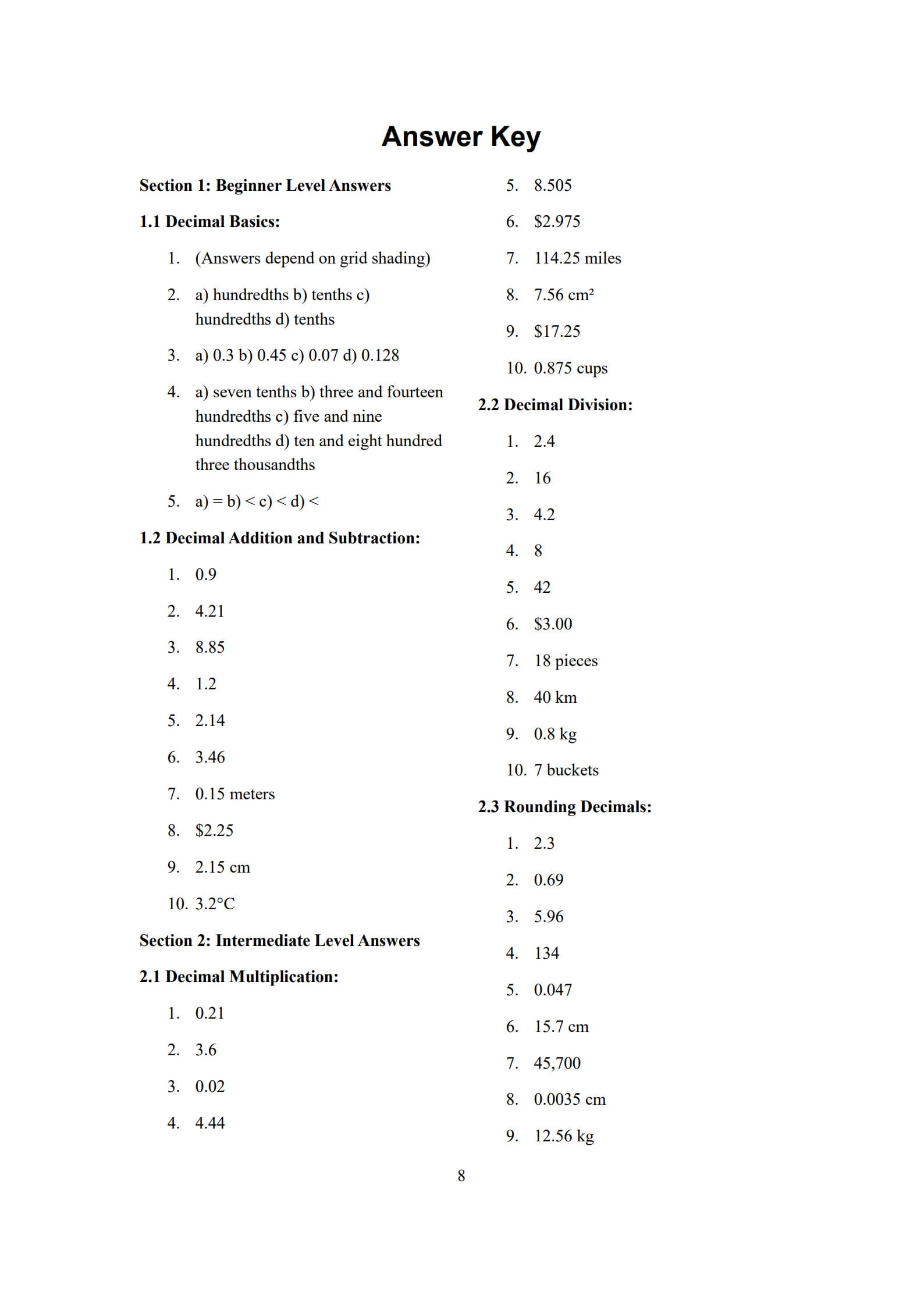
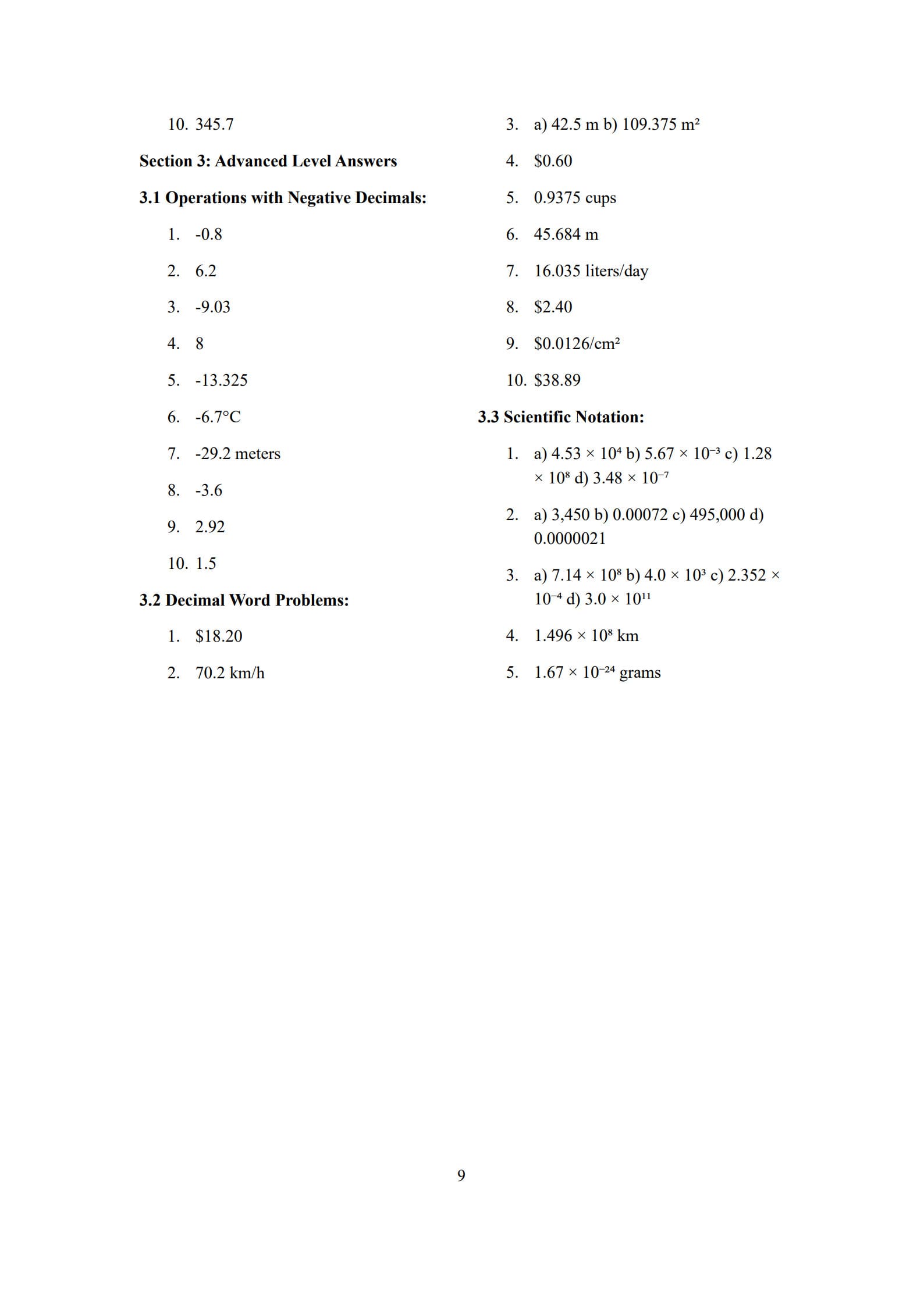
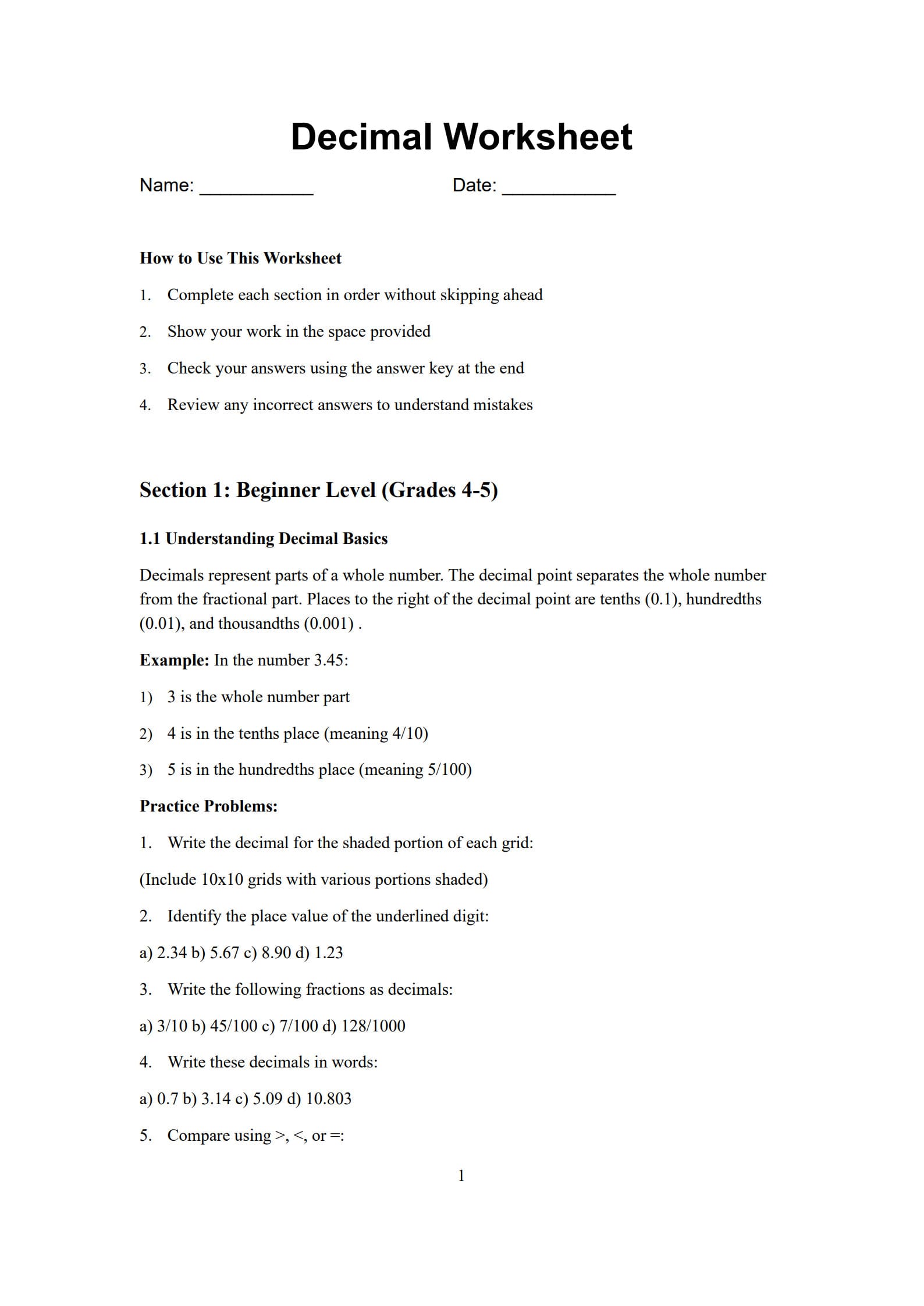
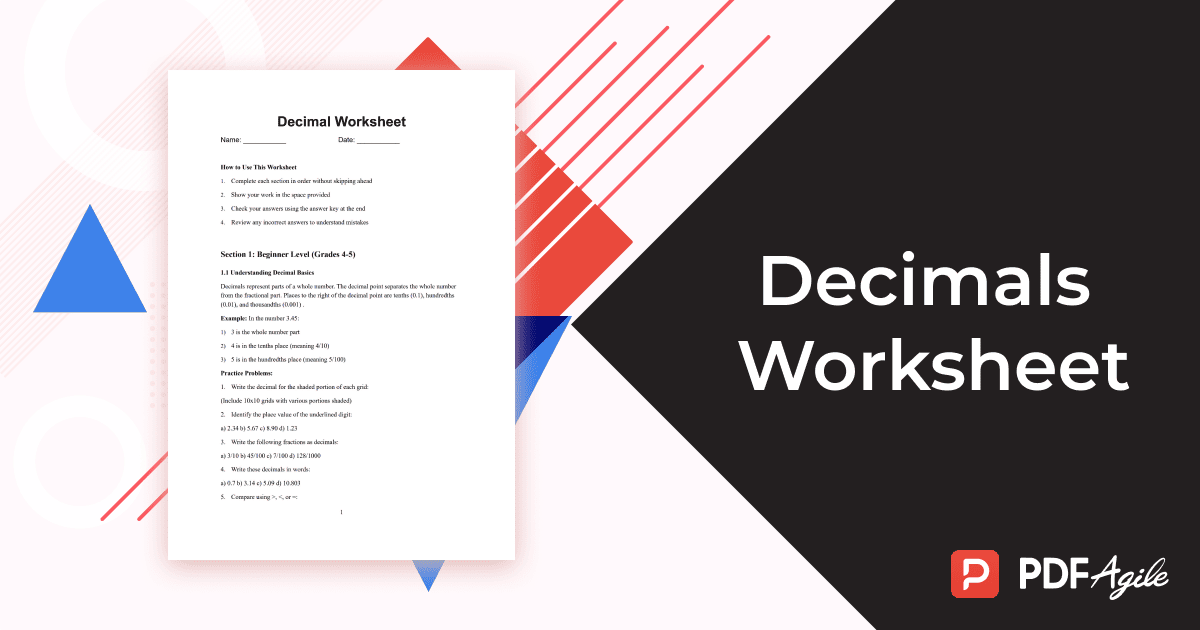
Are you looking for a structured, progressive way to master decimal operations? Whether you’re a student building foundational skills or an educator seeking comprehensive teaching materials, our Decimals Worksheet Template in PDF Agile offers a complete solution. This carefully designed template covers everything from basic decimal recognition to advanced scientific notation, following a logical learning progression across three difficulty levels. The template incorporates real-world applications, immediate practice opportunities, and self-assessment tools—all formatted for seamless use within PDF Agile’s intuitive interface.
How Can Adding Decimals Worksheets Build Mathematical Confidence?
What separates competent mathematicians from those who struggle? Often, it’s the foundational confidence built through systematic practice with resources like our adding decimals worksheet section. The template begins with visual learning—using shaded grids to help learners conceptualize decimals as parts of a whole. This approach bridges the gap between abstract concepts and tangible understanding, making decimal addition feel intuitive rather than intimidating.
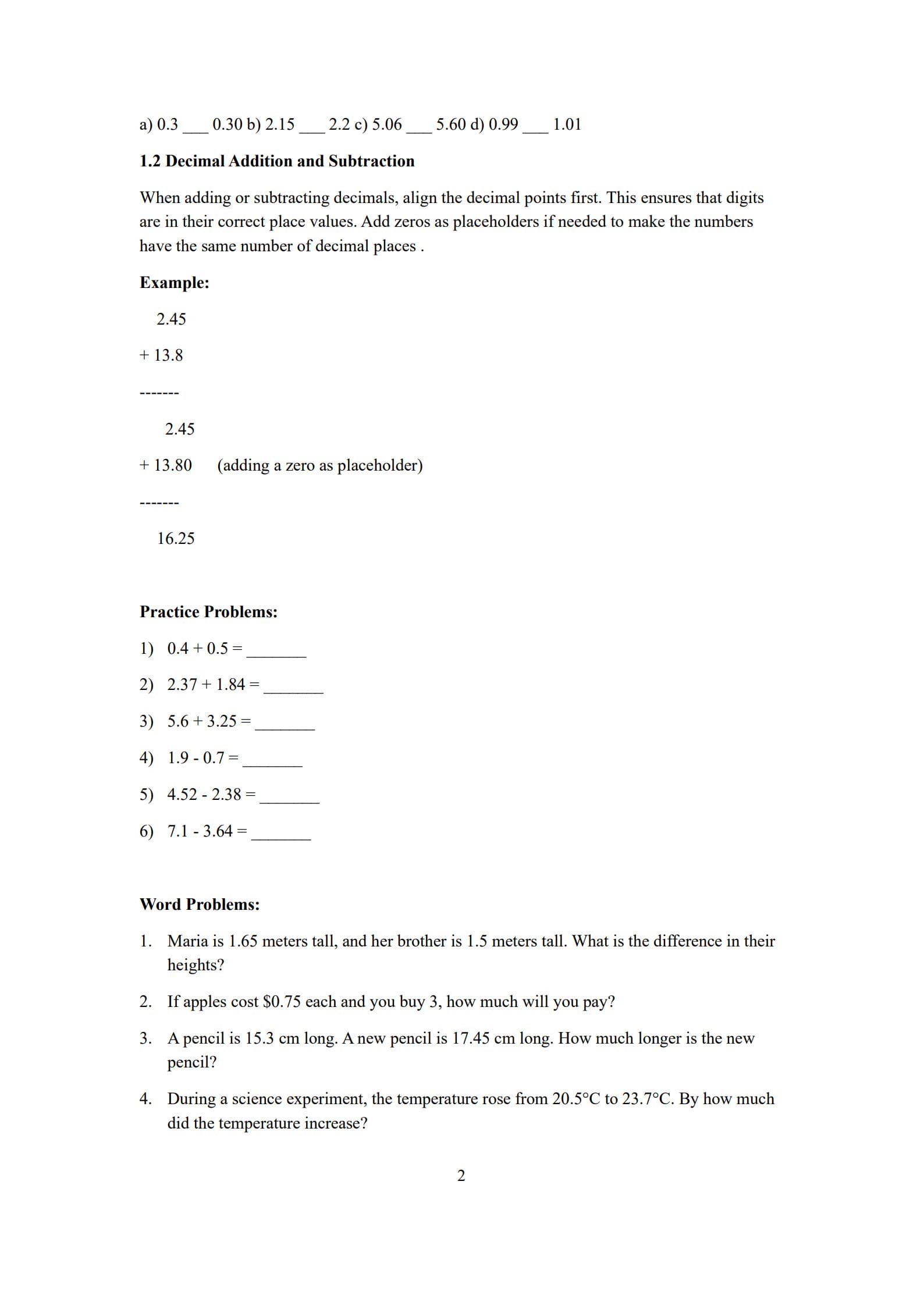
The template’s decimal addition problems follow a carefully scaffolded approach. Students first practice simple problems like 0.4 + 0.5 before progressing to multi-digit additions such as 2.37 + 1.84. Each problem includes workspace for calculations, encouraging learners to apply the crucial skill of decimal point alignment. The word problems integrate real-life contexts—comparing heights, calculating shopping costs, measuring temperature changes—that demonstrate why decimal operations matter beyond the classroom.
For educators, the included fractions worksheet to decimals worksheet section provides essential conversion practice that reinforces the relationship between different numerical representations. Problems like converting 3/10 to 0.3 or 128/1000 to 0.128 build numerical fluency that supports all future decimal operations. The immediate availability of answer keys allows for self-correction and learning from mistakes, turning potential frustrations into valuable learning moments.
What Makes Multiplying and Dividing Decimals Worksheets Effective Learning Tools?
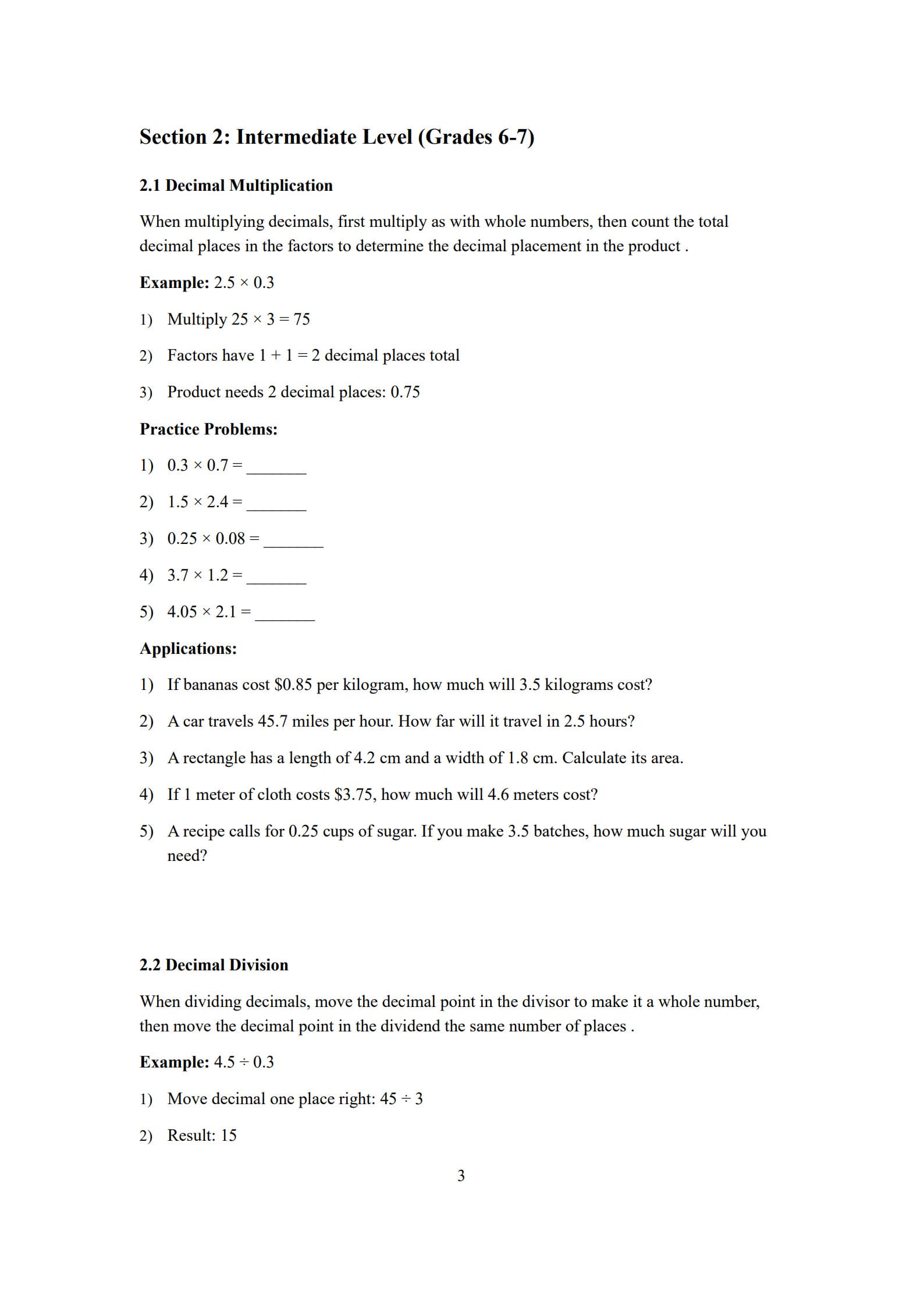
Why do many students find decimal multiplication and division particularly challenging? Often, it’s the placement of the decimal point that causes confusion. Our multiplying worksheets tackle this directly through clear examples demonstrating the “count the decimal places” method. The template breaks down problems like 2.5 × 0.3 into manageable steps: first multiply as whole numbers (25 × 3 = 75), then count total decimal places in the factors (1+1=2), and finally position the decimal point accordingly (0.75).
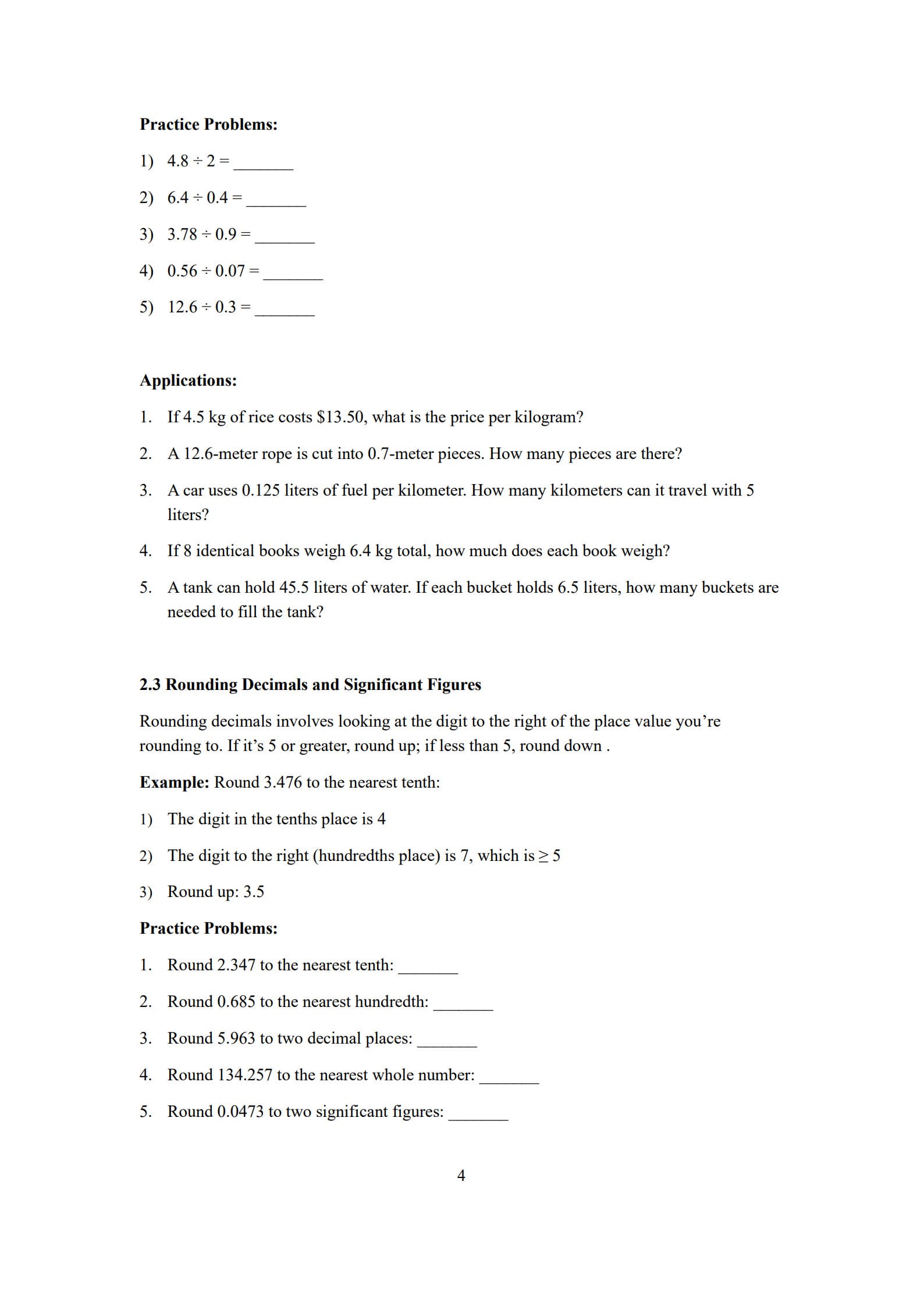
The dividing decimals worksheet section employs the equally important “decimal movement” strategy. Problems like 4.5 ÷ 0.3 become more accessible when students learn to transform them into 45 ÷ 3 by moving the decimal point. The template provides ample practice with divisors of varying decimal places, ensuring students become comfortable with this essential technique. Real-world applications—calculating unit prices, determining fuel efficiency, dividing quantities equally—show the practical necessity of these skills.
The progression from simple to complex problems allows learners to build confidence gradually. Starting with straightforward calculations like 0.3 × 0.7 and progressing to multi-digit problems such as 4.05 × 2.1 ensures that each step feels achievable. The template’s logical sequencing means that students master basic multiplication before encountering division, creating a natural learning pathway that reduces anxiety and promotes success.
From Estimation to Precision: How Rounding Decimals Worksheets Enhance Mathematical Thinking
Rounding decimals represents a critical junction where numerical fluency meets practical application. Our rounding decimals worksheet section teaches students when estimation is appropriate and how to perform it accurately. The template provides clear rules: identify the target place value, examine the digit to the right, and round up if it’s 5 or greater. This systematic approach eliminates guesswork and builds consistent reasoning skills.
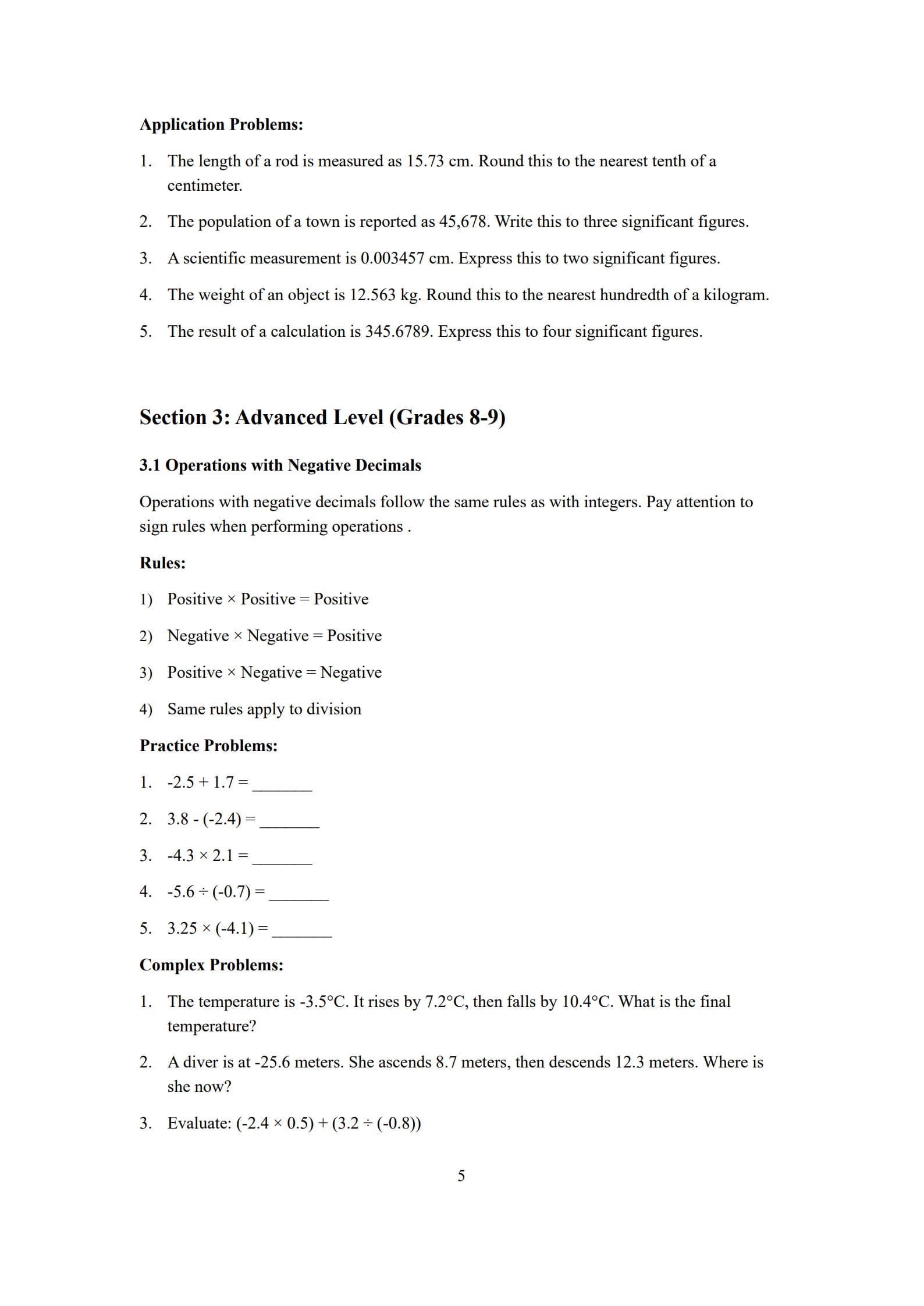
The template includes varied practice scenarios that demonstrate rounding’s real-world relevance. From measuring instruments that require practical precision (rounding 15.73 cm to 15.7 cm) to population reporting with significant figures (45,678 to 45,700), students learn that rounding isn’t about approximation but about appropriate precision. This understanding bridges classroom mathematics with everyday numerical decision-making.
Table: Rounding Decimals Practice Framework
| Original Value | Round To | Result | Practical Application |
|---|---|---|---|
| 2.347 | Nearest tenth | 2.3 | Measurement precision |
| 0.685 | Nearest hundredth | 0.69 | Financial calculations |
| 134.257 | Whole number | 134 | Quantity estimation |
| 0.0473 | Two significant figures | 0.047 | Scientific measurement |
The significant figures component introduces advanced learners to scientific conventions that will serve them in higher-level mathematics and science courses. By practicing with values like 0.003457 cm (rounded to 0.0035 cm), students gain familiarity with the precision standards used in technical fields. This forward-thinking approach ensures the template remains relevant throughout a student’s academic journey.
Advanced Decimal Operations: Building Toward Mathematical Mastery
The template’s advanced section challenges learners with negative decimals and multi-step word problems that simulate real mathematical thinking. Operations with negative decimals apply integer rules to decimal contexts, helping students recognize that mathematical principles transcend specific number types. Problems like -2.5 + 1.7 and -4.3 × 2.1 reinforce the consistent application of sign rules while building decimal fluency.
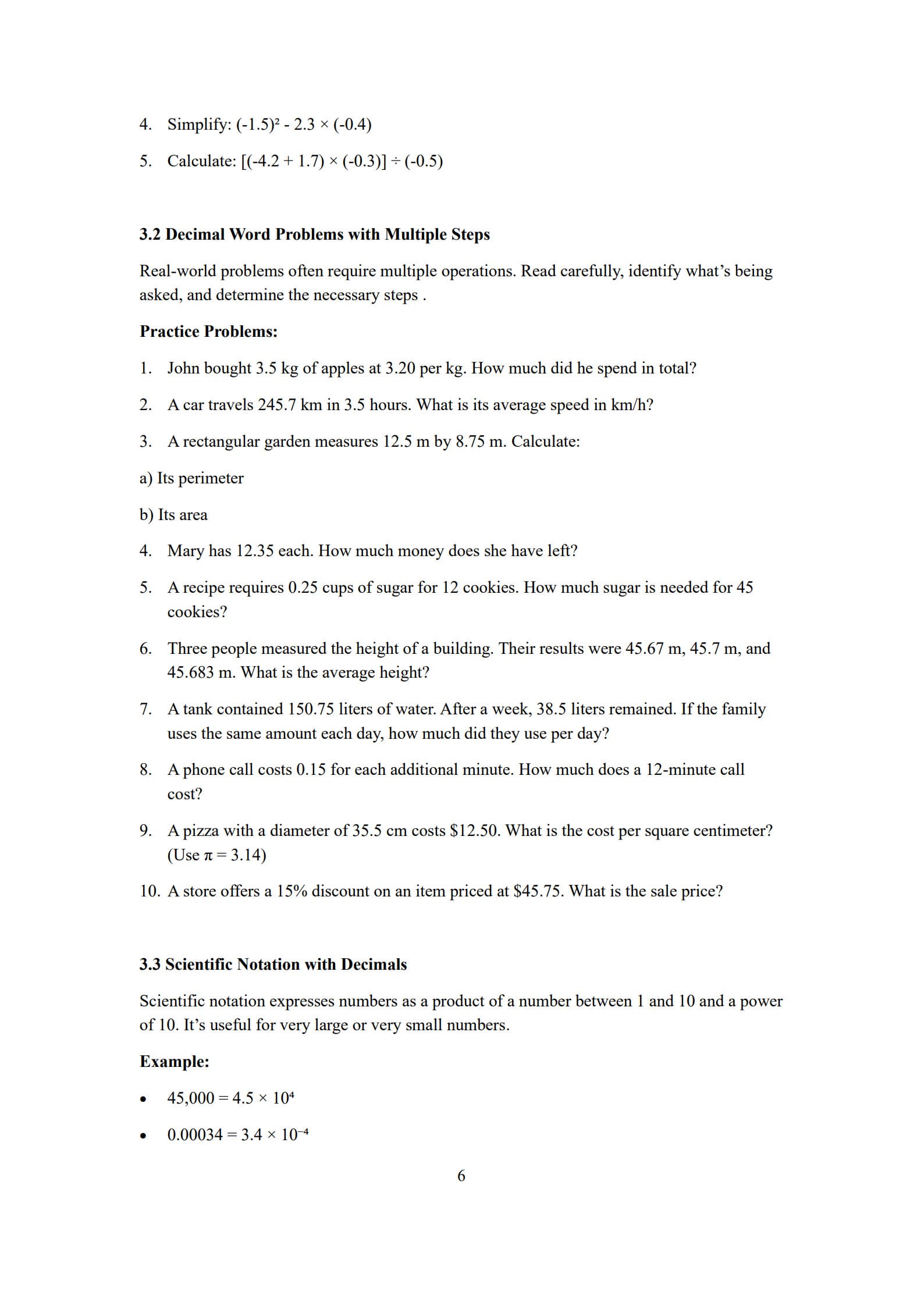
Multi-step problems represent the template’s capstone experience, requiring students to synthesize multiple skills. A single problem might involve decimal multiplication, unit conversion, and financial calculation—mirroring the integrated thinking needed for real-world problem solving. For example, calculating the cost per square centimeter of a pizza (with diameter 35.5 cm costing $12.50) requires geometric area calculation, division, and decimal rounding in a single cohesive process.
The scientific notation section elegantly connects decimals with exponential representation, demonstrating mathematics’ ability to efficiently express extreme values. Converting between standard form (149,600,000 km) and scientific notation (1.496 × 10⁸ km) builds flexibility in numerical representation while introducing conventions essential for STEM fields. This progression from basic decimals to scientific notation showcases the template’s comprehensive approach to numerical literacy.
How to Use This Template on PDF Agile: A Step-by-Step Guide
Step 1: Access the Decimals Worksheet Template
Open PDF Agile and navigate to the Education Templates section. Select “Decimals Worksheet” and click “Use Template”. The template comes pre-formatted with clear sections, examples, and answer keys—ready for immediate use. You can preview the entire document before downloading to ensure it meets your learning objectives.
Step 2: Customize for Specific Learning Needs
PDF Agile’s editing tools allow you to adapt the template for individual students or classroom use. Highlight key sections, add notes for specific learners, or modify problem values to create variation. The template’s structured layout maintains educational integrity while offering flexibility for differentiation. For group learning, you might focus on particular sections like the adding decimals worksheet or fractions to decimals worksheet components.
Step 3: Complete Exercises with Built-in Tools
Use PDF Agile’s annotation features to solve problems directly within the document. The drawing tools are perfect for showing work on multiplication problems or placing decimal points accurately. The highlighter function helps emphasize place values or key steps in multi-stage problems. These interactive elements transform passive reading into active learning.
Step 4: Check Answers and Review Progress
The integrated answer key enables immediate self-assessment. PDF Agile’s split-screen view allows students to compare their work with solutions side-by-side, identifying mistakes and learning from them in real-time. For educators, the template serves as both practice material and assessment tool, with clear benchmarks across difficulty levels.
Step 5: Save, Share, and Revisit
Save completed worksheets to track progress over time. Share specific sections with parents or tutors to demonstrate learning objectives. The template’s reusable design means it can be revisited for review purposes, with the option to create fresh copies for repeated practice. This digital approach eliminates paper waste while maintaining a permanent learning portfolio.
Conclusion
The Decimals Worksheet Template in PDF Agile represents more than just practice problems—it embodies a comprehensive approach to mathematical skill development. By integrating visual learning, real-world applications, and progressive challenge, the template addresses the complete learning journey from basic decimal recognition to advanced operations. The structured format reduces cognitive load, allowing students to focus on mathematical thinking rather than navigation.
Ultimately, mastering decimals opens doors to higher mathematics, scientific understanding, and everyday numerical literacy. Whether used in classroom instruction, homeschooling environments, or independent study, this template provides the foundation for decimal fluency that will serve learners across academic disciplines and throughout their lives. By making decimal concepts accessible, engaging, and relevant, PDF Agile’s Decimals Worksheet Template transforms mathematical anxiety into mathematical empowerment.