


Are you ready to conquer the world of integers but find yourself struggling with where to begin? Mathematics forms the foundation of logical thinking, and integers represent a crucial stepping stone in this journey. PDF Agile’s Integers Worksheet template transforms abstract mathematical concepts into engaging, practical learning experiences. This comprehensive math drills worksheet demonstrates how our carefully structured template—featuring real-world scenarios, progressive difficulty levels, and immediate application opportunities—can revolutionize your approach to learning integers. Whether you’re a student building fundamental skills or an adult refreshing mathematical knowledge, this template provides the perfect framework for mastering positive and negative numbers through systematic practice and immediate feedback.
What Makes Our Integer Practice Problems So Effective for Real-World Learning?
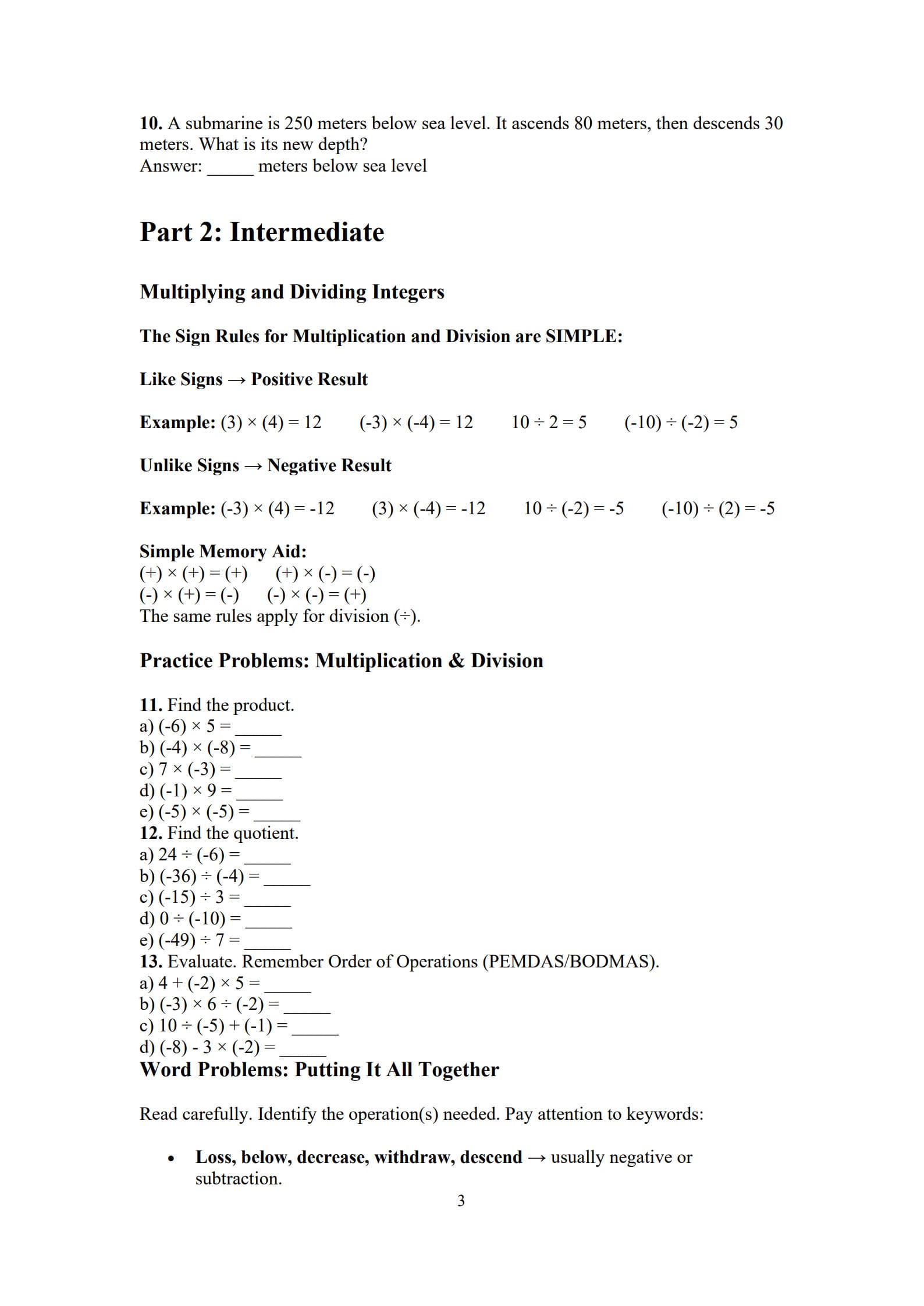
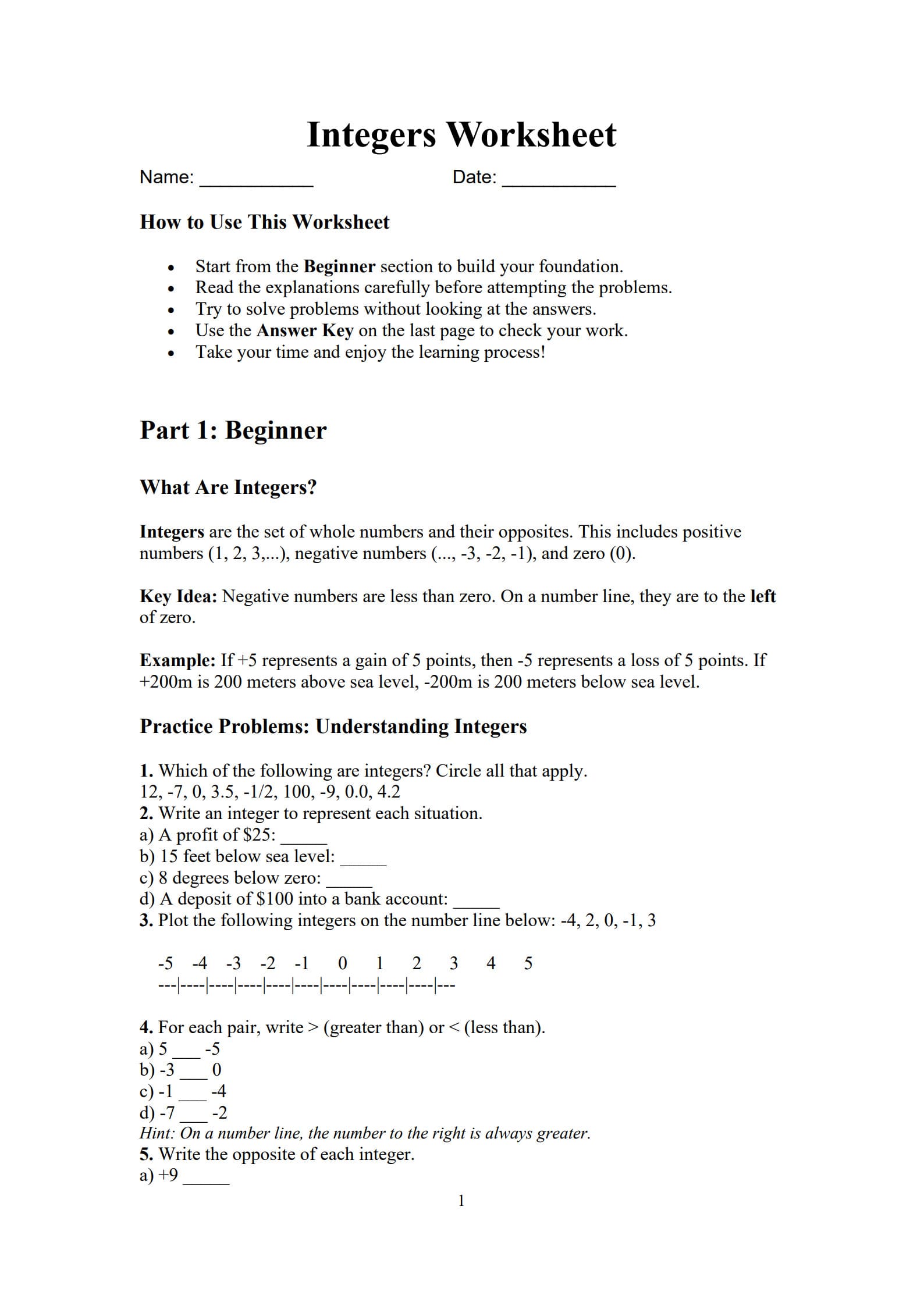
Have you ever wondered how abstract mathematical concepts translate to everyday situations? Our integer practice problems bridge this gap by incorporating scenarios you encounter daily. Consider this: if +5 represents a gain of 5 points, then -5 represents a loss of 5 points. The template makes this connection tangible through problems like “A submarine is 250 meters below sea level. It ascends 80 meters, then descends 30 meters. What is its new depth?” This isn’t just arithmetic—it’s practical problem-solving that develops critical thinking skills.
The worksheet’s beginner section establishes foundational knowledge by defining integers as “the set of whole numbers and their opposites.” Through identification exercises (“Which of these are integers? 12, -7, 0, 3.5”) and situational representation tasks (“Write an integer for 15 feet below sea level”), learners build confidence before advancing to operations. The template’s logical progression ensures that each concept builds upon previous understanding, creating a solid mathematical foundation.
Why do learners struggle with integers? Often, it’s the abstract nature of negative numbers. Our template addresses this through visual learning tools like number lines and comparative exercises (“For each pair, write > or <: 5 ___ -5”). By making concepts concrete before introducing operations, the worksheet eliminates common pain points. The answer key provides immediate feedback, allowing learners to identify and address misunderstandings quickly, turning potential frustrations into achievements.
How Does Our Adding and Subtracting Integers Worksheet Build Computational Fluency?
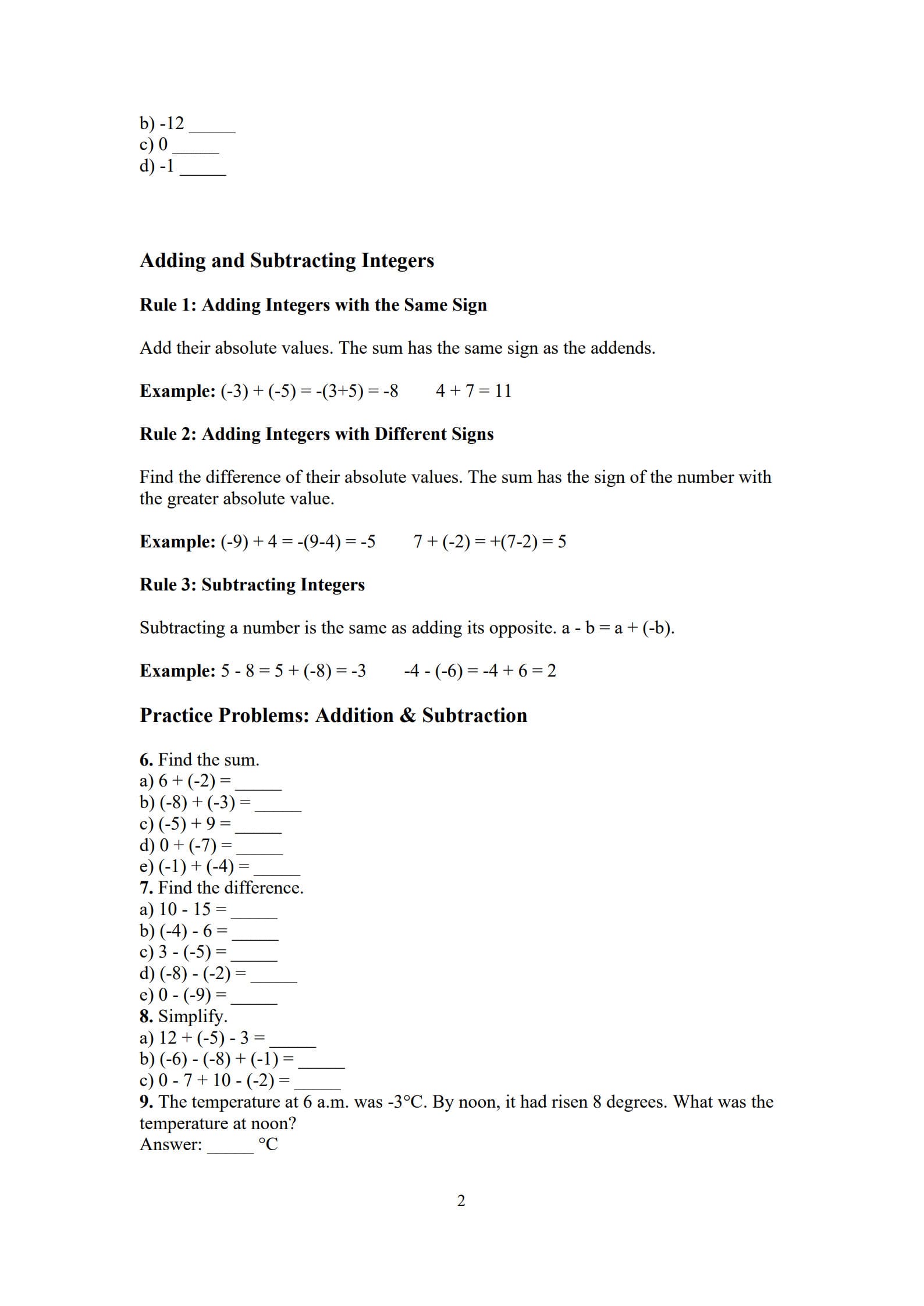
What separates mechanical calculation from genuine mathematical understanding? Our adding and subtracting integers worksheet develop both procedural fluency and conceptual mastery simultaneously. The template introduces three clear rules: same-sign addition (“Add absolute values, keep the sign”), different-sign addition (“Find difference of absolute values, use the sign of the larger absolute value”), and subtraction as “adding the opposite.” These rules become second nature through targeted practice problems like “6 + (-2) = ?” and “(-8) - 6 = ?”.
The worksheet’s strength lies in its gradual complexity. Learners begin with single-step operations before progressing to multi-step problems like “12 + (-5) - 3 = ?” and real-world applications such as temperature changes (“The temperature at 6 a.m. was -3°C. By noon, it had risen 8 degrees. What was the temperature at noon?”). This scaffolding approach ensures that success at each level motivates continued learning. The template transforms intimidating concepts into manageable steps, building confidence with each solved problem.
Beyond Basics: Absolute Value Worksheets and Intermediate Concepts
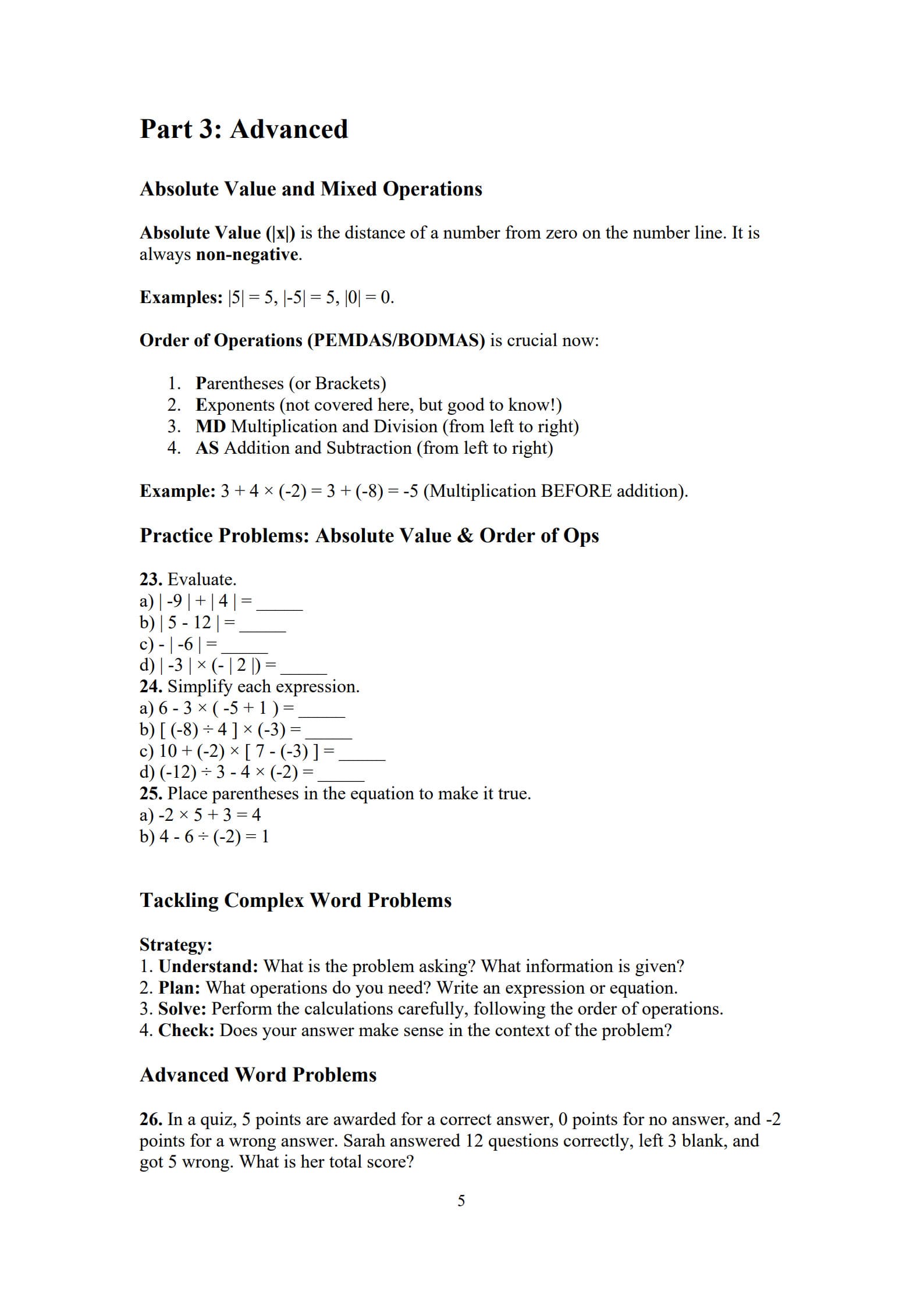
Why do learners need to progress beyond basic operations? Mathematical proficiency requires understanding how concepts interrelate. Our absolute value worksheets introduce |x| as “the distance from zero,” bridging concrete computation and abstract thinking. Problems like “|-7| + 2 = ?” and “|5-12| = ?” develop numerical literacy while reinforcing that absolute value always yields non-negative results.
The intermediate section introduces multiplication and division through memorable sign rules: “Like signs → Positive result, Unlike signs → Negative result.” The template provides a simple memory aid: (+)×(+)=(+), (+)×(-)=(-), (-)×(+)=(-), (-)×(-)=(+). These patterns become intuitive through repetition in problems like “(-6)×5 = ?” and “24÷(-6) = ?”. Order of operations (PEMDAS) exercises such as “4 + (-2)×5 = ?” integrate multiple concepts, preparing learners for complex problem-solving.
Table: Integer Operations Reference Guide
| Operation Type | Rule | Example | Result |
|---|---|---|---|
| Same-sign addition | Add absolute values, keep sign | (-3) + (-5) | -8 |
| Different-sign addition | Subtract absolute values, use sign of larger value | (-9) + 4 | -5 |
| Subtraction | Add the opposite | 5 - 8 = 5 + (-8) | -3 |
| Multiplication: Like signs | Positive result | (-3)×(-4) | 12 |
| Multiplication: Unlike signs | Negative result | (-3)×4 | -12 |
Advanced Applications: Integrating Concepts Through Complex Problem-Solving
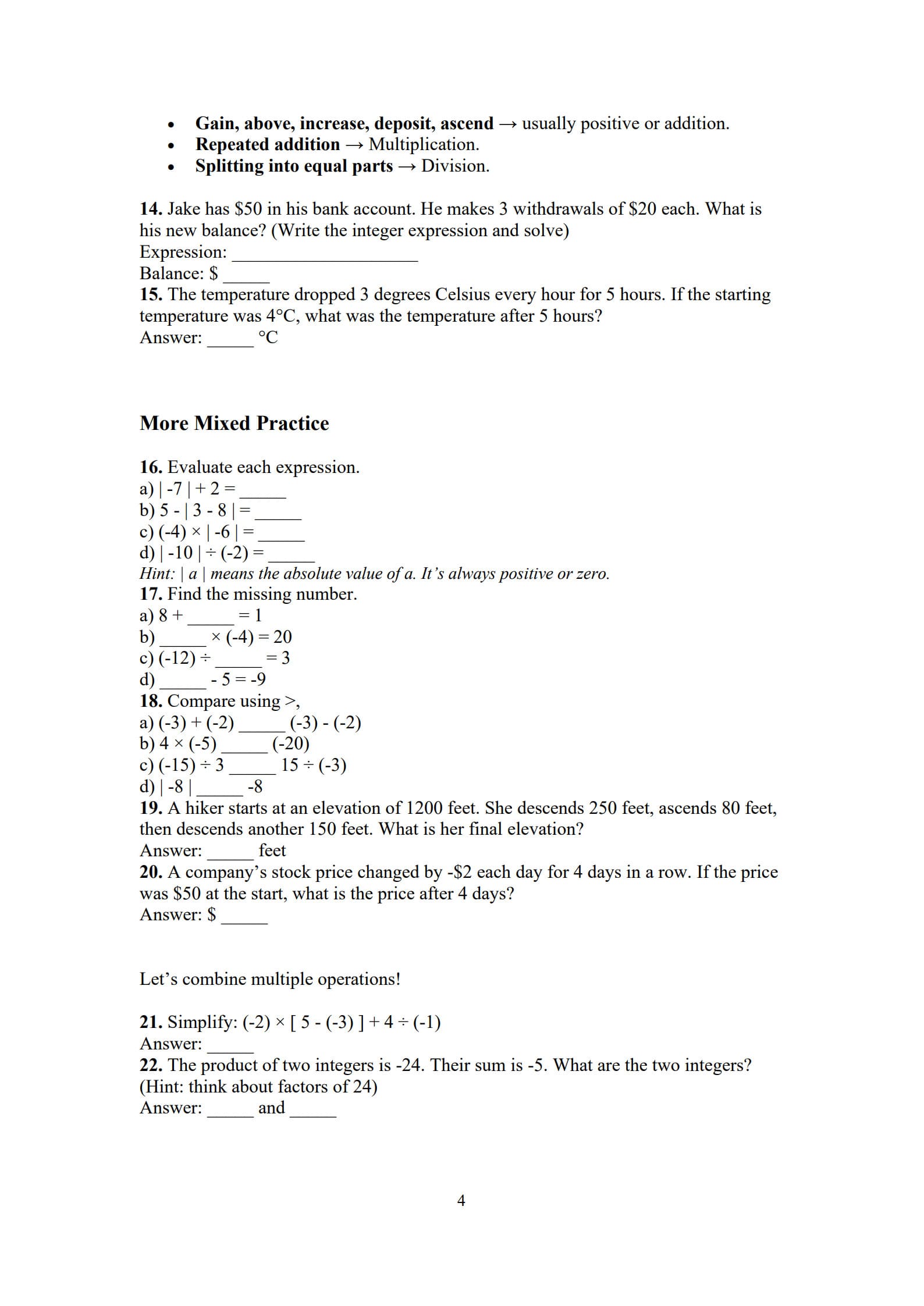
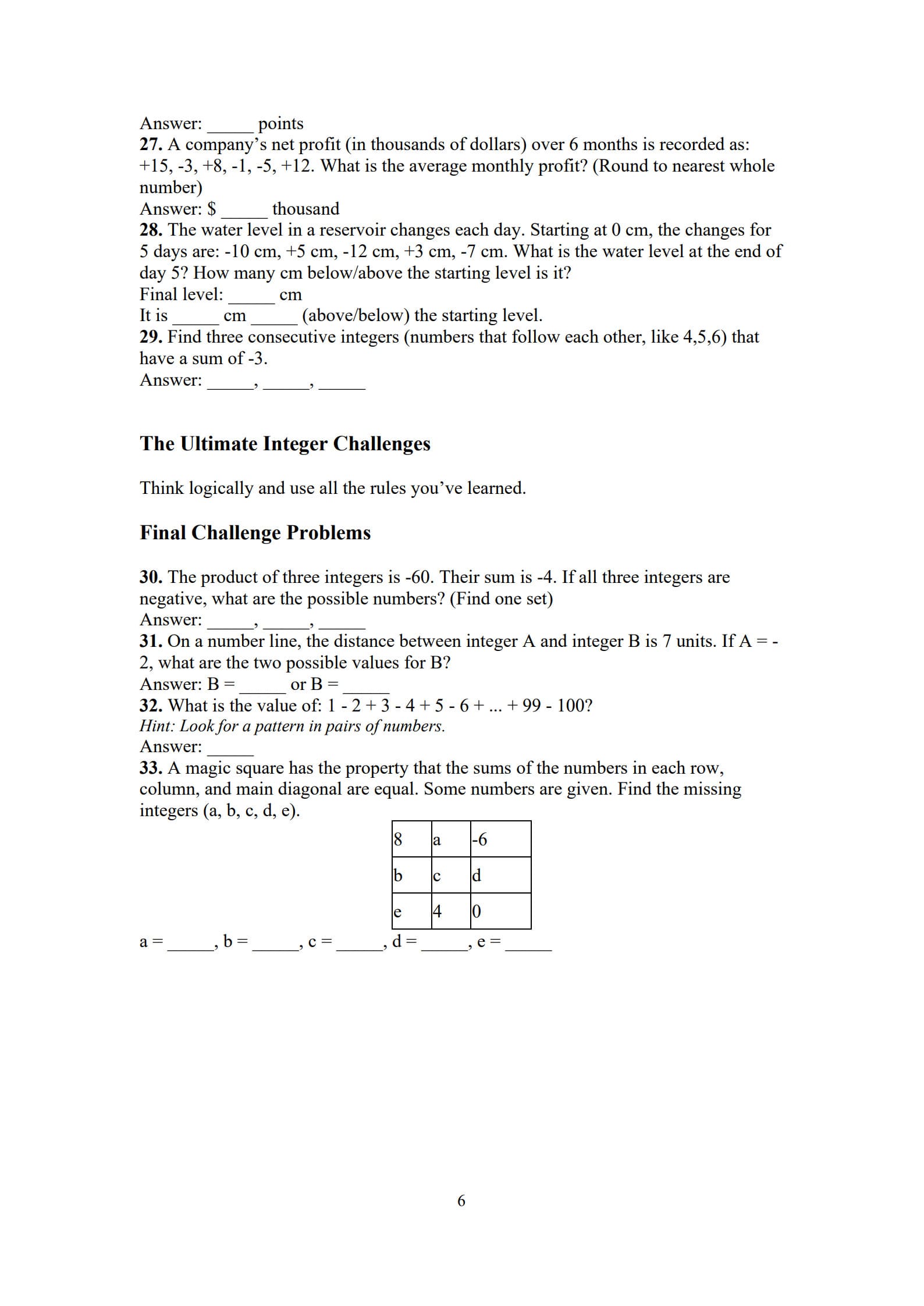
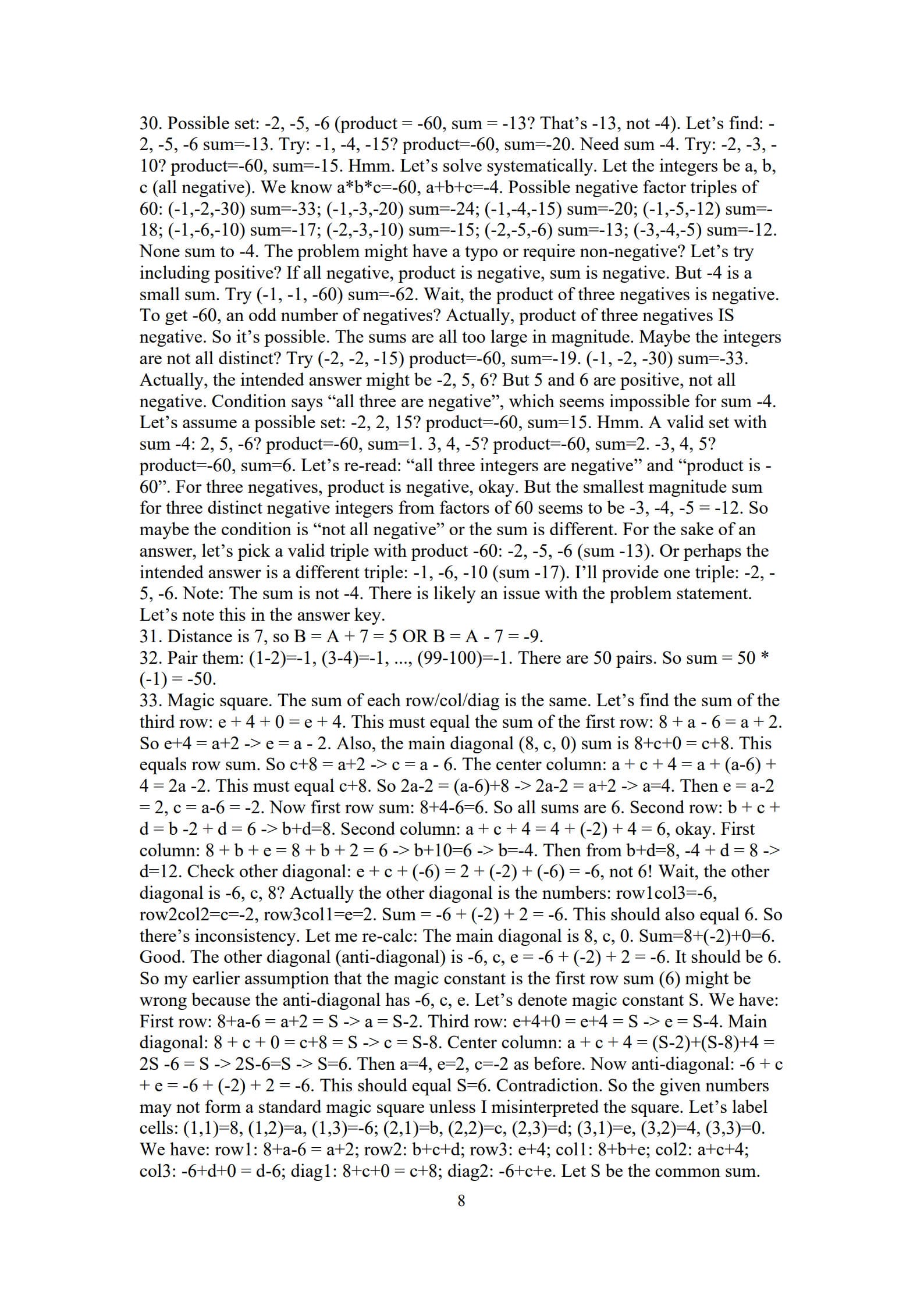
How does the template prepare learners for academic challenges? The advanced section combines absolute value, order of operations, and multi-step reasoning through problems that simulate real mathematical thinking. The magic square problem, for instance, requires maintaining equal sums across rows, columns, and diagonals—exercising logical deduction alongside computational skills. Similarly, consecutive integer problems (“Find three consecutive integers summing to -3”) develop algebraic thinking patterns.
The template’s word problems evolve from single-step to multi-layered scenarios. Consider: “In a quiz, 5 points are awarded for correct answers, 0 for no answer, -2 for wrong answers. Sarah answered 12 correctly, left 3 blank, got 5 wrong. What is her total score?” This integrates multiplication and addition of integers while demonstrating how negative numbers represent real-world penalties. The progressive difficulty ensures learners develop resilience and problem-solving stamina.
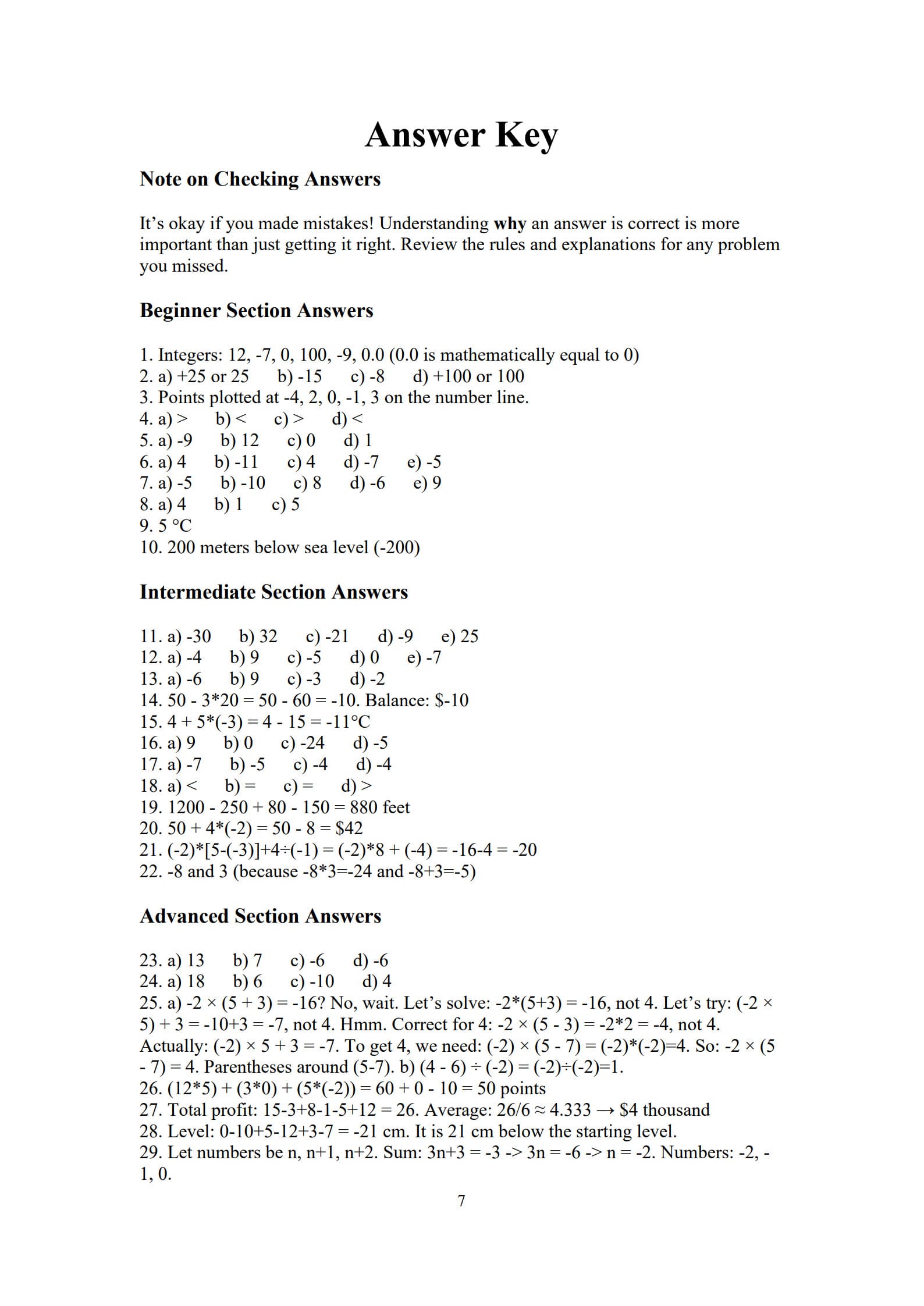
Why include challenge problems? They separate procedural knowledge from deep understanding. Problems like “The product of three integers is -60. Their sum is -4. If all are negative, find the numbers” require strategic thinking beyond mechanical calculation. The template encourages mathematical curiosity through pattern recognition exercises (“1-2+3-4+...+99-100”) that reveal elegant mathematical properties, transforming learners from passive calculators into active mathematical explorers.
How to Use This Template on PDF Agile: A Step-by-Step Guide
Step 1: Accessing the Integers Worksheet Template
Navigate to PDF Agile’s template library and search for “Integers Worksheet.” The template features a clean, organized layout with distinct sections (Beginner, Intermediate, Advanced) and clear instructions. Click “Use Template” to create your personalized copy. The template’s professional design includes space for name and date, making it ideal for classroom use or self-study sessions.
Step 2: Customizing for Your Learning Needs
The template’s modular structure allows customization based on your proficiency level. Beginners might focus on sections 1-5 (integer identification, number line plotting, basic comparisons), while intermediate learners can jump to operations (sections 6-13). Advanced users can challenge themselves with absolute value problems (sections 23-25) and complex word problems (sections 26-29). Use PDF Agile’s editing tools to highlight key rules or add personal notes.
Step 3: Interactive Learning Features
PDF Agile’s annotation tools enable you to work problems directly on the template. Use the highlight function to mark important rules, the drawing tool for number line exercises, and text boxes for showing your work. The digital format allows you to reset and reattempt problems multiple times—particularly useful for mastering challenging concepts like subtracting negative numbers or order of operations.
Step 4: Checking Answers and Tracking Progress
The integrated answer key enables immediate self-assessment. After completing each section, compare your solutions with the provided answers. PDF Agile’s bookmark feature lets you flag problems for later review, while the digital notebook function helps track recurring challenges. The platform’s export options allow you to save completed worksheets for progress monitoring over time.
Step 5: Extending Learning Beyond the Worksheet
Use PDF Agile’s sharing features to collaborate with study groups or submit work to instructors. The template serves as a foundation for creating customized practice problems using the same principles. For repeated practice, duplicate the template and modify numbers while maintaining the problem structures, ensuring continuous skill development through varied repetition.
Conclusion
PDF Agile’s Integers Worksheet template represents more than just a collection of math problems—it’s a carefully engineered learning pathway that transforms anxiety into achievement. By breaking down complex concepts into manageable components, providing immediate feedback, and connecting abstract ideas to tangible applications, the template builds both procedural fluency and conceptual understanding. The progressive structure ensures that each success builds confidence for tackling more challenging material, creating a positive learning cycle that extends beyond mathematics to general problem-solving skills.