

Welcome to the world of interactive learning where mathematics meets innovation! Our Number Pattern Worksheet template, now available on PDF Agile, transforms traditional pattern recognition exercises into an engaging digital experience. This carefully designed template offers three progressive difficulty levels—beginner, intermediate, and advanced—that guide learners through fundamental mathematical concepts while developing critical thinking skills. Whether you’re an educator seeking dynamic classroom materials or a parent looking to enhance your child’s numerical fluency, this math drills template provides structured yet flexible learning opportunities.
What Makes Pattern Recognition Essential for Early Mathematical Development?
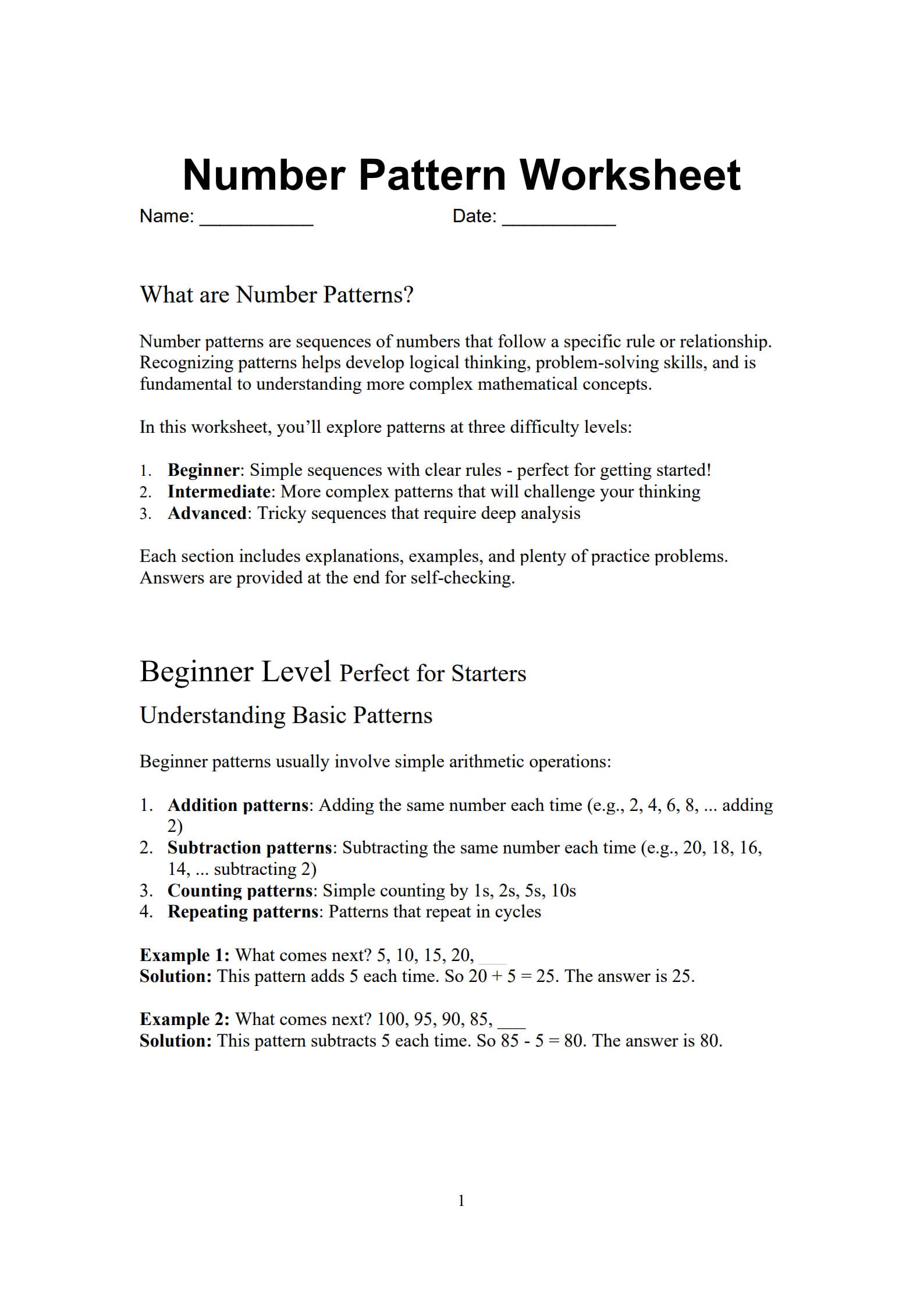
Patterns worksheets for kindergarten and early elementary students form the cornerstone of mathematical thinking. But why are number patterns so crucial in foundational education? The Number Pattern Worksheet template in PDF Agile addresses this fundamental question through carefully structured exercises that build logical reasoning from the ground up.
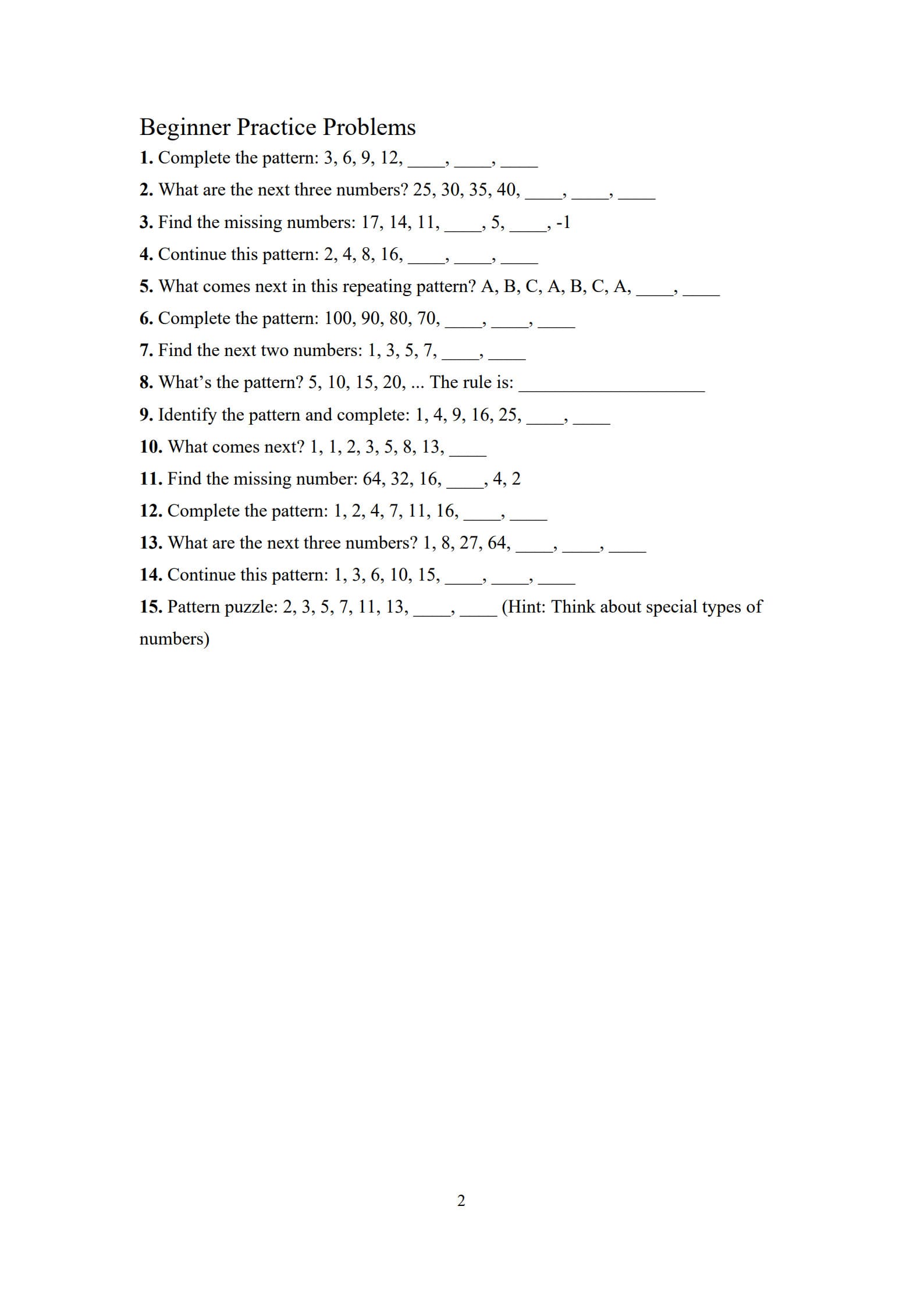
Consider the beginner-level sequences like “3, 6, 9, 12” or “100, 95, 90, 85”—these simple addition and subtraction patterns teach children to identify relationships between numbers. The template progresses systematically from basic arithmetic operations to more complex relationships, mirroring how mathematical understanding develops in young minds. Each section includes clear explanations, such as the demonstration that “5, 10, 15, 20” adds 5 each time, making abstract concepts concrete and accessible.
The template’s design recognizes that pattern identification isn’t just about mathematics—it’s about training the brain to recognize order in chaos. When children complete sequences like “17, 14, 11, __, 5” or identify repeating patterns like “A, B, C, A, B, C, A,” they’re developing cognitive skills that transfer to problem-solving across disciplines. PDF Agile enhances this learning process by making the worksheets interactive and easily customizable for different learning paces.
How Can Intermediate Patterns Challenge Growing Mathematical Minds?
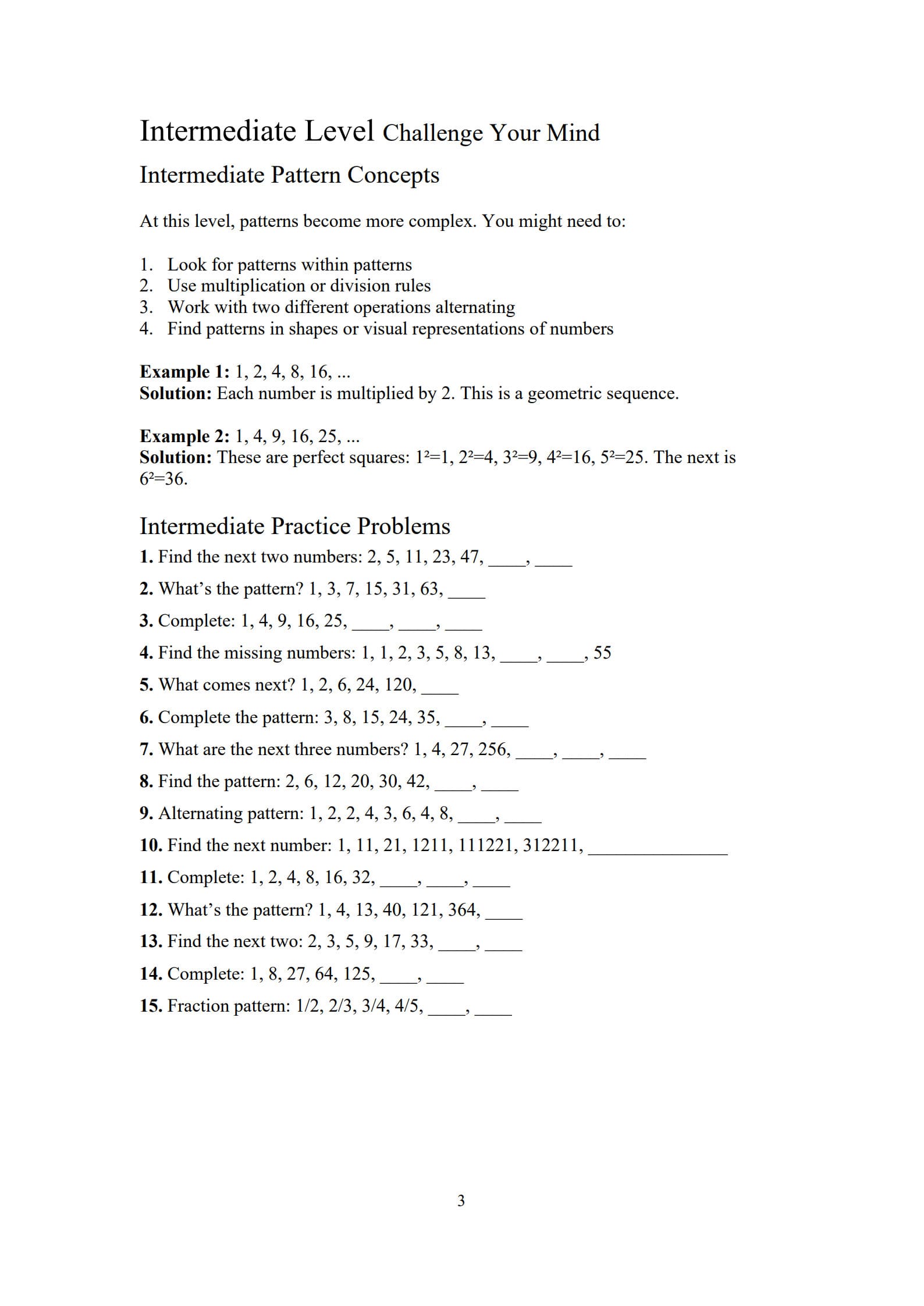
The intermediate section of our template introduces sophisticated patterns that require deeper analytical thinking. What strategies help learners decode sequences like “2, 5, 11, 23, 47” or “1, 3, 7, 15, 31, 63”? These problems encourage students to look beyond simple arithmetic and consider geometric sequences, recursive patterns, and special number properties.
The worksheet provides excellent examples of how patterns evolve in complexity. For instance, the sequence “1, 4, 9, 16, 25” introduces perfect squares (1², 2², 3²), while “1, 1, 2, 3, 5, 8, 13” demonstrates the famous Fibonacci sequence where each term sums the two preceding numbers. These patterns aren’t just mathematical exercises—they’re gateways to recognizing mathematical structures in nature, art, and science. The inclusion of the look-and-say sequence (“1, 11, 21, 1211”) further expands pattern recognition beyond conventional numerical relationships.
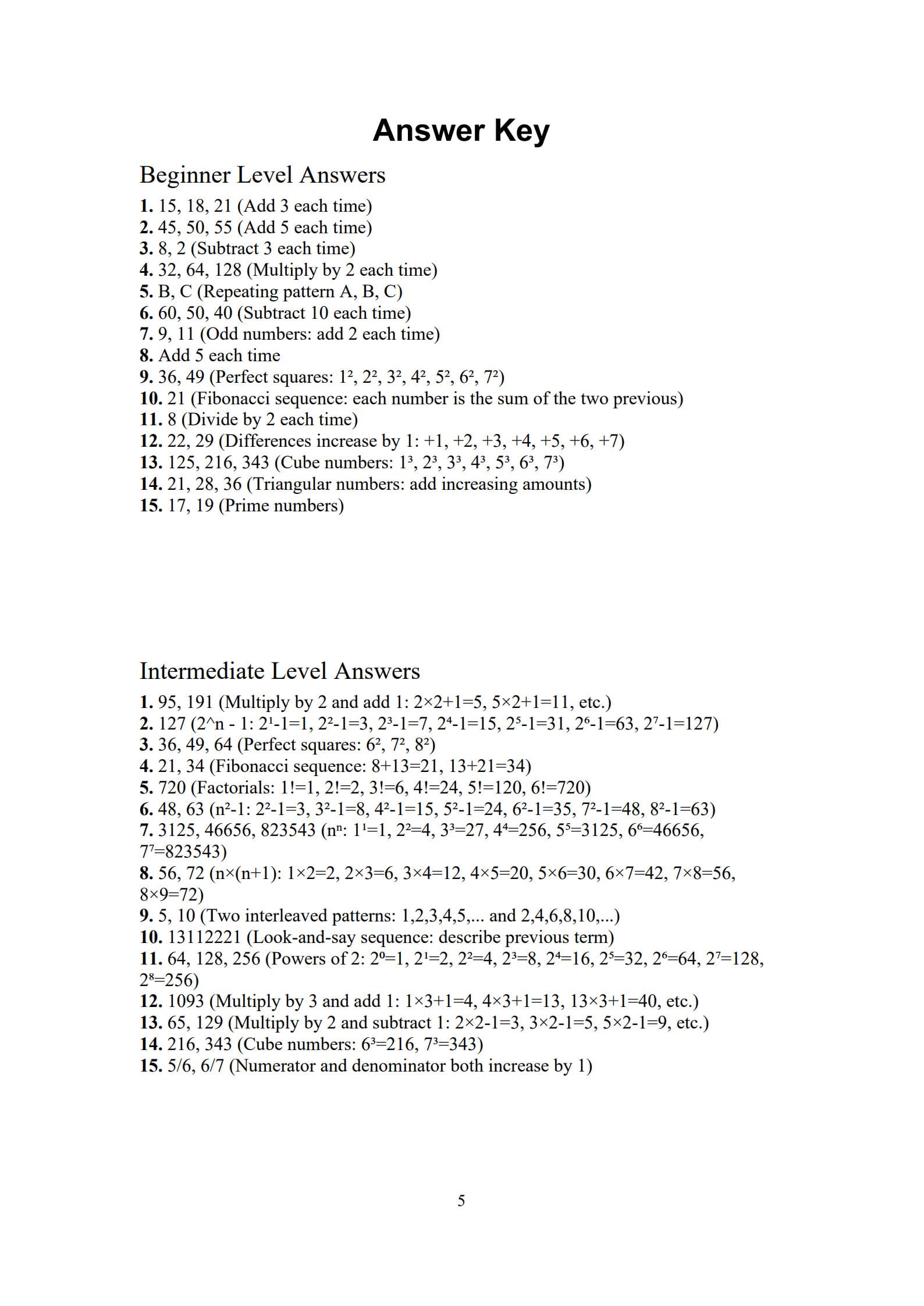
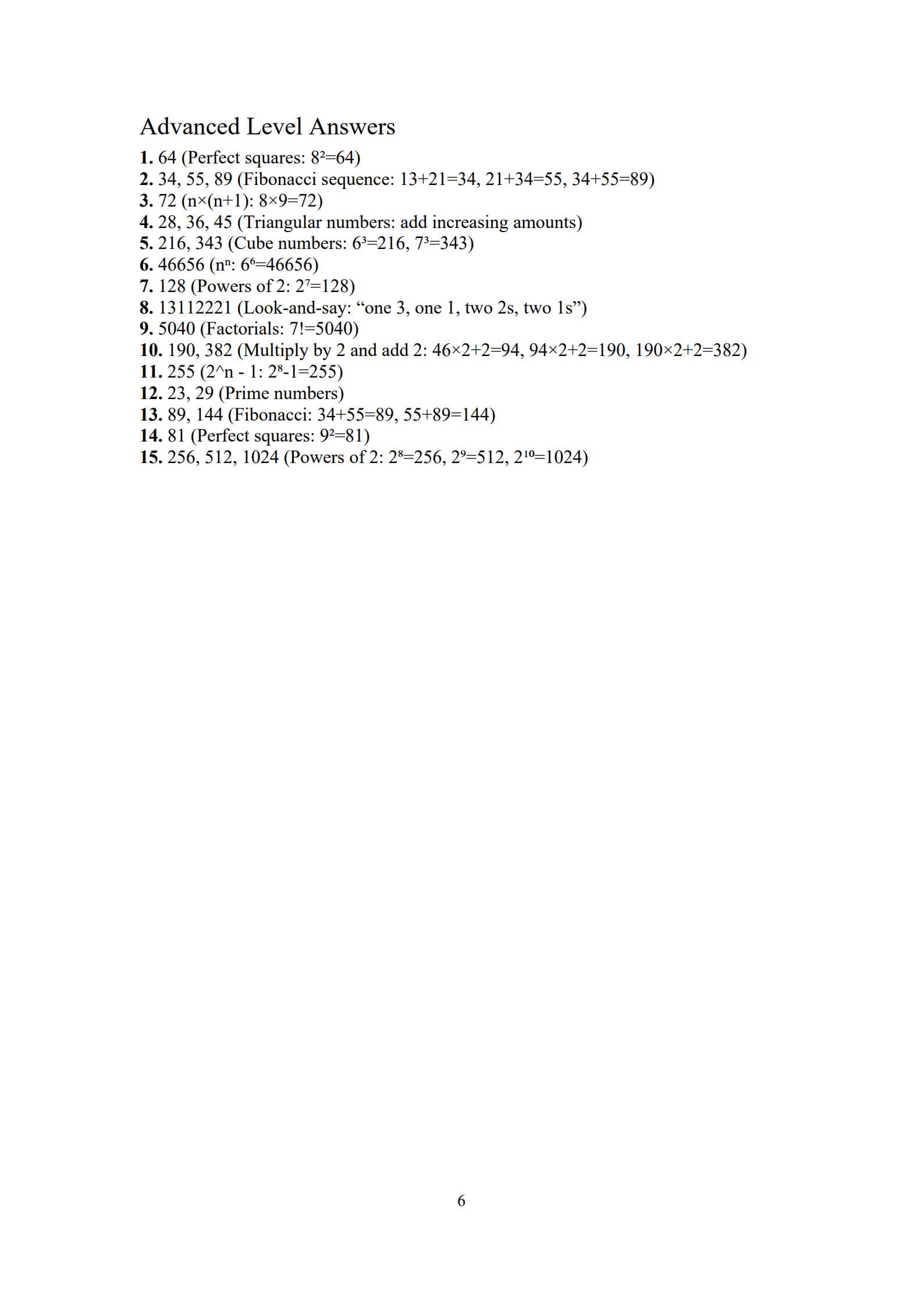
PDF Agile’s digital platform enhances these learning experiences by allowing educators to highlight specific pattern types or add annotations that guide students through the problem-solving process. The template’s answer key provides immediate feedback, helping learners understand whether they’ve correctly identified patterns like factorial sequences (“1, 2, 6, 24, 120”) or triangular numbers (“1, 3, 6, 10, 15”).
Mastering Advanced Patterns: A Journey into Mathematical Complexity
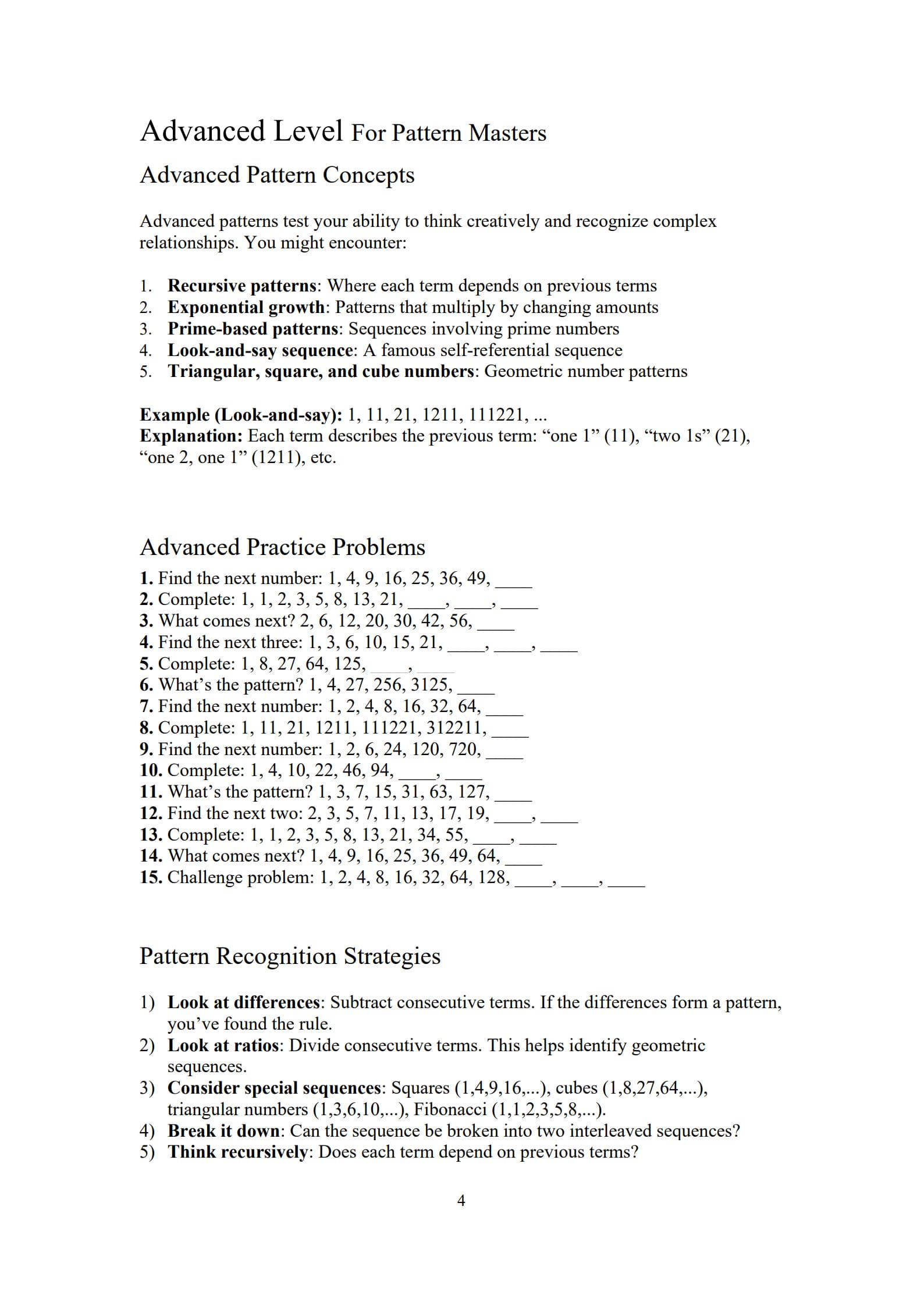
Advanced pattern recognition separates casual learners from true mathematical enthusiasts. Our template’s advanced section challenges users with recursive patterns, exponential growth, and special number sequences that require sophisticated problem-solving strategies. How do these complex patterns build upon foundational skills while introducing new mathematical concepts?
The advanced problems demonstrate how pattern recognition evolves into higher-order thinking. Sequences like “1, 4, 27, 256, 3125” (representing nⁿ) or “1, 3, 7, 15, 31, 63, 127” (demonstrating 2ⁿ-1) require learners to apply exponential thinking rather than linear progression. The template systematically introduces various pattern types, as shown in this comparative analysis:
| Pattern Type | Example Sequence | Mathematical Rule | Learning Objective |
|---|---|---|---|
| Geometric Progression | 2, 4, 8, 16, 32 | Multiply by constant factor | Understand exponential growth |
| Special Sequences | 1, 8, 27, 64, 125 | Cube numbers (n³) | Recognize spatial numerical relationships |
| Recursive Patterns | 1, 1, 2, 3, 5, 8, 13 | Fibonacci (sum of previous two terms) | Develop sequential logical thinking |
| Prime-Based | 2, 3, 5, 7, 11, 13 | Prime number sequence | Identify number theory concepts |
The template’s strategic progression ensures that learners build confidence with each success. PDF Agile’s technology enhances this journey by allowing customization that targets specific pattern types, enabling focused practice on areas needing improvement while tracking progress through repeated use of the template.
Practical Applications: Bringing Patterns to Life Through Technology
The Number Pattern Worksheet template transcends traditional paper-based exercises by leveraging PDF Agile’s interactive capabilities. How does technology enhance pattern recognition practice compared to static worksheets? The digital format allows for dynamic learning experiences that adapt to individual needs while maintaining the structured approach essential for mathematical development.
PDF Agile transforms pattern practice into an engaging activity through features like interactive answer checking and step-by-step solution guides. When working on sequences such as “1, 4, 9, 16, 25” or “1, 2, 6, 24, 120,” learners can immediately verify their understanding against the provided answer key. The platform’s annotation tools enable educators to highlight pattern rules directly on the worksheet, making abstract concepts visually accessible.
The template’s design incorporates real mathematical phenomena, helping students recognize that patterns aren’t just classroom exercises but fundamental to understanding the world. The Fibonacci sequence, for example, appears in natural formations like sunflower seed arrangements and nautilus shell spirals. Similarly, square and cube numbers have applications in geometry, physics, and computer science. PDF Agile’s digital platform can extend these connections through embedded links or supplementary materials that show patterns in action beyond the worksheet.
How to Use the Number Pattern Worksheet Template in PDF Agile: A Step-by-Step Guide
Step 1: Accessing the Number Pattern Worksheet Template
Begin by navigating to PDF Agile’s template library and selecting the Number Pattern Worksheet. Click “Use Template” and it comes pre-formatted with three distinct difficulty levels, clear instructions, and answer keys. You can either download it for immediate use or open it directly in PDF Agile’s editor for customization. The template maintains all original content from our sample worksheet, including beginner exercises like “3, 6, 9, 12” and advanced challenges like the look-and-say sequence.
Step 2: Customizing for Specific Learning Needs
PDF Agile’s editing tools allow you to tailor the worksheet to individual or classroom requirements. You might emphasize certain pattern types—perhaps focusing on arithmetic sequences for younger learners or introducing Fibonacci patterns to advanced students. The platform enables you to add annotations, highlight key concepts, or modify examples while preserving the template’s educational structure. For instance, you could add visual cues to help with sequences like “1, 4, 9, 16” (perfect squares) or “2, 6, 12, 20” (n×(n+1)).
Step 3: Interactive Learning Features
Utilize PDF Agile’s interactive elements to enhance engagement. The digital format allows students to input answers directly into the worksheet and receive immediate feedback by comparing their responses with the answer key. For complex patterns like “1, 11, 21, 1211, 111221” (look-and-say sequence), you can add explanatory notes that break down the pattern recognition process step by step.
Step 4: Saving and Sharing Completed Worksheets
Once customized, save your modified worksheet in PDF format for distribution. PDF Agile maintains the professional layout while ensuring all interactive elements function correctly. Educators can share worksheets electronically for remote learning or print them for classroom use.
Step 5: Tracking Progress and Iterating
With PDF Agile, you can create multiple versions of the worksheet to track student progress over time. Begin with beginner patterns like “100, 90, 80, 70” and gradually introduce intermediate sequences such as “2, 5, 11, 23, 47” as skills develop. The digital format makes it easy to modify difficulty levels and pattern types based on learner performance.
Conclusion
The Number Pattern Worksheet template in PDF Agile represents a significant advancement in mathematical education, blending time-tested pattern recognition exercises with modern technology. This powerful combination creates learning experiences that are both structured and adaptable, meeting diverse educational needs while maintaining mathematical rigor. From simple arithmetic sequences to complex recursive patterns, the template guides learners through progressively challenging concepts that build critical thinking skills.
The digital platform enhances the worksheet’s effectiveness by making pattern practice interactive and customizable. Educators can tailor content to specific learning objectives, whether emphasizing basic patterns for young learners or exploring advanced sequences with mathematical enthusiasts. The immediate feedback possible through PDF Agile’s interactive features reinforces learning and helps students develop confidence in their pattern recognition abilities.