

Are you struggling to distinguish between transitive and intransitive verbs? Do you find grammar exercises tedious or confusing? PDF Agile brings you a professionally designed Transitive and Intransitive Verbs Worksheet—a dynamic, ready-to-use template that transforms learning into an engaging experience. This template, structured across beginner, intermediate, and advanced levels, offers clear explanations, practical exercises, and instant feedback via an included answer key. Let’s dive into the world of verb worksheets!
What Makes the Transitive and Intransitive Verbs Worksheet with Answers Ideal for Learning?
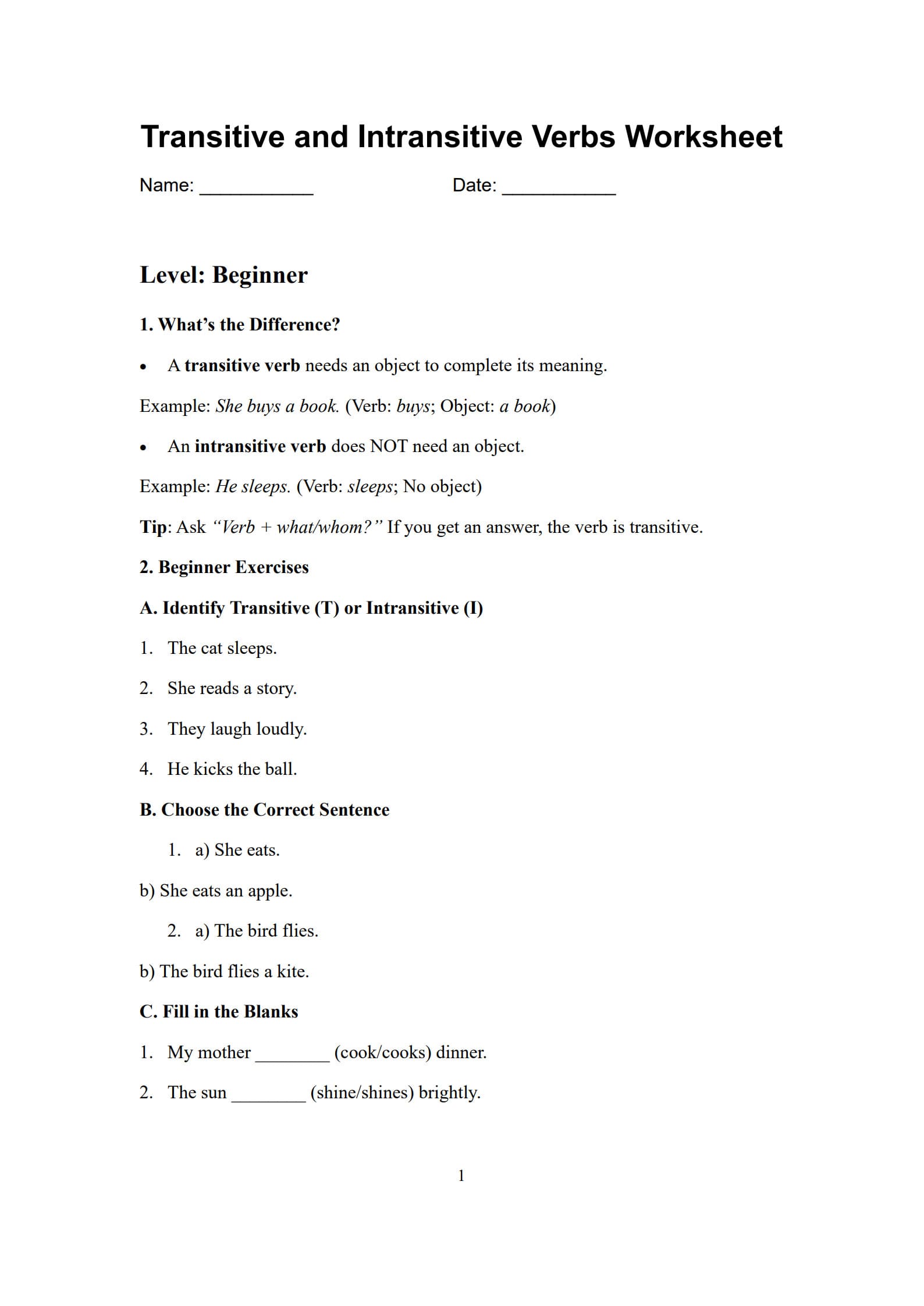
Why do learners often mix up transitive and intransitive verbs? The answer lies in the lack of structured practice. Our worksheet tackles this by starting with the basics: defining transitive verbs as those requiring an object (e.g., “She buys a book”) and intransitive verbs as those standing alone (e.g., “He sleeps”). The template includes a handy tip—asking “Verb + what/whom?” to test transitivity—which turns abstract rules into actionable strategies. For instance, in the beginner exercises, learners identify verbs in sentences like “The cat sleeps” (intransitive) or “She reads a story” (transitive). This approach not only clarifies concepts but also builds confidence through immediate application. By providing answers upfront, the worksheet encourages self-paced learning, making it perfect for classrooms or independent study. How does it progress to more complex topics? Let’s find out.
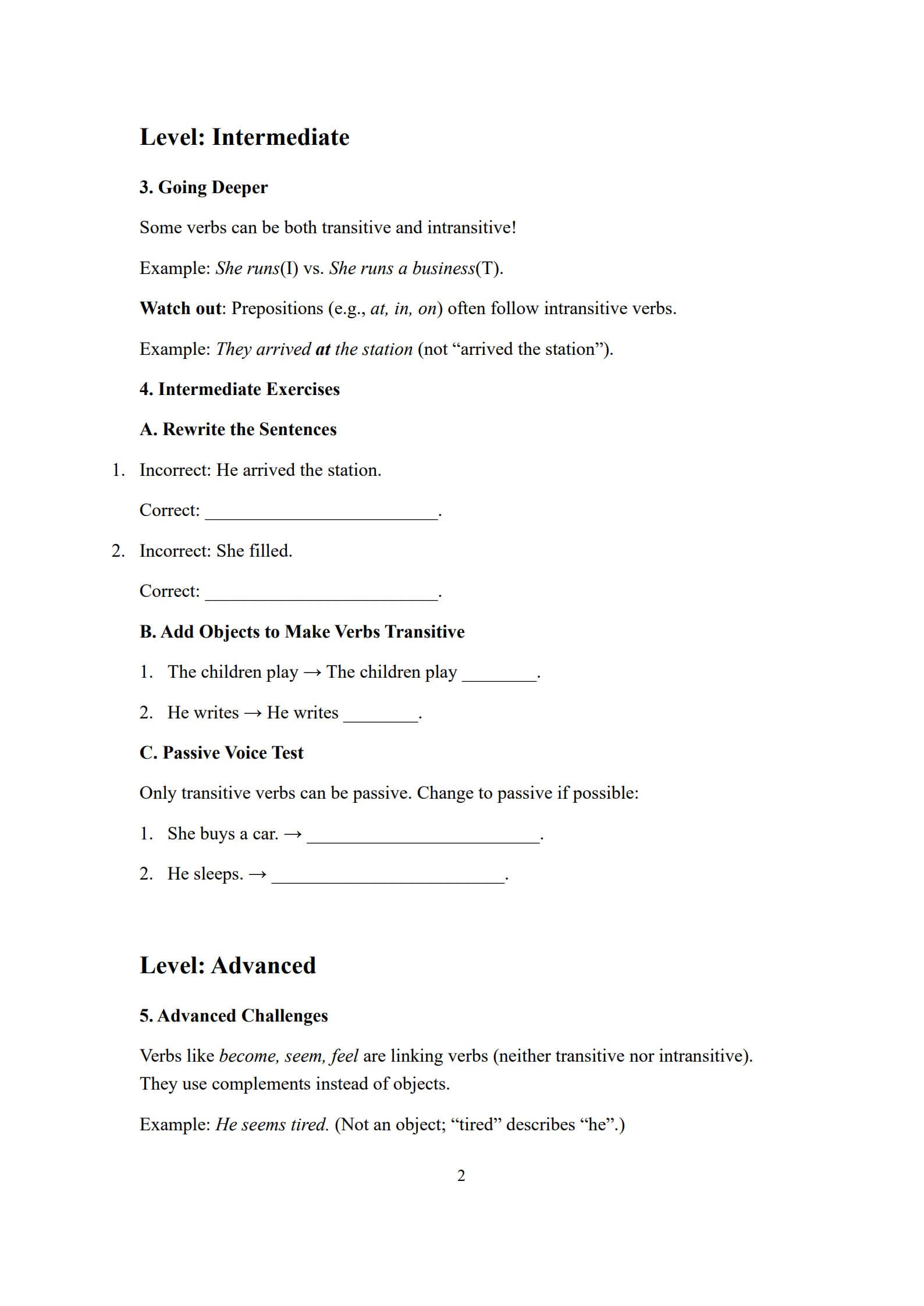
The worksheet’s multi-level design ensures a smooth learning curve. At the beginner level, exercises like “Choose the Correct Sentence” (e.g., selecting “She eats an apple” over “She eats” to highlight transitivity) reinforce fundamentals through simple choices. As learners advance, the intermediate section introduces verbs that can be both transitive and intransitive, such as “run” (“She runs” vs. “She runs a business”). This depth prevents oversimplification and prepares users for real-world usage. Additionally, the template addresses common errors, like missing prepositions after intransitive verbs (e.g., correcting “He arrived the station” to “He arrived at the station”). Such nuances are often overlooked in generic resources, but our worksheet makes them accessible through focused examples. With each level, learners develop a sharper eye for detail, turning grammar hurdles into achievable milestones.
How Does the Transitive and Intransitive Verb Exercise Enhance Retention?
Practice makes perfect, and the worksheet’s diverse exercises are crafted to maximize retention. For example, the “Fill in the Blanks” task (e.g., “My mother cooks dinner”) requires learners to apply verb forms contextually, moving beyond memorization to active usage. But how does it cater to different learning styles? The variety of exercise types—from identification to sentence rewriting—engages visual, analytical, and practical learners. In the intermediate section, activities like “Add Objects to Make Verbs Transitive” (e.g., expanding “The children play” to “The children play soccer”) foster creativity while solidifying rules. This hands-on approach transforms passive reading into dynamic problem-solving, ensuring that concepts stick long after the lesson ends.
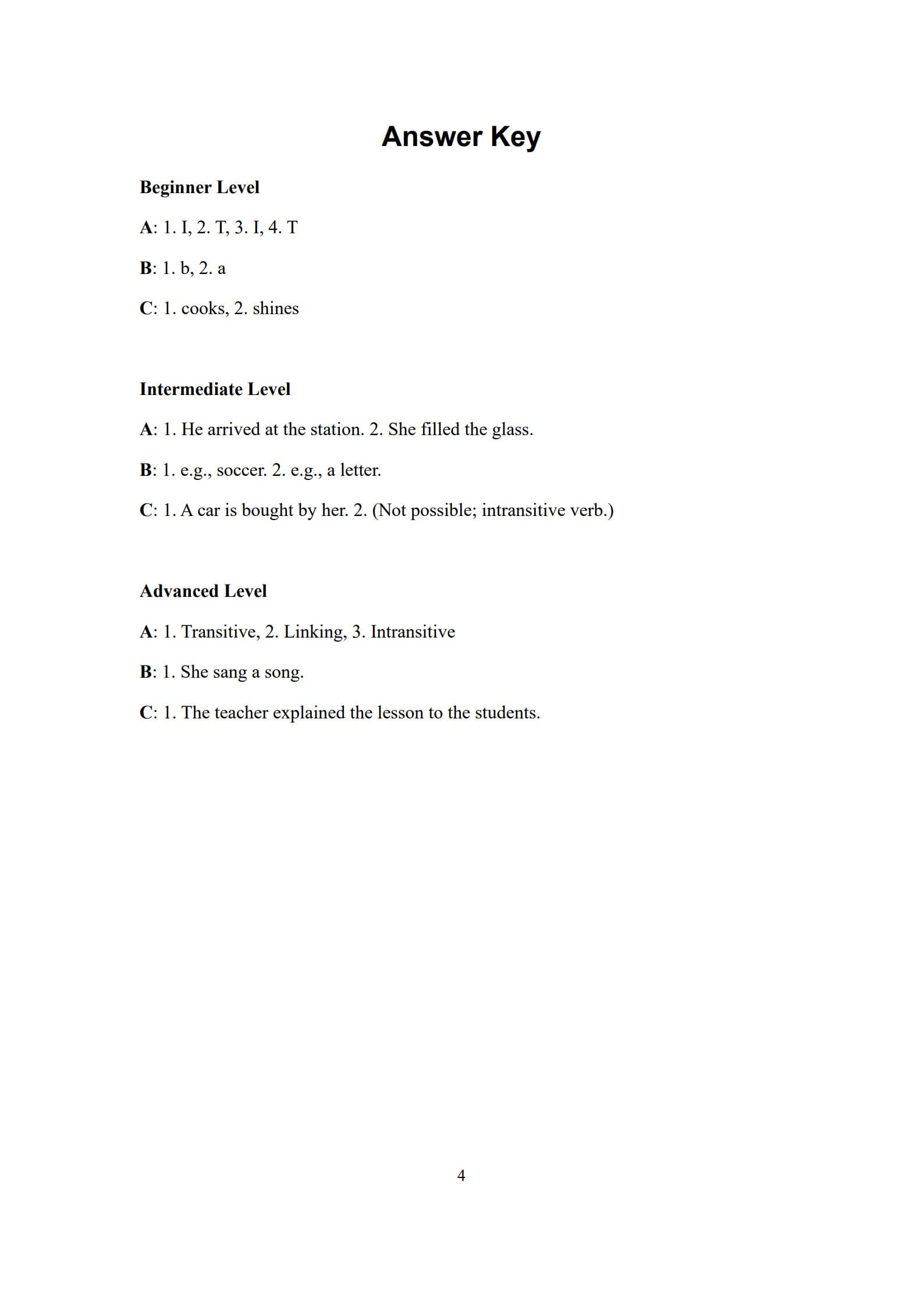
The inclusion of a passive voice test further deepens understanding. Since only transitive verbs can be passivized, exercises like changing “She buys a car” to “A car is bought by her” reinforce transitivity through structural manipulation. Conversely, attempting to passivize an intransitive verb like “He sleeps” reveals its limitations, providing a clear “aha!” moment. Such exercises not only teach grammar but also critical thinking, as learners analyze verb functionality in different contexts. By integrating answers directly into the template, PDF Agile eliminates guesswork and allows for instant feedback. This iterative process of attempt, check, and correct builds a robust mental framework for verb usage, making complex rules feel intuitive and manageable.
Breaking Down Advanced Concepts: Transitive, Intransitive, and Linking Verbs
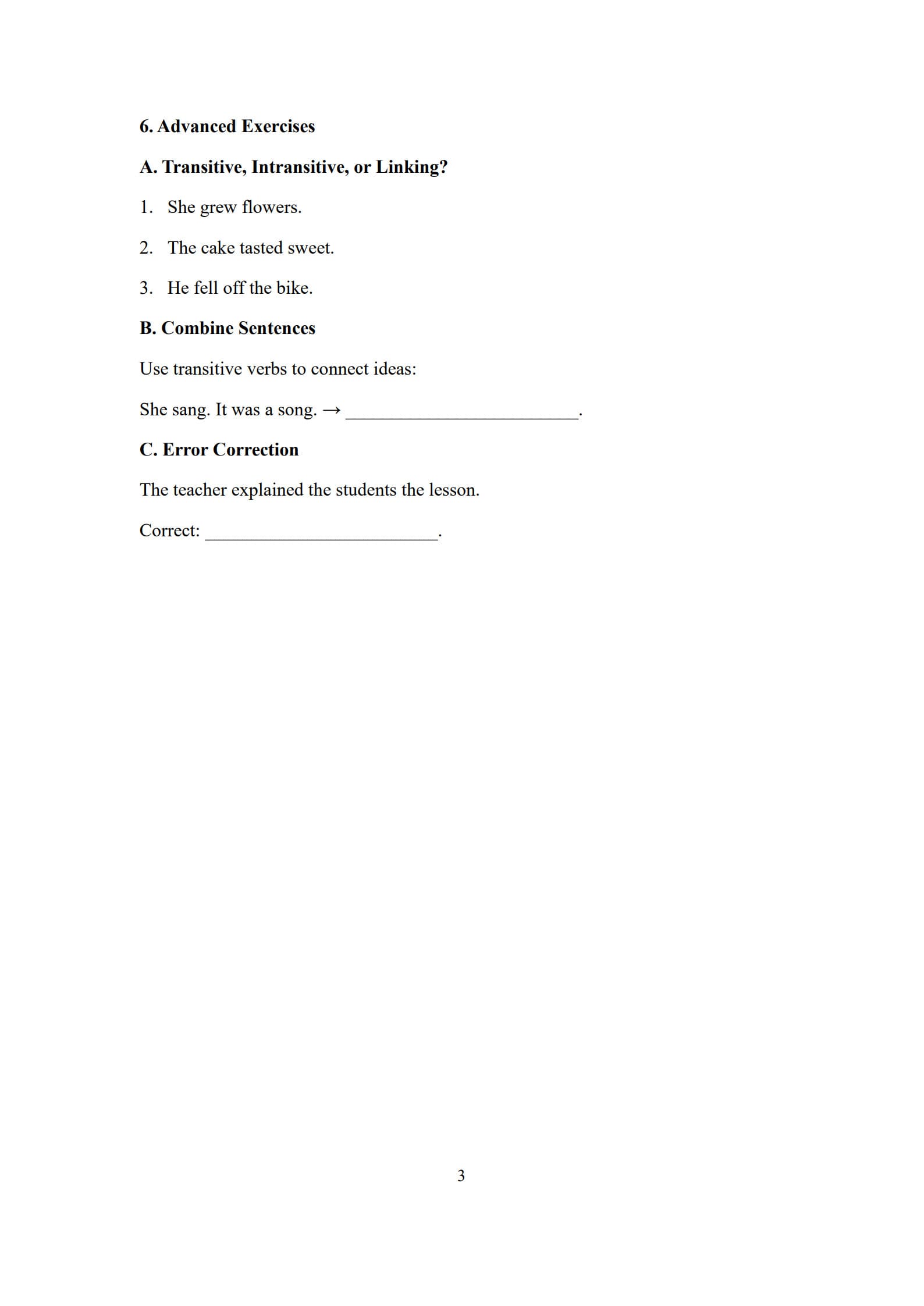
At the advanced level, the worksheet introduces linking verbs—a category that goes beyond the transitive-intransitive binary. Verbs like “become,” “seem,” or “feel” use complements instead of objects, as in “The cake tasted sweet,” where “sweet” describes the subject. How does the template make this subtle distinction clear? Through side-by-side examples, such as comparing “She grew flowers” (transitive) with “He grew tired” (linking), it highlights how context dictates verb classification. This advanced exercise challenges learners to categorize verbs in sentences like “He fell off the bike” (intransitive) or “She grew flowers” (transitive), sharpening their analytical skills. The following table summarizes key differences, using examples directly from the worksheet:
| Verb Type | Example from Worksheet | Key Feature |
|---|---|---|
| Transitive | She buys a book. | Requires a direct object (answers “what?/whom?”) |
| Intransitive | He sleeps. | No object needed; often stands alone |
| Linking | The cake tasted sweet. | Uses a complement to describe the subject |
This tabular comparison, paired with error correction tasks (e.g., fixing “The teacher explained the students the lesson” to “The teacher explained the lesson to the students”), addresses nuanced grammar pitfalls. By presenting information visually, the template appeals to learners who benefit from organized, at-a-glance references, making even advanced content approachable.
From Theory to Practice: Applying the Worksheet in Real-Life Learning
The true strength of this worksheet lies in its real-world applicability. For instance, the “Combine Sentences” exercise (e.g., merging “She sang” and “It was a song” into “She sang a song”) teaches learners to streamline ideas using transitive verbs—a skill valuable in writing and communication. But how does this translate beyond the classroom? Mastering verb types improves clarity in emails, essays, and conversations. The worksheet’s focus on common errors, such as omitting prepositions, helps non-native speakers avoid mistakes that can obscure meaning. Moreover, the progression from simple to complex exercises mirrors natural language acquisition, allowing learners to build competence gradually without feeling overwhelmed.
Teachers can leverage this template for differentiated instruction. Beginners might focus on identification exercises, while advanced students tackle linking verbs or passive transformations. The answer key enables facilitators to provide quick feedback, saving time on grading. For self-learners, the structured format acts as a personal tutor, guiding them through each concept with examples and corrections. By covering everything from basic definitions to exceptions, the worksheet serves as a comprehensive toolkit, adaptable to various goals—whether acing an exam, polishing professional writing, or mastering everyday English.
How to Use the Transitive and Intransitive Verbs Worksheet Template on PDF Agile
Ready to put this template into action? PDF Agile makes it effortless. Follow these steps to customize and use the worksheet in minutes:
Step 1: Access the Transitive and Intransitive Verbs Worksheet Template
Log in to PDF Agile and navigate to the Template Library. Search for “Transitive and Intransitive Verbs Worksheet” and click “Use Template.” The pre-designed layout includes all sections—explanations, exercises, and answer key—so you can start immediately.
Step 2: Customize for Your Needs
Personalize the worksheet by adding your name, date, or institutional logo. PDF Agile’s editing tools let you modify text, highlight key points, or even add extra exercises. For example, you might insert a sentence like “They discuss the project” to reinforce transitivity, adhering to the template’s existing style.
Step 3: Complete Exercises Interactively
Use PDF Agile’s fillable fields to answer questions directly on the worksheet. For instance, type “I” or “T” next to sentences like “The cat sleeps,” or drag and drop correct options in “Choose the Sentence” tasks. The app auto-saves your progress, allowing you to work at your pace.
Step 4: Check Answers and Review
Refer to the built-in answer key to self-assess. PDF Agile’s annotation features let you mark errors or add notes for revision. For advanced learners, try hiding the key initially to test recall, then reveal it for feedback.
Step 5: Save, Share, or Print
Export your completed worksheet as a PDF for digital sharing via email or cloud storage. Alternatively, print it for offline practice. PDF Agile ensures formatting remains intact across devices, making it ideal for hybrid learning environments.
Conclusion
In summary, the Transitive and Intransitive Verbs Worksheet is more than a static resource—it’s a dynamic tool that adapts to your learning pace and goals. By breaking down verb types into digestible segments, from beginner exercises like “Identify Transitive or Intransitive” to advanced challenges involving linking verbs, it builds a solid grammatical foundation. The inclusion of immediate feedback through an answer key empowers users to learn independently, while PDF Agile’s functionality enhances accessibility and engagement.
We encourage English learners to explore this template as part of their regular practice. Whether you’re correcting common mistakes or mastering nuances, this worksheet offers a clear path to proficiency. Download it today from PDF Agile and turn grammar challenges into opportunities for growth. Remember, understanding verbs is key to unlocking fluent, confident English—and with this template, you’re well on your way.