

Are you struggling to make your subjects and verbs agree in English sentences?
Subject-verb agreement is a foundational grammar rule that often trips up learners, leading to awkward phrasing and confusion. But fear not—PDF Agile’s ready-to-use Subject-Verb Agreement Worksheet template is here to transform your learning experience.
Definitions and Reasons of Subject-Verb Agreement
Subject-verb agreement is the grammatical principle that the subject (the main person, place, or thing in a sentence) and the verb (the action or state) must match in number. Simply put, a singular subject requires a singular verb, while a plural subject needs a plural verb. For example, from our template:
- Singular: “The cat sleeps peacefully.”
- Plural: “The cats sleep peacefully.”
Why is this so important?
Proper subject-verb agreement ensures clarity and professionalism in writing and speaking. It’s essential for exams like TOEFL or IELTS, academic essays, and daily communication. Missteps can change meaning or sound uneducated—imagine writing “The team are winning” instead of “The team is winning”! By mastering this, you’ll boost your English fluency and avoid common errors that even native speakers make.
Rules of Subject-Verb Agreement with Practices
Our PDF Agile template organizes these rules into digestible sections with exercises to reinforce learning. Here’s a sneak peek from the worksheet:
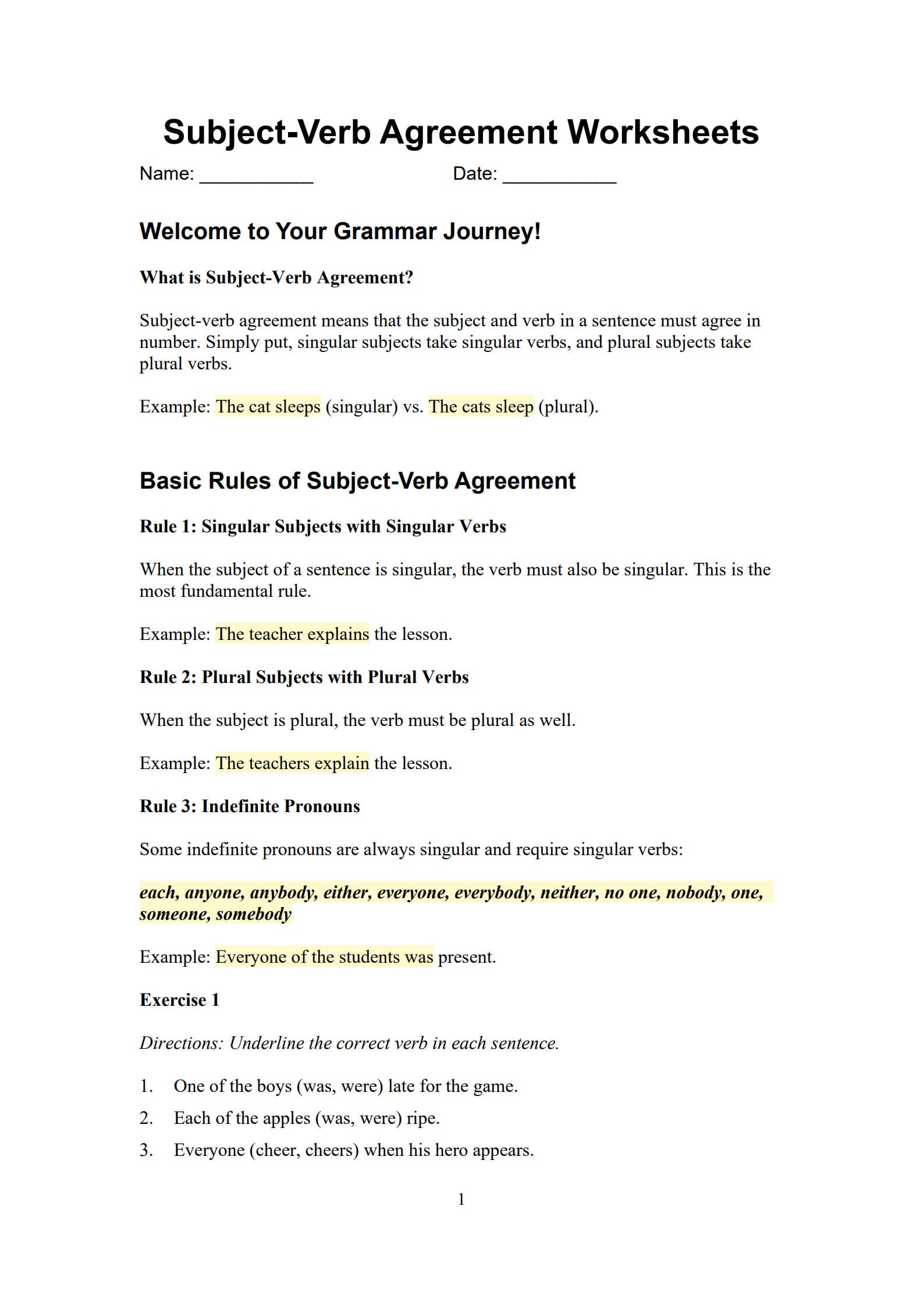
Rule 1: Singular Subjects Take Singular Verbs
When the subject is singular, use a singular verb (often ending in “-s” in present tense).
- Example: “The teacher explains the lesson.”
- Practice: In Exercise 1, sentence 3, “Everyone (cheer, cheers) when his hero appears.” The correct verb is “cheers” because “everyone” is singular.
Rule 2: Plural Subjects Take Plural Verbs
Plural subjects pair with plural verbs (usually without “-s”).
- Example: “The teachers explain the lesson.”
- Practice: Sentence 22 from Exercise 3: “Mary and her mother (is, are) in the store.” Here, “are” is correct as “Mary and her mother” form a compound plural subject.
Rule 3: Indefinite Pronouns Are Often Singular
Words like “everyone,” “someone,” or “each” are singular.
- Example: “Everyone of the students was present.”
- Practice: Sentence 2: “Each of the apples (was, were) ripe.” Choose “was”—it agrees with the singular “each.”
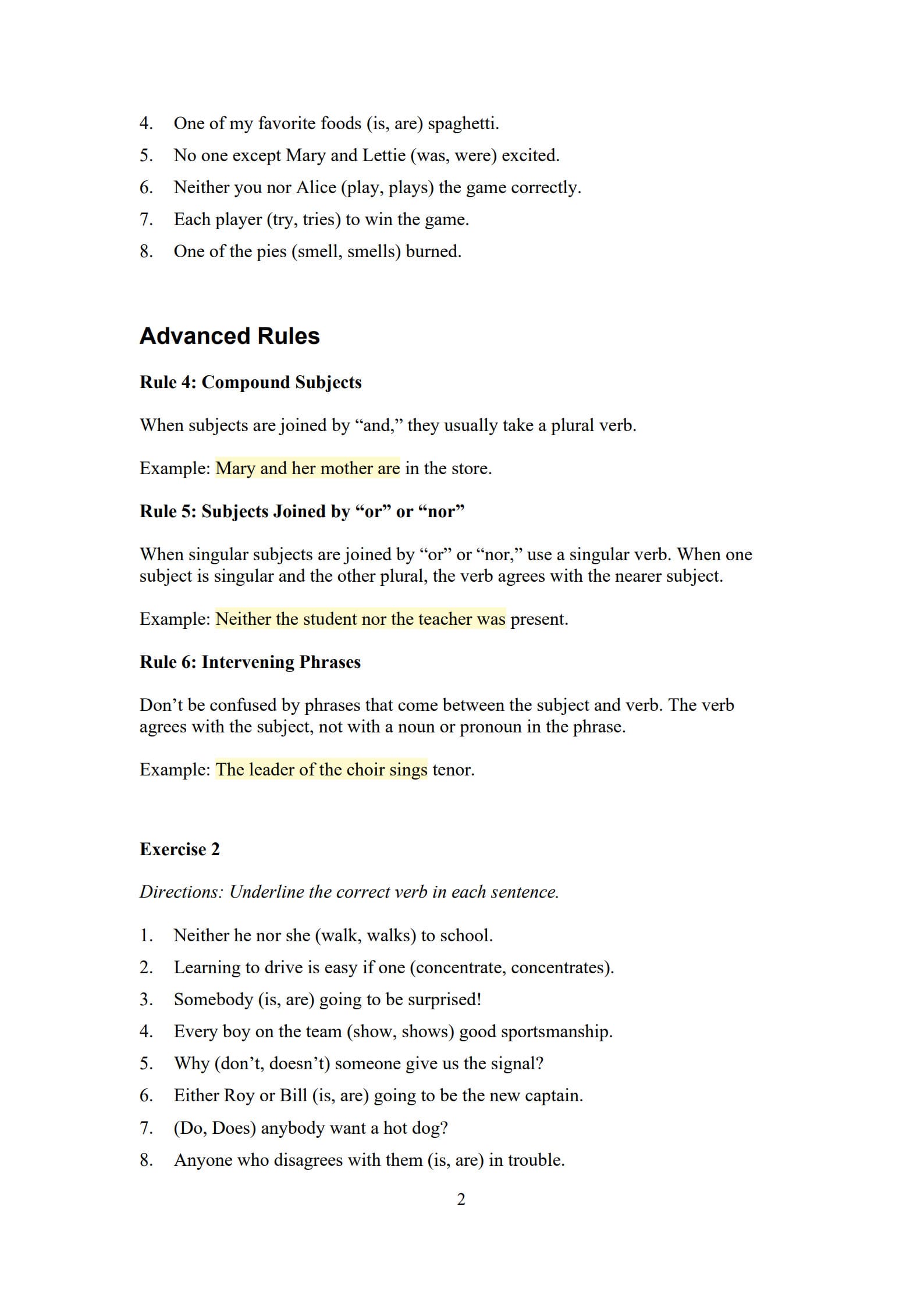
Rule 4: Intervening Phrases Don’t Change Agreement
Phrases between the subject and verb can be misleading. Always match the verb to the main subject.
- Example: “The leader of the choir sings tenor.”
- Practice: Sentence 18: “Steve, along with Jim and George, (was, were) there.” The verb “was” agrees with “Steve,” ignoring the intervening phrase.
Rule 5: Compound Subjects with “Or” or “Nor”
For subjects joined by “or” or “nor,” the verb agrees with the nearer subject.
- Example: “Neither the student nor the teacher was present.”
- Practice: Sentence 14: “Either Roy or Bill (is, are) going to be the new captain.” “Is” is correct because “Bill” (singular) is nearer.
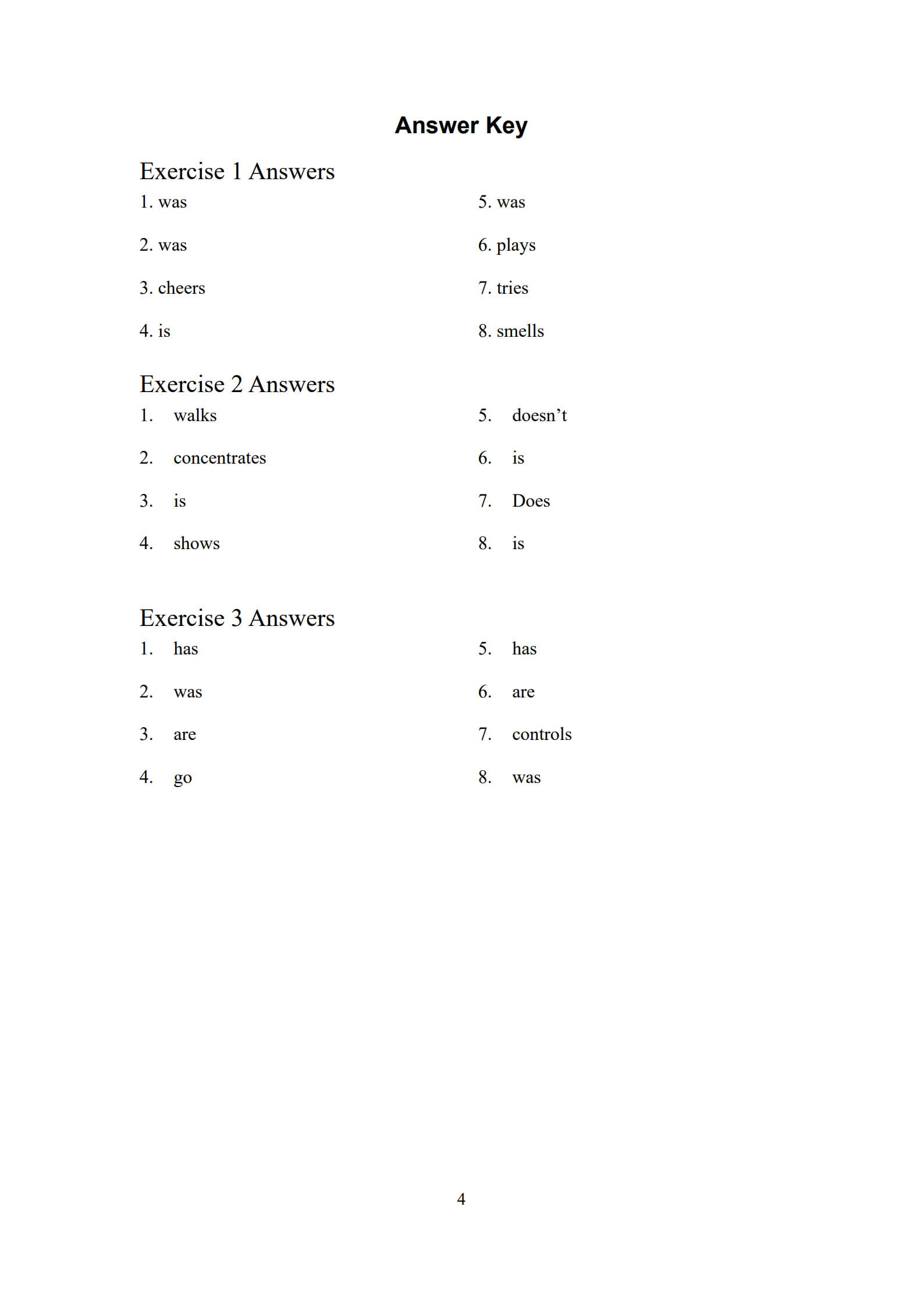
The template includes over 20 exercises like these, with an answer key for self-check. For instance, in Exercise 1, sentence 7, “Each player (try, tries) to win the game,” you’d underline “tries” to apply Rule 3. These practices turn theory into habit!
Five Techniques to Quickly Tackle Subject-Verb Agreement
Struggling to apply rules on the fly? These techniques, inspired by the template, will speed up your learning:
Identify the True Subject First
Ignore descriptive phrases. Ask: “Who or what is doing the action?” In “One of the boys was late,” the subject is “one,” not “boys.”
Test with Pronouns
Replace subjects with pronouns like “he” (singular) or “they” (plural). For “Everyone cheers,” think “He cheers” to confirm singularity.
Watch for “And” vs. “Or”
Subjects connected by “and” are usually plural, but with “or” or “nor,” focus on the closer noun. Our template’ Rule 5 exemplifies this.
Remember Common Singular Indefinite Pronouns
Create a mental list: “each,” “anyone,” “nobody.” Sentence 16 reinforces this: “Anyone who disagrees with them (is, are) in trouble.” “Is” is correct.
Practice with Real-Life Sentences
Use the template’s exercises daily. For example, tackle Exercise 2, sentence 13: “Why (don’t, doesn’t) someone give us the signal?” Here, “doesn’t” fits as “someone” is singular.
Mistakes and Reflections
Even advanced learners slip up. Common errors from the template include:
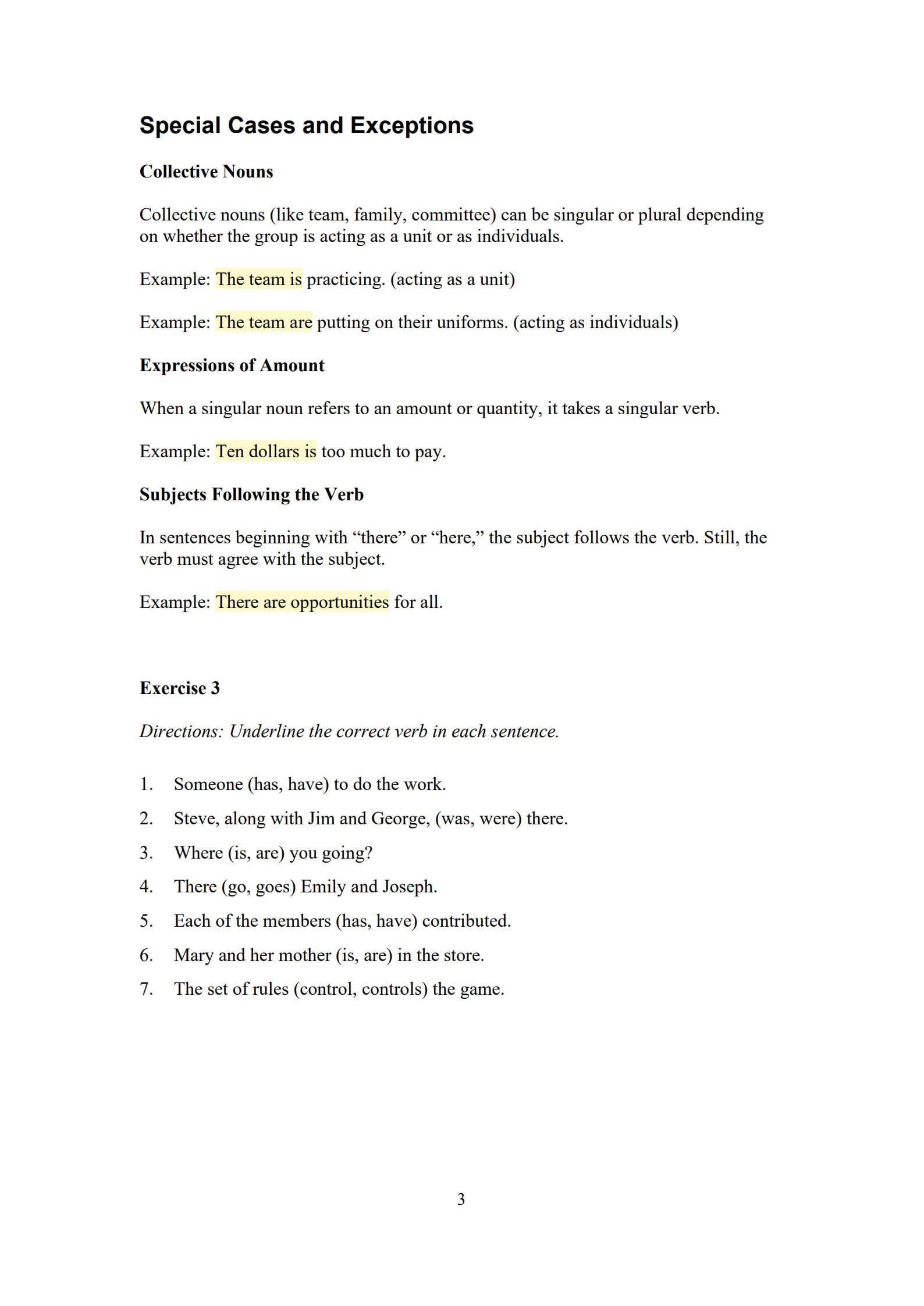
- Ignoring Intervening Phrases: “The set of rules (control, controls) the game,” some pick “control” due to “rules,” but “controls” agrees with “set.”
- Misjudging Collective Nouns: Words like “team” can be tricky. The template explains: “The team is practicing” (unit) vs. “The team are putting on their uniforms” (individuals).
- Overlooking Inverted Sentences: In “There go Emily and Joseph,” “go” matches the plural subject “Emily and Joseph,” not “there.”
How to Use This Template on PDF Agile?
PDF Agile’s Subject-Verb Agreement Worksheet template is designed for seamless learning. Follow these four steps to get started:
Step 1: Access the Template in PDF Agile
Open the PDF Agile app and navigate to the Template Library. Search for “Subject-Verb Agreement Worksheet” and click “Use Template.” Alternatively, download it directly from the official website. The template comes pre-formatted with rules, examples, and exercises—ready for instant use.
Step 2: Complete the Exercises Interactively
Fill in the blanks digitally using PDF Agile’s text tool. For example, in Exercise 1, sentence 4—” One of my favorite foods (is, are) spaghetti”—type your answer directly. The app auto-saves your progress, allowing you to pause and resume anytime.
Step 3: Check Answers with the Built-in Key
After attempting exercises, refer to the answer key included in the template. For instance, compare your response for sentence 11 (“Somebody is going to be surprised!”) to verify accuracy. PDF Agile’s highlight feature lets you mark corrections for review.
Step 4: Save, Print, or Share for Practice
Once done, save your completed worksheet as a PDF. You can print it for offline study or share it with a teacher via email for feedback. The template’s reusable design means you can reset it for repeated practice.
Tips for Maximizing the Template
- Practice Daily: Spend 10 minutes on one exercise section to build consistency.
- Use the Rules as a Guide: Keep the rule summaries handy while working through sentences.
- Customize for Difficulty: Add your own sentences using PDF Agile’s edit tools to challenge yourself further.
FAQs about Subject-Verb Agreement
Q1: What if the subject is a fraction or amount?
A: Singular nouns for amounts take singular verbs. The template’s “Expressions of Amount” section notes: “Ten dollars is too much to pay.”
Q2: How do I handle sentences starting with “here” or “there”?
A: The verb agrees with the subject after it. From Exercise 3, sentence 20: “There go Emily and Joseph” uses “go” because the subject “Emily and Joseph” is plural.
Q3: Are collective nouns always singular?
A: No! As the template explains, it depends on context. “The family is large” (unit) vs. “The family are arguing” (individuals).
Q4: Can I use this template for group learning?
A: Absolutely! PDF Agile’s sharing features make it ideal for classrooms. Discuss answers like those in Exercise 2 to foster collaboration.
Conclusion
Mastering subject-verb agreement is a game-changer for English learners, and PDF Agile’s template turns this challenge into an engaging journey. With clear rules, hands-on exercises, and user-friendly features, you’ll quickly gain confidence. Don’t let grammar hold you back—download the template today and start practicing.
Remember, consistency is key: as you work through sentences like
“Each player tries to win,”
you’ll internalize the rules naturally.
Happy learning, and here’s to flawless English!