

Welcome to PDF Agile’s innovative learning ecosystem, where complex mathematical concepts become accessible and engaging through expertly designed math drills worksheet templates. Our Order of Operations Worksheet template transforms the often-daunting PEMDAS/BODMAS rules into an exciting learning journey. This comprehensive guide will show you how to leverage this template to build strong mathematical foundations, whether you’re a beginner tackling basic operations or an advanced learner solving complex expressions.
Why Are PEMDAS Worksheets Essential for Building Mathematical Confidence?
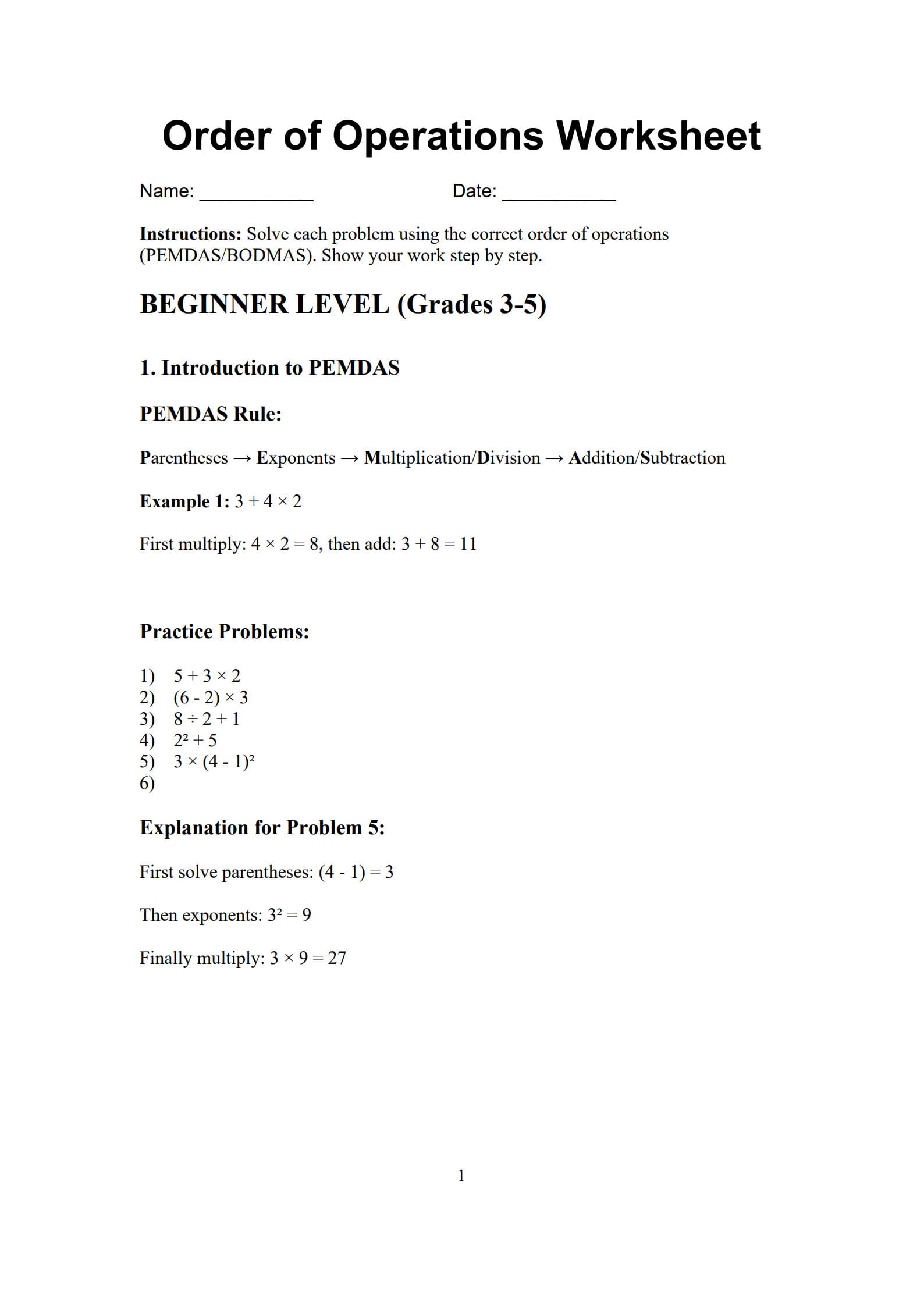
What if you could transform mathematical anxiety into excitement? Our PEMDAS worksheets achieve exactly this by breaking down complex problems into manageable steps. The template begins with fundamental concepts, such as Problem 1: “5 + 3 × 2,” where students learn that multiplication precedes addition, yielding 11 instead of 16. This foundational approach prevents common calculation errors and builds confidence through immediate success.
The worksheet’s logical progression mirrors how mathematical thinking develops naturally. Starting with basic PEMDAS problems like “(6-2)×3” allows learners to grasp parentheses before advancing to exponents in problems such as “2² + 5.” Each section includes worked examples that demonstrate the thinking process, making abstract rules concrete. For instance, the explanation for Problem 5 shows how “3×(4-1)²” becomes “3×3²” then “3×9,” finally reaching 27 through systematic steps.
This structured approach eliminates the overwhelm many students experience when facing complex expressions. By mastering smaller components first, learners develop the analytical skills needed for advanced mathematics. The template’s design acknowledges that mathematical proficiency isn’t about memorization—it’s about understanding processes. Through repeated practice with varied PEMDAS problems, students internalize the order of operations until it becomes second nature, creating a solid foundation for algebraic thinking and beyond.
How Do Our PEMDAS Practice Problems Cater to Different Learning Levels?
The template’s multi-level design addresses a crucial educational challenge: meeting students where they are. The beginner section (Grades 3-5) introduces PEMDAS through straightforward calculations like “8 ÷ 2 + 1,” establishing core principles without overwhelming young learners. This careful scaffolding ensures that students develop competence before confronting complexity.
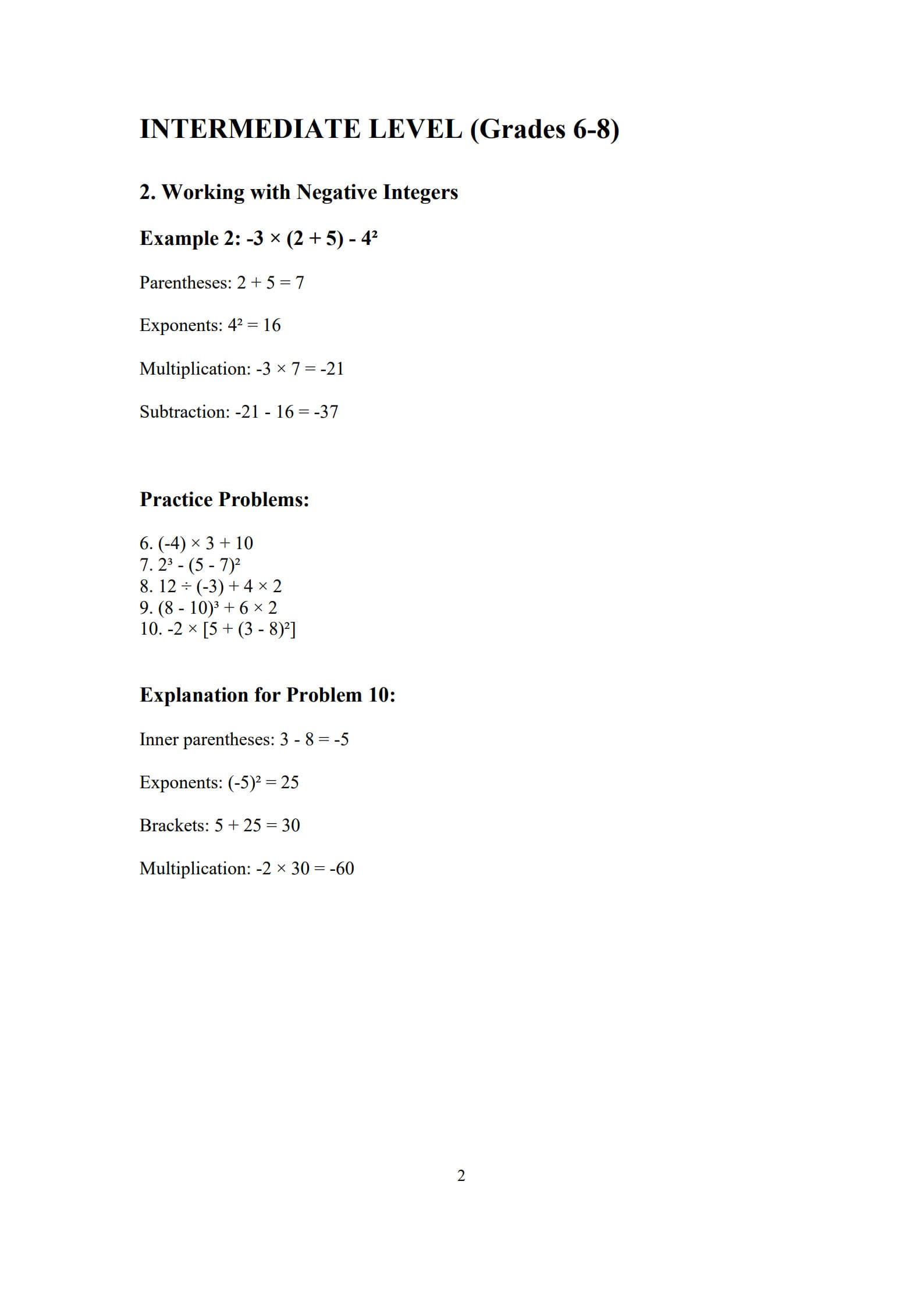
Intermediate PEMDAS practice problems introduce negative integers and deeper conceptual challenges. Problem 10, “-2×[5+(3-8)²],” demonstrates how the template builds upon earlier learning by incorporating multiple operations within brackets. The step-by-step explanation shows the problem’s transformation: inner parentheses “3-8=-5” become “(-5)²=25” through exponents, then “5+25=30” before the final multiplication “-2×30=-60.” This layered approach develops critical thinking skills essential for academic success.
Advanced sections (Grades 9+) present real-world applications and complex expressions, such as Problem 12’s word problem about calculating store purchases with discounts. This progression from abstract to applied mathematics demonstrates PEMDAS’s practical relevance while maintaining academic rigor. The template’s thoughtful sequencing means learners never face concepts they’re unprepared for, creating a seamless learning trajectory that adapts to individual pace and ability.
What Makes Our Order of Operations Worksheets With Answers Particularly Effective?
Table: Learning Progression in PDF Agile’s PEMDAS Template
| Level | Key Skills Developed | Sample Problem | Built-in Support |
|---|---|---|---|
| Beginner | Basic operations sequencing | 3×(4-1)²=27 | Step-by-step worked examples |
| Intermediate | Negative integers & brackets | -2×[5+(3-8)²]=-60 | Detailed parentheses explanations |
| Advanced | Real-world applications & complex expressions | 2⁴-(3-7)×(5-9)²=0 | Multi-step problem breakdowns |
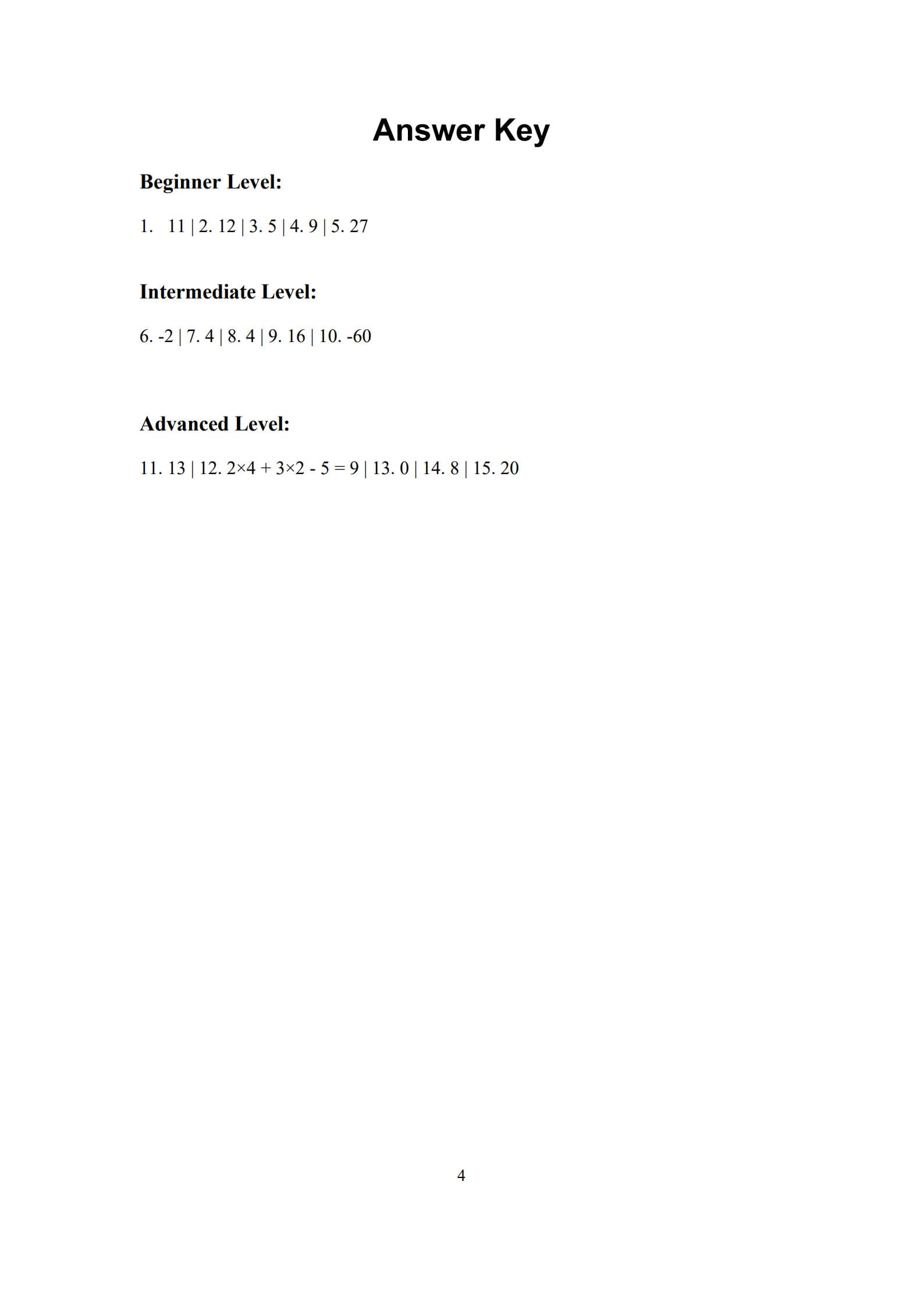
The inclusion of comprehensive answer keys transforms practice into active learning. Each solution provides immediate feedback, allowing students to self-correct and understand precisely where they veered off course. This instant validation reinforces correct methodology while correcting misconceptions before they become habitual.
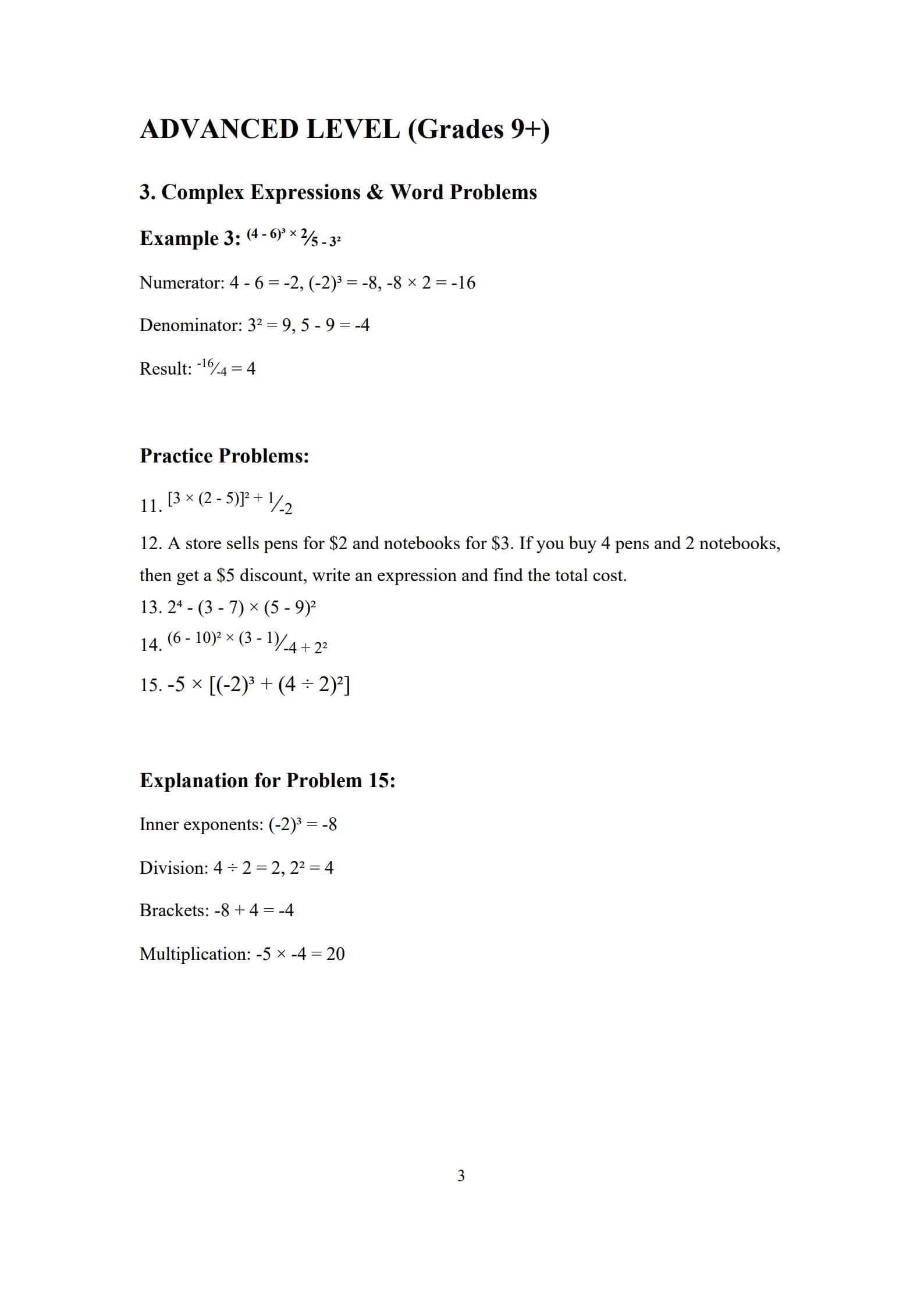
The template’s design incorporates cognitive learning principles through varied problem types. From simple calculations like Problem 3’s “8 ÷ 2 + 1 = 5” to sophisticated expressions such as Problem 14’s “(6-10)² × (3-1)⁄4 + 2² = 8,” the worksheets maintain engagement while systematically building competency. This variety prevents mechanical repetition and encourages adaptive thinking.
Scaffolded explanations model expert problem-solving approaches. The advanced section’s breakdown of Problem 15 demonstrates professional mathematical thinking: “Inner exponents: (-2)³=-8; Division: 4÷2=2, 2²=4; Brackets: -8+4=-4; Multiplication: -5×-4=20.” This transparent reasoning process demystifies complex problems and teaches students to articulate their own reasoning clearly.
Maximizing Learning Outcomes Through Strategic Worksheet Implementation
The template’s structure encourages metacognition—the ability to think about one’s own thinking. When students compare their approaches to the provided solutions, they develop self-assessment skills crucial for independent learning. This process turns simple practice into deep conceptual understanding, moving beyond rote memorization to genuine comprehension.
Educators can leverage the template’s progression to identify learning gaps precisely. A student struggling with Problem 7’s “2³-(5-7)²=4” might need reinforcement on negative integers, while difficulties with Problem 13’s “2⁴-(3-7)×(5-9)²=0” could indicate challenges with multiple operations. This diagnostic capability makes the worksheets invaluable for targeted instruction.
The inclusion of word problems bridges abstract mathematics and real-world applications. Problem 12’s scenario about calculating purchase costs (“2×4+3×2-5=9”) demonstrates PEMDAS’s practical utility, enhancing engagement while developing analytical skills applicable beyond the classroom. This contextual learning increases motivation and knowledge retention significantly.
How to Use This Template on PDF Agile: A Step-by-Step Guide
Step 1: Accessing the Order of Operations Worksheet Template
Open PDF Agile and navigate to the Education Templates section. Search for “Order of Operations Worksheet”. The template features a clean, organized layout with distinct beginner, intermediate, and advanced sections. Click “Use Template” to create your editable copy instantly.
Step 2: Customizing for Specific Learning Needs
Personalize the worksheet by adding your institution’s logo, modifying problem difficulty, or inserting additional examples. PDF Agile’s intuitive editing tools allow you to adapt the template for individual students, classroom use, or homeschool settings. The drag-and-drop interface makes customization effortless without compromising the template’s structural integrity.
Step 3: Interactive Learning Features
Utilize PDF Agile’s annotation tools to work through problems digitally. Students can highlight operations steps, insert comments showing their work, and use the drawing tools to circle key components. The platform’s collaboration features enable real-time feedback from instructors, creating an interactive learning experience beyond static worksheets.
Step 4: Saving and Sharing Completed Work
Export completed worksheets as polished PDFs for submission or printing. The platform maintains all formatting and annotations during export, ensuring professional presentation. Share via email, cloud storage, or direct link while controlling access permissions to protect student privacy and work integrity.
Step 5: Tracking Progress and Revisions
Use PDF Agile’s version history to monitor improvement over time. Each saved iteration documents learning progression, providing valuable insights for both students and educators. This feature transforms the template from a single-use worksheet into a comprehensive learning portfolio.
Conclusion
PDF Agile’s Order of Operations Worksheet template represents a paradigm shift in mathematical education. By combining pedagogical expertise with innovative technology, we’ve created a learning tool that adapts to individual needs while maintaining academic rigor. The template’s careful progression from basic PEMDAS problems to advanced applications ensures continuous challenge and growth, making it suitable for diverse learning environments and objectives.
Embrace the future of mathematical education with PDF Agile. Our Order of Operations Worksheet template doesn’t just teach rules—it cultivates mathematical thinkers equipped to tackle academic challenges and real-world problems with equal proficiency. Discover how structured practice, immediate feedback, and engaging content can unlock mathematical potential at every level.