

Welcome to PDF Agile’s educational resource center! As an English learner, have you ever struggled with when to use “much” versus “many”? Or wondered why we say “some water” but “an apple”? Our specially designed Countable and Uncountable Nouns Worksheet template addresses these exact challenges. This comprehensive 13-section worksheet provides a complete learning journey from basic concepts to advanced applications. Whether you’re a beginner navigating articles or an advanced learner mastering quantifiers, this template offers structured exercises that transform abstract grammar rules into practical skills. The best part? You can instantly access and customize this resource through PDF Agile’s user-friendly platform, making grammar practice engaging and effective.
What Are Countable and Uncountable Nouns? Your Ultimate Worksheet Guide
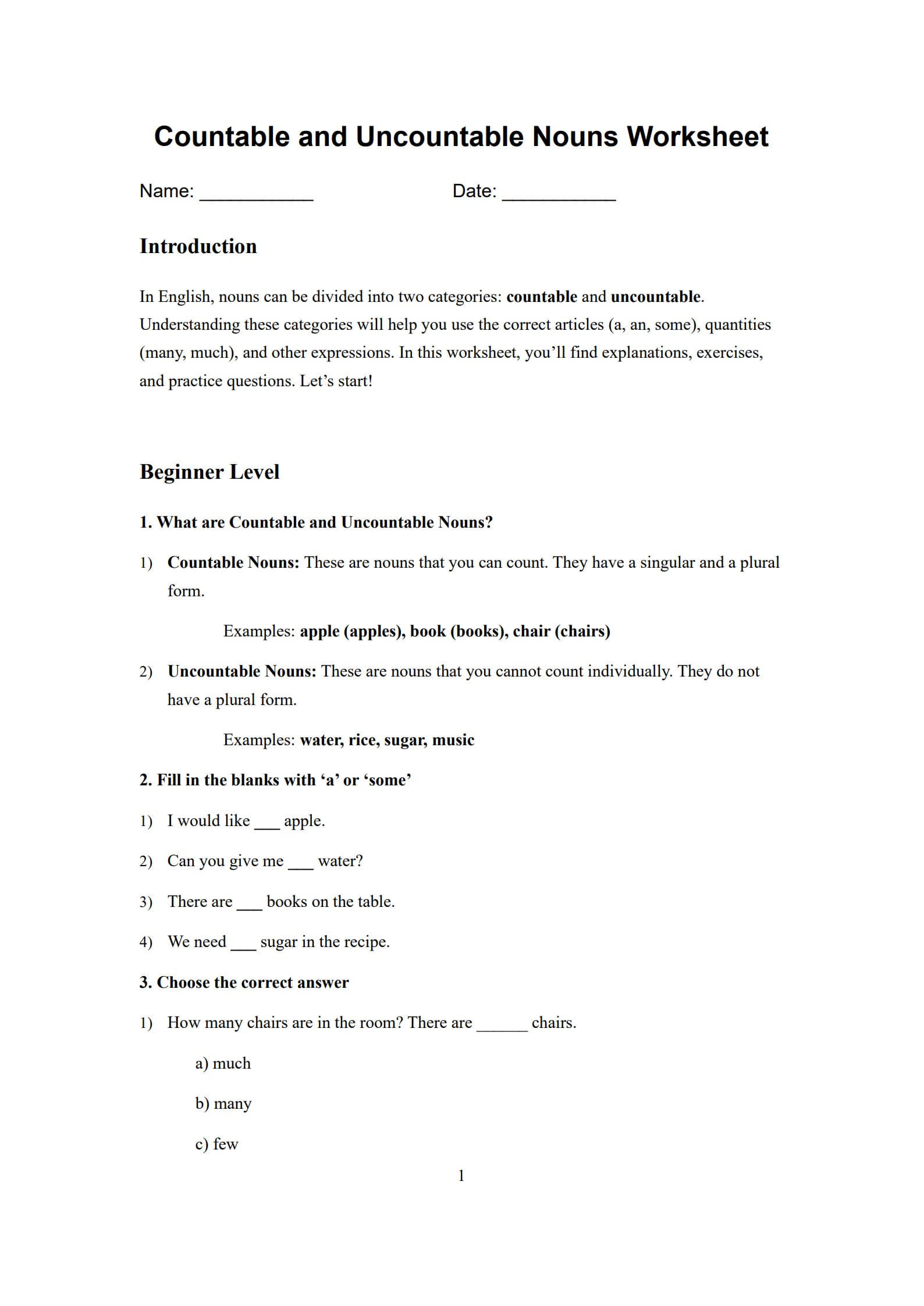
Have you ever wondered why some nouns can be counted while others cannot? Our countable uncountable nouns worksheet begins by answering this fundamental question through clear explanations and practical examples. The template starts with beginner-friendly definitions: countable nouns like “apple” and “book” have singular and plural forms, while uncountable nouns like “water” and “rice” represent concepts or substances we cannot count individually. This distinction forms the foundation of English grammar that affects article usage, verb agreement, and quantifier selection.
The worksheet strategically progresses from identification to application. Section 2 immediately tests your understanding with fill-in-the-blank exercises using “a” or “some”—forcing you to apply the theory you’ve just learned. For instance, you’ll practice writing “I would like an apple” versus “Can you give me some water?” This immediate application reinforces learning and builds confidence. The template’s logical sequencing ensures that each concept builds upon the previous one, creating a natural learning curve that respects your cognitive process.
How Can Countable Nouns Exercises Transform Your English Skills?
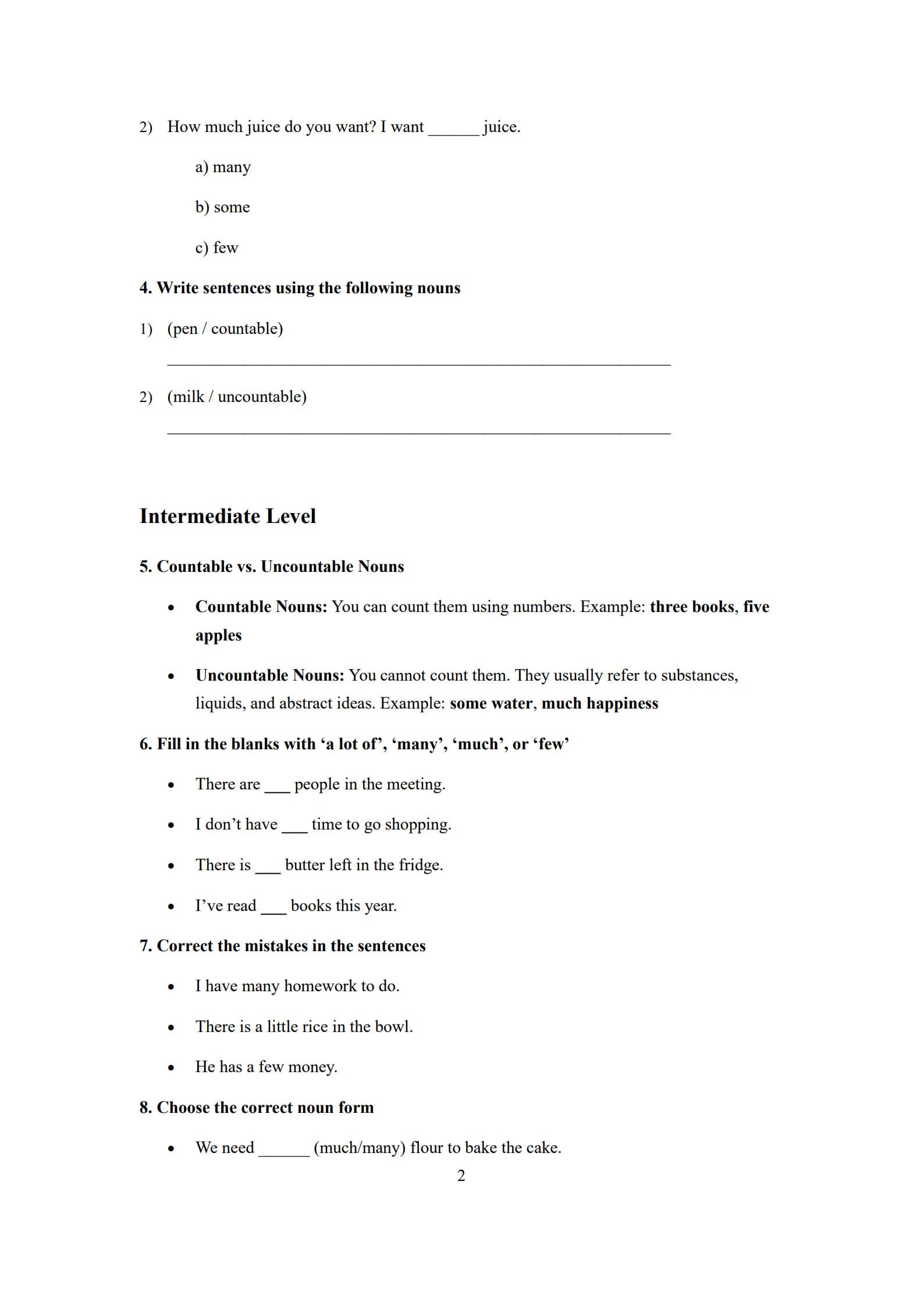
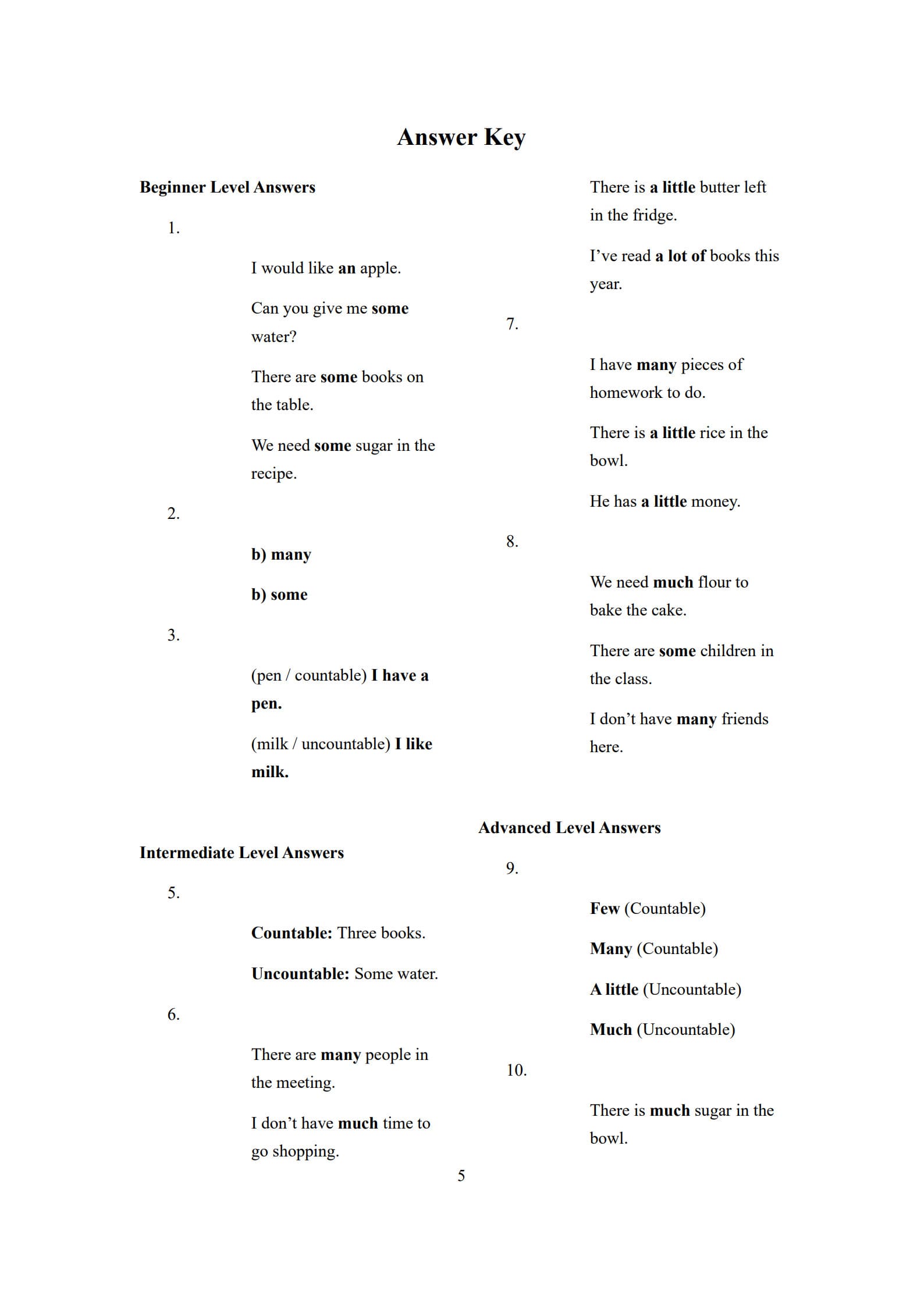
Our countable nouns exercises section demonstrates why practice makes perfect in language acquisition. Section 3 presents multiple-choice questions that challenge common mistakes, such as choosing between “many” and “much” in questions like “How many chairs are in the room?” versus “How much juice do you want?” These carefully designed exercises target specific trouble spots for English learners, providing immediate feedback through the answer key that helps self-correction and retention.
The intermediate level exercises dive deeper into quantifier usage with “a lot of,” “many,” “much,” and “few.” You’ll encounter sentences like “There are many people in the meeting” and “I don’t have much time to go shopping”—practical scenarios that reflect real-world English usage. The correction exercises in Section 7 are particularly valuable, addressing common errors like “I have many homework to do” (corrected to “I have much homework to do”) and “He has a few money” (corrected to “He has a little money”). These exercises develop your error-recognition ability, a crucial skill for achieving fluency.
Why Choose Our Uncountable Nouns Worksheet for Advanced Learning?
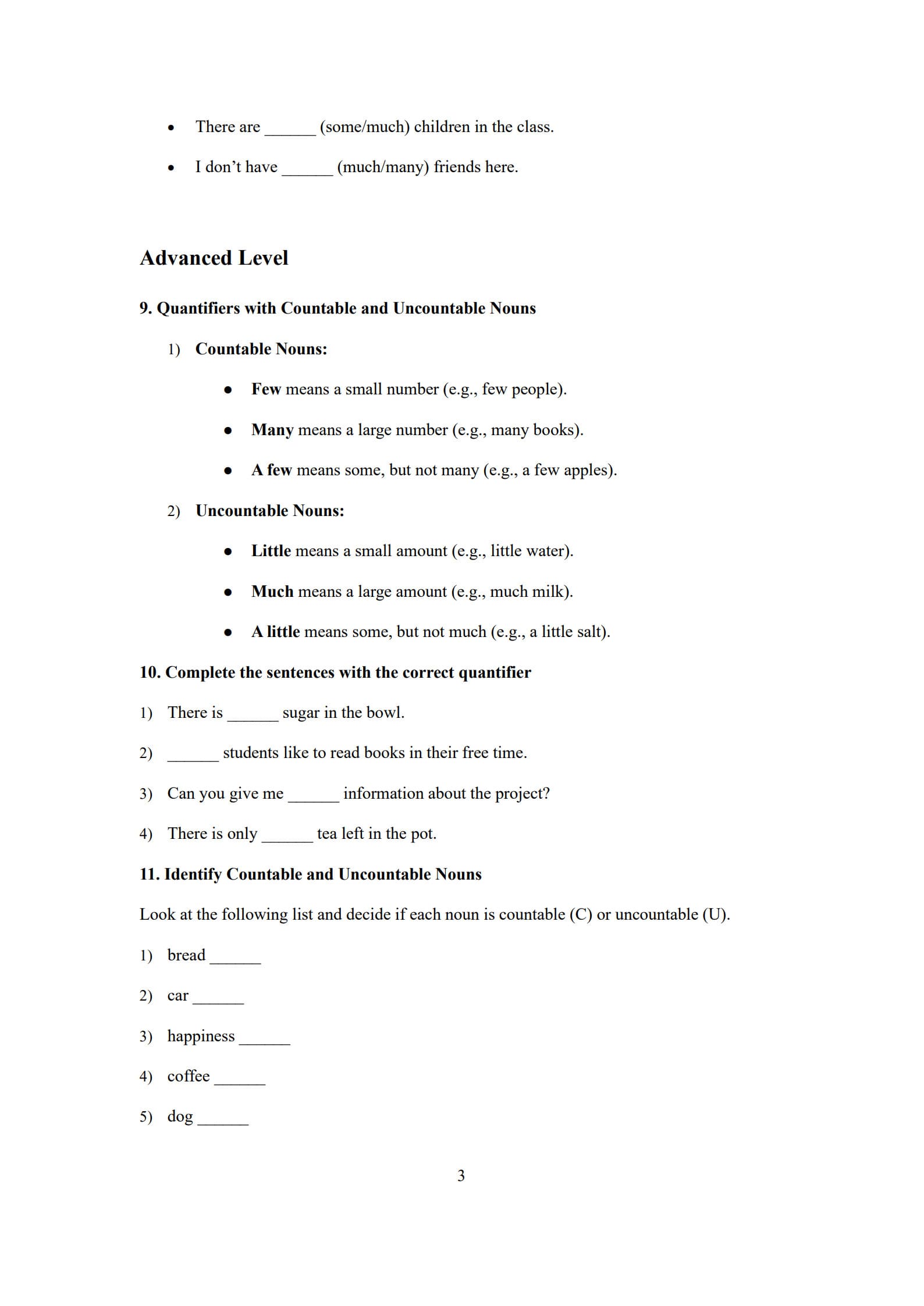
Comparing with Common and Proper Nouns worksheets, the uncountable nouns worksheet component addresses the more challenging aspects of English grammar that often perplex even advanced learners. Section 9 provides a comprehensive reference guide for quantifiers, clearly distinguishing between those used with countable nouns (“few,” “many,” “a few”) and uncountable nouns (“little,” “much,” “a little”). This visual comparison helps you internalize the patterns rather than memorizing isolated rules, promoting long-term retention.
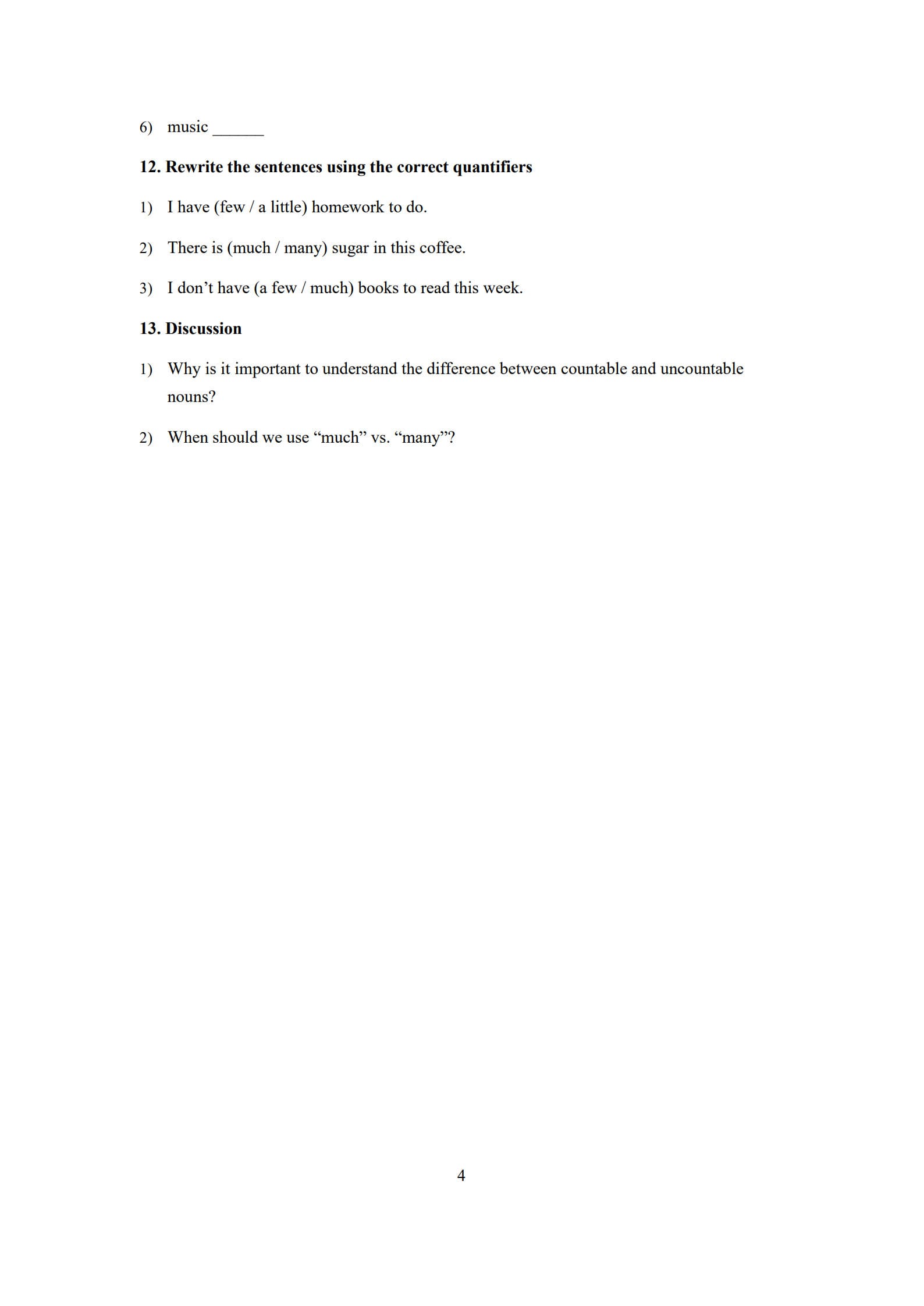
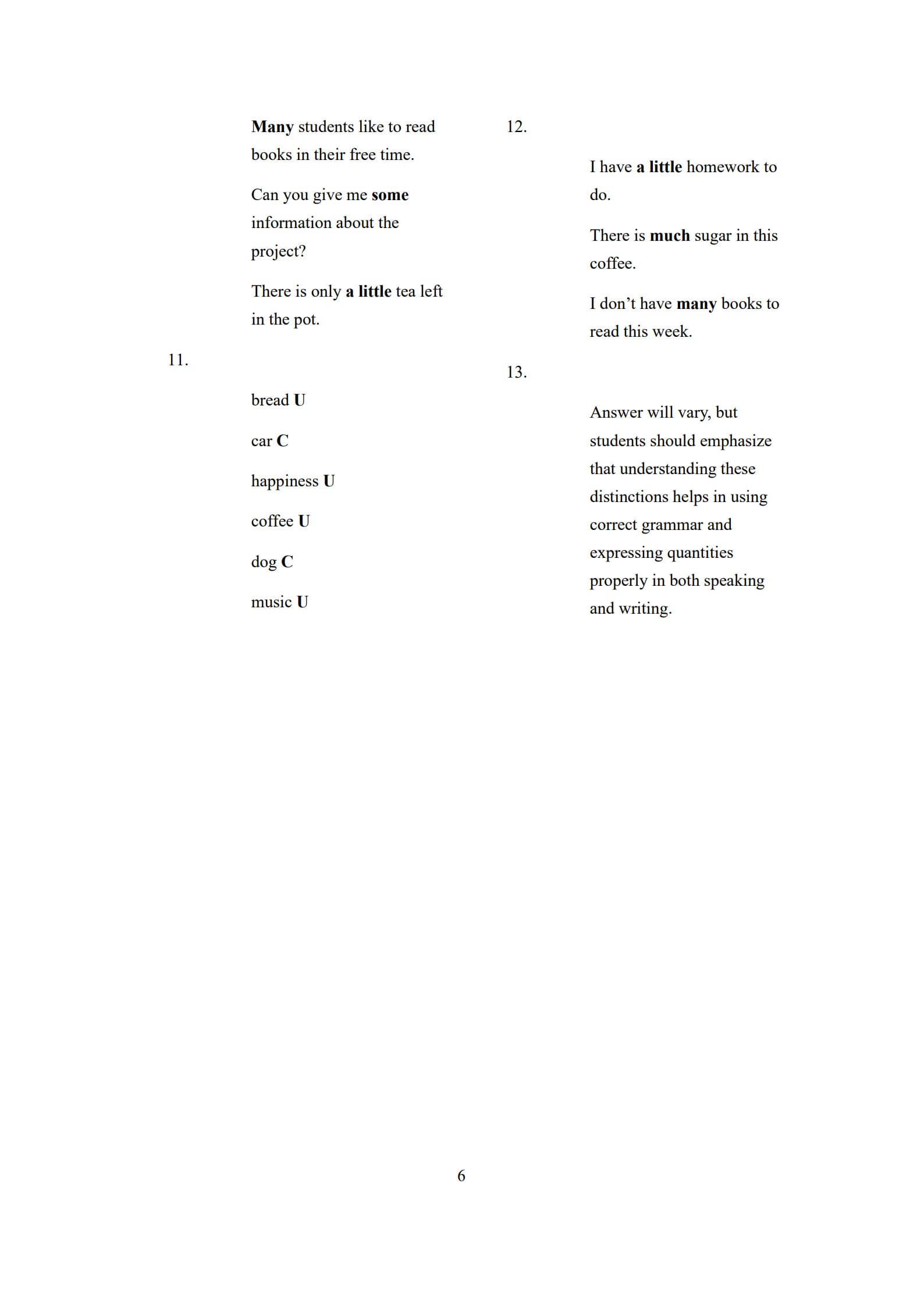
Advanced learners will appreciate Section 11’s identification exercise, where you classify nouns like “bread,” “happiness,” and “music” as countable (C) or uncountable (U). This activity develops your analytical skills by challenging you to think beyond concrete objects to abstract concepts—a sophisticated grammatical understanding that reflects native-speaker competence. The rewriting exercises in Section 12 further reinforce this knowledge by having you transform sentences like “I have few homework to do” into the correct “I have a little homework to do.”
Maximizing Your Practice with Countable and Uncountable Nouns Exercises PDF
Our countable and uncountable nouns exercises pdf format offers unparalleled flexibility for diverse learning styles and situations. The digital template allows you to practice anywhere—on your commute, during breaks, or in dedicated study sessions. The PDF format preserves the carefully designed layout that supports visual learning, with clear sections, organized spacing, and logical flow that enhances comprehension and retention.
The template’s structure accommodates different learning approaches. If you prefer systematic study, you can work through the sections sequentially from beginner to advanced levels. If you need targeted practice, you can jump directly to specific sections like quantifiers or correction exercises. This adaptability makes the resource valuable for both classroom use and self-study, serving learners at different proficiency levels within the same document. The inclusion of an answer key enables immediate feedback, crucial for independent learning environments.
What truly sets this resource apart is its balance of comprehensiveness and conciseness. The worksheet covers all essential aspects of countable and uncountable nouns without overwhelming learners. Each exercise serves a specific purpose, eliminating unnecessary repetition while ensuring adequate practice. The realistic language examples throughout the template mean you’re learning grammar in context, which research shows leads to better retention and application than isolated rule-memorization.
How to Use This Template on PDF Agile: A Step-by-Step Guide
Accessing and customizing our Countable and Uncountable Nouns Worksheet is simple with PDF Agile’s intuitive platform. Follow these four steps to begin your grammar improvement journey:
Step 1: Download the Countable and Uncountable Nouns Worksheet Template
Visit the PDF Agile Template Library and search for “Countable and Uncountable Nouns Worksheet.” Click “Use Template” to instantly access the pre-formatted document. The template comes organized with clear sections, examples, and exercises—ready for immediate use.
Step 2: Customize for Your Learning Needs
Personalize the worksheet by adding your name and date in the designated fields. PDF Agile’s editing tools allow you to highlight key sections, add notes, or modify examples to match your specific learning goals. The flexible format supports both digital completion and printing for traditional pencil-and-paper practice.
Step 3: Complete the Exercises and Check Answers
Work through the three levels—beginner, intermediate, and advanced—at your own pace. Use the integrated answer key to self-assess your progress. PDF Agile’s annotation features enable you to mark corrections directly on the document, creating a visual record of your improvement.
Step 4: Save, Review, and Revisit
Save your completed worksheet for future reference. Return to challenging sections periodically to reinforce your learning until the concepts become second nature.
Conclusion
Mastering countable and uncountable nouns is more than an academic exercise—it’s a gateway to fluent and accurate English communication. Our carefully designed worksheet template transforms this challenging grammatical concept into an achievable learning goal through structured exercises, realistic examples, and progressive difficulty levels. The PDF Agile platform enhances this learning experience with customizable features that adapt to your individual needs and learning style.
With PDF Agile’s Countable and Uncountable Nouns Worksheet, you have everything you need to turn grammar challenges into strengths. Start your journey toward more precise and effective English communication today.