

Have you ever wondered why “teacher” is written in lowercase, but “Mr. Higgins” starts with a capital letter?
You’re not alone! Mastering the distinction between common and proper nouns is a fundamental step toward polished and accurate English writing. It’s the difference between referring to any city (a common noun) and the specific, vibrant metropolis of “New York City” (a proper noun). This knowledge instantly elevates your grammar, making your writing clearer and more professional.
This essay will not only clarify the rules of common and proper nouns but also show you how to use the pre-designed Common and Proper Nouns Practice Worksheet template in PDF Agile, turning grammar practice into an engaging and effective learning experience. Let’s dive in and demystify these essential building blocks of the English language!
What Are Definitions of a Common Noun and a Proper Noun?
Before we practice, let’s get the definitions straight. Think of nouns as the names we give to everything around us.
A Common Noun is a general, non-specific name for a person, place, animal, or thing. It’s a category. For example, the word “teacher” is a common noun. It doesn’t point to one specific individual but to anyone in that profession. Similarly, car, park, and city are all common nouns. They are the “everyday” names for things.
A Proper Noun is the unique, specific name of a particular person, place, organization, or sometimes thing. It acts as an official title. For instance, while teacher is common, Mr. Higgins is a proper noun—it’s the specific name of a particular teacher. Central Park isn’t just any park; it’s a famous park in New York City. Proper nouns are like the unique fingerprints of the noun world.
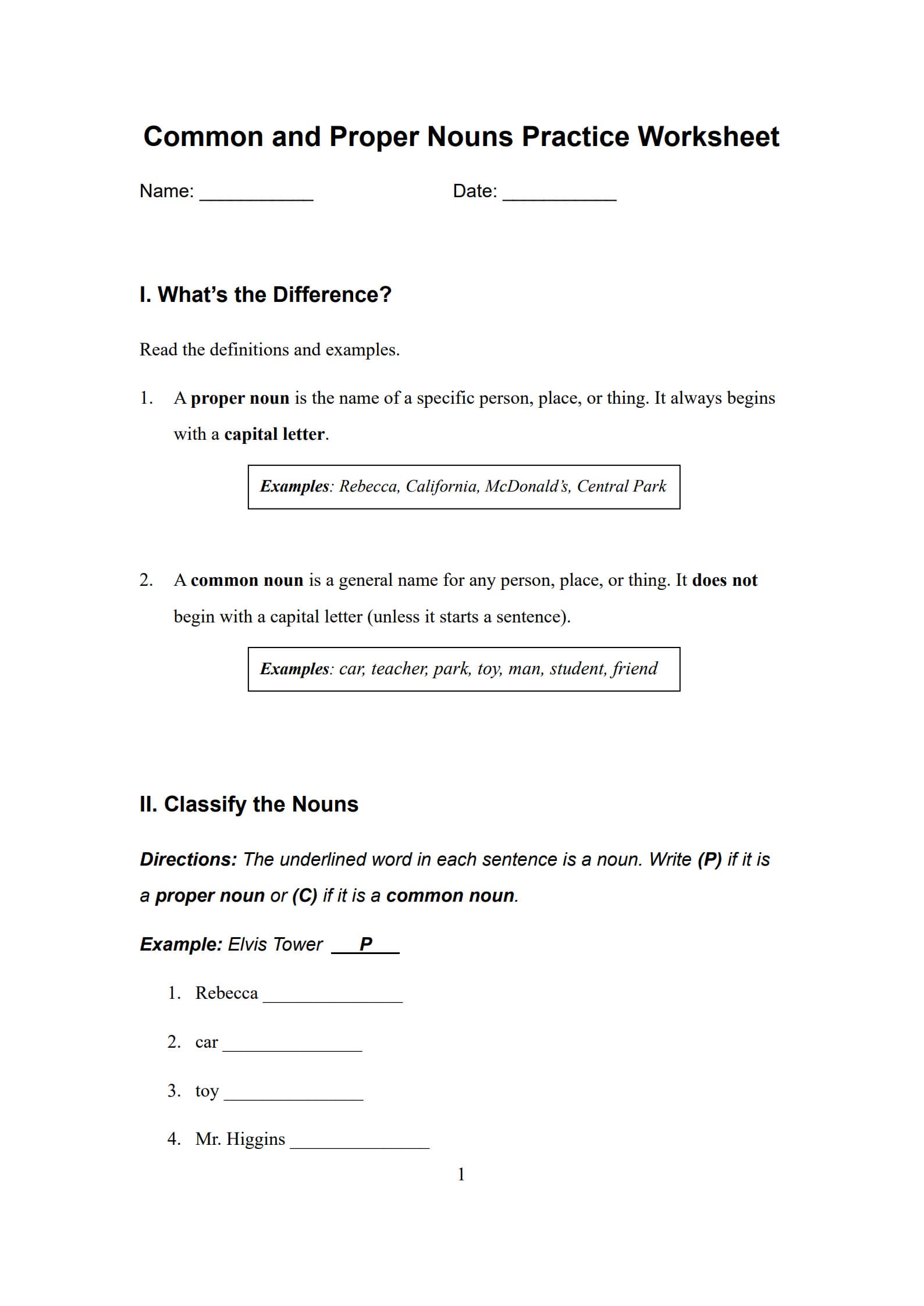
In the PDF Agile template, you’ll see these definitions clearly stated at the top, just like in our introduction, providing a perfect reference point as you work through the exercises.
What are Rules and Practicing Examples for Capitalizing Common Nouns and Proper Nouns?
The most important rule is simple: Always capitalize the first letter of a proper noun.
This capitalization rule is the primary visual clue that distinguishes a proper noun from a common one.
- Common Noun (Lowercase):
e.g., I drove my car to the park.
Proper Noun (Capitalized):
e.g., I drove my Toyota to the park.
Let’s look at more examples from our worksheet template:
| Common Noun (General, lowercase) | Proper Noun (Specific, Capitalized) |
|---|---|
| woman, teacher | Rebecca, Mr. Higgins |
| state, river | California, Mississippi River |
| restaurant, park | McDonald’s, Central Park |
| team, class | Boston Celtics, Period 3 Science |
IMPORTANT tip:
A common noun is only capitalized when it is the first word in a sentence!
e.g., “The teacher entered the classroom.”
Here, “The” is capitalized because it starts the sentence, but “teacher” remains a common noun.
TEN Questions to Quickly Identify a Common or Proper Noun Within a Sentence:
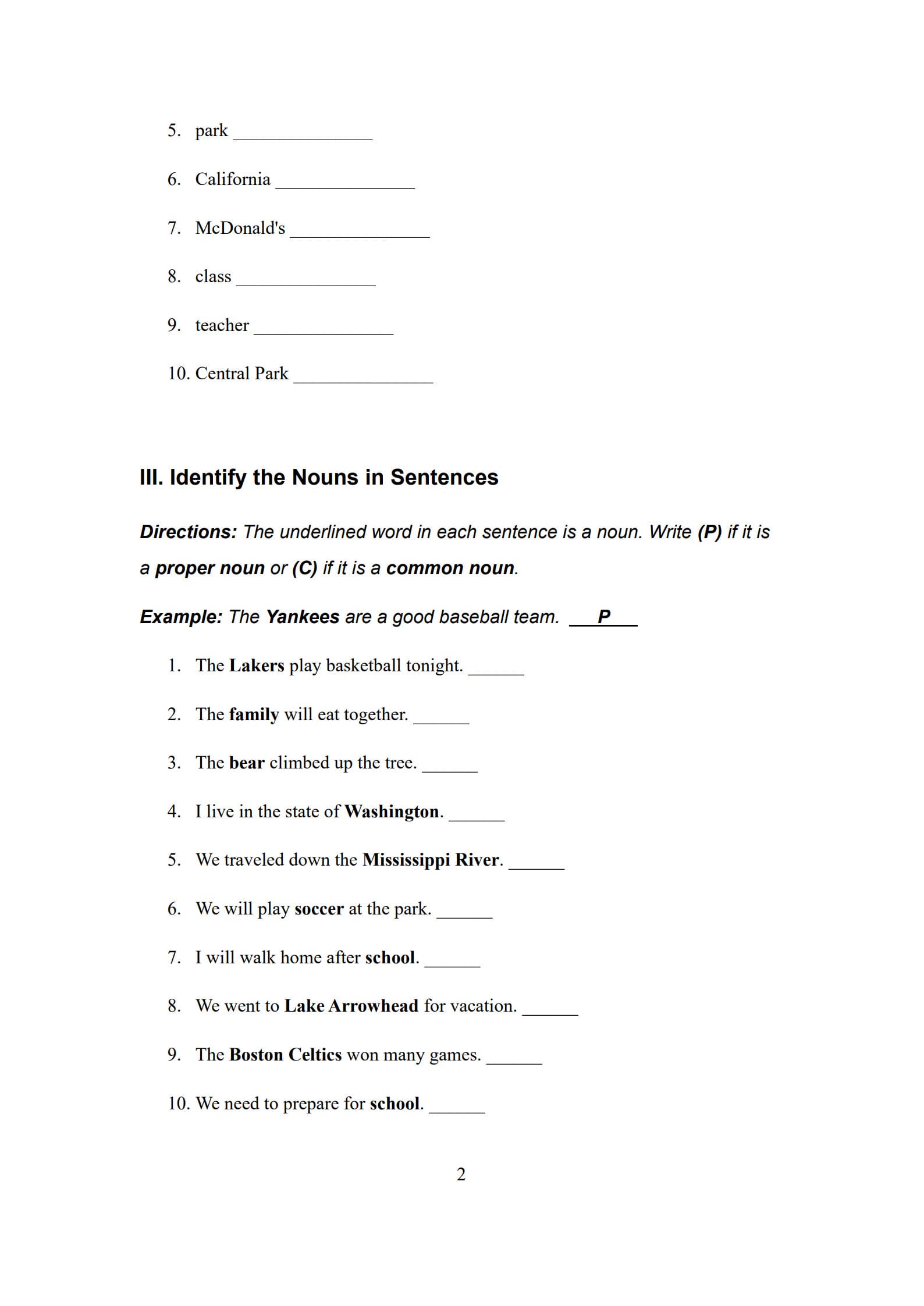
The best way to learn is by doing. The “Identify the Nouns in Sentences” section of our PDF Agile template is designed for this exact purpose. Here is a set of questions for you to test your skills. Try to answer each one before moving on. The answers are provided at the end of this article for you to check your work.
QUESTIONS: Write (P) if it is a proper noun or (C) if it is a common noun.
- The Lakers play basketball tonight. ______
- The family will eat together. ______
- The bear climbed up the tree. ______
- I live in the state of Washington. ______
- We traveled down the Mississippi River. ______
- We will play soccer at the park. ______
- I will walk home after school. ______
- We went to Lake Arrowhead for vacation. ______
- The Boston Celtics won many games. ______
- We need to prepare for school. ______
How to Use a Common and Proper Nouns Practice Worksheet with Template?
Using PDF Agile’s pre-designed template makes practicing grammar simple and efficient. Here’s how you can get started in just a few steps:
Step 1: Access the Common and Proper Nouns Worksheet Template
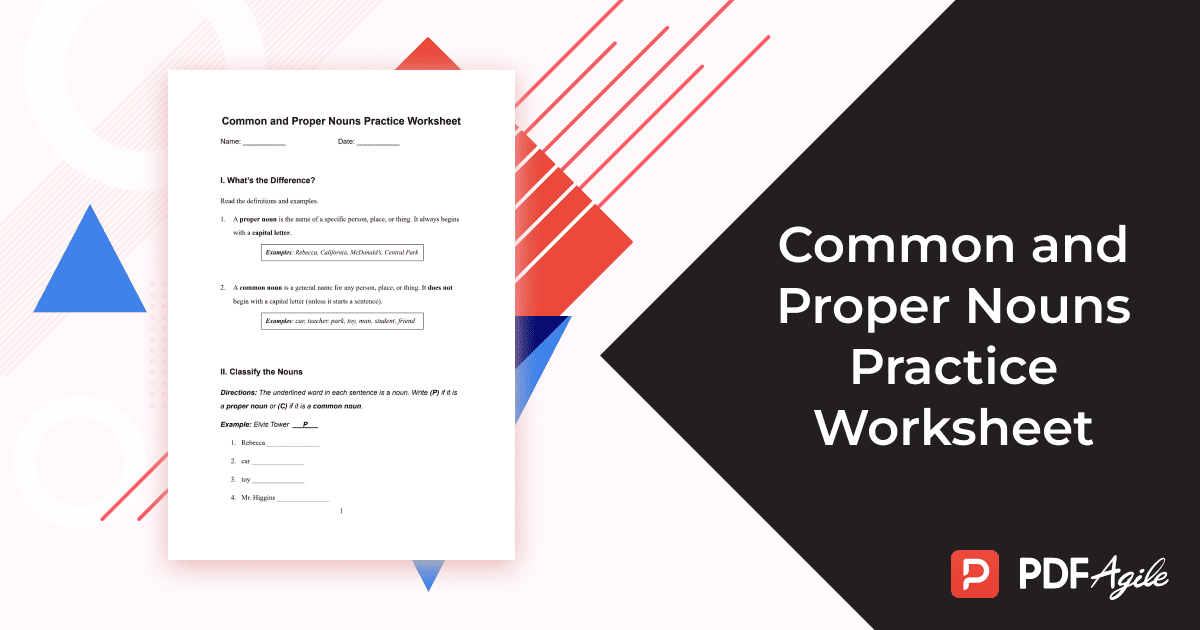
Open the PDF Agile app and navigate to the Template Library. Search for “Common and Proper Nouns Practice Worksheet” or browse the “Education” category. You’ll find the template, which is already formatted with clear instructions and exercises, just like the document shown at the beginning of this essay. Click “Use Template” to instantly create your own copy.
Step 2: Complete the Exercises Directly on Your Device
This is where the fun begins! PDF Agile allows you to type directly into the worksheet.
- Go to the “Classify the Nouns” section. For words like Rebecca, car, and California, simply click on the blank line and type P for Proper or C for Common.
- Next, move to the “Identify the Nouns in Sentences” section. Read each sentence carefully and type your answer (P or C) on the corresponding line.
Step 3: Utilize PDF Agile’s Tools for Enhanced Learning
Make the most of the app’s features:
- Highlighting Tool: Use the highlighter to mark key words in the definitions or the sentences. For example, you could highlight all the proper nouns in one color and common nouns in another.
- Notes Function: If you want to remind yourself why you chose a particular answer, use the sticky note tool to add a comment. For instance, next to “Lake Arrowhead,” you could add a note: “Specific name of a lake = Proper Noun.”
Step 4: Save, Share, or Print Your Completed Worksheet
Once you’ve finished the exercises, save your work. You can save it as a filled-out PDF for your personal records. If you’re studying with a friend or a teacher, use the “Share” function to send them a copy for review. You can also print the worksheet if you prefer a physical copy.
Mistakes with Examples to Avoid in Identifying Common and Proper Nouns
Even with clear rules, a few common pitfalls can trip up learners. Be mindful of these:
- Mistake 1: Capitalizing Common Nouns in the Middle of a Sentence.
- Incorrect: I saw a Bear in the Park.
- Correct: I saw a bear(C) in the park(C).
- Why: Unless it’s the start of a sentence, common nouns like bearand parkremain lowercase.
- Mistake 2: Forgetting to Capitalize All Parts of a Proper Noun.
- Incorrect: We visited central park.
- Correct: We visited Central Park(P).
- Why: Both words in “Central Park” form the specific name and must be capitalized.
- Mistake 3: Confusing a Job Title (Common) with a Specific Person’s Name (Proper).
- Incorrect: “Hello, Teacher!” (if you are addressing Mr. Higgins directly).
- Correct: “Hello, Mr. Higgins!” (P) or “The teacher(C) is here.”
- Why: “Teacher” is common, but the specific name “Mr. Higgins” is proper.
FAQs about Common Nouns and Proper Nouns
Q1: Are the names of days and months common or proper nouns?
A1: They are proper nouns because they are the specific names of days and months. Always capitalize them.
- Example: Monday, October.
Q2: What about the names of subjects in school, like “english” or “history”?
A2: This is tricky! Subject names are common nouns unlessthey are language names. Language names are proper nouns.
- Common Nouns: I love history and science.
- Proper Nouns: I am studying English and Spanish.
Q3: Is “mom” or “dad” a common or proper noun?
A3: It depends on how you use it. If you use it as a name (like a substitute for their actual name), it becomes a proper noun. Otherwise, it’s common.
- Common: My mom is a doctor. (Here, “my” shows it’s not being used as a name).
- Proper: Can you help me, Mom? (Here, you are directly addressing her as “Mom,” making it a proper noun).
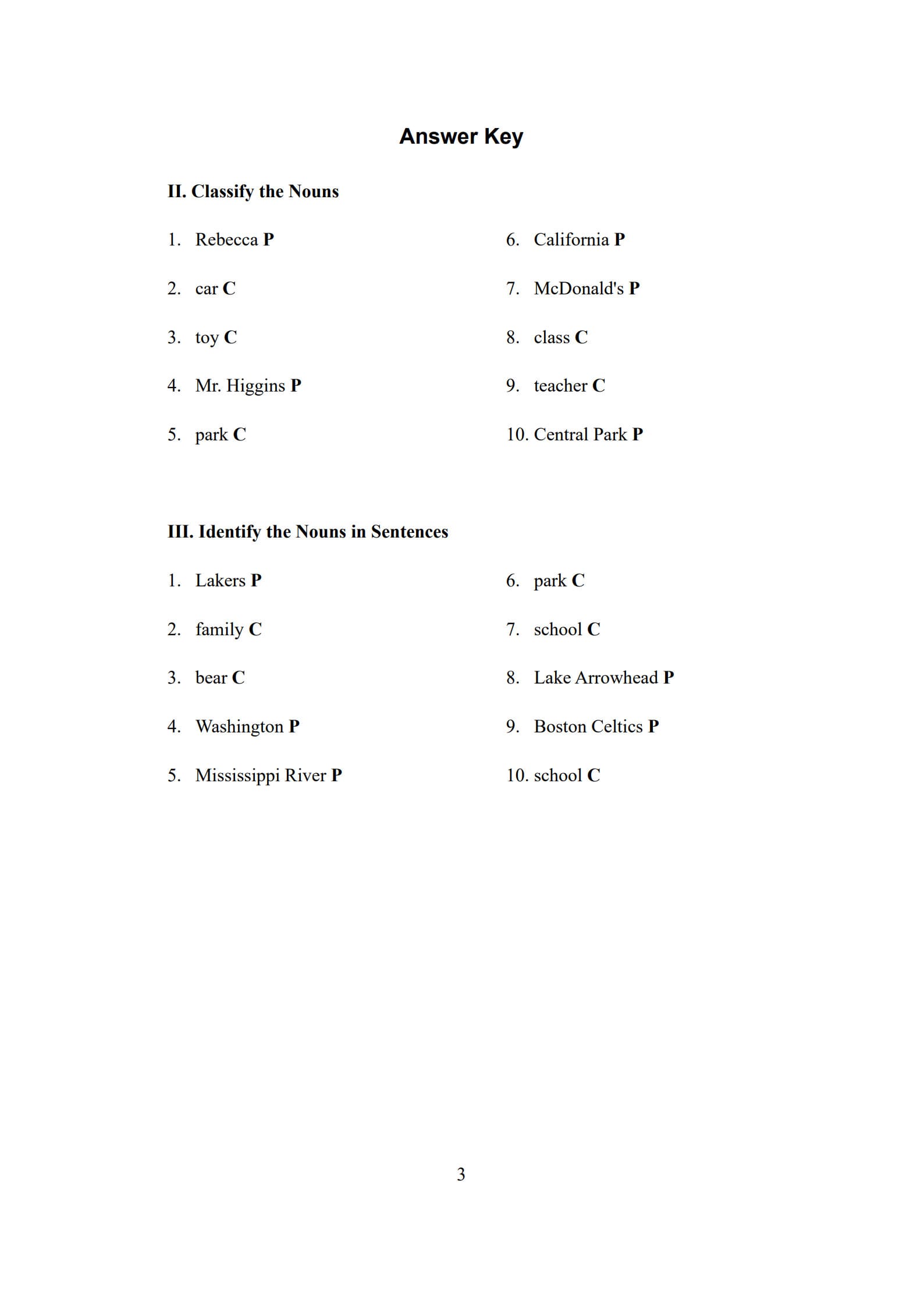
Quick Check for TEN Questions:
- The Lakers play basketball tonight. P
- The family will eat together. C
- The bear climbed up the tree. C
- I live in the state of Washington. P
- We traveled down the Mississippi River. P
- We will play soccer at the park. C
- I will walk home after school. C
- We went to Lake Arrowhead for vacation. P
- The Boston Celtics won many games. P
- We need to prepare for school. C
Conclusion
Understanding common and proper nouns is more than a grammar exercise—it’s a key to precise and effective communication. By consistently applying the simple rule of capitalization, you can significantly improve the clarity and professionalism of your writing.
With the Common and Proper Nouns Practice Worksheet template in PDF Agile, you have a powerful, interactive tool at your fingertips. It transforms abstract rules into tangible practice, providing immediate application and reinforcement. So, don’t just read about grammar—experience it. Open PDF Agile, find the template, and start your journey to mastering English nouns today. Your path to confident writing is just a few clicks away.