

Want to cut your reading time in half while boosting comprehension?
English learners can accelerate their skills using our specially designed PDF Agile template! The secret isn’t reading faster—it’s reading smarter!
Find Your Starting Point (30-Second Assessment)
Answer these questions to begin at the right level:
When reading English, do you:
- Struggle with basic sentences? → Start with “Busy Bees” (K1-3)
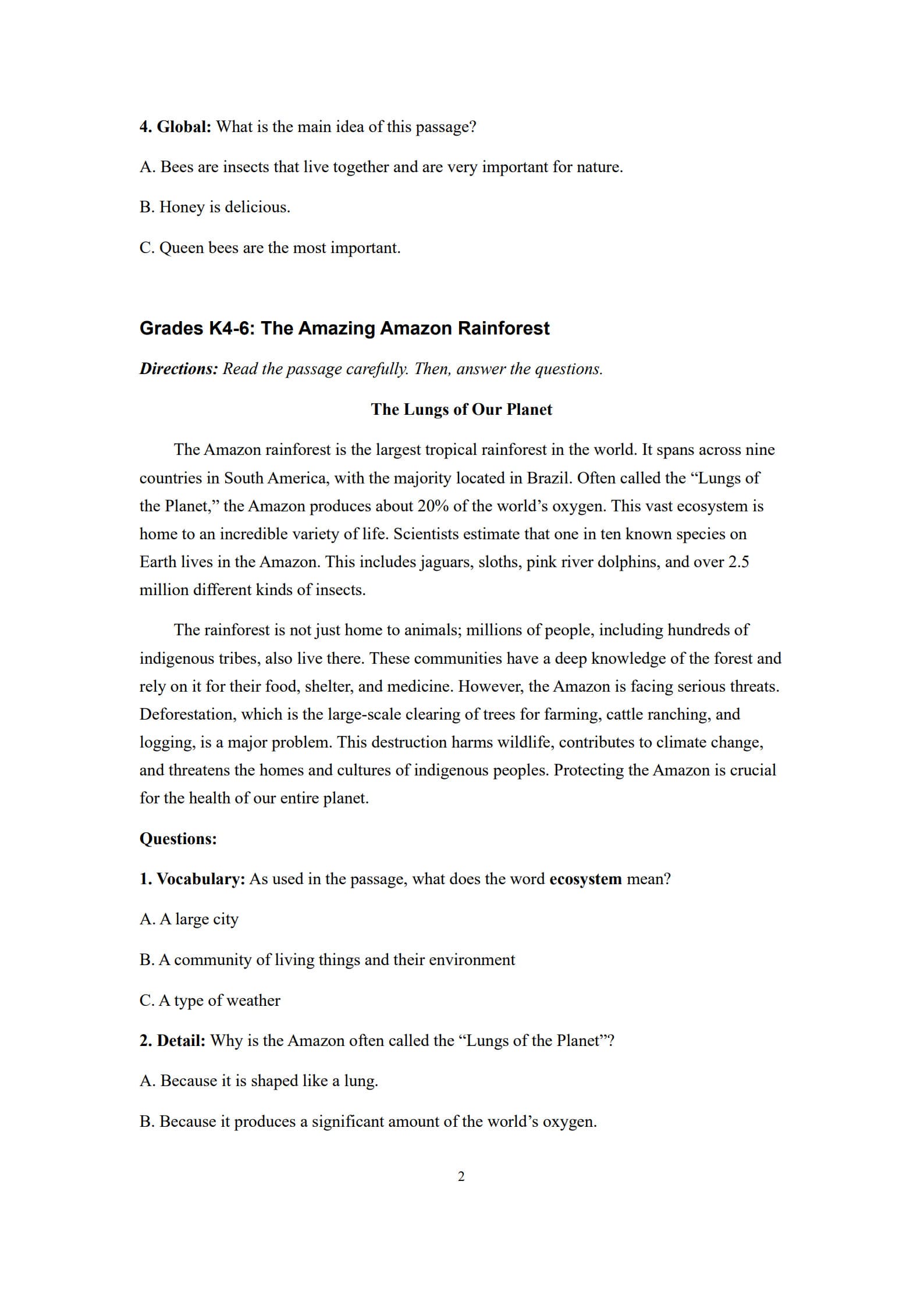
- Understand simple articles but miss details? → Start with “Amazon Rainforest” (K4-6)
- Handle everyday texts but struggle with academic content? → Start with “Industrial Revolution” (K7-9)
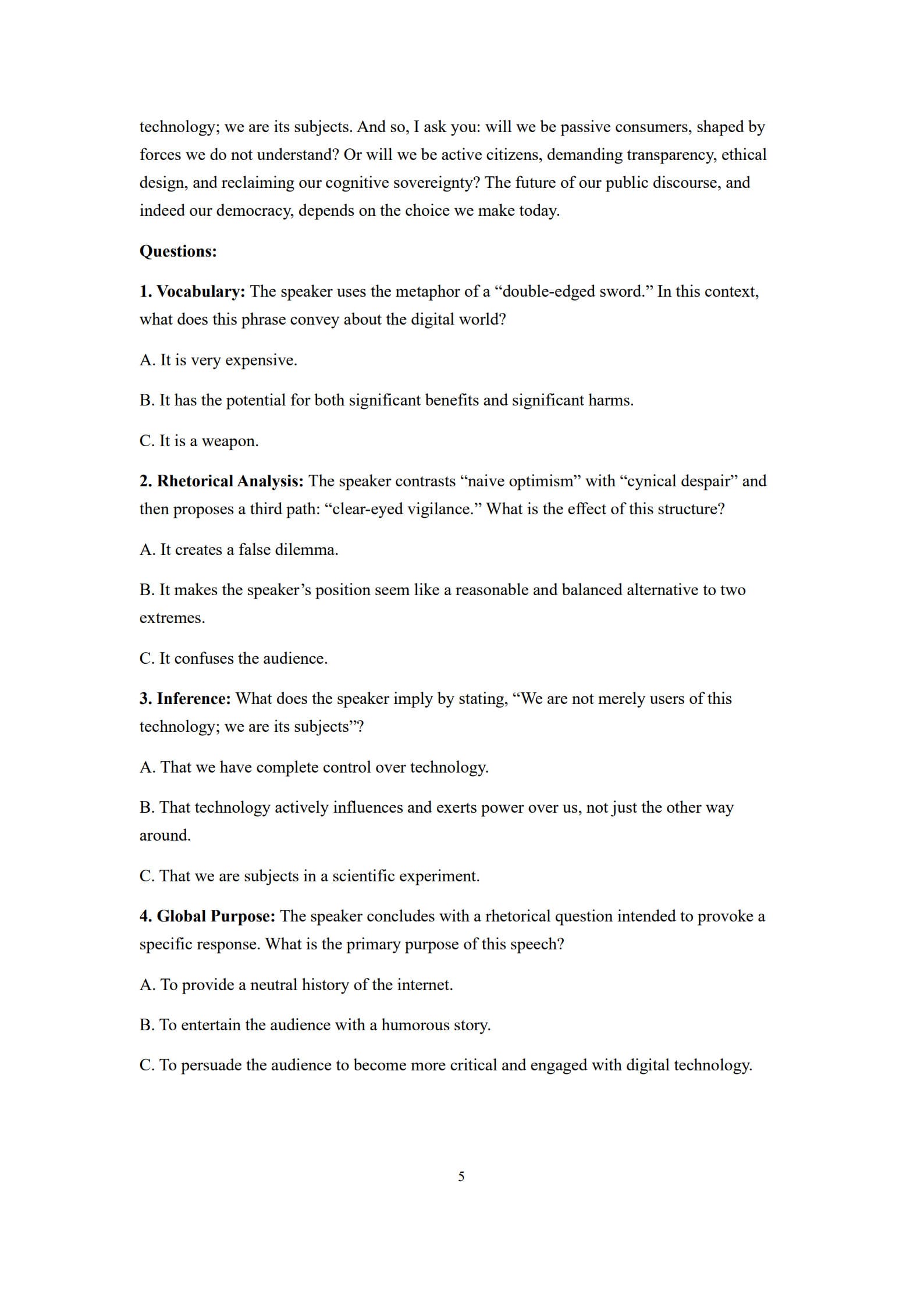
- Read well but need advanced analysis skills? → Start with “Digital Responsibility” (K10-12)
Your biggest challenge is:
- Vocabulary → Focus on context clues
- Understanding main ideas → Practice summarization
- Answering questions correctly → Master question types
- Speed → Use timed practice
The 3-Step Speed Comprehension Method That Works Immediately
Step 1: The 60-Second Pre-Read Power Scan
This one habit can double your comprehension speed overnight
Instead of: Reading passively from beginning to end
Try this: Scan the passage in this order:
- Read the title and first sentence
- Skim the questions (30 seconds)
- Read the last paragraph (20 seconds)
- Now read the full text with purpose
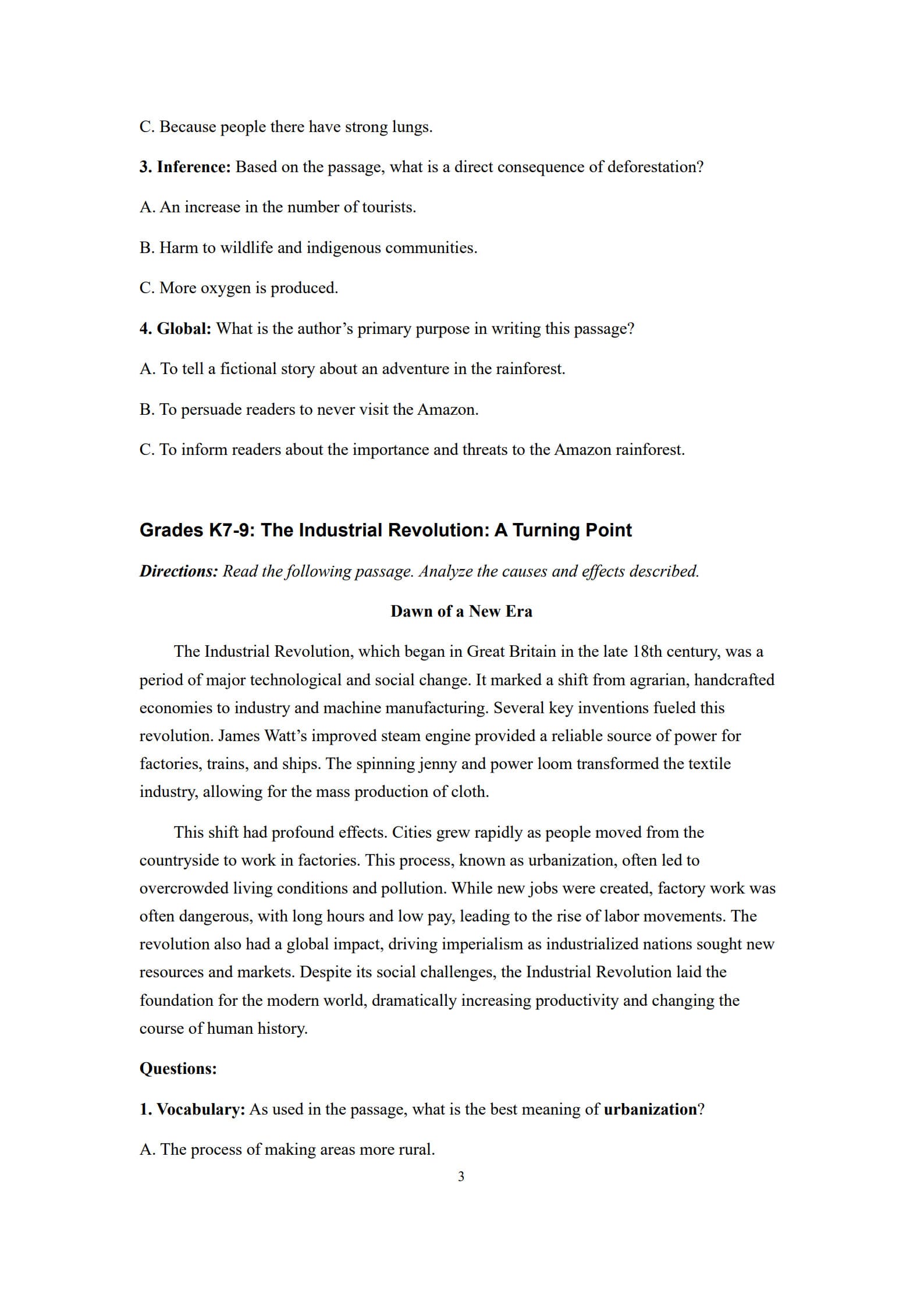
Real example from our “Amazon Rainforest” passage:
Title reveals topic: “The Amazing Amazon Rainforest”
Questions show what matters: oxygen production, deforestation, ecosystem
Your brain now knows what to look for = faster, more accurate reading
Step 2: Active Reading with the 3-Question Technique
As you read ANY passage, constantly ask:
- What’s happening? (Main events/ideas)
- Why does it matter? (Purpose/significance)
- How do I know? (Evidence in text)
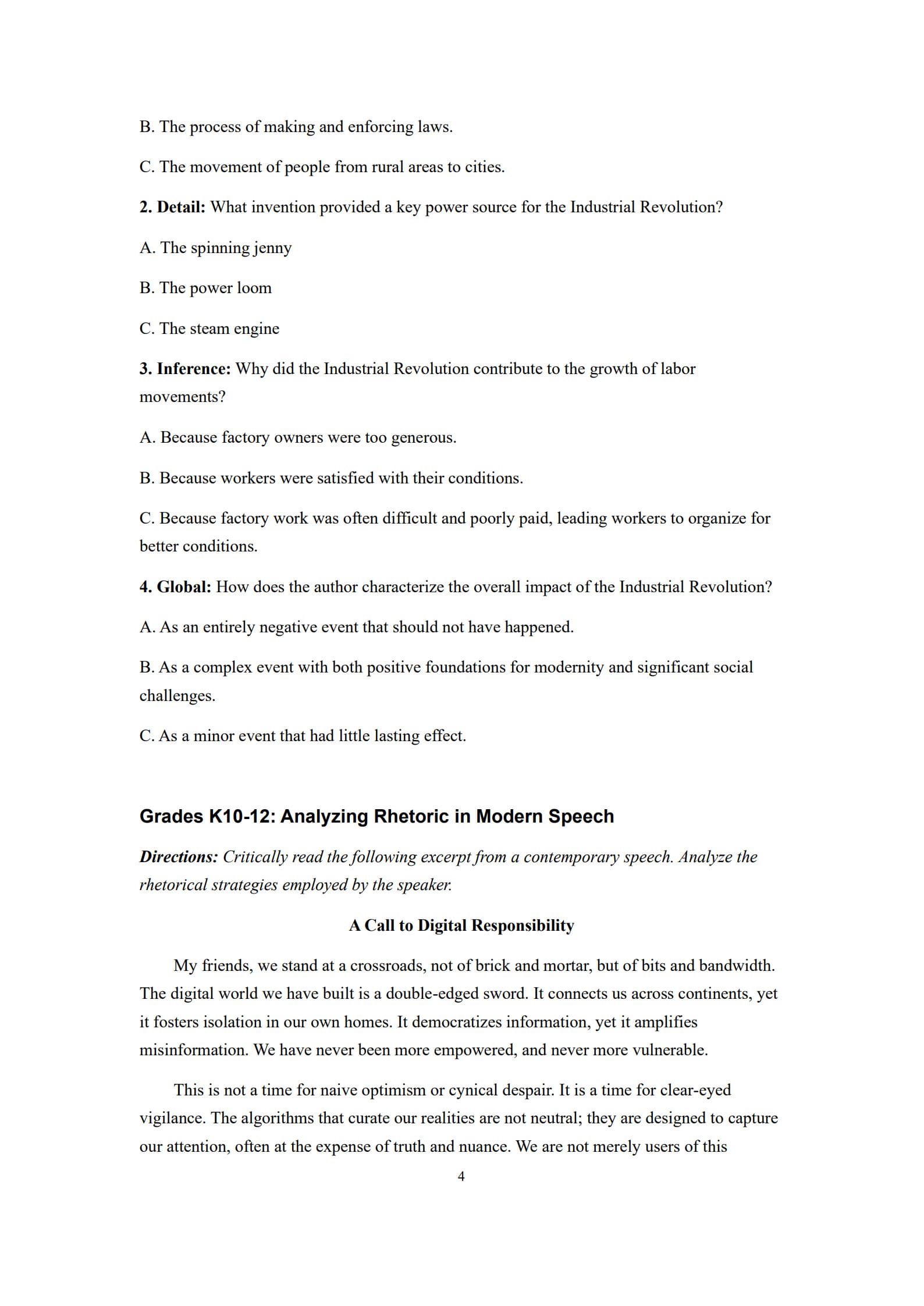
Practice with “Industrial Revolution” passage:
What’s happening? Shift from farming to factories
Why matters? Changed society and work conditions
How know? Specific inventions mentioned (steam engine, etc.)
Step 3: The 30-Second Answer Strategy
Stop wasting time on confusing questions
The Elimination Race Technique:
Seconds 0-10: Try answering from memory
Seconds 10-20: Scan for keywords if unsure
Seconds 20-30: Eliminate obviously wrong options
Example from template:
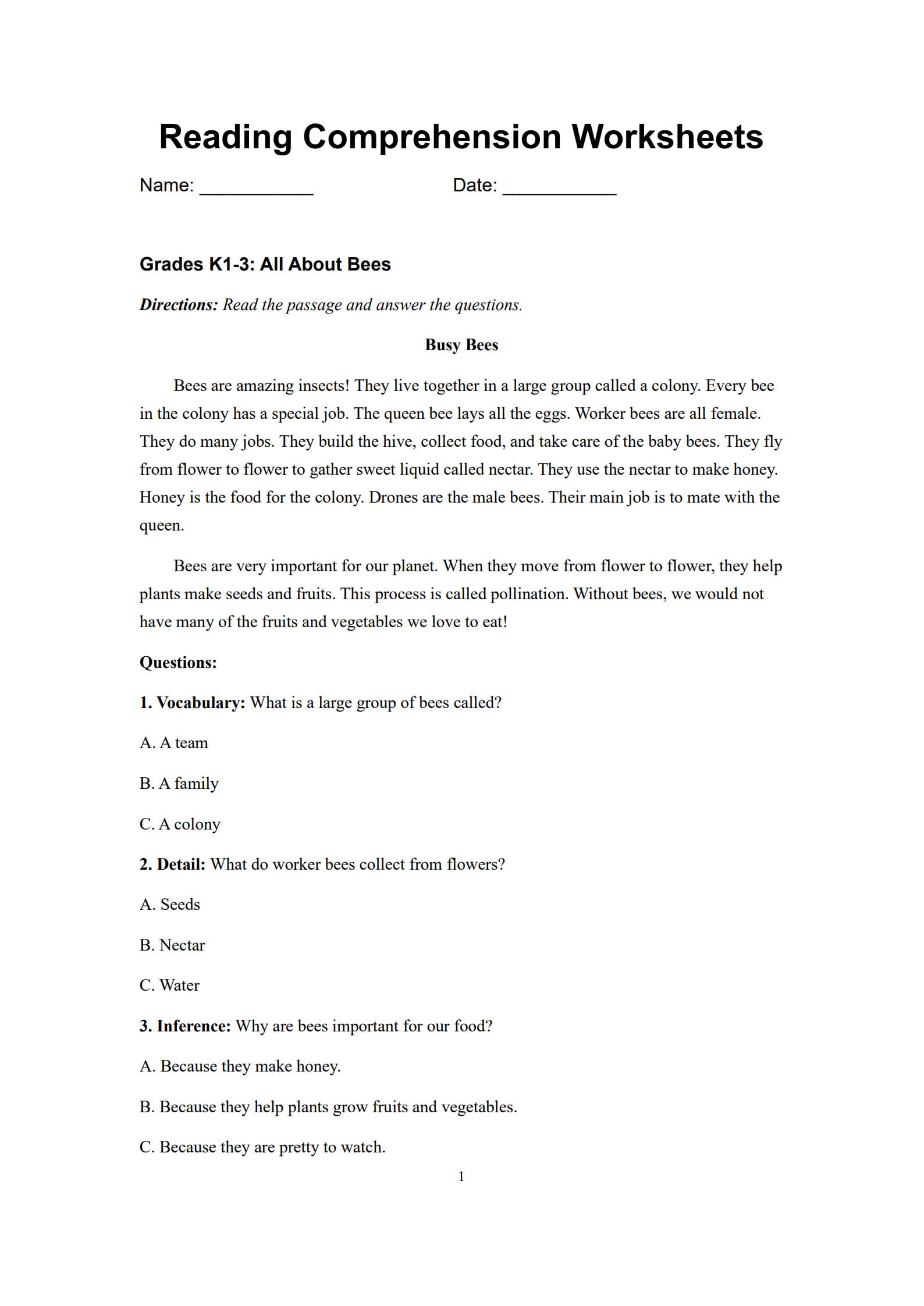
“Why are bees important for our food?”
- Because they make honey (partial answer)
- Because they help plants grow fruits and vegetables (complete answer)
- Because they are pretty to watch (irrelevant)
Five Lightning-Fast Techniques for Improvement
Technique 1: Keyword Lightning Rod
Instantly spot the answers you need
Action: Circle these words in questions:
- Main/primary → Tells you to find the most important point
- Best → Means there might be multiple options, but one is superior
- Because → Requires finding a reason or cause
- However/But → Signals contrast or exception
PDF Agile Advantage: Use different colored highlighters for each question type to train your brain to recognize patterns faster.
Technique 2: Context Clue Shortcut
Decode unfamiliar words in seconds
The 10-Second Vocabulary Solution:
- Read the sentence with the unknown word
- Look for explanations (often after commas, “called,” or “meaning”)
- Substitute a similar word and keep reading
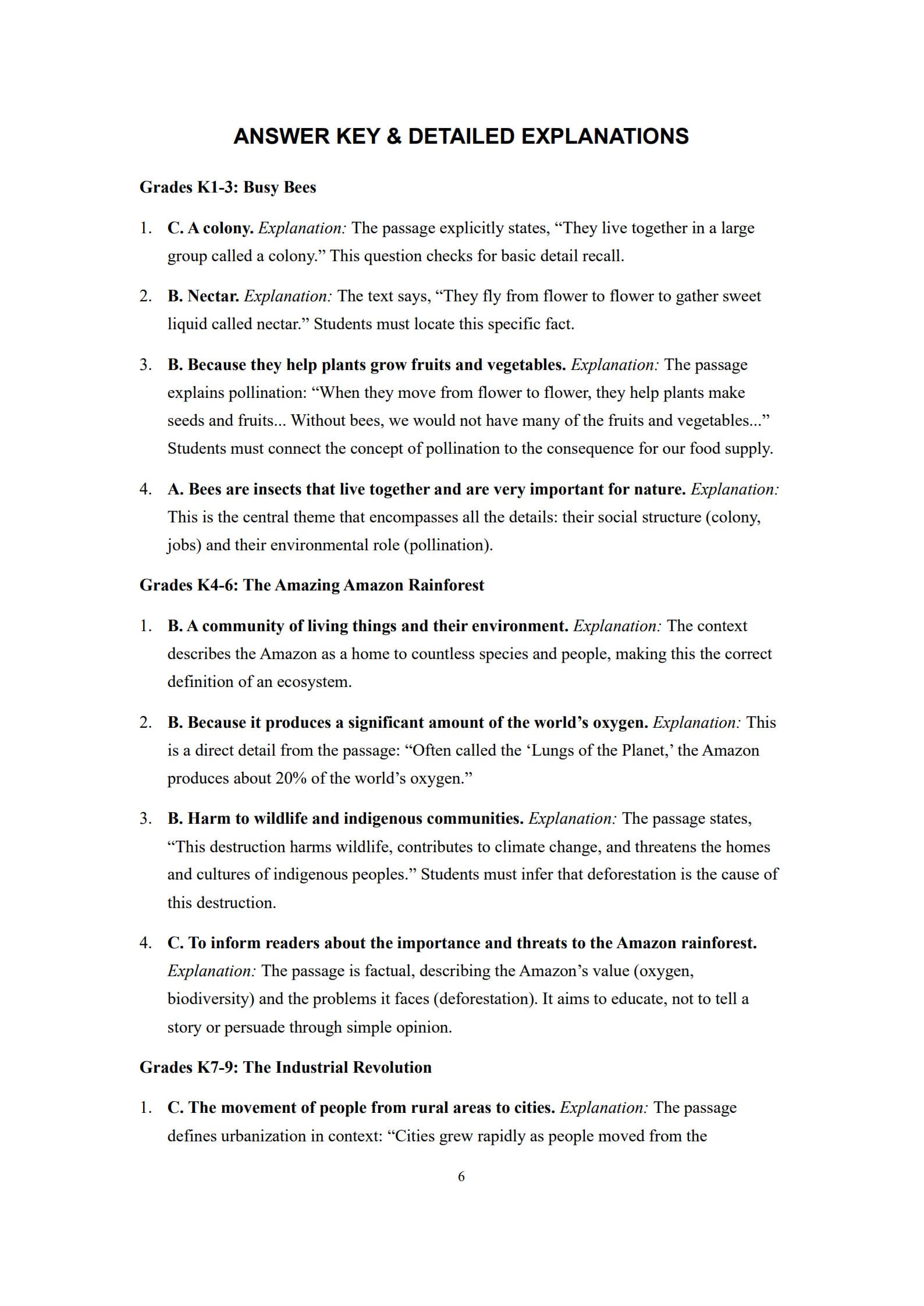
Example from “Busy Bees”:
“They help plants make seeds and fruits. This process is called pollination.”
→ Even if you don’t know “pollination,” the context tells you it’s the process of making seeds and fruits.
Technique 3: Paragraph Prediction
Prime your brain for faster understanding
Before reading each paragraph:
- Look at the first sentence
- Predict what the paragraph will discuss
- Read to confirm your prediction
Result: You engage with the text actively instead of passively, leading to better retention.
Technique 4: The 15-Second Summary Test
Ensure you actually understand what you read
After each paragraph, set a timer and summarize aloud in 15 seconds. This forces you to identify essential information and discard unimportant details.
Technique 5: Answer Elimination Race
Speed up multiple-choice decisions
Practice eliminating wrong answers within 10 seconds using these patterns:
- Too extreme: Words like “always,” “never,” “all”
- Irrelevant: Information not mentioned in the text
- Partial truth: Correct but incomplete answers
Your 7-Day Speed Comprehension Challenge
Day 1: Foundation Building (30 Minutes)
Focus: Literal comprehension
Activity: Complete “Busy Bees” passage focusing only on detail questions
Target: 100% accuracy on vocabulary and detail questions
PDF Agile Tip: Use the highlight tool to mark exact sentences containing answers
Day 2: Inference Acceleration (35 Minutes)
Focus: Reading between the lines
Activity: Practice “Amazon Rainforest” inference questions
Target: Correctly answer 2 inference questions using text evidence
Strategy: For each answer, ask “What in the text proves this?”
Day 3: Speed Drill (25 Minutes)
Focus: Timed practice
Activity: Re-try Day 1 and 2 passages against a timer
Target: Reduce completion time by 40% while maintaining accuracy
Mindset: Speed comes from familiarity, not rushing
Day 4: Analysis Breakthrough (40 Minutes)
Focus: Critical thinking
Activity: Tackle “Industrial Revolution” cause-effect questions
Target: Master 1 analytical question type completely
Technique: Create quick cause-effect charts in margins
Day 5: Advanced Application (45 Minutes)
Focus: Author’s purpose and rhetoric
Activity: Attempt “Digital Responsibility” speech analysis
Target: Correctly identify 2 rhetorical strategies
Insight: Ask “Why did the author choose these words?”
Day 6: Integration Day (30 Minutes)
Focus: Switching between question types
Activity: Mixed questions from all levels
Target: Maintain accuracy under question-type pressure
Strategy: Practice identifying question types within 5 seconds
Day 7: Mastery Demonstration (50 Minutes)
Focus: Full application
Activity: Complete entire template under timed conditions
Target: 90%+ accuracy with 25% time reduction
Celebration: Acknowledge your progress!
Track Your Progress: Watch Your Speed Soar
Use this simple scoring system:
Speed Score = (Correct Answers × 10) ÷ Time (minutes)
Day | Passage | Time | Accuracy | Speed Score |
|---|---|---|---|---|
1 | Busy Bees | 10 min | 80% | 8.0 |
3 | Busy Bees | 6 min | 95% | 15.8 |
7 | All Levels | 25 min | 90% | 3.6 |
Goal: Double your Speed Score within 7 days
Avoid These 5 Common Speed Bumps
- Reading everything equally → Focus on keywords and main ideas
- Getting stuck on hard words → Use context clues and move on
- Overthinking answers → Trust your first instinct (it’s usually right)
- Ignoring time → Practice with timer from day one
- Skipping review → Always analyze mistakes to prevent repetition
Keep Your Momentum: Next Steps
After the 7-Day Challenge:
- Week 2-3: Apply techniques to news articles
- Month 2: Challenge yourself with academic papers
Pro Tip: Set specific, measurable goals like “I will read and comprehend a 500-word article in 5 minutes with 85% accuracy by [date].”
Your Journey Starts NOW!
Today’s Action: Click “Use Template” and complete the 30-second assessment
This Week: Follow the 7-day plan exactly
Within 1 Month: Move up at least one comprehension level
Remember: Consistency beats intensity. 25 minutes daily creates faster results than 3 hours once a week.
The PDF Agile template gives you the structure. Your practice provides the speed. Together, they create reading mastery.
Conclusion
Reading comprehension isn’t an innate talent but a developable skill that opens doors to academic success, professional advancement, and personal enrichment. PDF Agile’s Reading Comprehension Worksheet Template provides the structured framework needed to build this essential competency systematically.