

Are you ready to conquer one of the most crucial topics in middle school mathematics? Fraction division often feels like a daunting hurdle, but it doesn’t have to be. With the right tools and a clear path, you can transform confusion into confidence.
PDF Agile is thrilled to present our expertly designed “Dividing Fractions Worksheet” template, created specifically to guide math learners from fundamental concepts to advanced problem-solving. This template isn’t just another worksheet; it’s a structured learning journey. It breaks down the intimidating process into manageable steps, offering clear explanations, visual aids, and progressively challenging problems.
Transform Your Understanding of Dividing Fractions Practice Problems
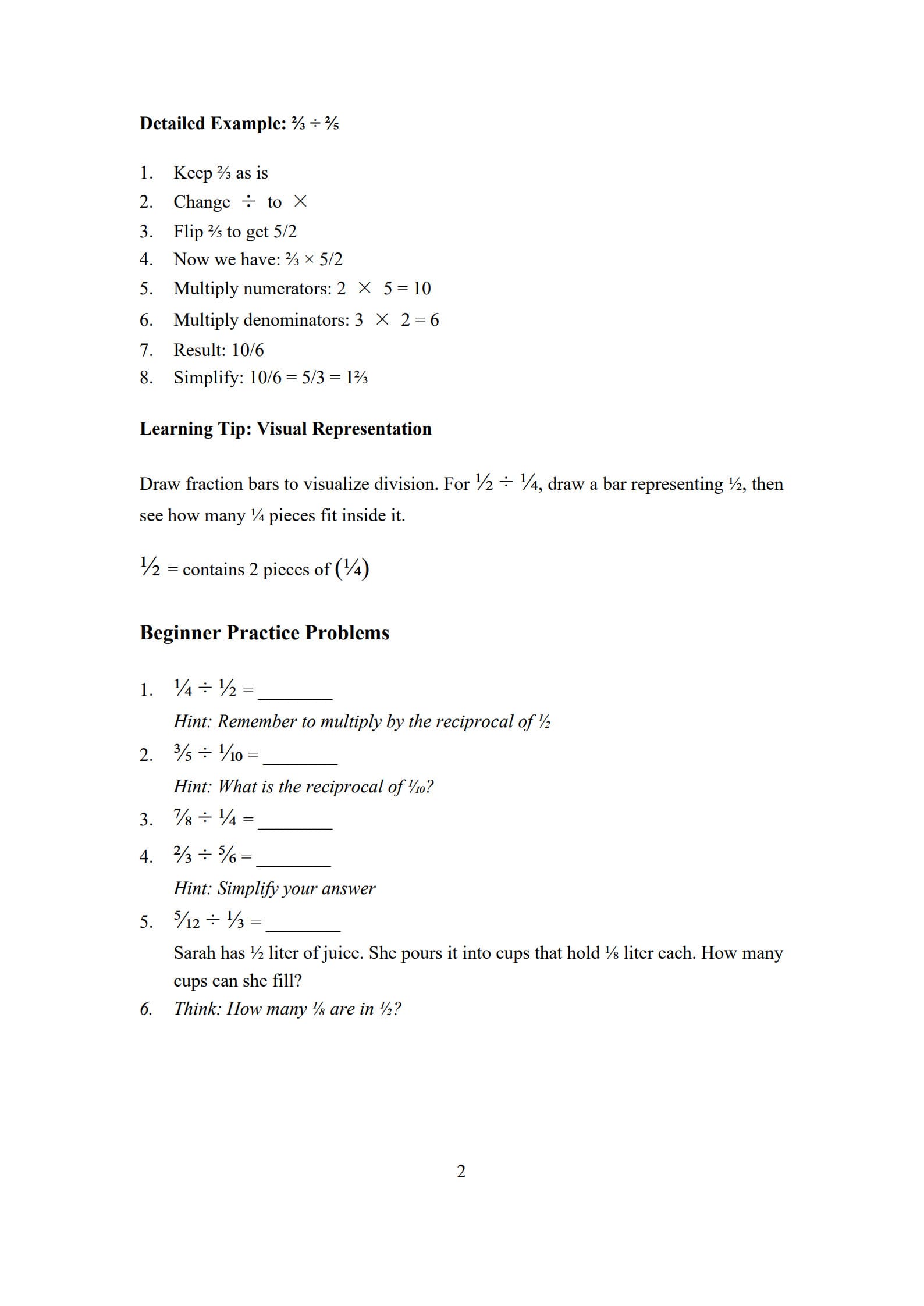
Many students memorize the “invert and multiply” rule without ever understanding why it works. Our template bridges this gap from the very beginning by focusing on the core question: “How many groups of size B fit into quantity A?” This conceptual foundation is what sets successful learners apart. For instance, the problem 1/2 ÷ 1/4is framed as “How many quarters are in one half?” This shifts the focus from a mechanical calculation to a logical, visual puzzle that you can solve intuitively.
Our worksheet emphasizes that when you divide by a fraction less than one, your answer should be larger than the dividend, which is different from whole number division. To solidify this, the template includes a “Learning Tip” on visual representation, suggesting you draw fraction bars. By visualizing a bar representing 1/2and seeing that it contains two 1/4pieces, the abstract concept becomes concrete. The following table summarizes the core conceptual shift the template facilitates, using examples directly from the dividing fractions practice problems section:
| Misconception | Template’s Conceptual Approach | Example from Template |
|---|---|---|
| Division always makes numbers smaller. | Dividing by a fraction < 1 makes the quotient larger. | 1/2 ÷ 1/4 = 2(2 is larger than 1/2) |
| “Invert and multiply” is a magic trick. | It’s a shortcut based on finding how many times the divisor fits into the dividend. | How many 1/10 are in 3/5?leads to 3/5 ÷ 1/10 = 3/5 x 10/1. |
| The answer is just a number. | The answer has a meaningful interpretation in the context of the problem. | Sarah’s juice problem: 1/2 ÷ 1/8 = 4means she can fill 4 cups. |
What is the Golden Rule for Solving Any Multiplying and Dividing Fractions Worksheets?
The cornerstone of fraction division is the Golden Rule: To divide fractions, multiply the first fraction by the reciprocal of the second. Our template presents this rule clearly as a/b ÷ c/d = a/b × d/c. But we don’t stop there. We provide a foolproof, step-by-step procedure that learners can apply to any problem, turning a complex operation into a simple, repeatable process. This structured approach is especially valuable for students working through multiplying and dividing fractions worksheets, as it highlights the intimate connection between the two operations.
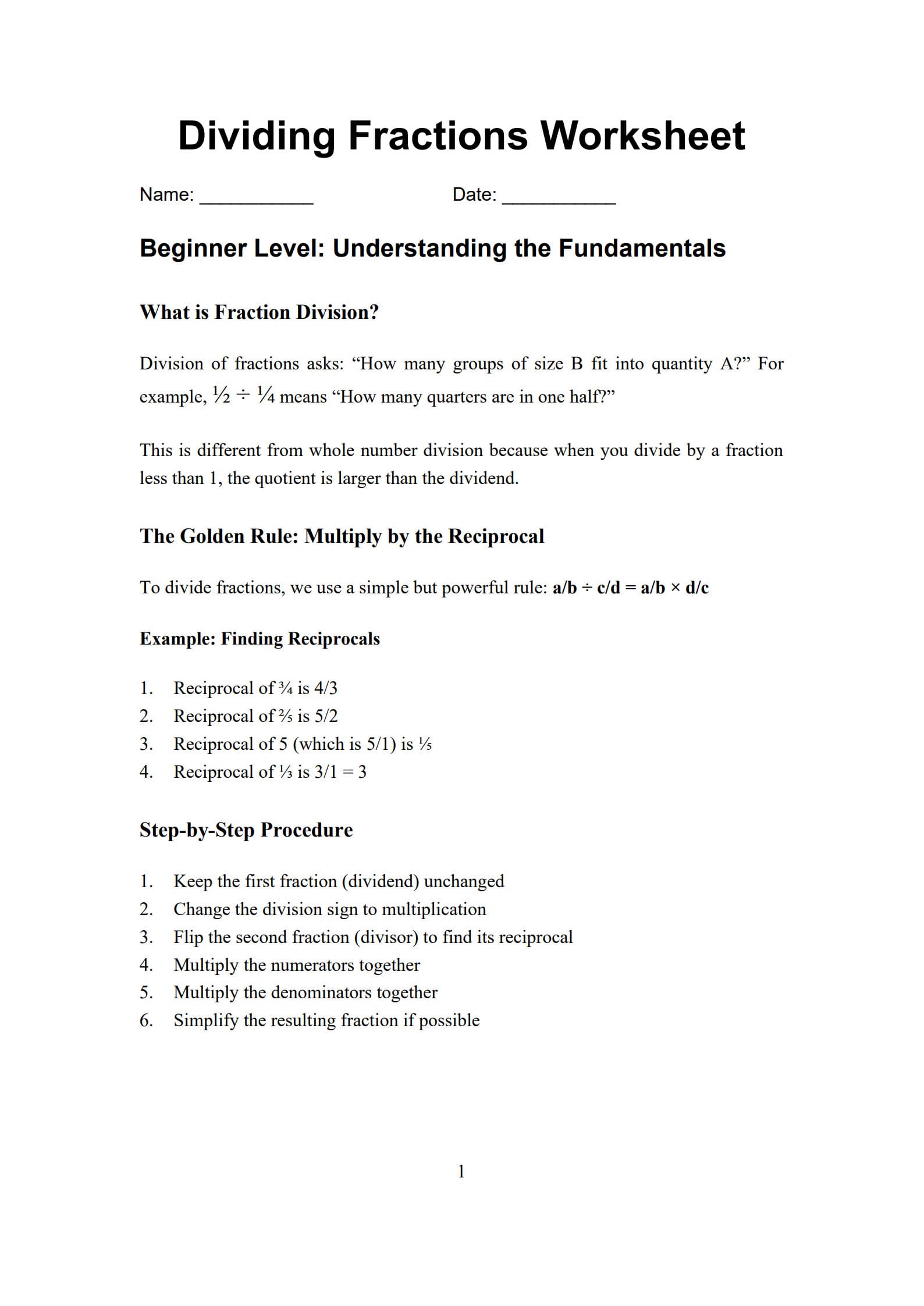
The template walks you through each step with a detailed example, 2/3 ÷ 2/5:
- Keep the first fraction (2/3) unchanged.
- Change the division sign (÷) to a multiplication sign (×).
- Flip the second fraction (2/5) to find its reciprocal (5/2).
- Multiply the numerators: 2 × 5 = 10.
- Multiply the denominators: 3 × 2 = 6.
- Simplify the resulting fraction: 10/6 = 5/3.
This meticulous breakdown ensures you never get lost. The practice problems in this section, such as 7/8 ÷ 1/4and 5/12 ÷ 1/3, are designed to reinforce this procedure until it becomes second nature. The template also includes a crucial section on finding reciprocals, ensuring you have all the prerequisite skills for success.
How Do You Tackle Real-World Division Fraction Word Problems with Confidence?
The true test of mathematical skill is application. The intermediate and advanced sections of our template are filled with division fraction word problems that simulate real-life scenarios. These problems require you to go beyond calculation and practice the essential skill of translating a word problem into a mathematical expression. This builds critical thinking and demonstrates the practical value of what you’re learning.
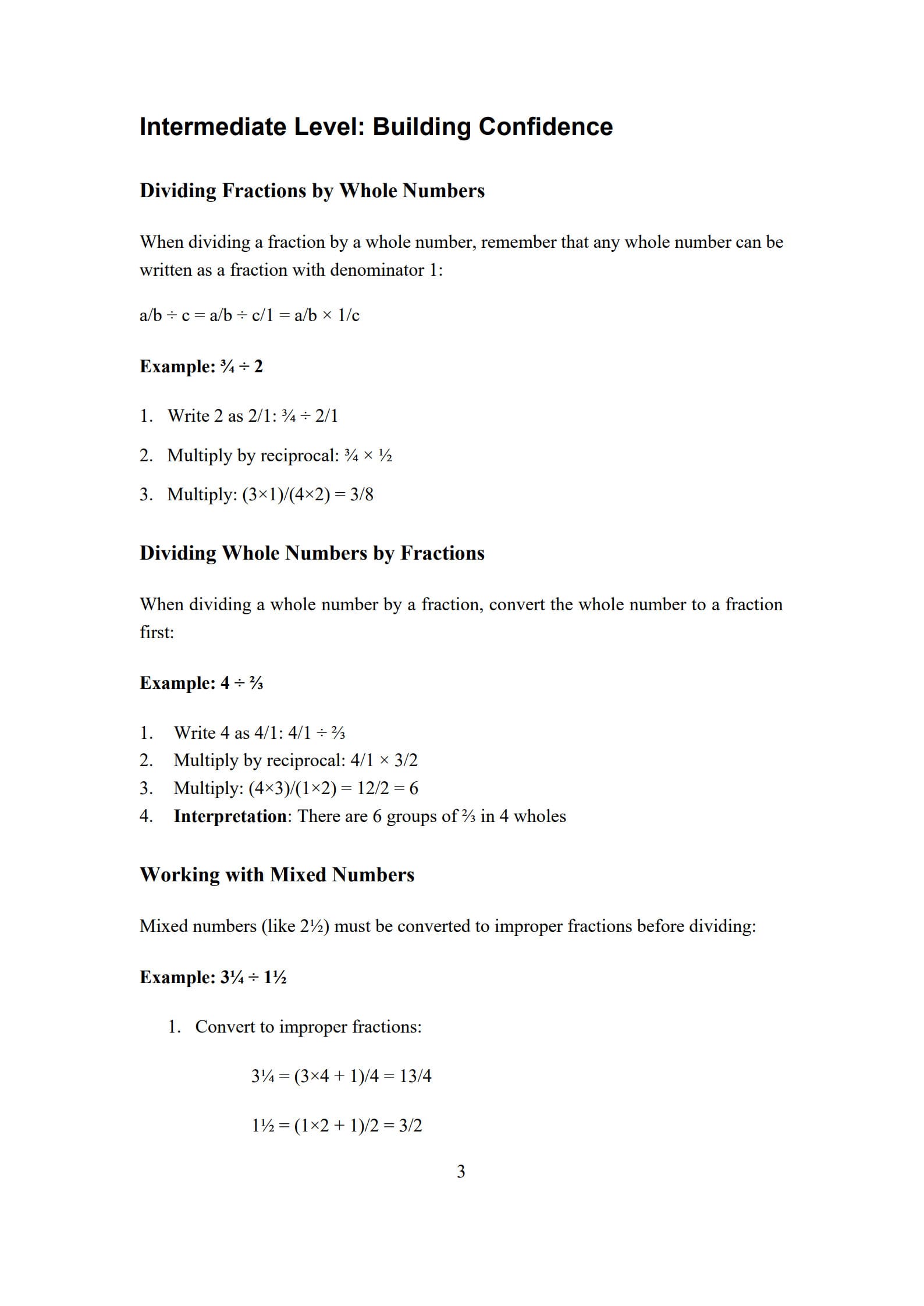
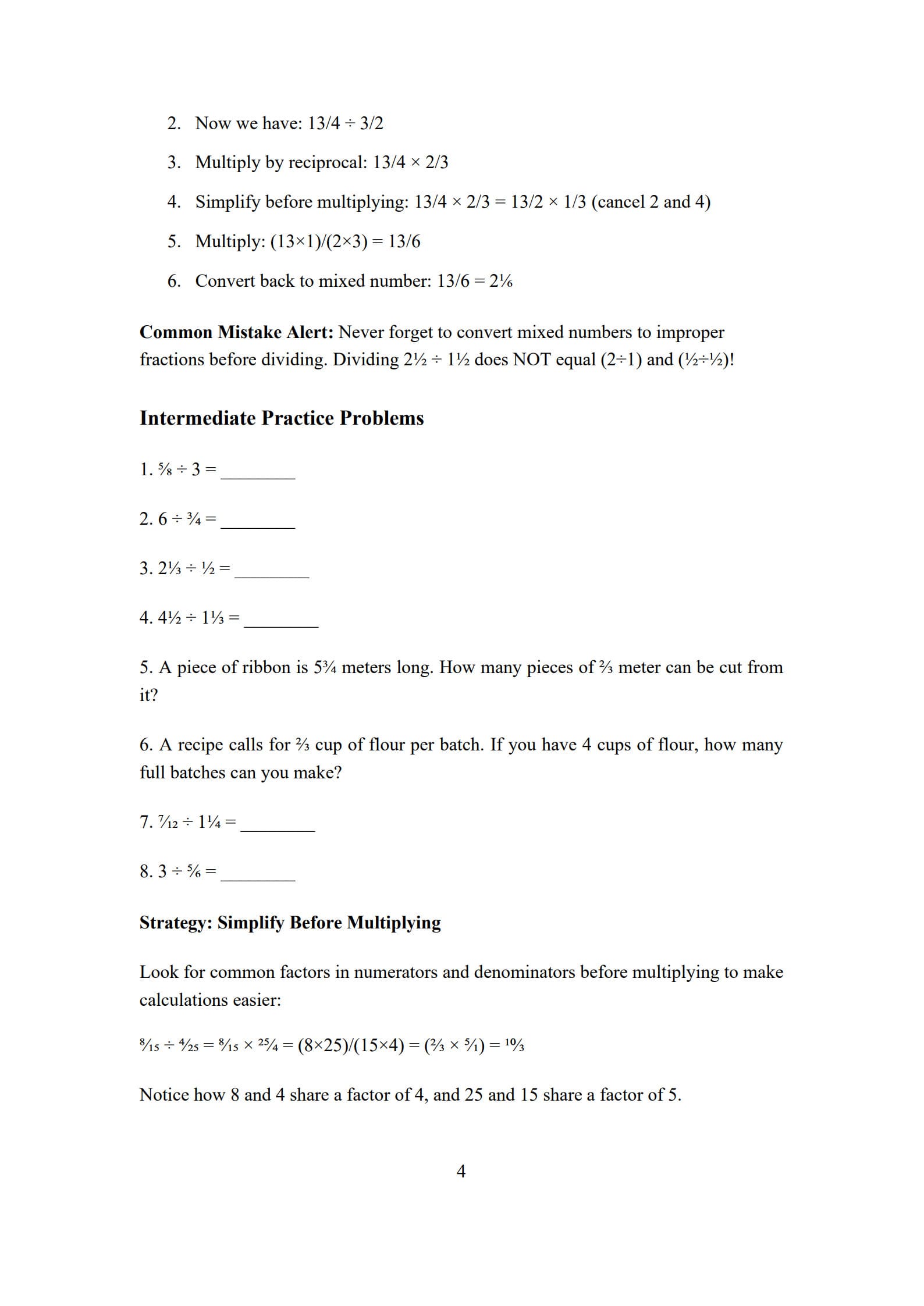
For example, the template presents this problem: “A recipe calls for 2/3 cup of flour per batch. If you have 4 cups of flour, how many full batches can you make?”
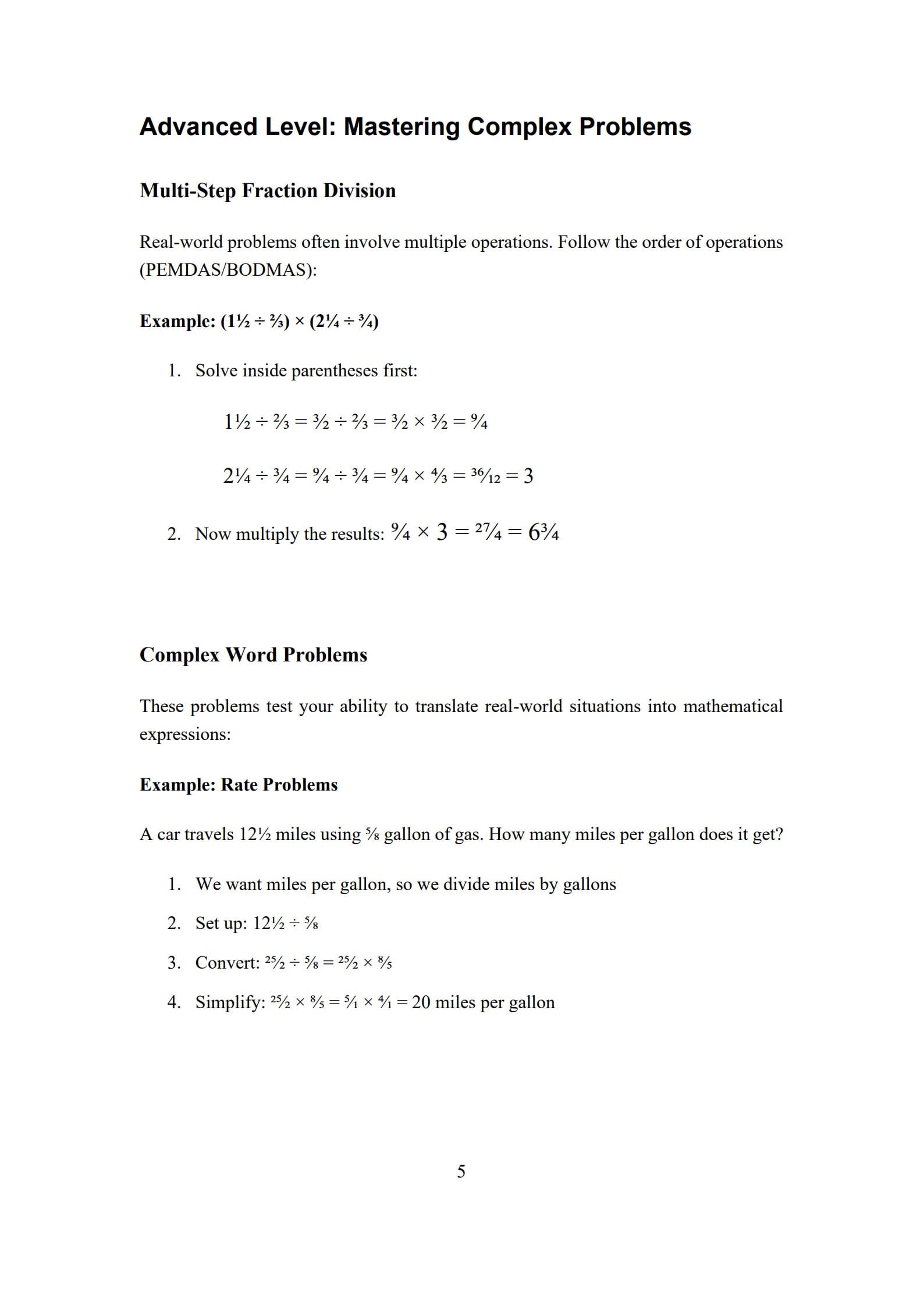
The solution involves recognizing that you need to divide the total flour by the amount per batch: 4 ÷ 2/3. The template guides you to convert the whole number to a fraction (4/1), multiply by the reciprocal of 2/3(3/2), and solve to find you can make 6 full batches. Another advanced problem involves calculating miles per gallon: “A car travels 12 1/2 miles using 5/8 gallon of gas. How many miles per gallon does it get?”
The template shows the setup 12 1/2 ÷ 5/8and the conversion to improper fractions to efficiently find the answer of 20 miles per gallon.
How to Resolve the Most Complex Dividing Fractions Practice Problems?
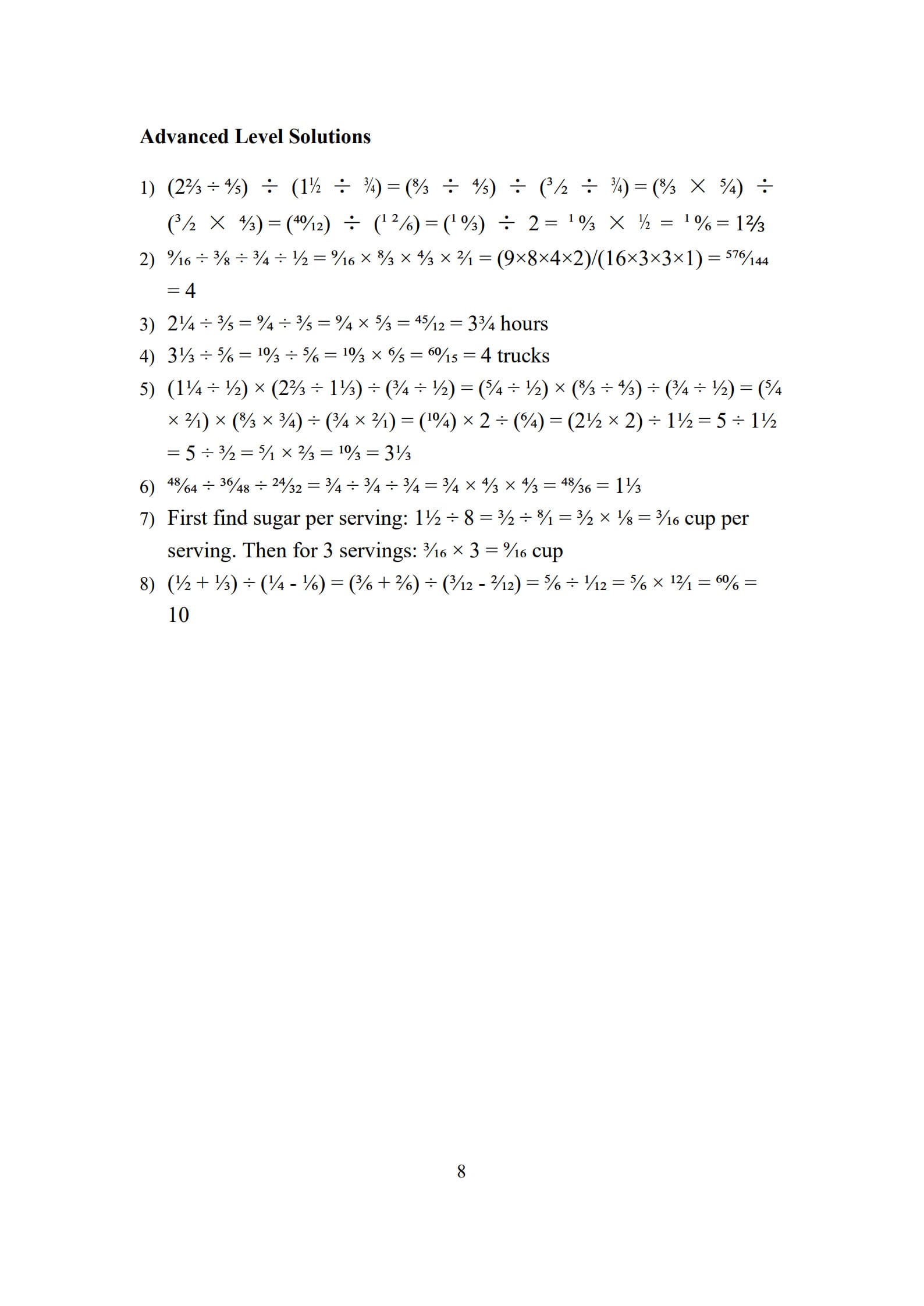
As learners progress, they encounter problems involving mixed numbers, multi-step operations, and simplification. Our template’s advanced section provides powerful strategies to master these challenges. A key strategy is simplifying before multiplying.
The template shows how to solve 8/15 ÷ 4/25by writing it as 8/15 × 25/4and then canceling common factors before multiplying: the 8 and 4 share a factor of 4, and the 25 and 15 share a factor of 5, simplifying the calculation to 2/3 × 5/1 = 10/3. This makes the process faster and minimizes errors.
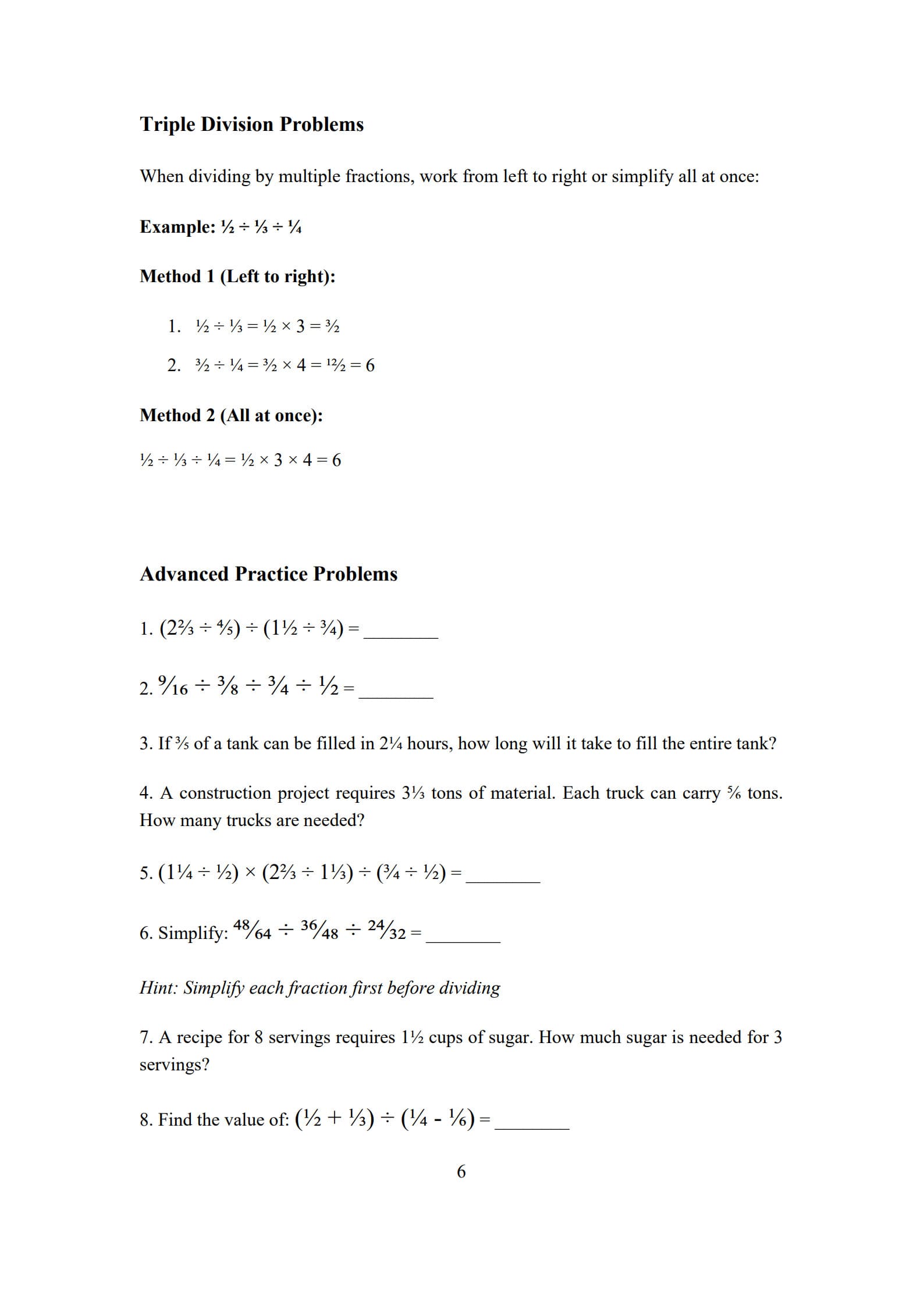
The template also expertly handles mixed numbers and multi-step problems using order of operations (PEMDAS). For a problem like (1 1/2 ÷ 2/3) × (2 1/4 ÷ 3/4), it demonstrates converting mixed numbers to improper fractions, solving the operations inside the parentheses first, and then multiplying the results. The following table contrasts common pitfalls with the strategies promoted in the template:
| Common Challenge | Template’s Advanced Strategy | Example |
|---|---|---|
| Dealing with Mixed Numbers | Always convert to improper fractions first. | 3 1/4 ÷ 1 1/2becomes 13/4 ÷ 3/2. |
| Complex Multi-Step Problems | Follow PEMDAS/BODMAS and solve step-by-step. | Solve inside parentheses first in (a ÷ b) × (c ÷ d). |
| Large Numbers in Multiplication | Simplify by canceling common factors before multiplying. | In 8/15 × 25/4, cancel 8 & 4 (÷4), and 25 & 15 (÷5). |
| Triple Division | Work left to right, or multiply by all reciprocals at once. | 1/2 ÷ 1/3 ÷ 1/4 = 1/2 × 3/1 × 4/1 = 6. |
How to Use This Dividing Fractions Worksheet Template on PDF Agile
Unlocking the potential of our Dividing Fractions Worksheet is effortless with PDF Agile. Follow these simple steps to start your learning journey:
Step 1: Access and Download the Template
Navigate to the PDF Agile Template Library from within the app or website. Search for “Dividing Fractions Worksheet” and click to preview. You can then download it instantly or click the prominent “Use Template” button to create a personal copy directly in your PDF Agile workspace.
Step 2: Complete the Exercises interactively
PDF Agile’s powerful editing tools are perfect for this template. Use the fillable fields to enter your name and date. Then, solve the practice problems directly on the digital worksheet using the text tool. The app allows you to neatly type your answers next to each problem, keeping your work organized.
Step 3: Check Your Work and Annotate
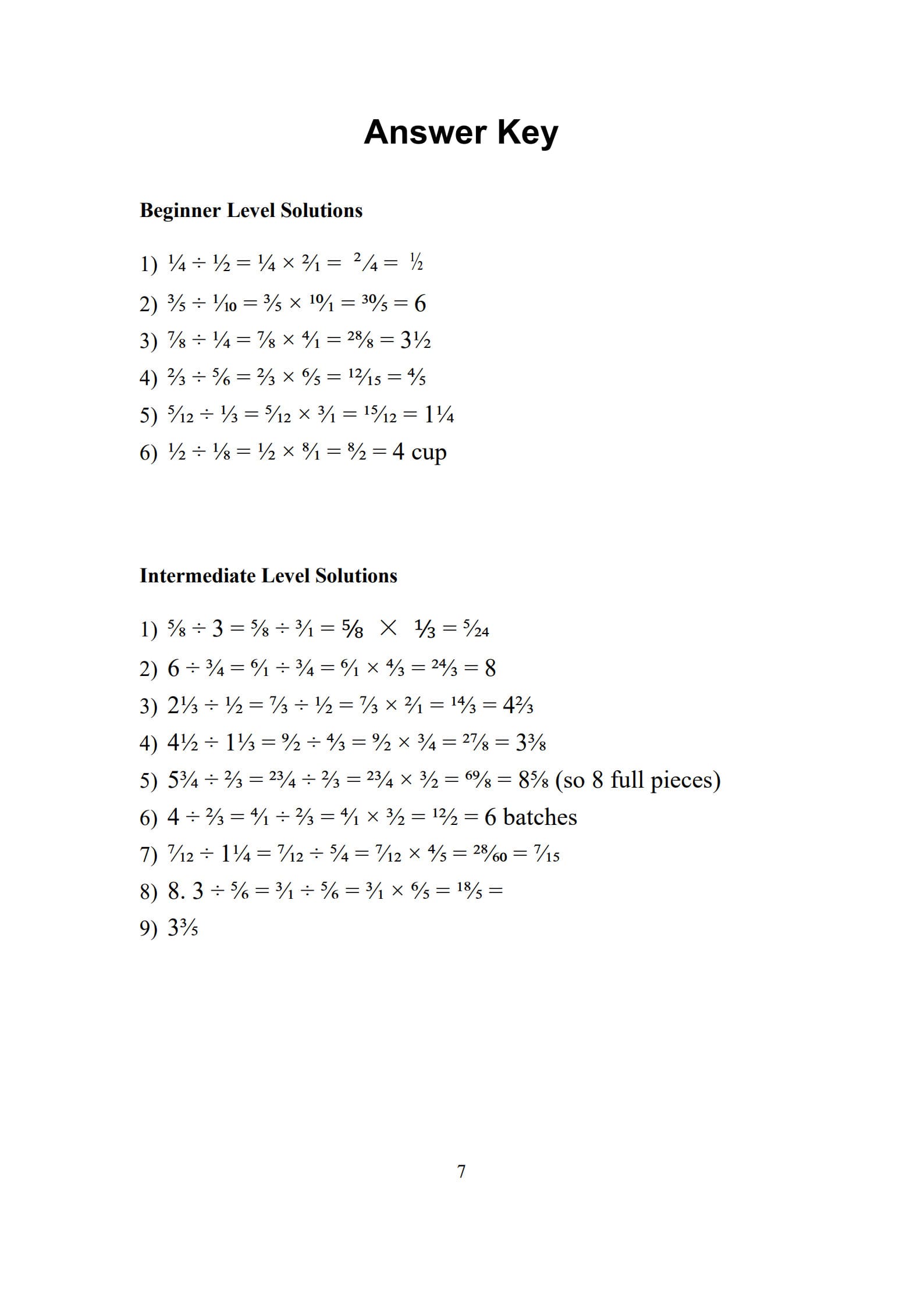
Once you’ve completed a section, use the answer key provided at the end of the template to check your solutions. PDF Agile’s highlight and comment tools are ideal for this review phase. Highlight problems you found challenging and add comments with notes on why you made a mistake. This creates a powerful personalized study log.
Step 4: Save, Organize, and Share Your Progress
Save your completed worksheet. You can organize all your math worksheets in separate folders within PDF Agile for easy revision. If you’re working with a study group or need help from a tutor, use the app’s seamless sharing feature to send your worksheet via email or link in just a few clicks.
Conclusion
Mastering fraction division is a fundamental achievement that paves the way for success in algebra and beyond. Our meticulously crafted “Dividing Fractions Worksheet” template in PDF Agile provides the structured, engaging, and comprehensive practice necessary to achieve this mastery. It guides you from the “why” behind the math to the strategic solving of complex, real-world problems.
By leveraging the intuitive functionality of the PDF Agile app, you can interact with this template dynamically, making your study sessions more efficient and effective. Don’t just memorize steps—understand the concepts, apply the strategies, and build unshakable confidence. Download the template today and turn the challenge of fraction division into your greatest mathematical strength.