

---Imagine a world without color, texture, or scale.
A sentence without description is just like that—a flat, monochrome sketch.
Adjectives are the vibrant palette that transforms our language from a simple outline into a rich, detailed masterpiece. They are the words that add flavor, emotion, and clarity, allowing us to share not just facts, but experiences. For English learners, mastering adjectives is a crucial step toward achieving fluency and expressiveness.
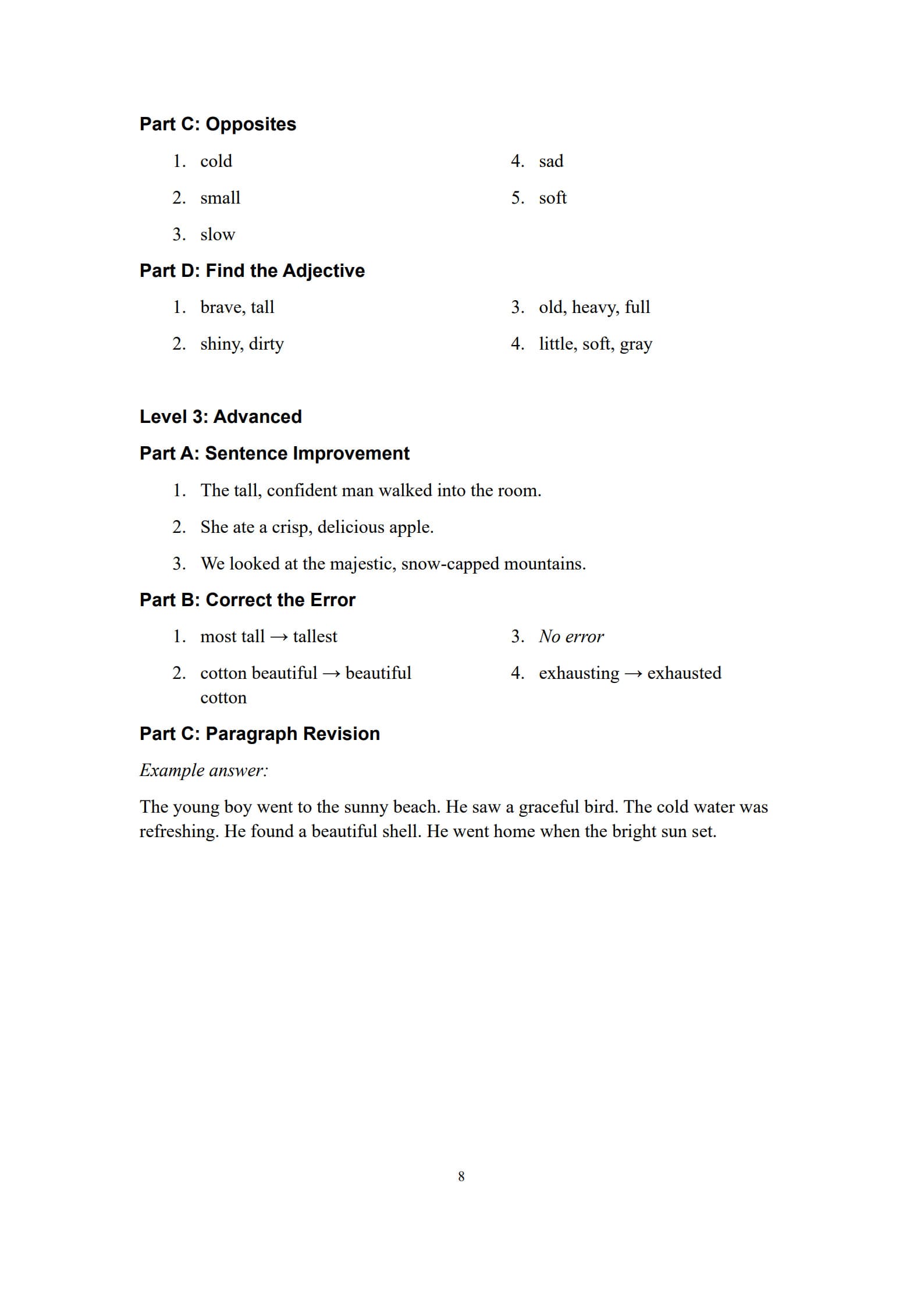
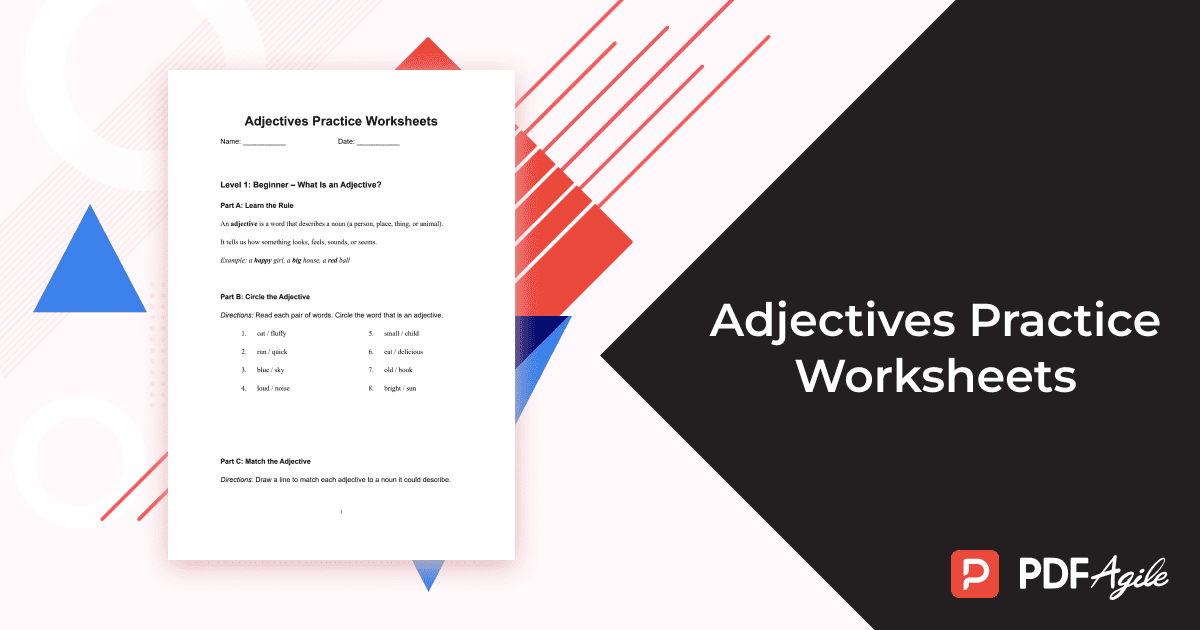
Adjectives Practice Worksheet template available in PDF Agile is your all-in-one gym for strengthening your descriptive language skills. Let’s embark on this journey to make your English more vivid, persuasive, and engaging than ever before.
What are Definitions and Types of Adjectives?
At its core, an adjective is a word that modifies a noun or a pronoun. It provides essential information about which one, what kind, or how many. Think of a noun as a person, place, or thing, and the adjective as its personal stylist, defining its appearance, character, and qualities.
Adjectives can be categorized in four ways to make them easier to understand and use:
- Descriptive Adjectives: These are the most common type. They describe qualities like size, color, shape, taste, or feeling. Examples from our worksheet include fluffy, blue, sweet, and soft.
- Quantitative Adjectives: These answer “how many?” or “how much?” (e.g., five apples, some water, many reasons). While not the focus of our template, they are a key part of the adjective family.
- Demonstrative Adjectives: These point out specific nouns (e.g., this book, that house, these flowers, those days).
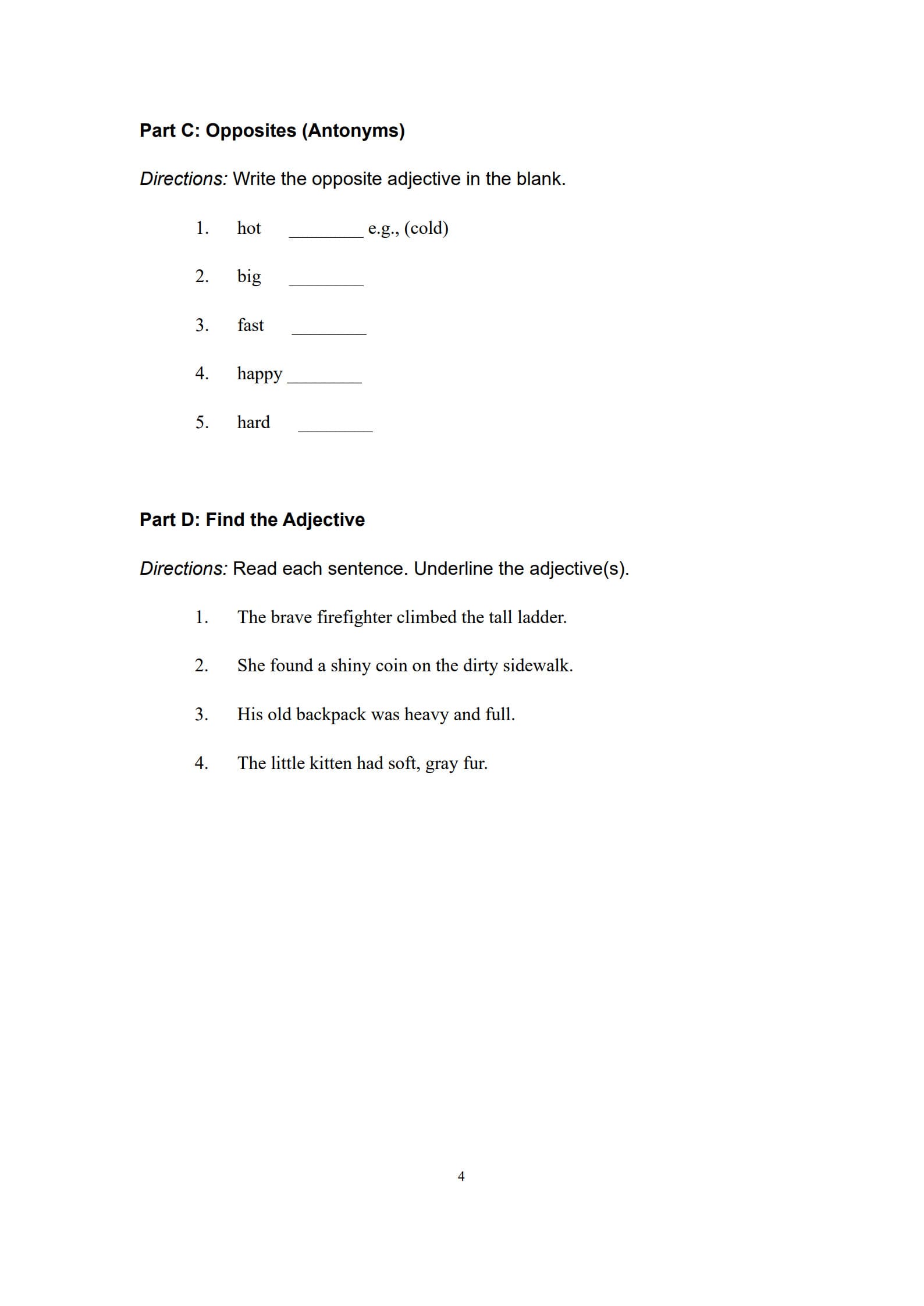
- Comparative and Superlative Adjectives: These are used for making comparisons. The comparative form (e.g., taller, faster) compares two things, while the superlative form (e.g., tallest, fastest) compares three or more.
Basic Adjective Training:
The beginner level is all about recognition and simple association. Our PDF Agile template’s Level 1 section is meticulously designed to build this foundational knowledge through intuitive exercises.
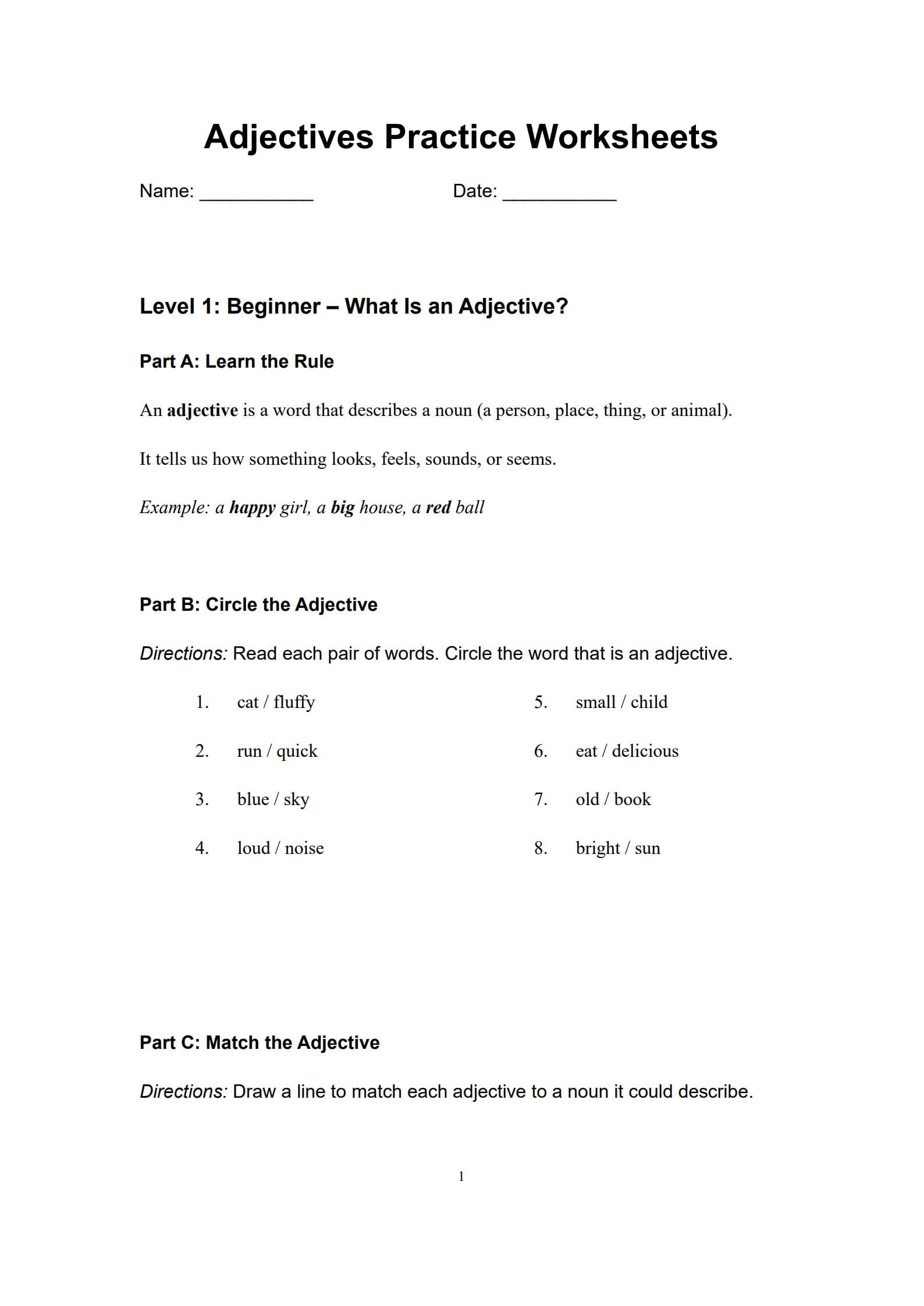
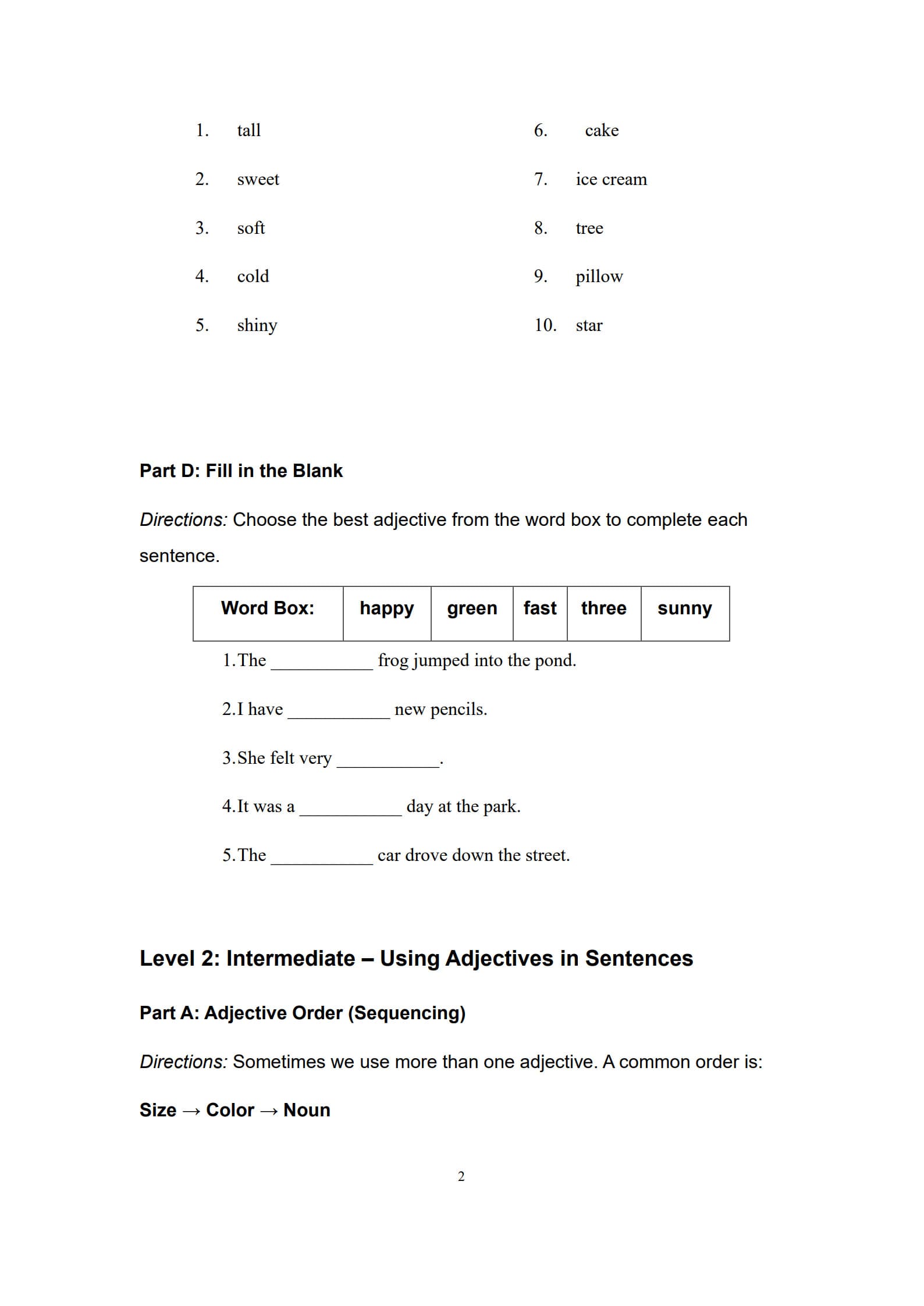
Question Pair:
Directions: Circle the Adjectives
- cat / fluffy
- run / quick
- blue / sky
- loud / noise
- small / child
Intermediate Adjective Training:
Once you can identify adjectives, the next step is to use them correctly within the rules of English grammar. Level 2 of our worksheet tackles these essential rules.
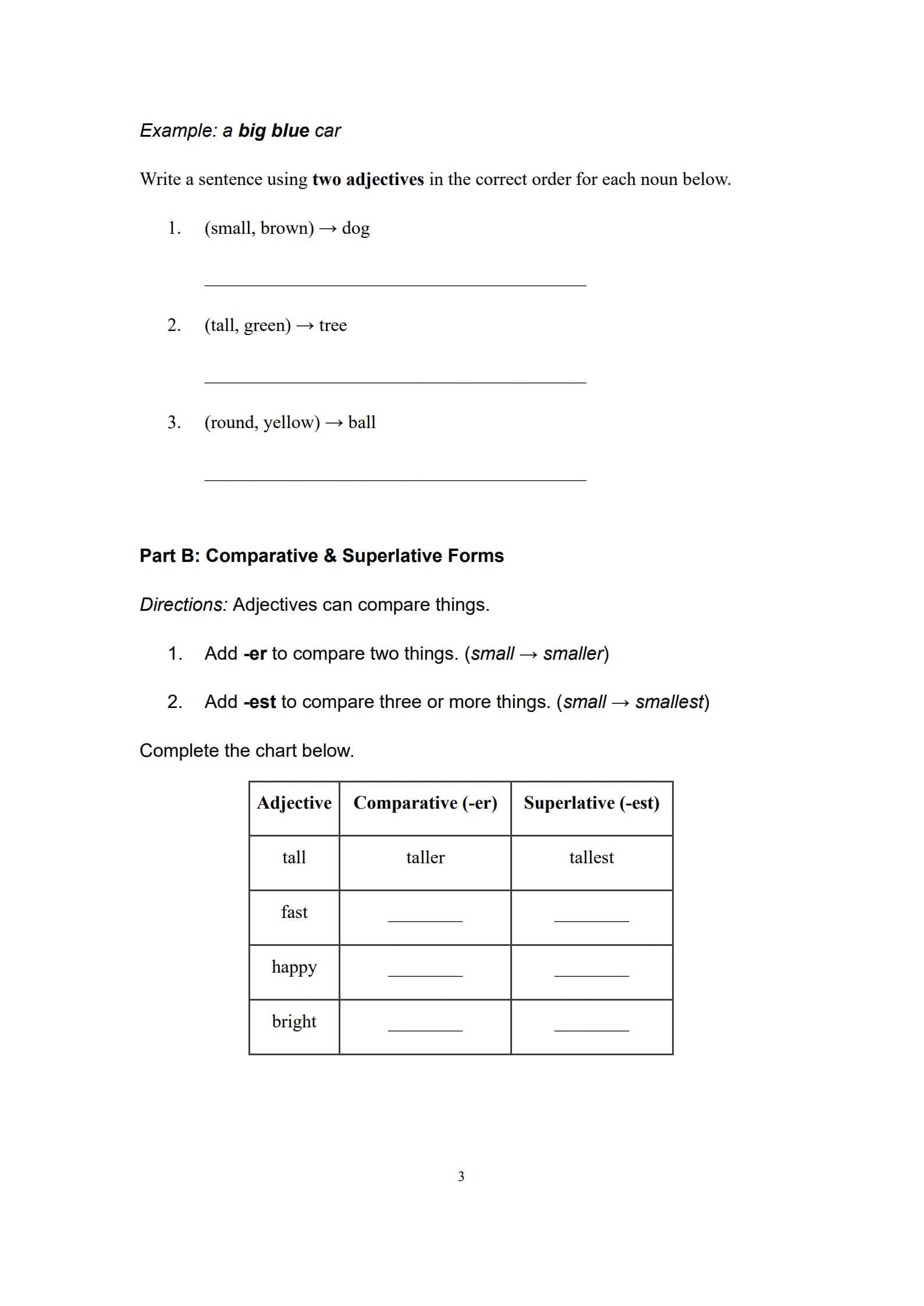
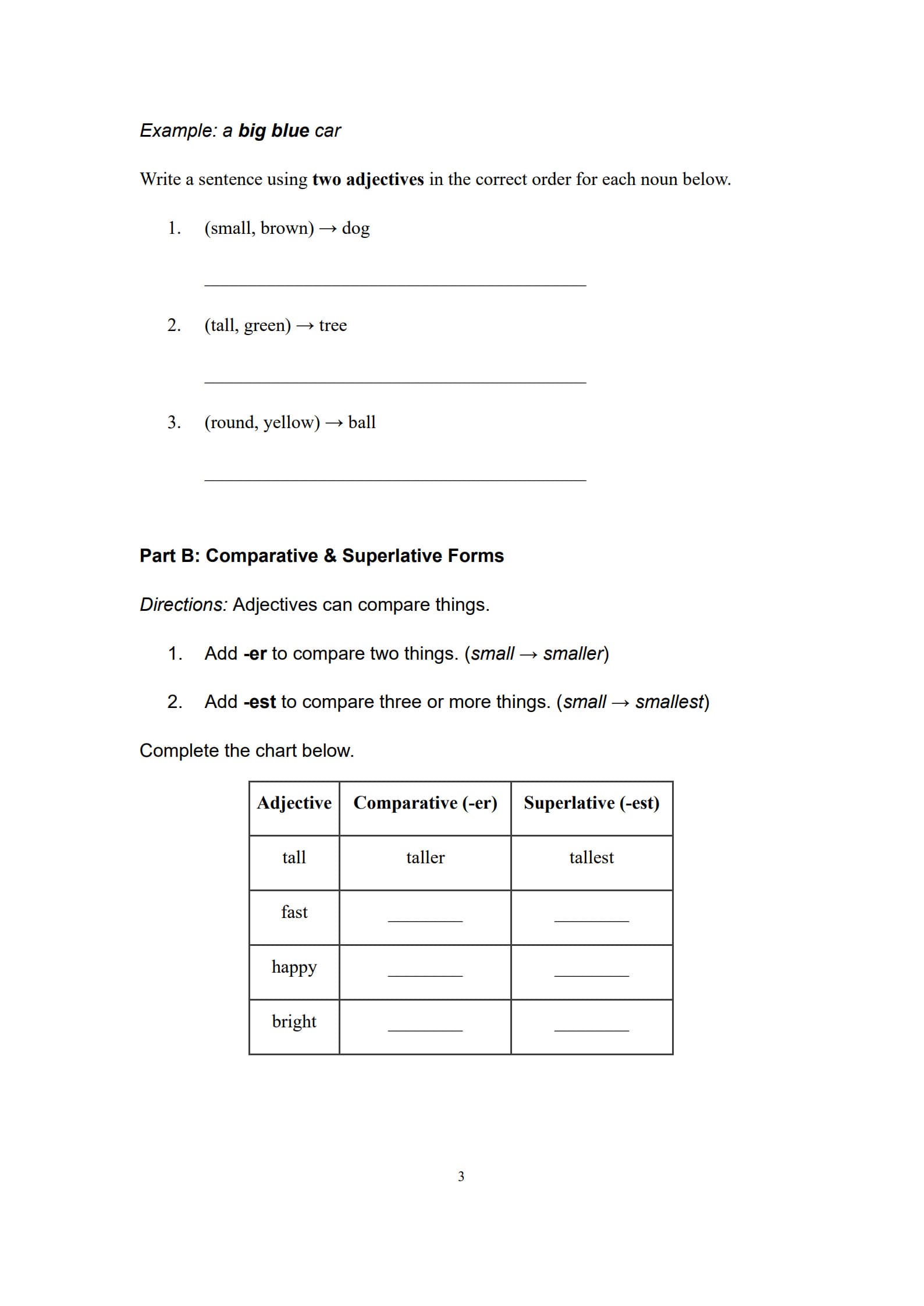
Adjective Order
Directions: Follow the pattern: Size → Color → Noun
| Noun | Adjective Pair | Sample Sentence |
|---|---|---|
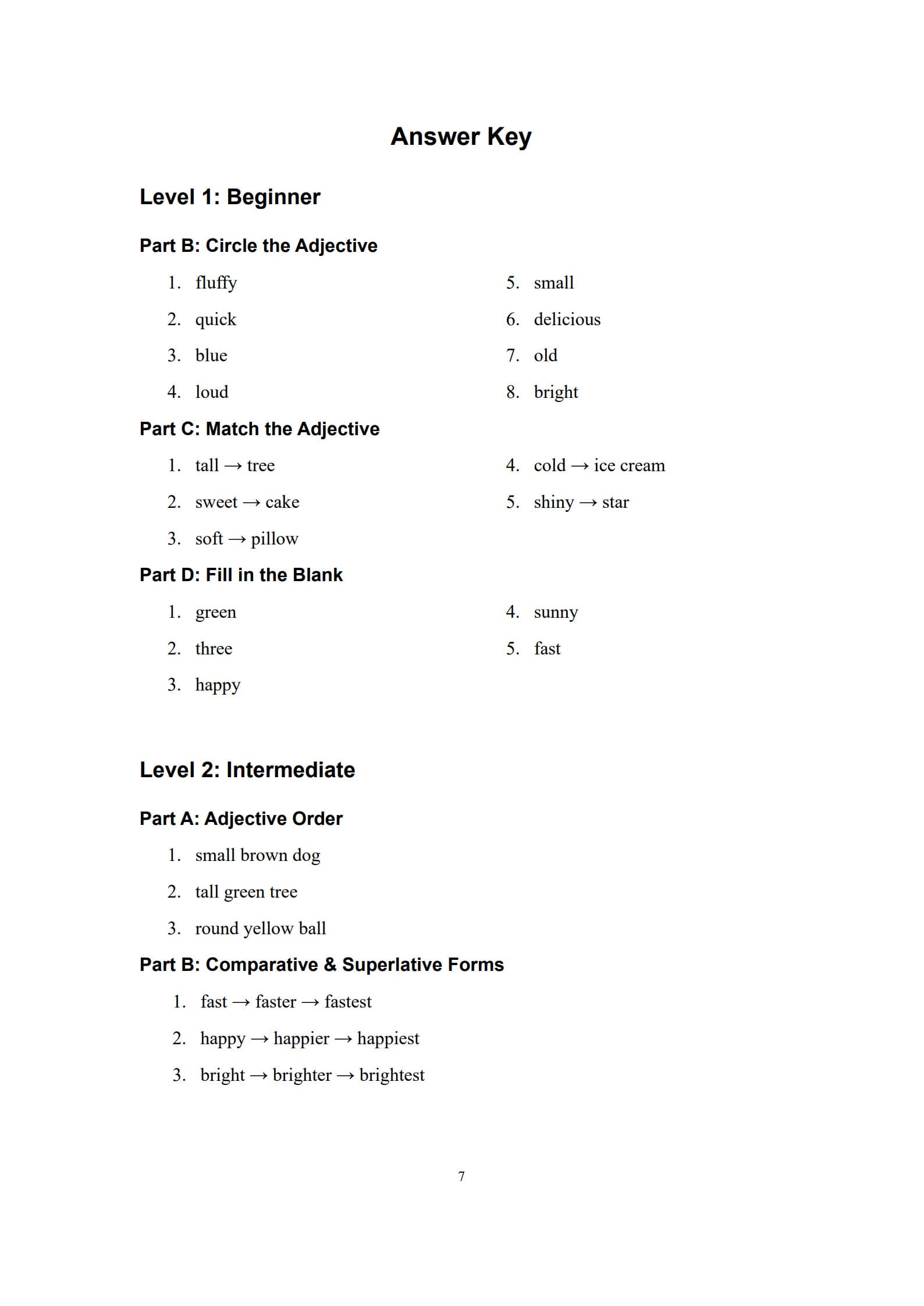
| dog | (small, brown) | The small brown dog wagged its tail. |
| tree | (tall, green) | A tall green tree shaded the garden. |
| ball | (round, yellow) | The child kicked the round yellow ball. |
Advanced Adjective Training:
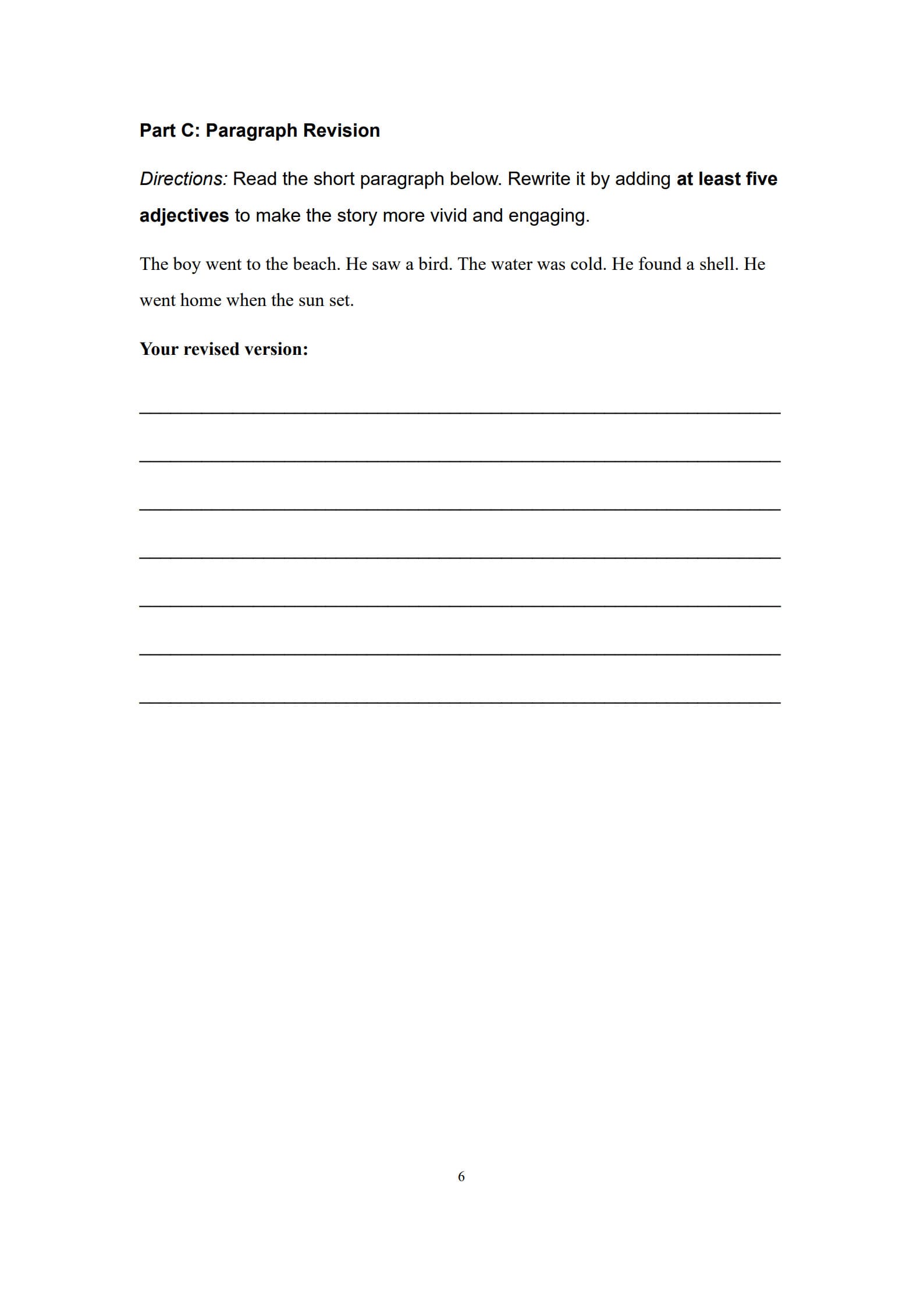
The ultimate goal of learning adjectives is to enhance your writing and speaking. Level 3 pushes you toward this goal by focusing on creativity, precision, and self-correction.
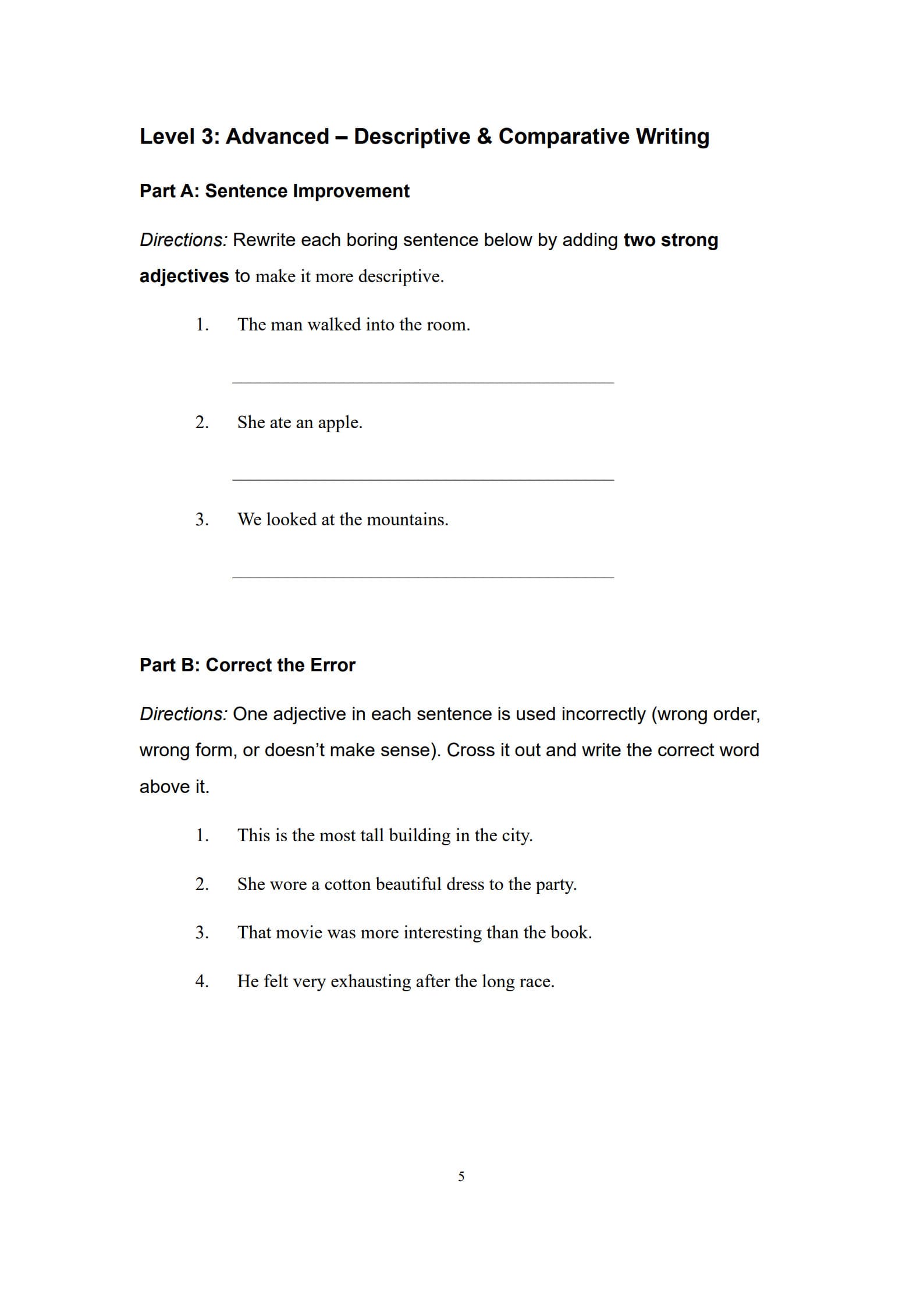
Correct the Error
Directions: Spot the mistake and write the correction above it.
| Sentence | Error | Correction |
|---|---|---|
| This is the most tall building. | Wrong superlative form | tallest |
| She wore a cotton beautiful dress. | Wrong adjective order | beautiful cotton |
| He felt very exhausting after the race. | Wrong adjective form (should describe “he”) | exhausted |
How to Use the Adjectives Worksheet Template in PDF Agile?
Now that you’ve seen the power of this structured worksheet, let’s integrate it with the powerful tool designed to make your learning seamless: PDF Agile. This app turns a static PDF into an interactive, personalized learning experience. Here’s how to get started in four simple steps:
- Step 1: Download the Adjectives Practice Worksheet Template
Simply click the “Use Template” button on this page to launch it directly in the PDF Agile editor.
- Step 2: Complete the Exercises Digitally
This is where PDF Agile shines. Instead of printing and using a pen, you can complete the worksheet directly on your tablet or computer.
- Step 3: Save Your Progress and Create a Portfolio
You can save one version after completing Level 1, another after Level 2, and a final one after Level 3. This creates a fantastic digital portfolio of your progress, which you can review later to see how much you’ve improved.
- Step 4: Share with a Teacher or Study Partner
Use PDF Agile’s built-in “Share” function to send your completed worksheet to a teacher, tutor, or study group.
6. Mistakes with Examples to Avoid:
Even with a great template, common pitfalls can occur.
- Incorrect Adjective Order:
As practiced in Level 2, order matters.
Incorrect: “She wore a cotton beautiful dress.”
Correct: “She wore a beautiful cotton dress.” (Opinion before material).
- Mis-formed Comparatives/Superlatives:
For most one-syllable adjectives, add -er and -est.
Incorrect: “This is the most tall building.”
Correct: “This is the tallest building.”
- Using an Adjective Instead of an Adverb:
Adjectives describe nouns; adverbs describe verbs.
Incorrect: “He felt exhausting after the race.” (He isn’t causing exhaustion).
Correct: “He felt exhausted after the race.” Or “The race was exhausting.”
FAQs about Adjectives
Q1: Can a noun be used as an adjective?
Yes! This is called an “attributive noun.” For example, in the phrase “a history teacher,” “history” is a noun acting as an adjective to describe what kind of teacher. Our worksheet focuses on traditional adjectives first to build a solid base.
Q2: What is the correct order for more than two adjectives?
A more detailed order is: Opinion, Size, Age, Shape, Color, Origin, Material, Purpose. Our template starts with the most common (Size, Color) to make it manageable. For example, “a beautiful (opinion) small (size) old (age) round (shape) wooden (material) table.”
Q3: How do I know if I should use a comma between adjectives?
A good trick is to use a comma if you can reverse the order of the adjectives or insert the word “and” between them. For example, “a soft, fluffy pillow” can be “a fluffy, soft pillow” or “a soft and fluffy pillow.” You wouldn’t do this with “a beautiful cotton dress.”
Conclusion:
The Adjectives Practice Worksheet template provides the structured path for a learning journey. PDF Agile provides the modern, flexible tool to walk it effortlessly. By engaging with each level from basic identification to advanced creative writing, you are not just memorizing words, but you are also building a fundamental skill for eloquent English. Download your template today and start bringing your language to life!