

Welcome to PDF Agile, where learning meets innovation. We are excited to introduce our comprehensive Trigonometry Worksheet template—a complete resource designed to help students explore shapes, angles, lines, and geometric properties in depth. This expertly crafted PDF template features clear diagrams and engaging activities that develop spatial reasoning, problem-solving, and measurement skills. Ideal for classroom instruction or home learning, it supports learners at all levels in mastering key concepts with confidence. This guide will walk you through the rich content of this template and show you how to seamlessly integrate it into your study routine using the PDF Agile app.
Laying the Foundation – What is SOHCAHTOA and How Does It Solve Right Triangles?
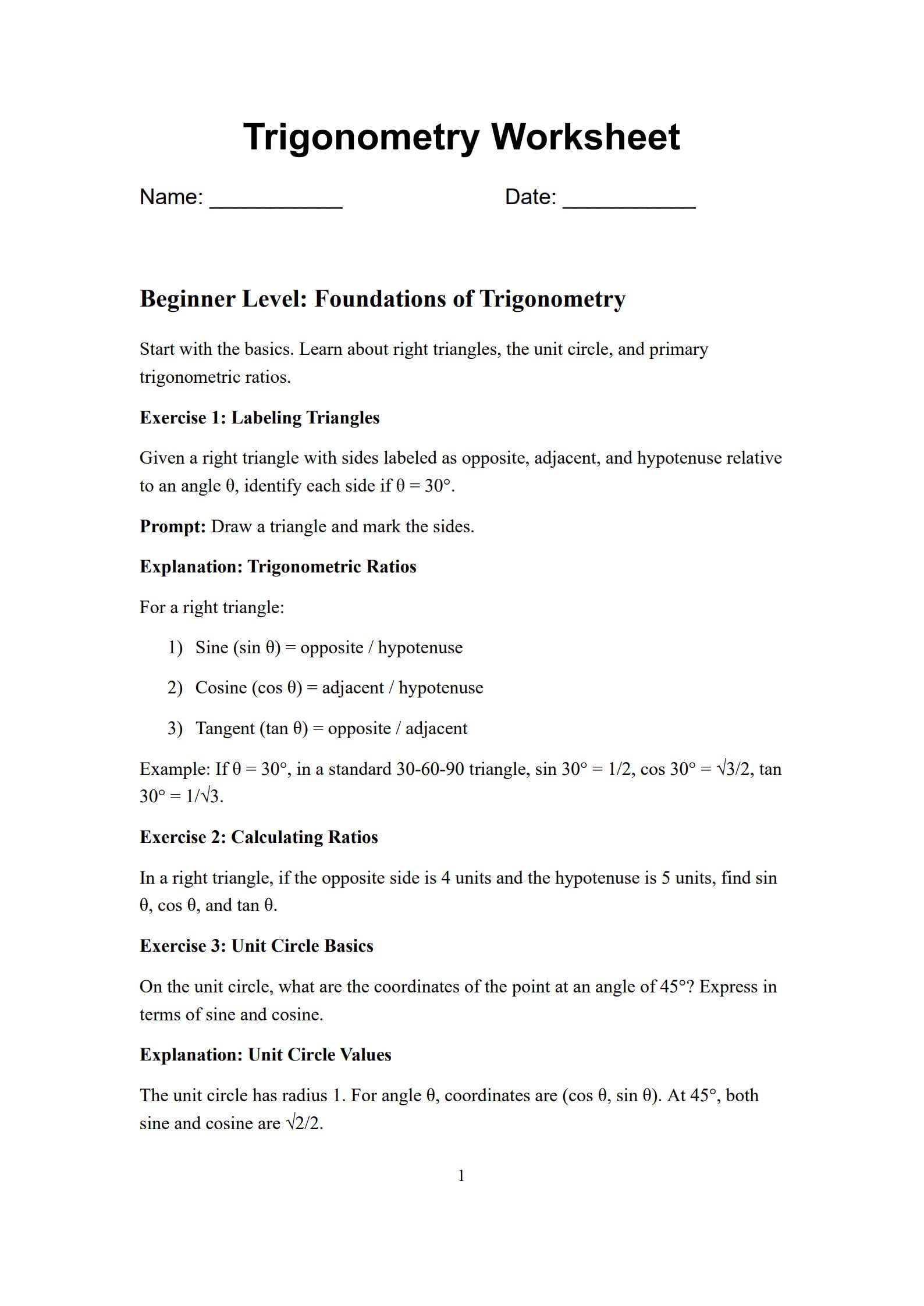
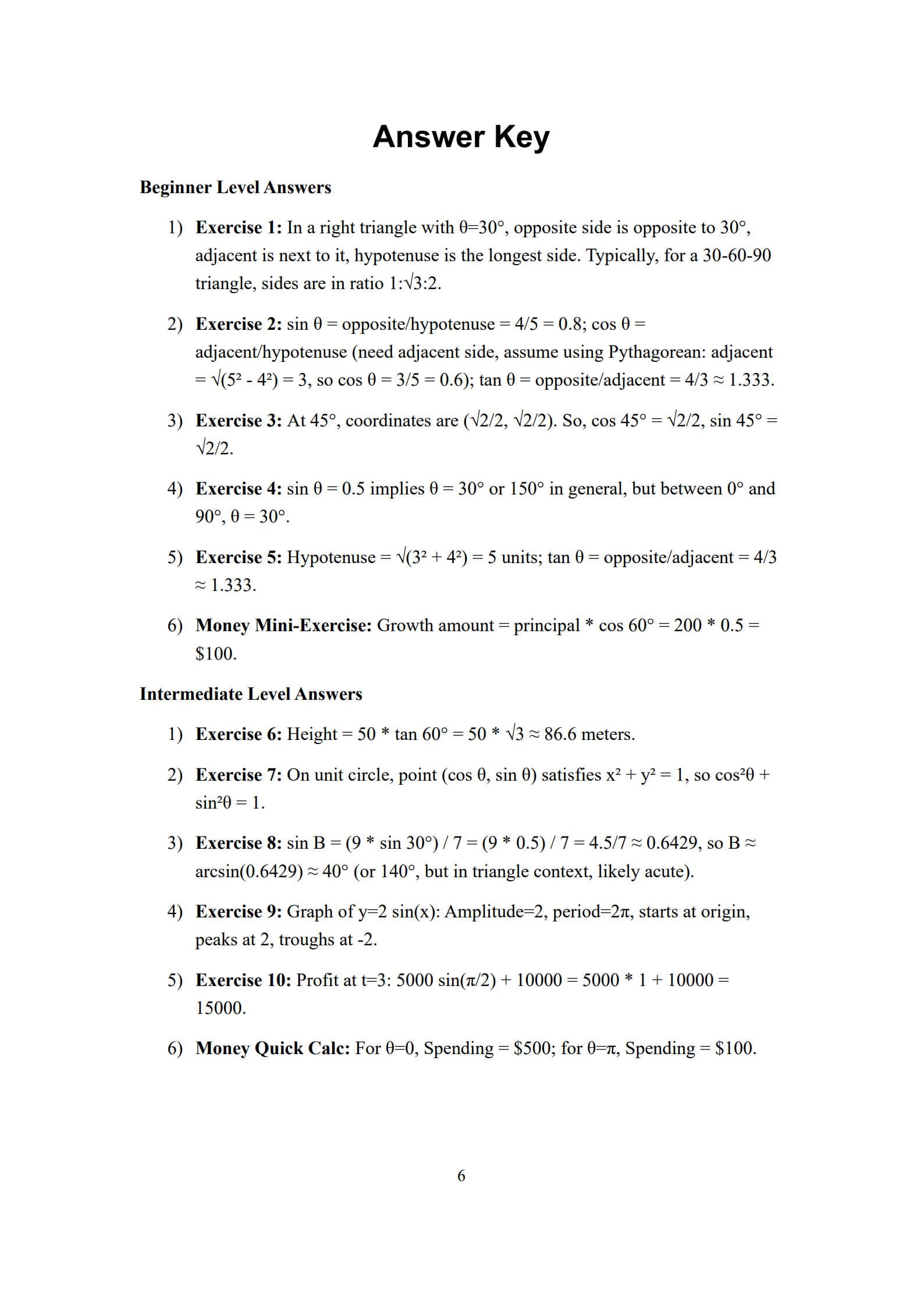
Every journey into trigonometry begins with understanding the right triangle. Our right triangle trigonometry worksheet section is designed to build this essential foundation from the ground up. How do we make sense of the sides and angles? The answer lies in three simple ratios: Sine, Cosine, and Tangent, famously remembered by the mnemonic SOHCAHTOA (Sine = Opposite/Hypotenuse, Cosine = Adjacent/Hypotenuse, Tangent = Opposite/Adjacent).
The template starts with a hands-on exercise: labeling a right triangle’s sides relative to a given angle, such as 30°. This visual practice is crucial. It then immediately applies the theory. For instance, the worksheet provides a classic example: in a standard 30-60-90 triangle, sin 30° = 1/2, cos 30° = √3/2, and tan 30° = 1/√3. This is not just abstract theory. You are then prompted with a practical problem: “In a right triangle, if the opposite side is 4 units and the hypotenuse is 5 units, find sin θ, cos θ, and tan θ.” To solve this, you must first use another foundational tool—the Pythagorean theorem—to find the missing adjacent side (which is 3 units), before calculating the ratios: sin θ = 4/5, cos θ = 3/5, and tan θ = 4/3. This interconnected approach ensures you understand how these core concepts work together from the very first page.
From Triangles to Circles – How Can the Unit Circle Simplify Trigonometry?
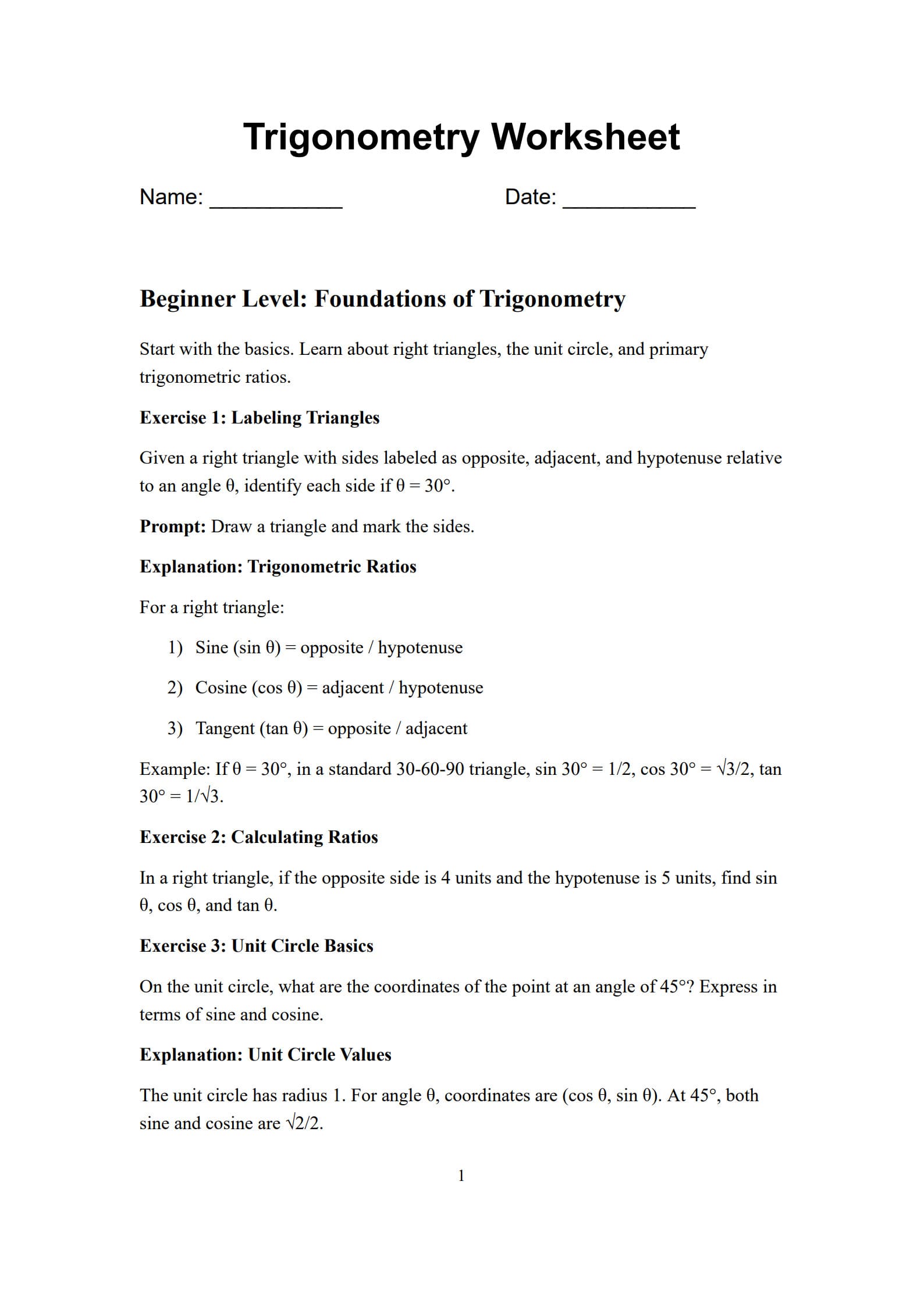
Once comfortable with triangles, the template elegantly transitions to the unit circle, a powerful tool that generalizes trigonometric ratios for all angles. This section answers a fundamental question: What are the coordinates of the point at an angle of 45°? The worksheet clearly explains that on a unit circle (radius = 1), the coordinates for any angle θ are simply (cos θ, sin θ). Therefore, at 45°, both the x and y coordinates are √2/2. This elegant connection transforms sine and cosine from mere ratios into coordinates on a circle, providing a visual and intuitive understanding.
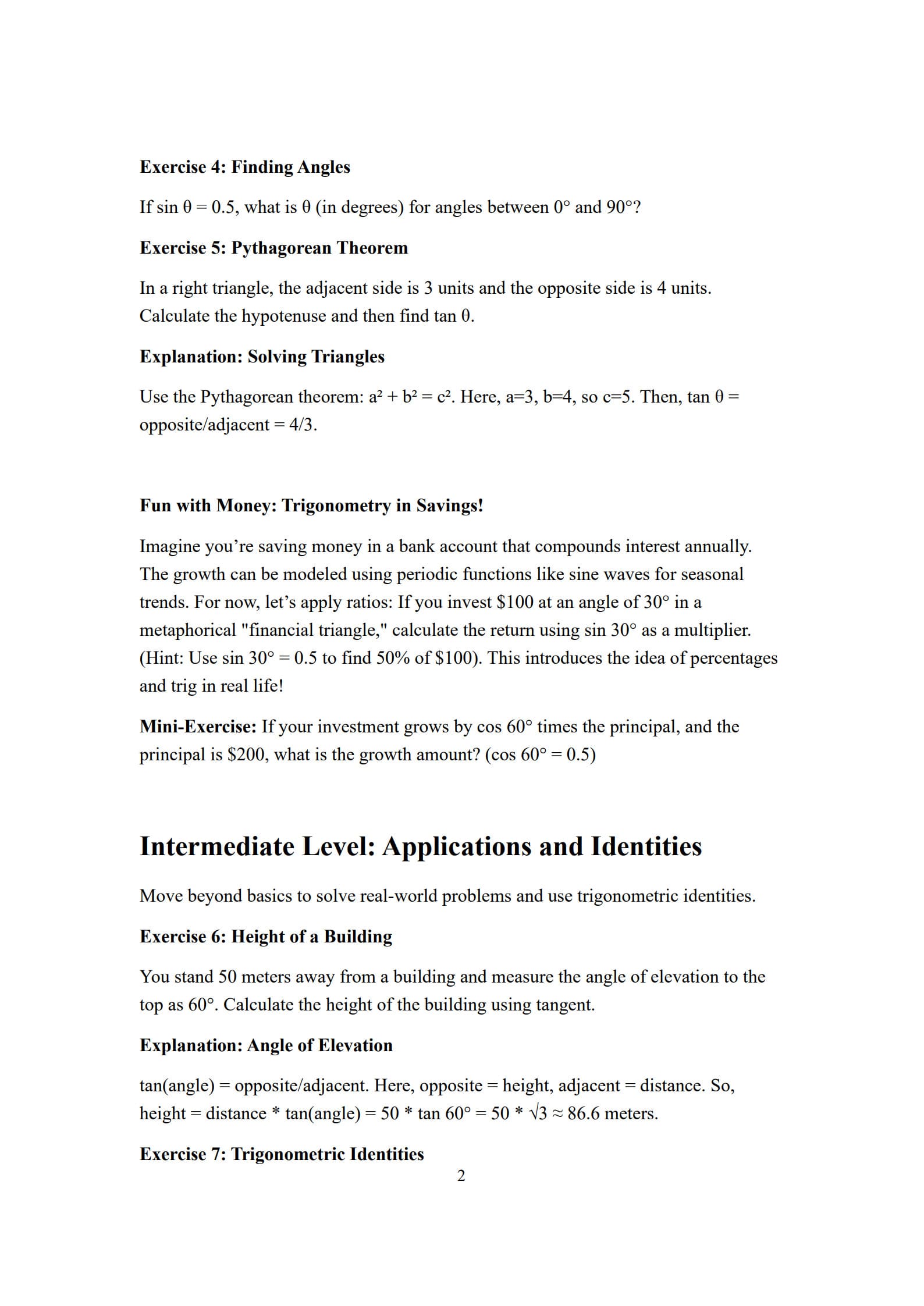
The template reinforces this with exercises that bridge computation and conceptual understanding. For example, it asks: “If sin θ = 0.5, what is θ (in degrees) for angles between 0° and 90°?” Leveraging the unit circle concept or the foundational ratios learned earlier, you determine that θ must be 30°. Furthermore, the worksheet introduces a creative, real-world link titled “Fun with Money: Trigonometry in Savings!” It playfully suggests modeling interest with trigonometric functions. A mini-exercise asks: “If your investment grows by cos 60° times the principal, and the principal is 100. This unique application shows how these abstract values translate into tangible, percentage-based calculations.
Applying Knowledge – How Do We Use Trigonometry in the Real World?
The intermediate level of this trigonometry worksheet pdf shifts focus to practical applications and deeper identities. One standout section tackles a classic problem: calculating the height of a building. The worksheet presents a scenario: “You stand 50 meters away from a building and measure the angle of elevation to the top as 60°. Calculate the height.” Using the tangent ratio (tan(angle) = opposite/adjacent), it guides you to the solution: height = 50 * tan 60° = 50 * √3 ≈ 86.6 meters. This direct application demonstrates the tangible power of the ratios learned earlier.
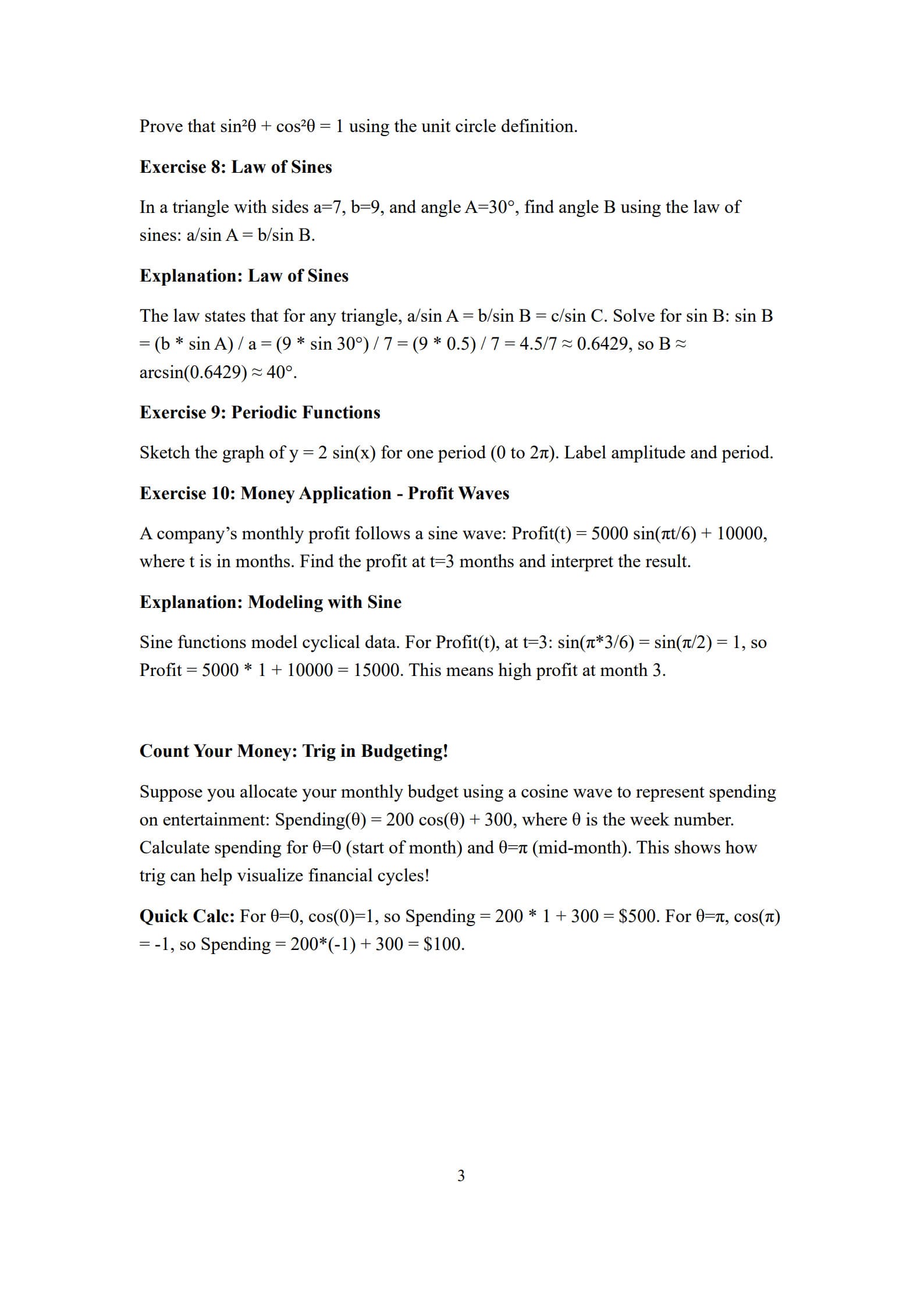
The template also delves into essential theoretical underpinnings, such as proving the Pythagorean identity sin²θ + cos²θ = 1 using the unit circle definition. It then expands the solver’s toolkit with the Law of Sines for non-right triangles, providing a worked example to find an unknown angle. To keep the learning engaging and relevant, another “Money Application” module models a company’s profit with a sine wave: Profit(t) = 5000 sin(πt/6) + 10000. The exercise asks for the profit at t=3 months. By evaluating sin(π/2) = 1, you find the profit is $15,000, illustrating how trigonometry models cyclical real-world data like seasonal business trends.
Advancing Your Skills – What Lies Beyond Solving Basic Equations?
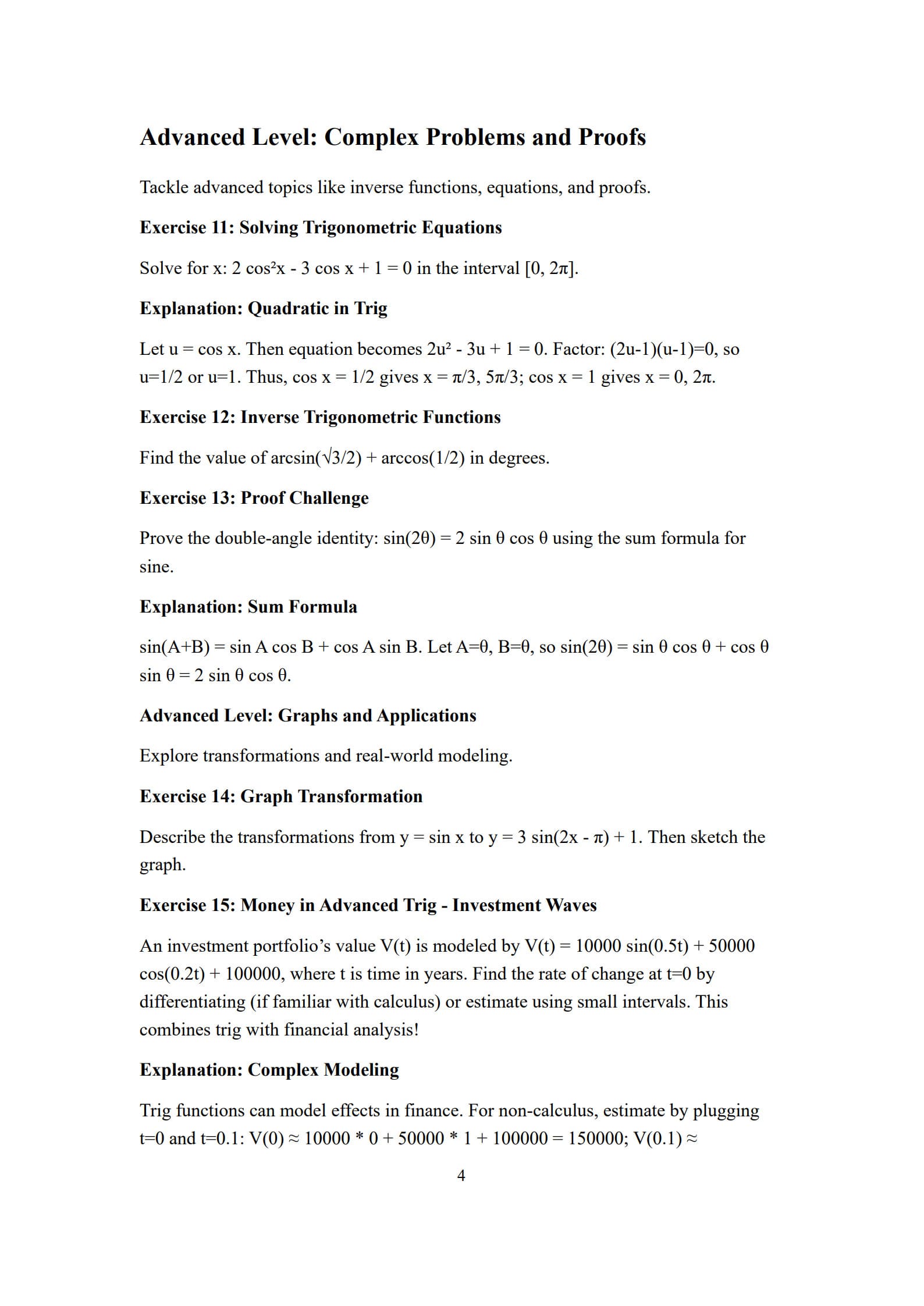
For learners ready for a challenge, the advanced section of this worksheet transforms students into confident problem-solvers. It introduces solving complex trigonometric equations, like 2 cos²x - 3 cos x + 1 = 0, by treating them as quadratics. The template clearly outlines the substitution method (let u = cos x) and guides you to all solutions within a given interval.
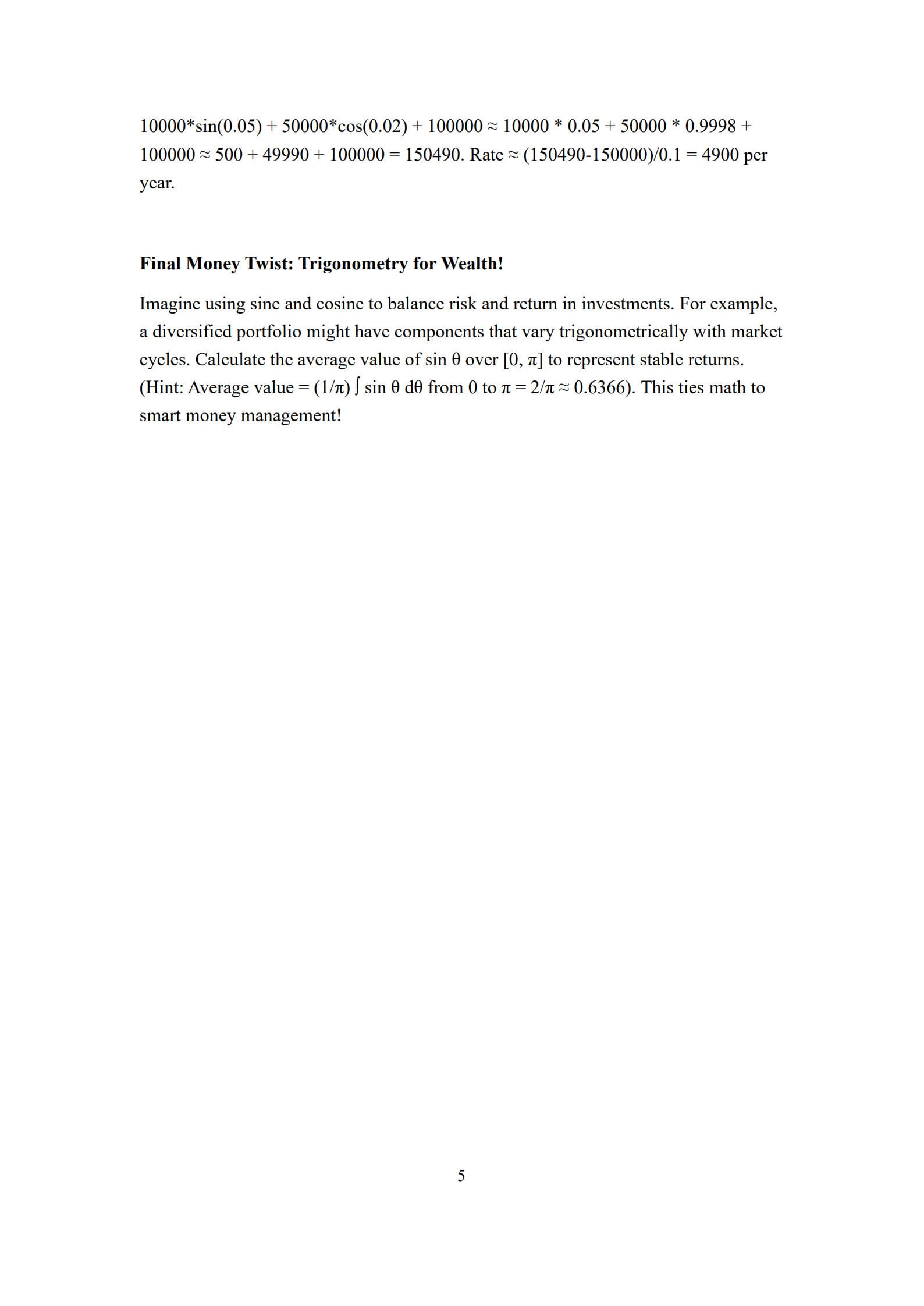
It also explores inverse functions with problems such as finding the value of arcsin(√3/2) + arccos(1/2), leading to a sum of 120°. A proof challenge invites you to derive the double-angle identity sin(2θ) = 2 sin θ cos θ using the sum formula, solidifying your understanding of how identities interconnect. The most sophisticated application revisits financial modeling with an advanced investment wave function: V(t) = 10000 sin(0.5t) + 50000 cos(0.2t) + 100000. The worksheet explains how to estimate the rate of change at a specific time, either through calculus or numerical estimation, blending trigonometry with fundamental concepts of calculus and financial analysis, showcasing its utility in complex, dynamic systems.
How to Use This Trigonometry Worksheet Template on PDF Agile
Utilizing this rich educational resource is straightforward and efficient with PDF Agile. Follow these simple steps to customize and deploy your interactive Trigonometry Worksheet:
Step 1: Access and Download the Template
Navigate to the PDF Agile Template Library on our website or within the app. Search for “Trigonometry Worksheet” and click to preview. You will see the complete, professionally formatted resource with all exercises, explanations, and answer keys. Click “Use Template” to instantly open a copy in your PDF Agile editor. The template is ready to use, saving you hours of design and preparation time.
Step 2: Customize for Your Learning Needs
This is where PDF Agile shines. The template is fully editable. You can:
- Personalize Instructions: Add your student’s or class’s name at the top.
- Focus Practice: Highlight or annotate specific exercises (like the Pythagorean theorem worksheet problems or the SOHCAHTOA worksheet sections) for targeted practice.
- Add Notes: Use the comment tool to insert helpful tips, links to video explanations, or alternative methods next to complex problems like the Law of Sines exercise.
Step 3: Complete and Solve Interactively
Engage directly with the worksheet. Use the form-filling tools to type answers into the provided spaces for each exercise. For graphical exercises, such as sketching the graph of y = 2 sin(x), you can use the drawing tool to plot directly on the PDF. Calculate the hypotenuse for the Pythagorean theorem problem or solve for the angle B using the Law of Sines—all within the same document.
Step 4: Review, Save, and Share
Once completed, use the answer key section at the end of the template to check your work. PDF Agile allows you to easily compare pages. Save your filled-out worksheet as a new PDF file for your records. You can then share it instantly via email with a teacher, upload it to a classroom portal, or print it for offline review. The final document maintains a clean, professional layout suitable for submission or portfolio inclusion.
Conclusion
Our Trigonometry Worksheet template in PDF Agile is more than just a collection of problems; it is a structured learning pathway. It begins by cementing the basics of right triangles and SOHCAHTOA, gracefully progresses to the unifying model of the unit circle, and then applies this knowledge to solve real-world measurement problems. Finally, it challenges learners with advanced equations and proofs, all while weaving in engaging themes like financial modeling to demonstrate relevance.