

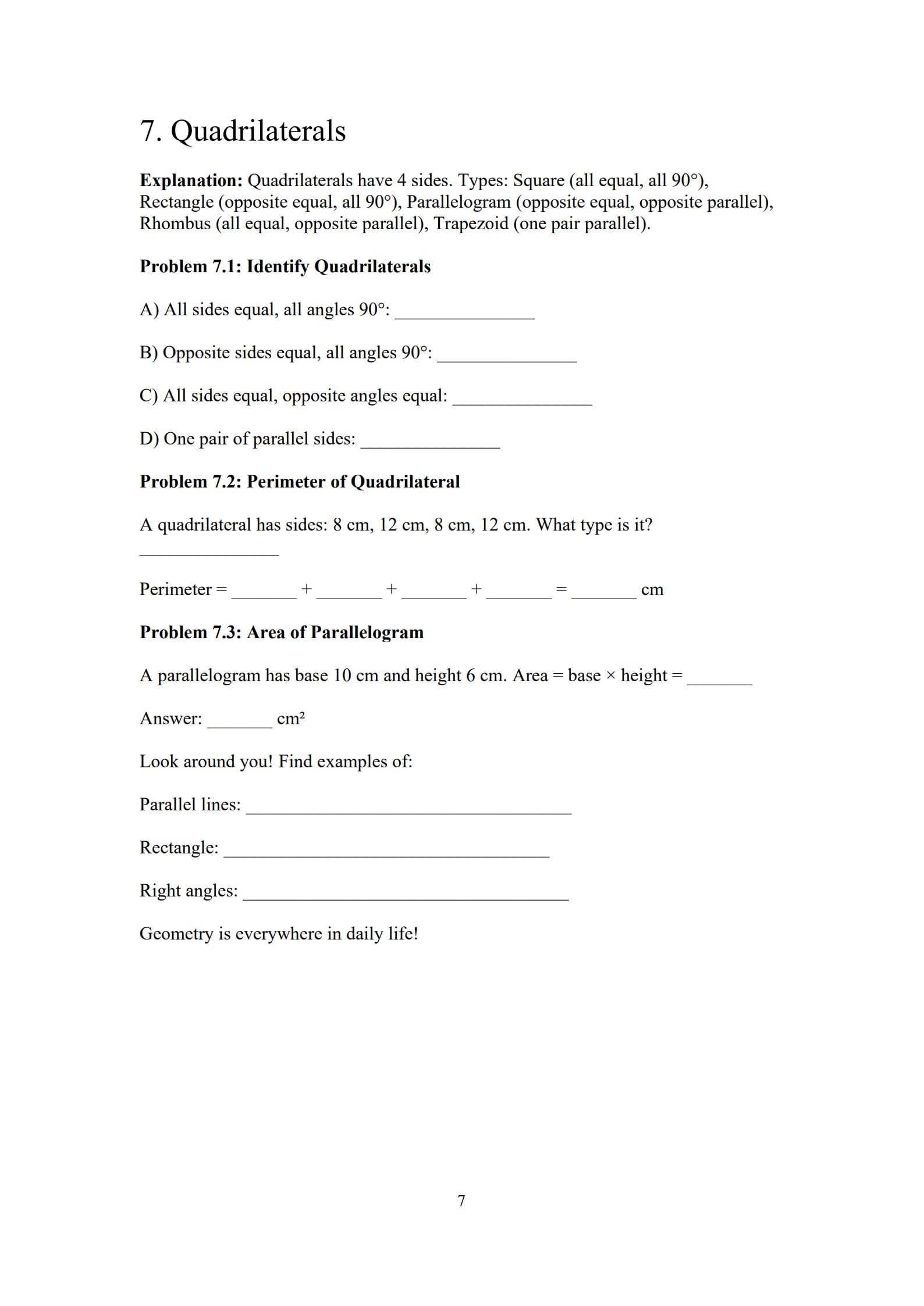
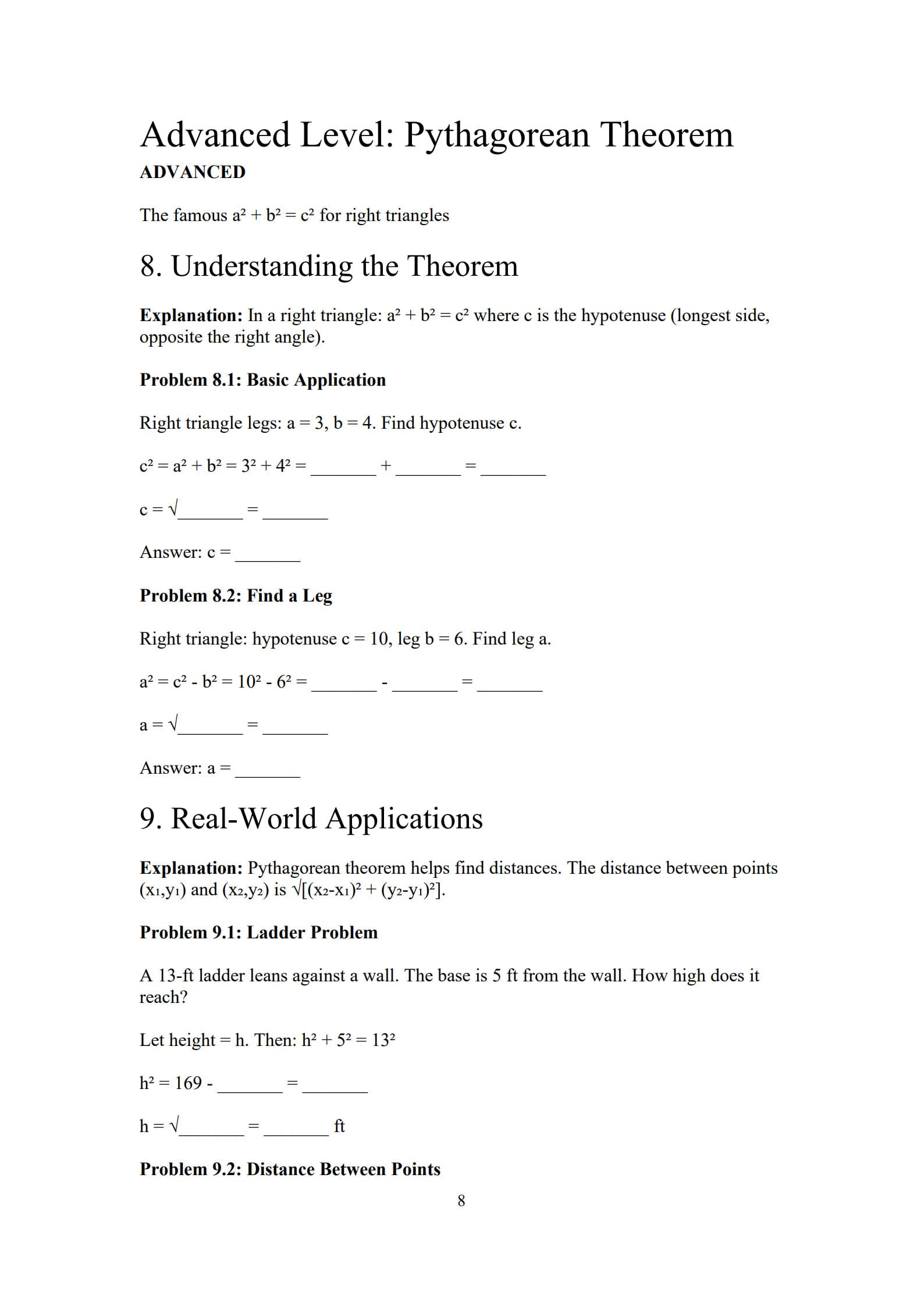
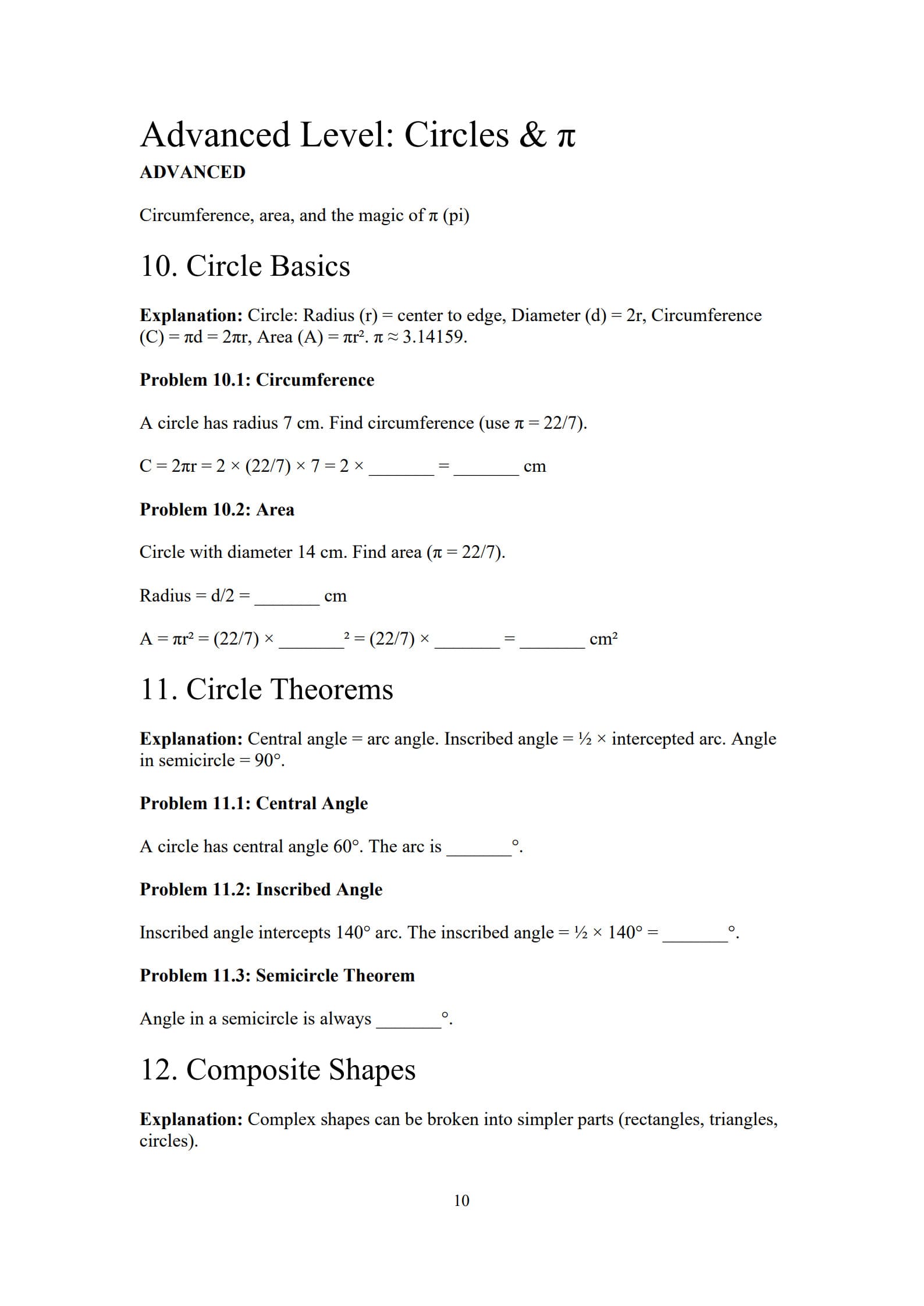
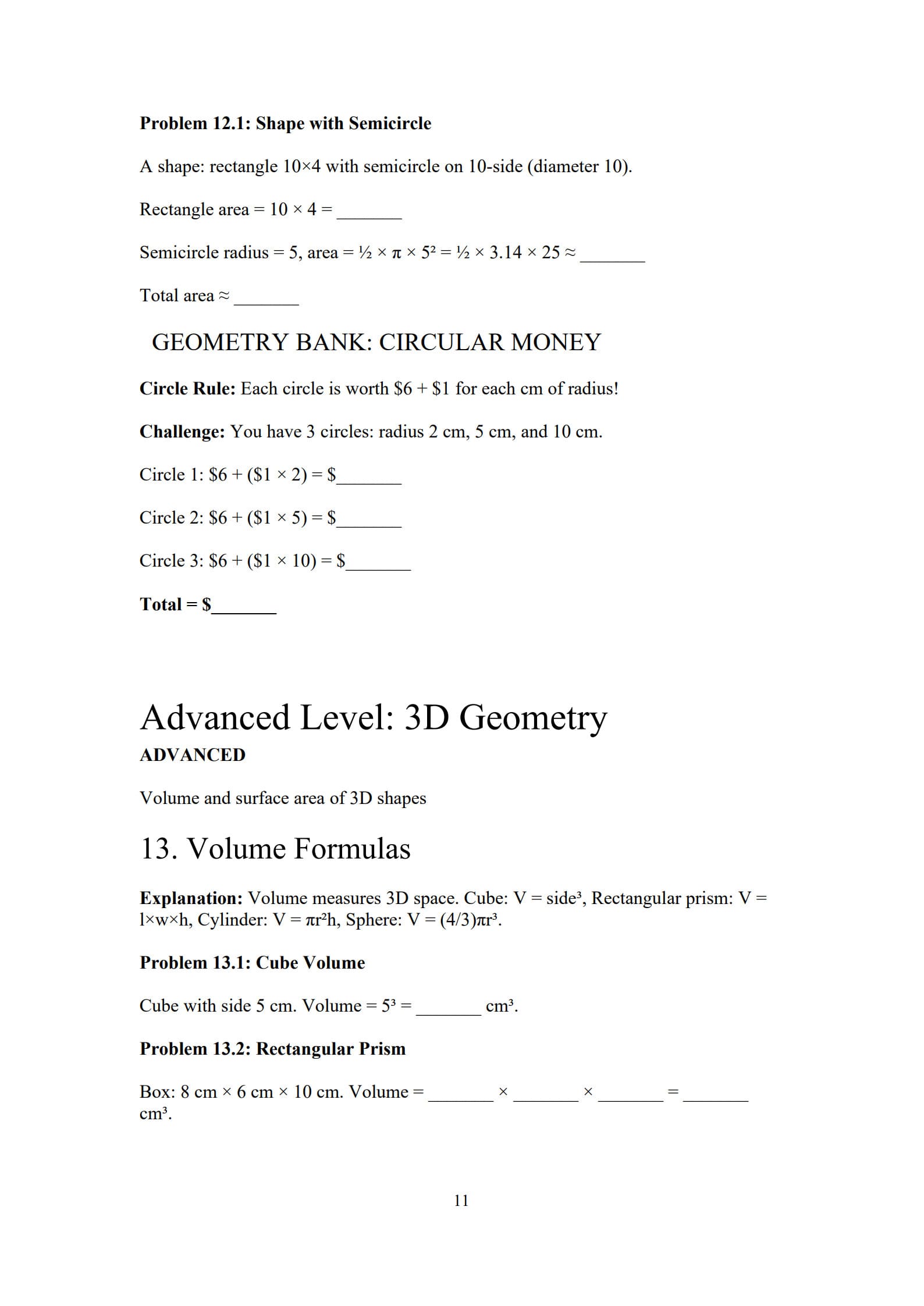
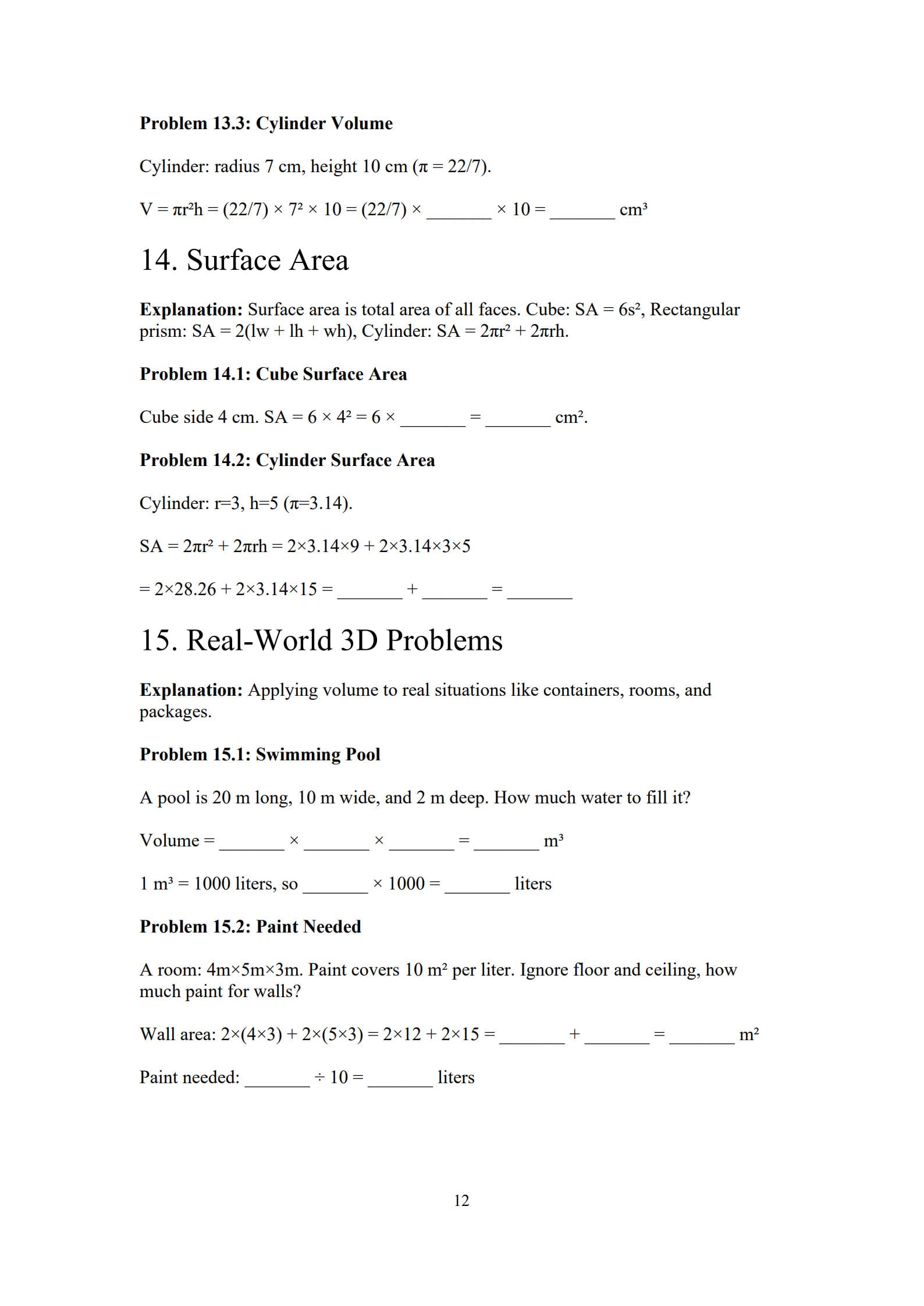
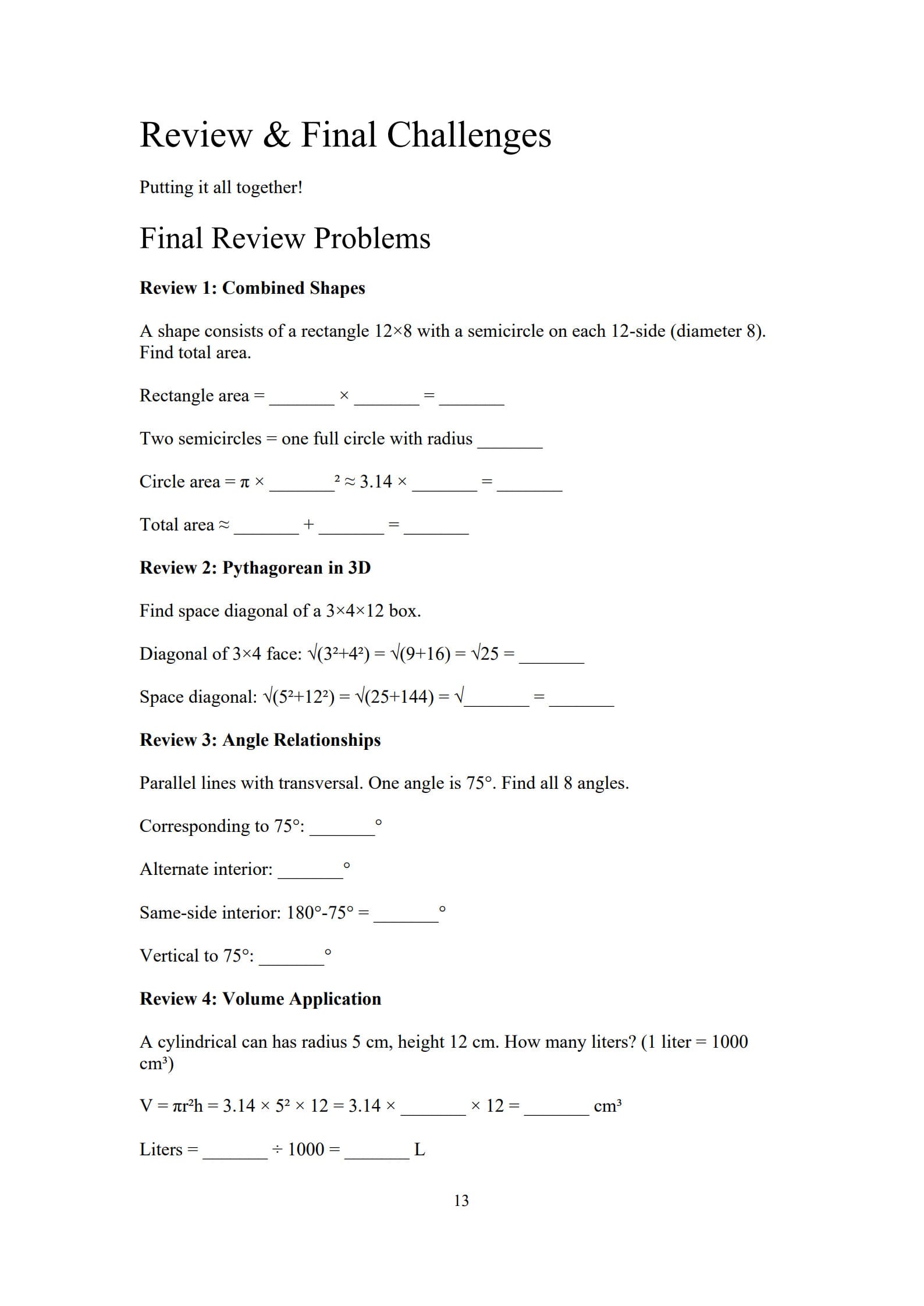
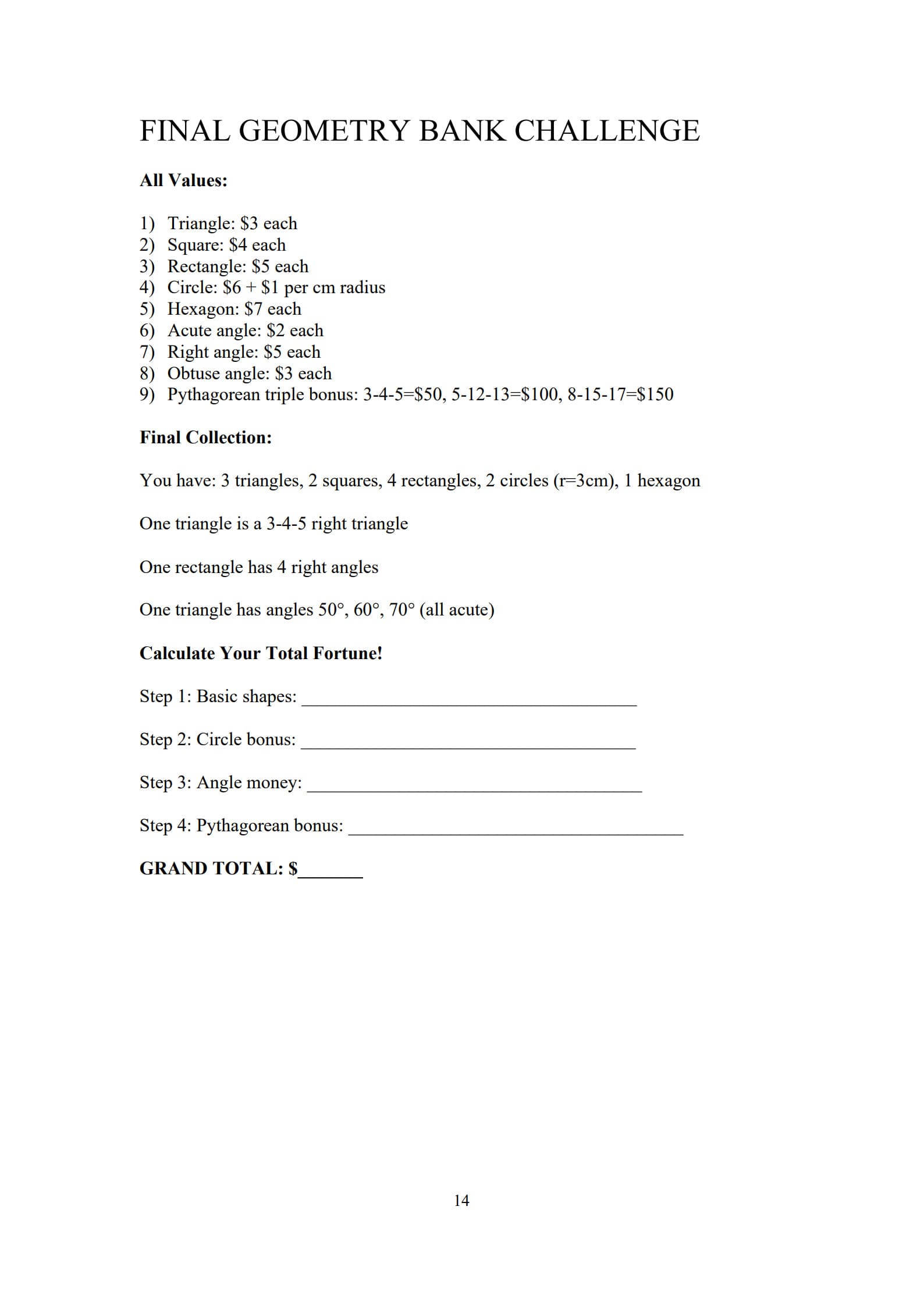
Welcome to the official resource hub for educators, parents, and lifelong learners. In today’s digital learning environment, having structured, engaging, and ready-to-use educational materials is not just a convenience—it’s a necessity. We are thrilled to introduce our meticulously crafted Geometry Worksheet template, now available for seamless use within the PDF Agile app. This template is far more than a simple collection of problems; it is a complete, progressive journey through the foundational and advanced concepts of geometry. Designed with clarity and engagement in mind, it features clear diagrams, real-world applications, and interactive challenges like the “Geometry Bank” to transform abstract concepts into tangible skills. Whether you are reinforcing classroom lessons, facilitating home learning, or seeking to build spatial reasoning and problem-solving abilities, this template provides a scaffolded path from basic shapes to complex theorems. It supports learners at all levels, ensuring everyone can master key geometry concepts with confidence and a sense of discovery. Let this template be your partner in unveiling the geometric patterns that structure our world.
How Can Foundational Shapes and Area and Perimeter Worksheets Build Confidence?
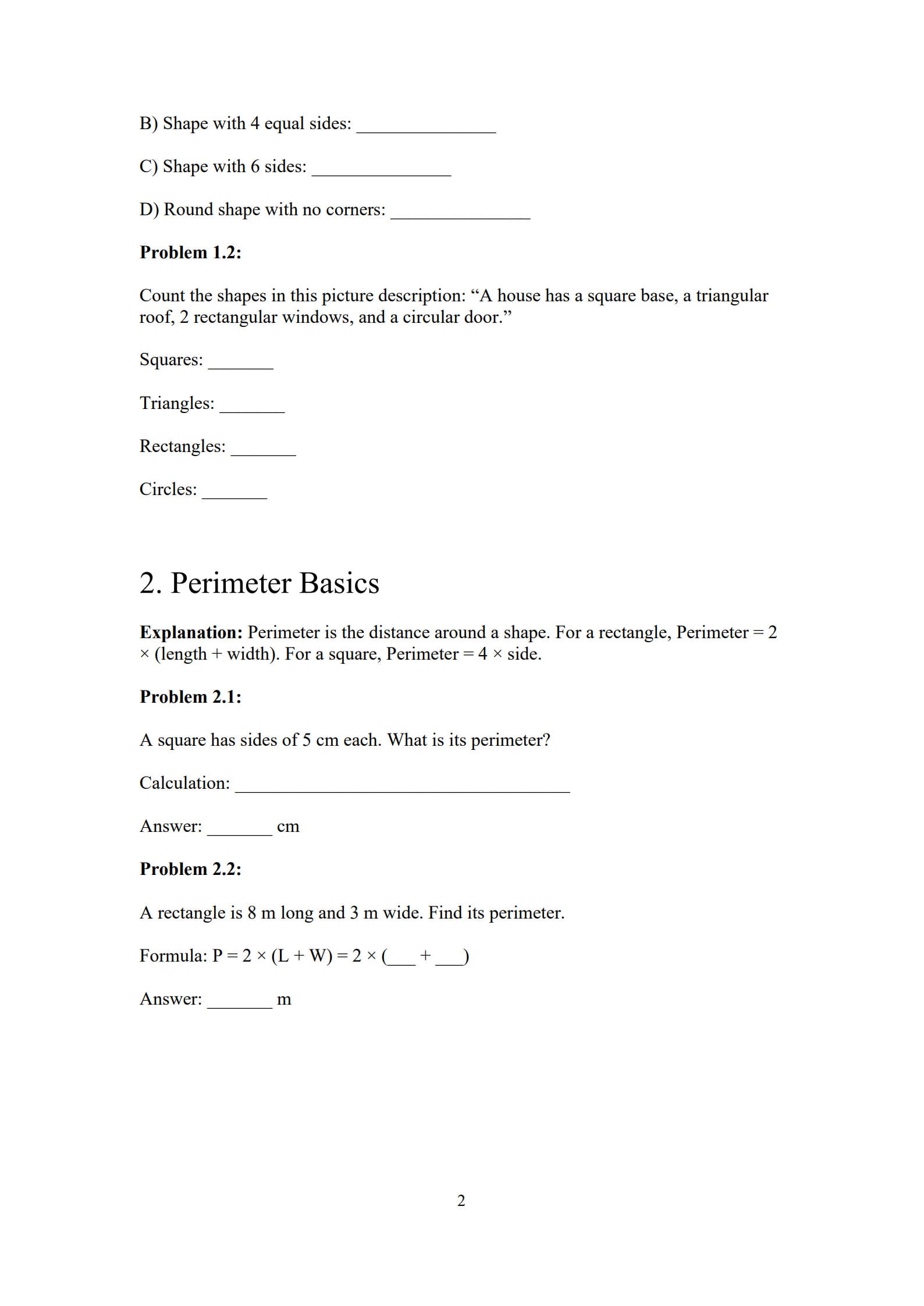
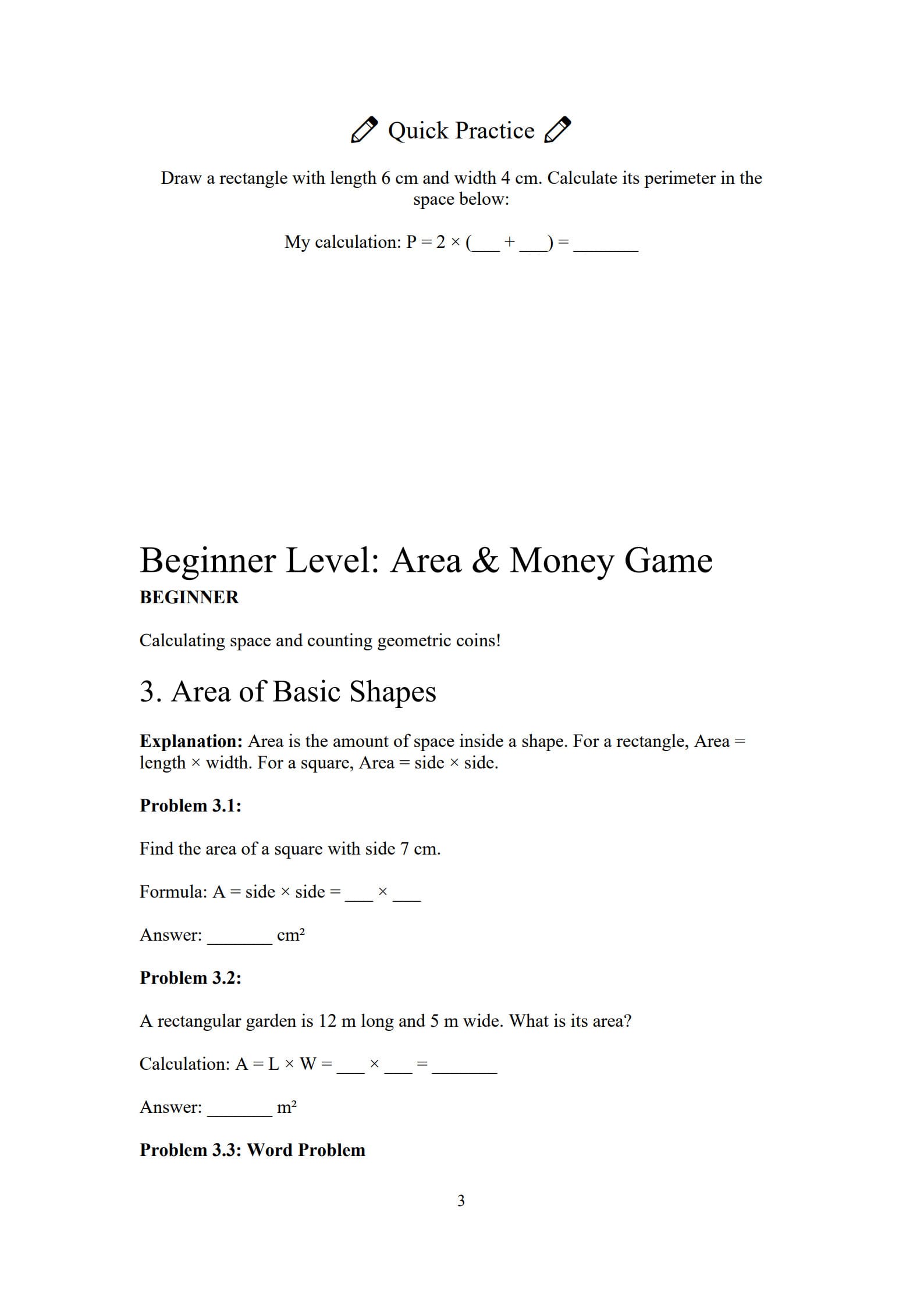
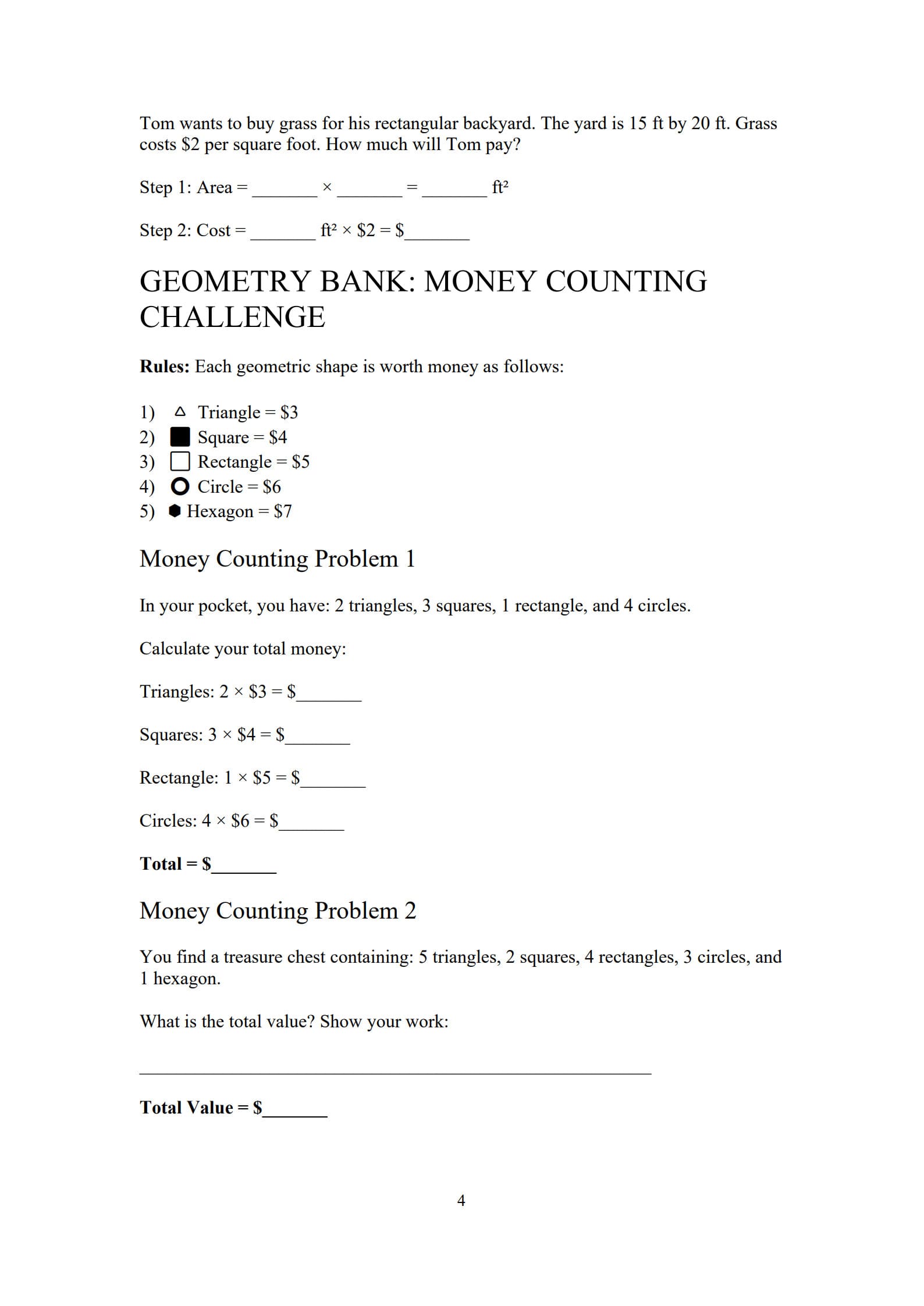
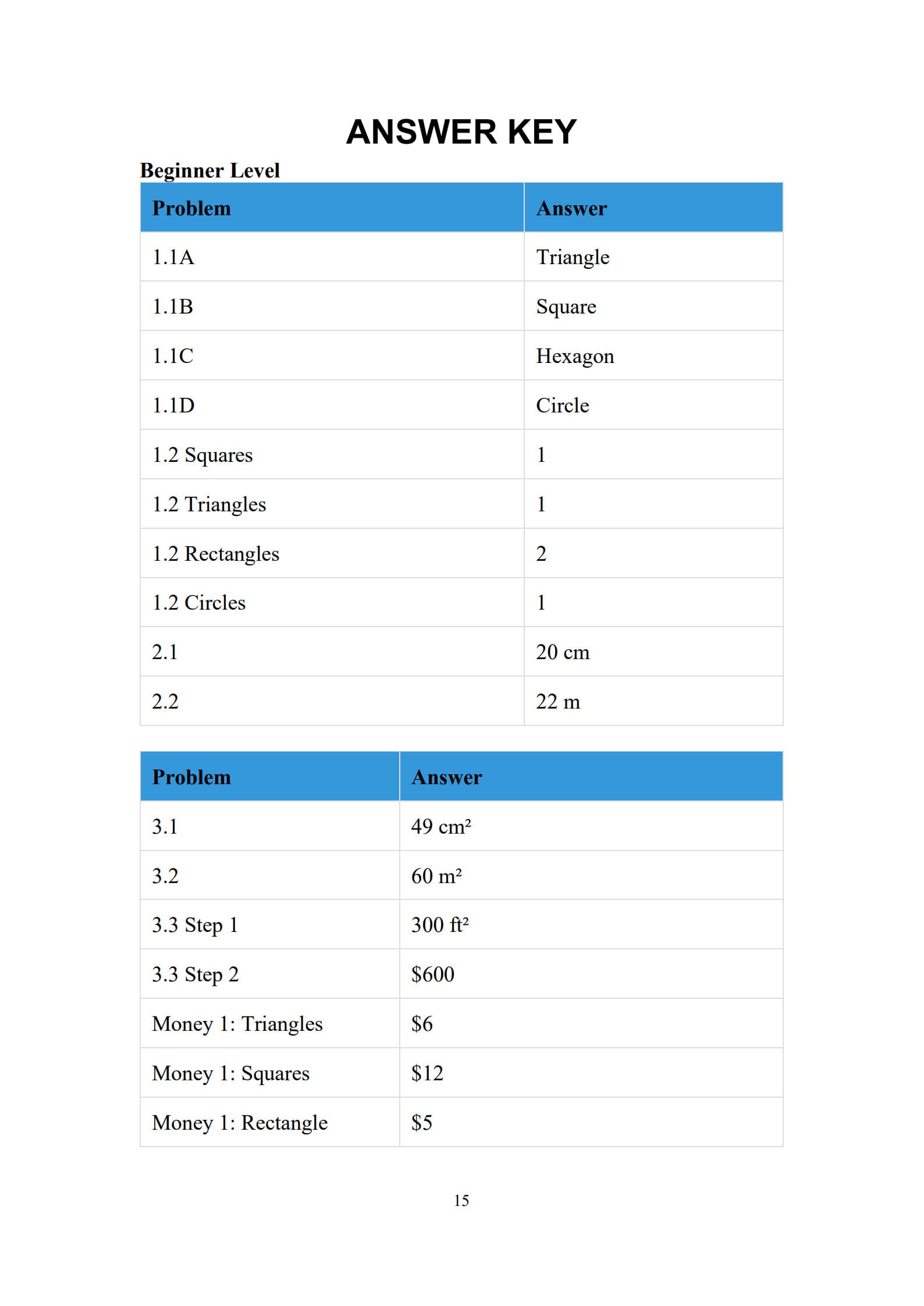
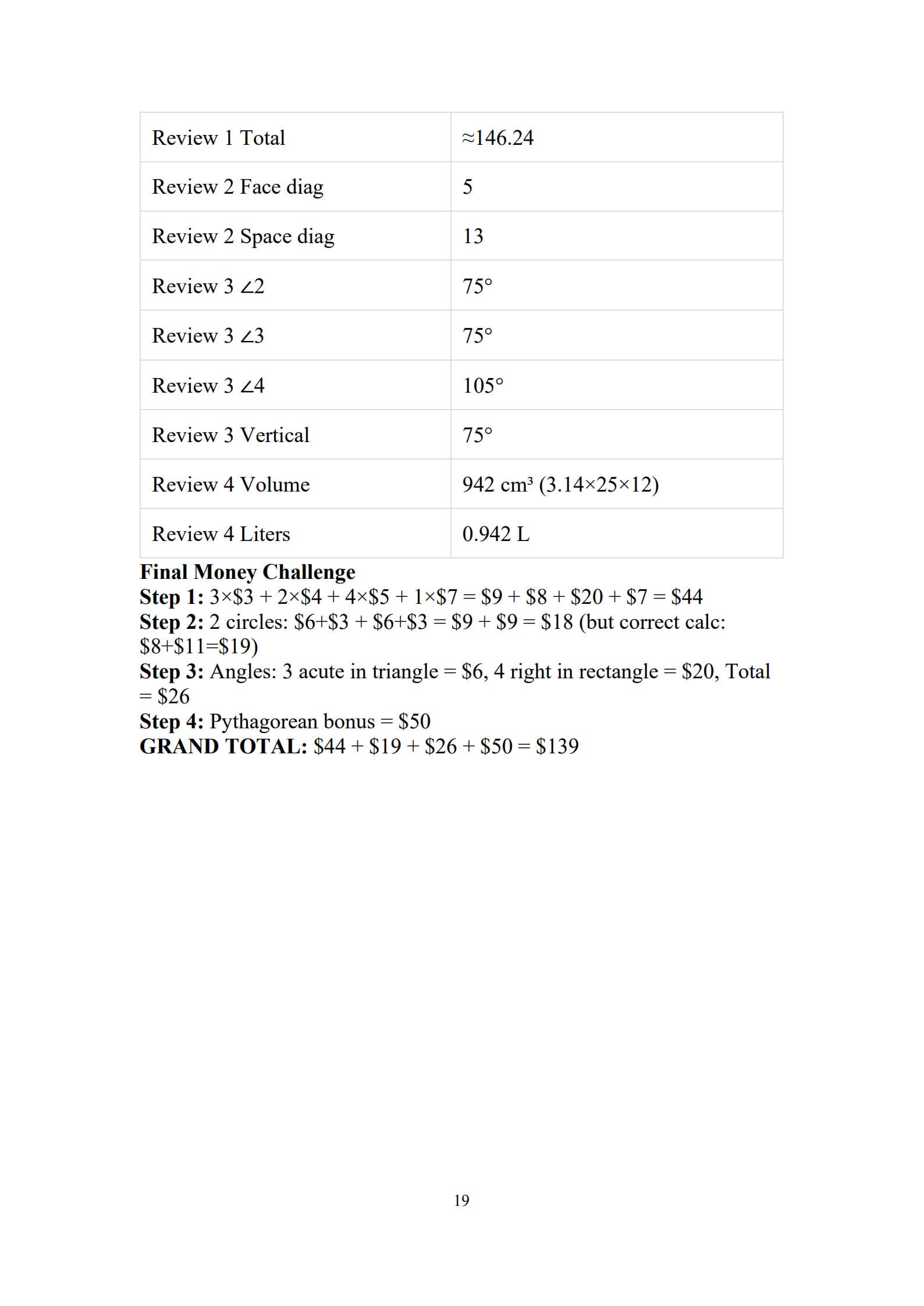
Every geometric exploration begins with recognizing the basic building blocks that surround us. Our template’s Beginner Level is meticulously designed to turn intimidation into intrigue, starting with the most common 2D shapes. The worksheet doesn’t just list shapes; it connects them to everyday objects. For instance, a problem asks students to identify the shapes in a house description: “A house has a square base, a triangular roof, 2 rectangular windows, and a circular door.” This immediately grounds geometry in the familiar. From recognition, the journey seamlessly moves to calculation, introducing perimeter and area through straightforward formulas and relatable contexts. Learners calculate the perimeter of a square with 5 cm sides (finding it to be 20 cm) and the area of a garden that is 12 m long and 5 m wide (resulting in 60 m²). These area and perimeter worksheets are crafted to build procedural fluency. The template then brilliantly bridges math with a playful context through the “Geometry Bank: Money Counting Challenge.” Here, shapes are assigned monetary values—a triangle is worth 4, a rectangle 6. A student with “2 triangles, 3 squares, 1 rectangle, and 4 circles” must calculate their total wealth, applying multiplication and addition in a fun, motivating scenario. This layered approach—from identification to formula application to gamified practice—ensures that foundational concepts are not only understood but enjoyed, building the confidence necessary for more complex topics.
Why Is Mastering Angles and Triangles Crucial for Spatial Understanding?
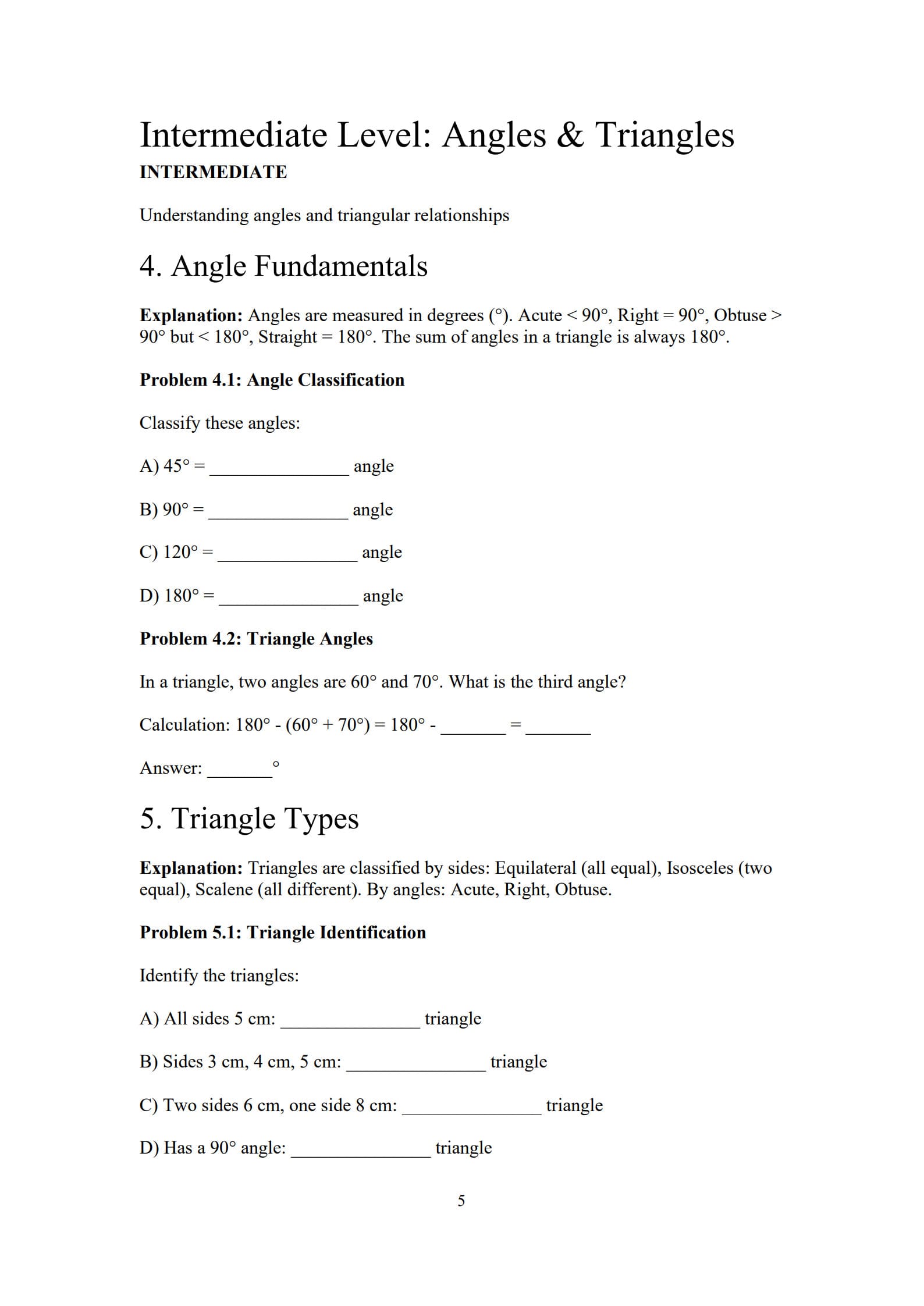
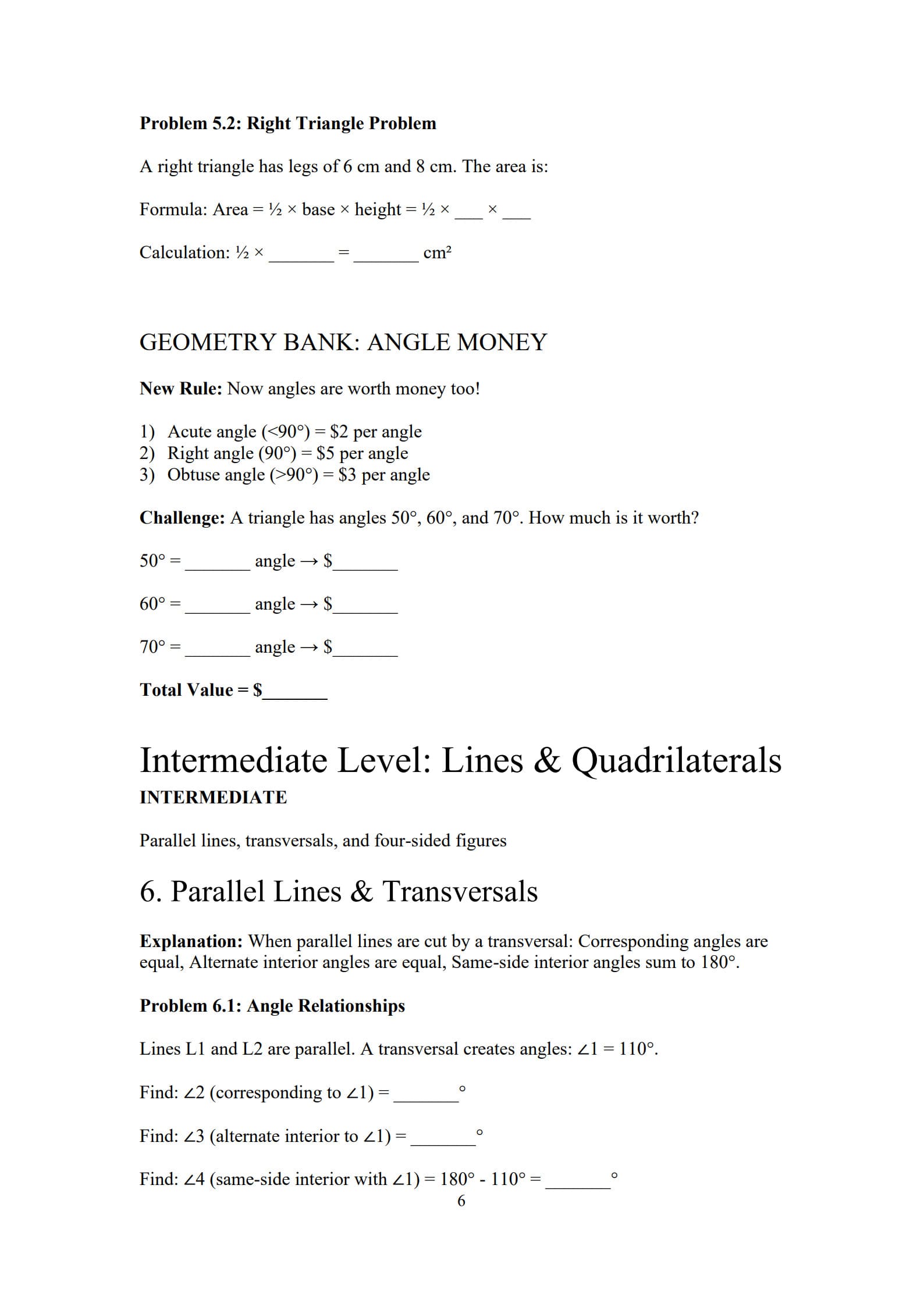
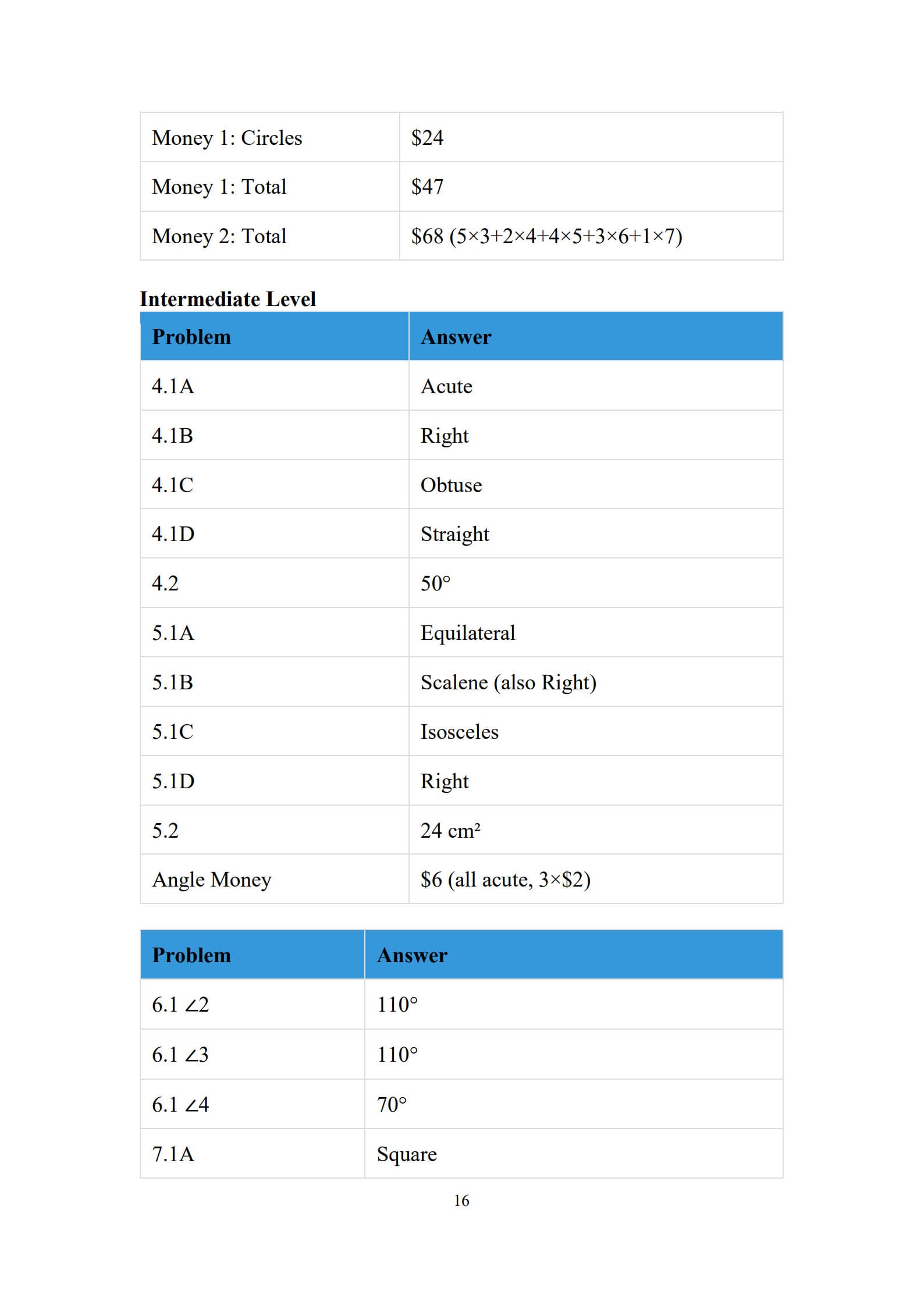
As learners progress, the template introduces the dynamic world of angles and triangles, fundamental elements that define the structure of countless forms. The Intermediate Level begins with angle classification, teaching students to distinguish between acute (<90°), right (90°), obtuse (>90° but <180°), and straight (180°) angles through direct examples like 45°, 90°, 120°, and 180°. This clear categorization is vital for measuring angles in various contexts. The worksheet then reinforces a core theorem: the sum of angles in any triangle is always 180°. A practical problem gives two angles (60° and 70°) and asks for the third, guiding the student through the calculation: 180° - (60° + 70°) = 50°. This application solidifies a critical geometric rule. Furthermore, the template delves into triangle taxonomy—by sides (Equilateral, Isosceles, Scalene) and by angles (Acute, Right, Obtuse). A problem set asks students to identify a triangle with all sides 5 cm as Equilateral, and one with sides 3cm, 4cm, 5cm as a Scalene (and Right) triangle. To reinforce these concepts engagingly, the “Geometry Bank” rules are extended: acute angles are worth 5, and obtuse angles 2 = $6). This section transforms angle measurement and triangle properties from abstract facts into tools for analysis and even playful “valuation,” deepening spatial reasoning in a memorable way.
From Lines to Theorems: How Do Pythagorean Theorem Worksheets Solve Real Problems?
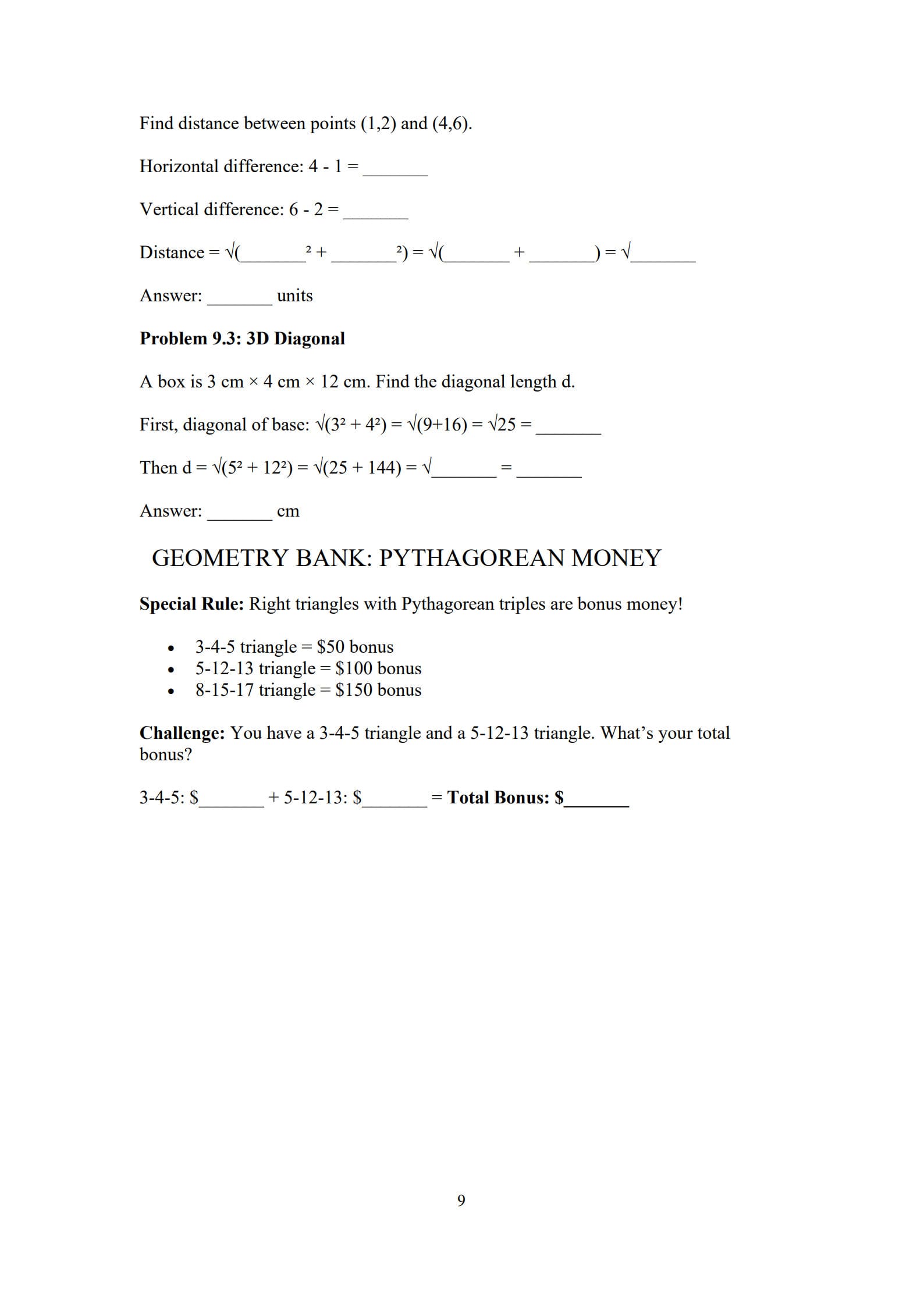
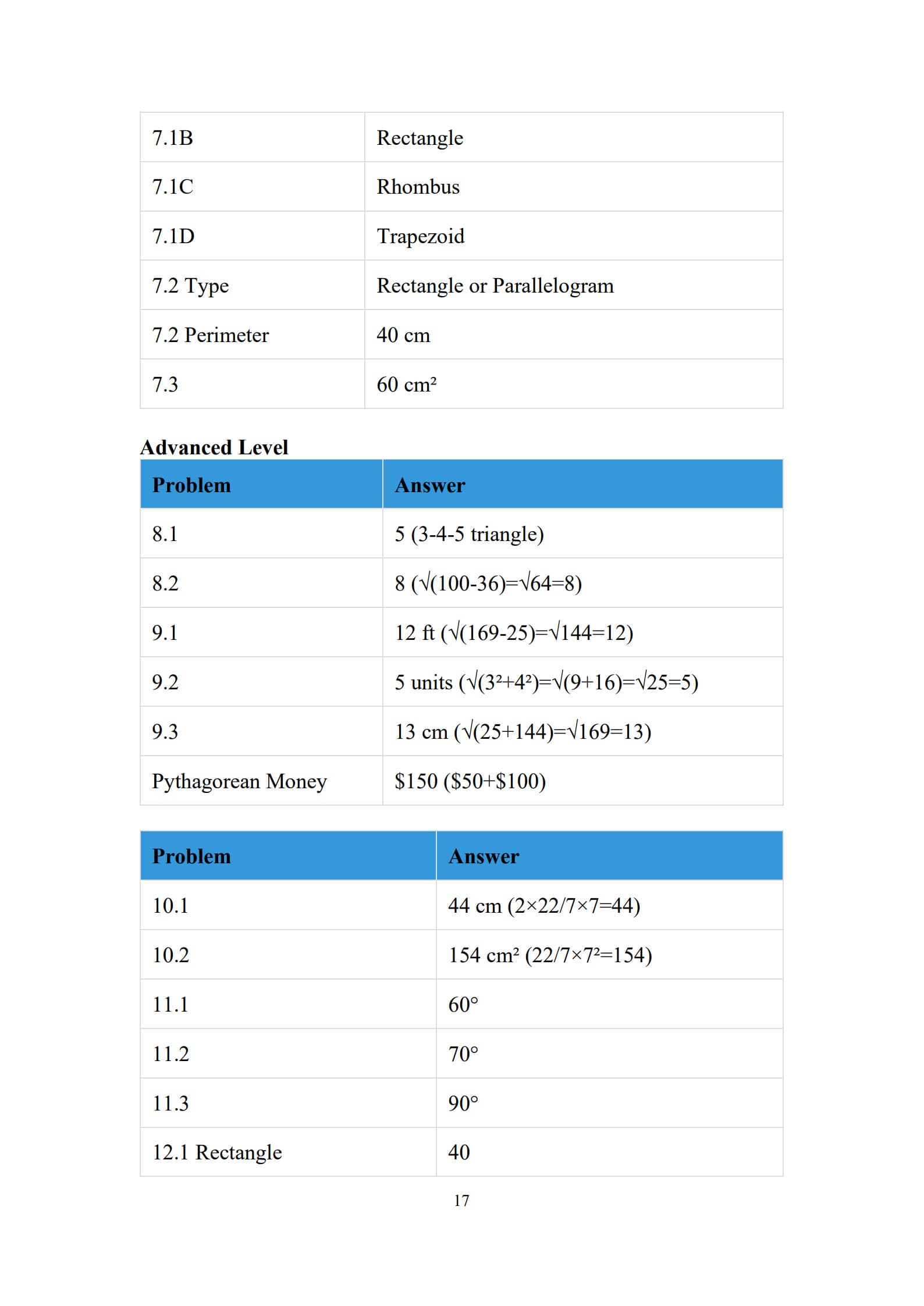
The journey into advanced geometry unveils powerful tools for solving real-world problems, crowned by the indispensable Pythagorean Theorem. Our Advanced Level section dedicates itself to this principle, expressed as a² + b² = c² for right triangles. The template breaks it down with classic examples. One problem provides legs a=3 and b=4, guiding the student to find the hypotenuse: c² = 3² + 4² = 9 + 16 = 25, so c = 5. Another reverses the challenge: given hypotenuse c=10 and leg b=6, find leg a (a² = 10² - 6² = 100 - 36 = 64, so a=8). These Pythagorean theorem worksheets are designed for mastery through repetition and variation. The application extends brilliantly to real-world scenarios, such as calculating how high a 13-ft ladder reaches if its base is 5 ft from a wall (solution: height = 12 ft). The template even explores 3D space, asking for the diagonal of a 3 cm x 4 cm x 12 cm box, which requires a two-step Pythagorean application, yielding a result of 13 cm. To heighten engagement, a special “Pythagorean Money” bonus rule is introduced for famous Pythagorean triples. The worksheet challenges: “You have a 3-4-5 triangle and a 5-12-13 triangle. What’s your total bonus?” The answer, 50 + $100), is found in the answer key. This section effectively demonstrates how a single theorem can unlock solutions in diverse contexts, from simple triangles to spatial diagonals.
Table: Pythagorean Triples and Their Applications in the Worksheet
| Pythagorean Triple | Example Problem from Template | Real-World Application Context | Bonus Value in “Geometry Bank” |
|---|---|---|---|
| 3-4-5 | Legs a=3, b=4, find c. | Foundation for basic right-angle construction. | $50 |
| 5-12-13 | Hypotenuse c=13, base=5, find height (ladder problem). | Calculating ladder height against a wall. | $100 |
| 8-15-17 | Implied through bonus rule; used for more complex calculations. | Solving for unknown legs in larger-scale problems. | $150 |
How to Use This Geometry Worksheet Template on PDF Agile?
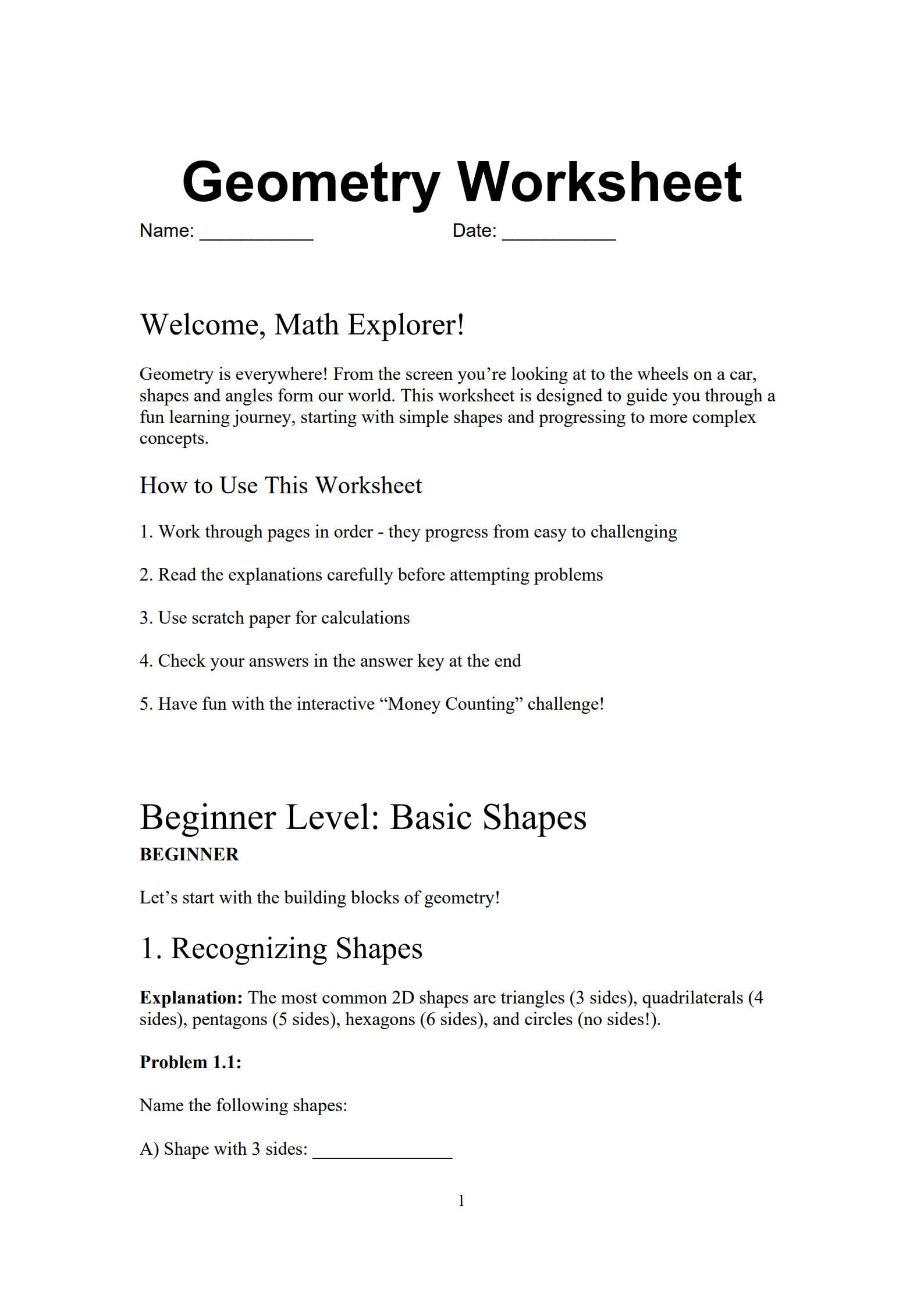
Utilizing this comprehensive Geometry Worksheet template within PDF Agile is a streamlined process designed for maximum efficiency and customization. Follow these simple steps to get started:
Step 1: Access and Download the Geometry Template
Navigate to the PDF Agile Template Library either within the app or on our website. Search for “Geometry Worksheet” or browse the Education category. You can preview the complete template, which includes all levels from Beginner to Advanced, the Geometry Bank challenges, and the Answer Key. Click “Use Template” or “Download” to instantly add this ready-to-use PDF to your PDF Agile workspace.
Step 2: Customize for Your Learner’s Needs
This is where PDF Agile’s powerful editing tools shine. The template is fully customizable. You can:
- Edit Text: Modify instructions, add student names, or change numerical values in problems to create unlimited practice variations.
- Highlight Key Concepts: Use the highlight tool to emphasize important formulas like “P = 2 × (L + W)” or “a² + b² = c²”.
- Add Notes or Hints: Insert text comments or sticky notes in the margins for additional guidance or scaffolding tailored to an individual learner.
Step 3: Complete and Solve Interactively
Learners can engage with the worksheet directly within PDF Agile. They can use the “Fill & Sign” tool to type their answers into the blank fields (e.g., “_ cm” or “_ m²”). For scratch work or diagrams, such as “Draw a rectangle with length 6 cm and width 4 cm,” they can utilize the Pencil or Drawing tool. This creates an active, digital workspace.
Step 4: Review, Save, and Share
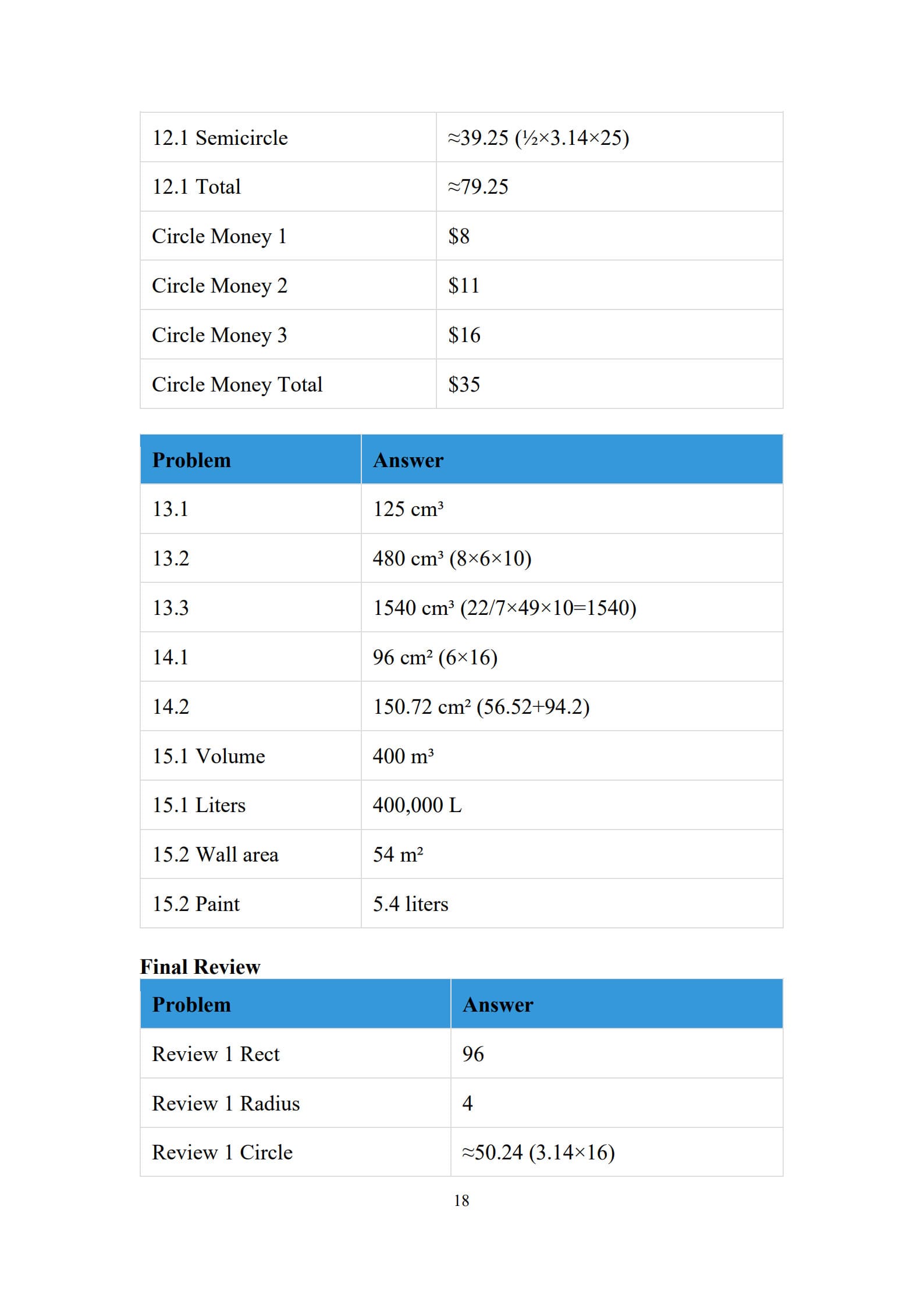
Once completed, use the Answer Key section at the end of the template for review. PDF Agile allows you to compare answers easily. Finally, save the filled-out worksheet as a new PDF file. The entire process—from customization to completion—happens within one intuitive application, making geometry learning organized, paperless, and highly effective.
Conclusion
The Geometry Worksheet template in PDF Agile represents a significant leap forward in digital learning resources. It is not a static document but a dynamic, adaptable, and complete educational toolkit. From the first steps of identifying basic shapes to the advanced applications of the Pythagorean theorem in three-dimensional space, the template provides a structured, engaging, and confidence-building path. Its unique integration of traditional practice with innovative elements like the “Geometry Bank” challenges demonstrates a deep understanding of how students learn—by connecting logic with creativity and abstract formulas with tangible rewards.