

Mastering area and perimeter is a foundational math skill that bridges classroom learning with real-world applications. For educators, students, and parents seeking an engaging way to practice these concepts, PDF Agile offers a dynamic, pre-designed Area and Perimeter Worksheet template. This template is expertly structured to guide learners from basic shapes like rectangles and triangles to advanced composite figures, with interactive problems and visual aids. Whether you’re a teacher creating homework assignments or a student reinforcing your skills, this template transforms abstract formulas into tangible understanding.
Why Start with an Area and Perimeter of Rectangle Worksheet?
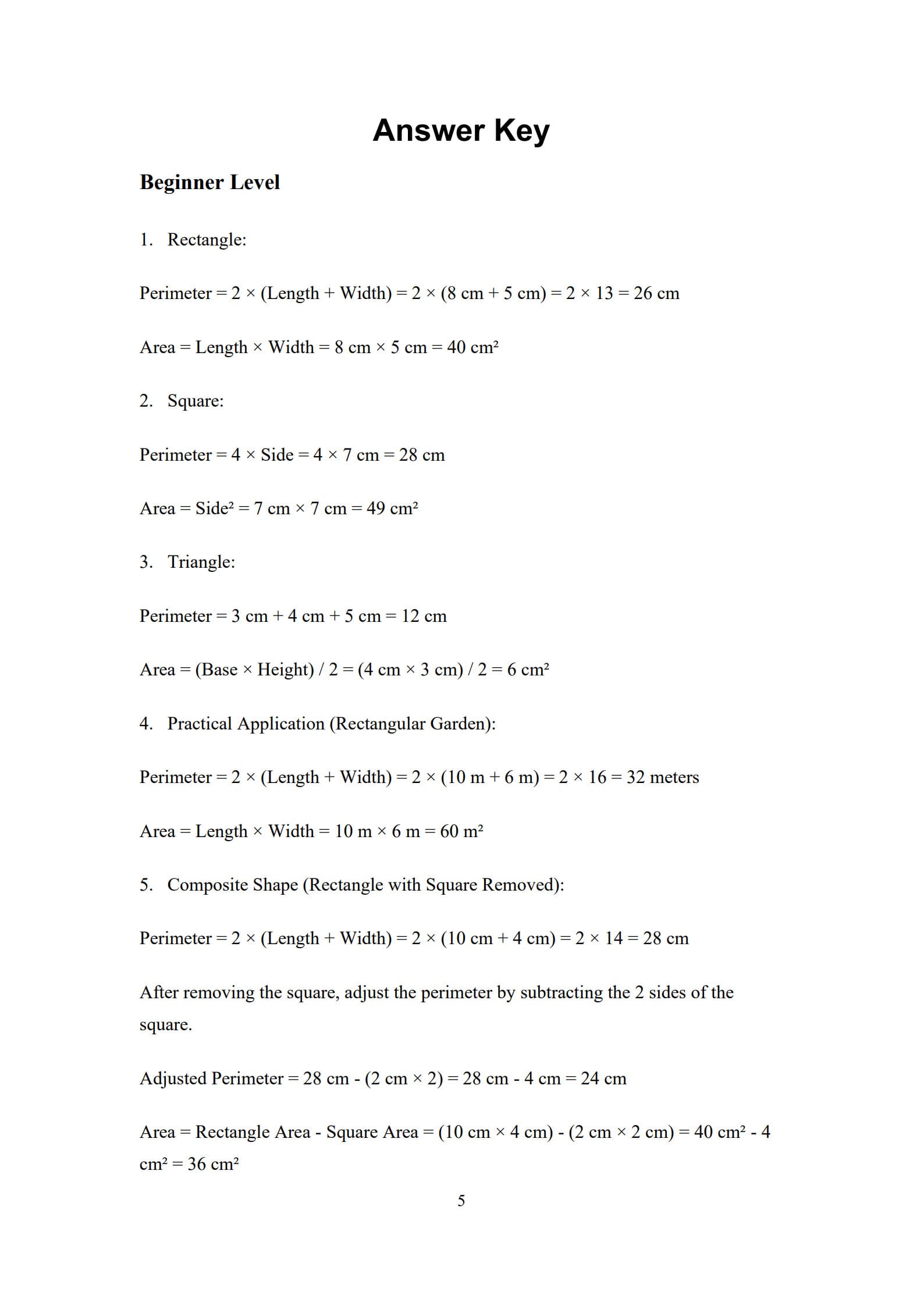
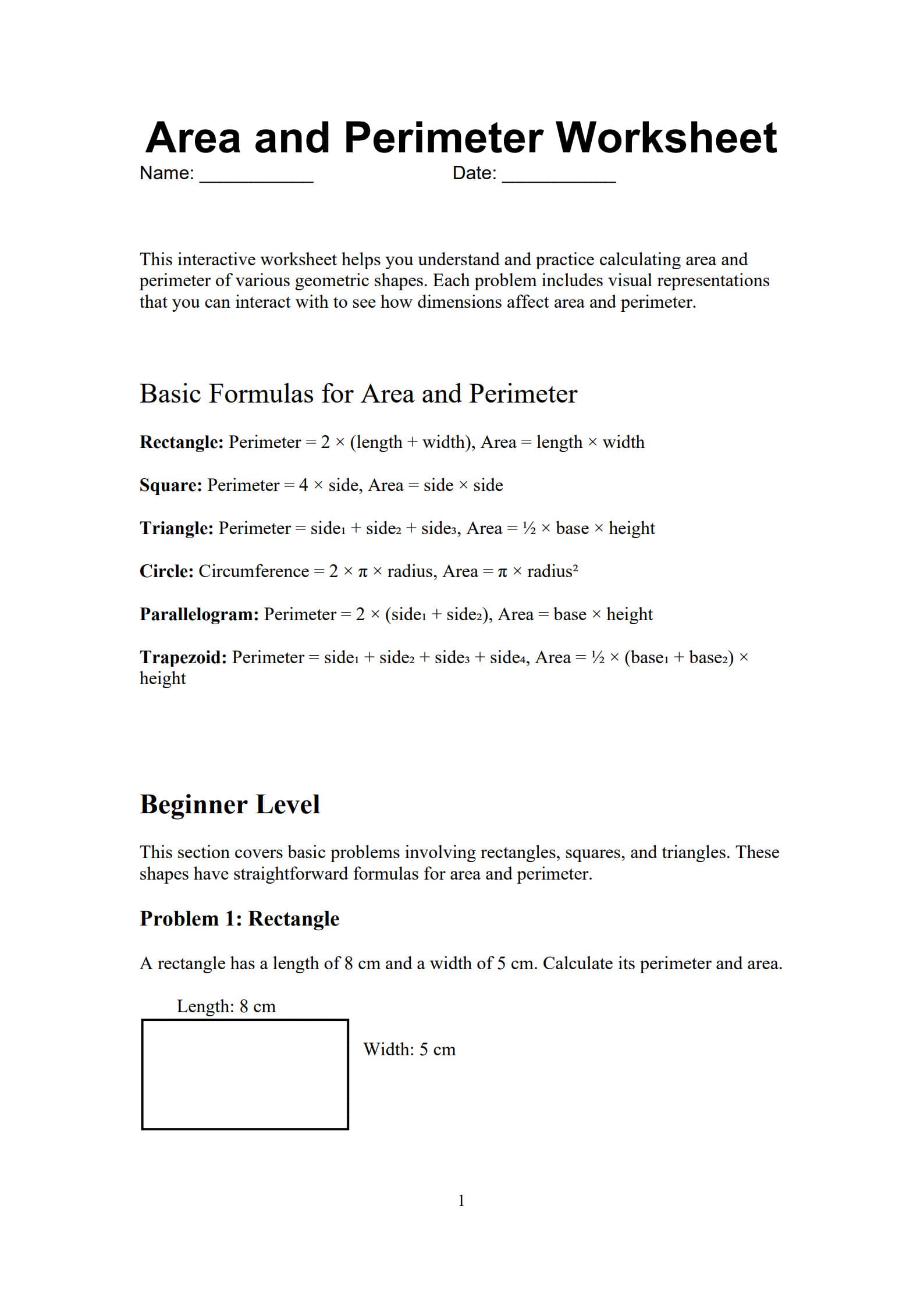
The journey into geometry often begins with rectangles, making an area and perimeter of rectangle worksheet the perfect starting point for beginners. Why? Because rectangles are everywhere—from garden plots to book covers—and their formulas are straightforward. For instance, the template’s Problem 1 features a rectangle with a length of 8 cm and width of 5 cm. By applying the perimeter formula , learners find the answer is 26 cm, while the area formula gives 40 cm². This practical approach builds confidence before tackling complex shapes.
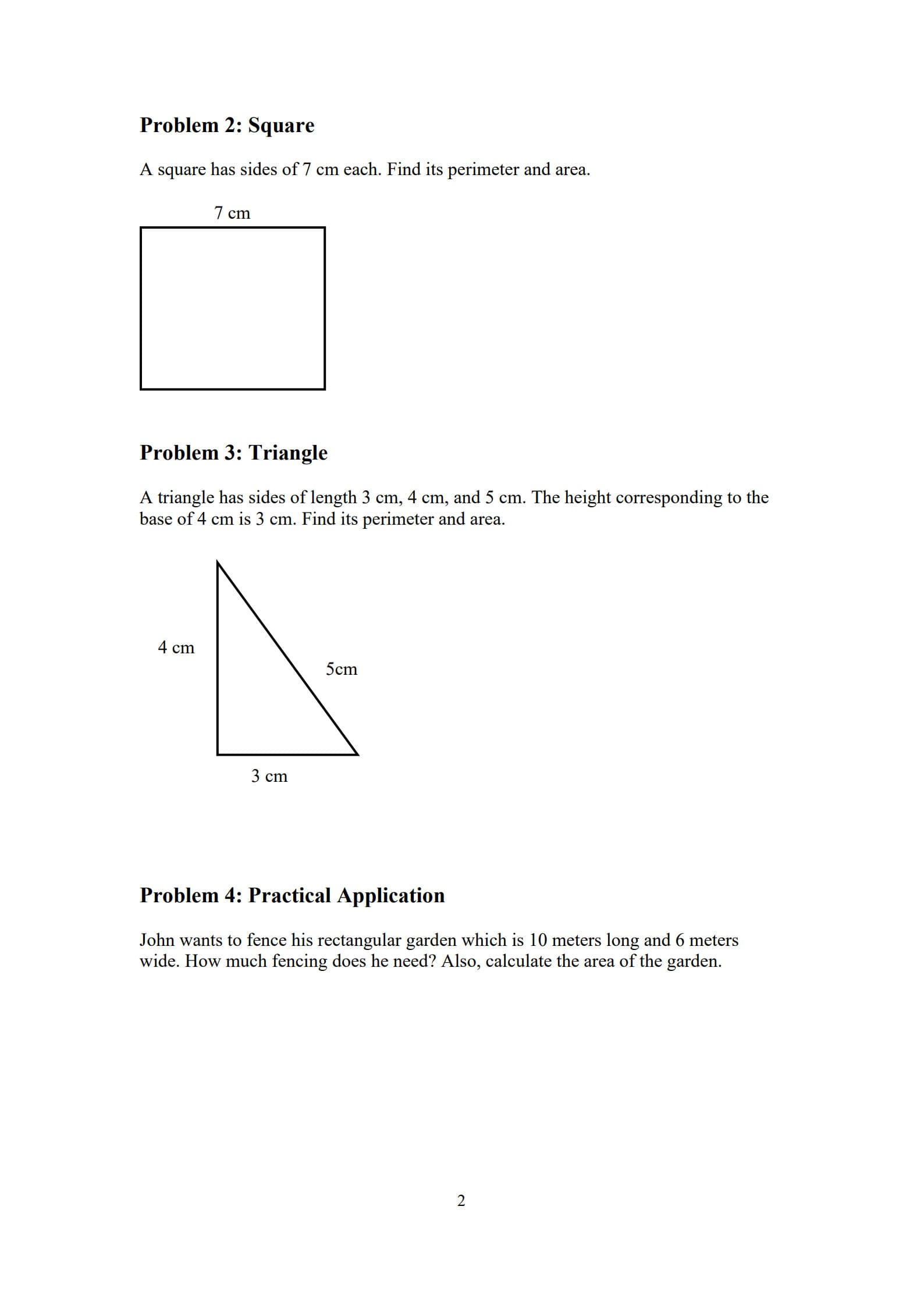
Moreover, the worksheet includes real-world scenarios, like John’s rectangular garden (Problem 4), which is 10 meters long and 6 meters wide. Here, students calculate the fencing needed (perimeter = 32 meters) and the garden’s area (60 m²), linking math to everyday decisions. Such problems enhance retention by showing how formulas apply beyond the classroom. PDF Agile’s template allows users to interact with these dimensions digitally, adjusting values to see instant results—a feature that caters to visual learners and encourages experimentation. By starting with rectangles, the worksheet ensures a solid foundation, making it ideal for class 5 students or anyone new to geometry.
How Do Area and Perimeter Questions Progress in Difficulty?
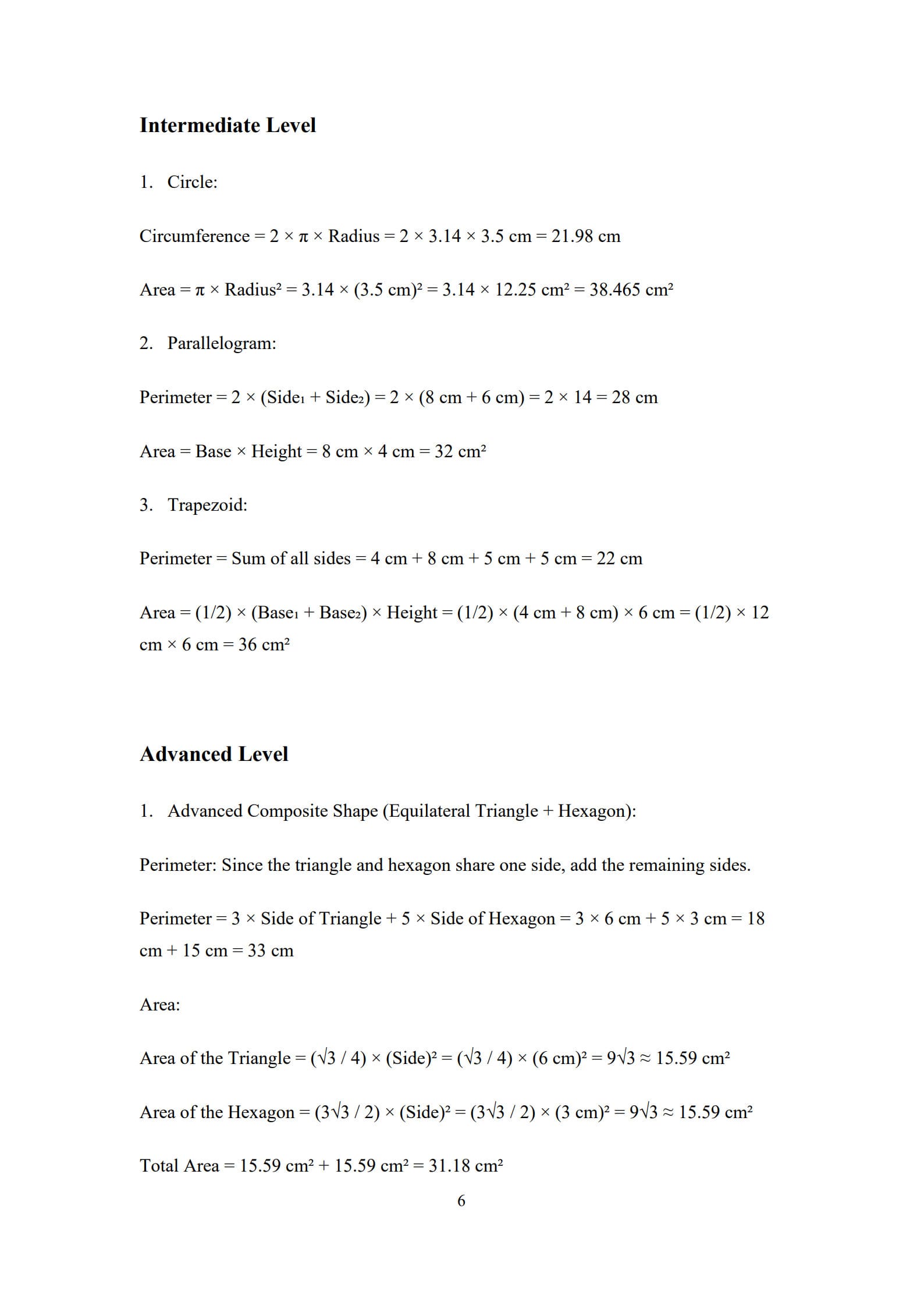
As learners advance, the template introduces area and perimeter questions that scale in complexity, moving from simple shapes to circles and trapezoids. For example, the Intermediate Level includes Problem 1 on circles, where a radius of 3.5 cm leads to a circumference of 21.98 cm and an area of 38.465 cm² using π=3.14. This step-by-step progression prevents overwhelm and reinforces logical thinking.
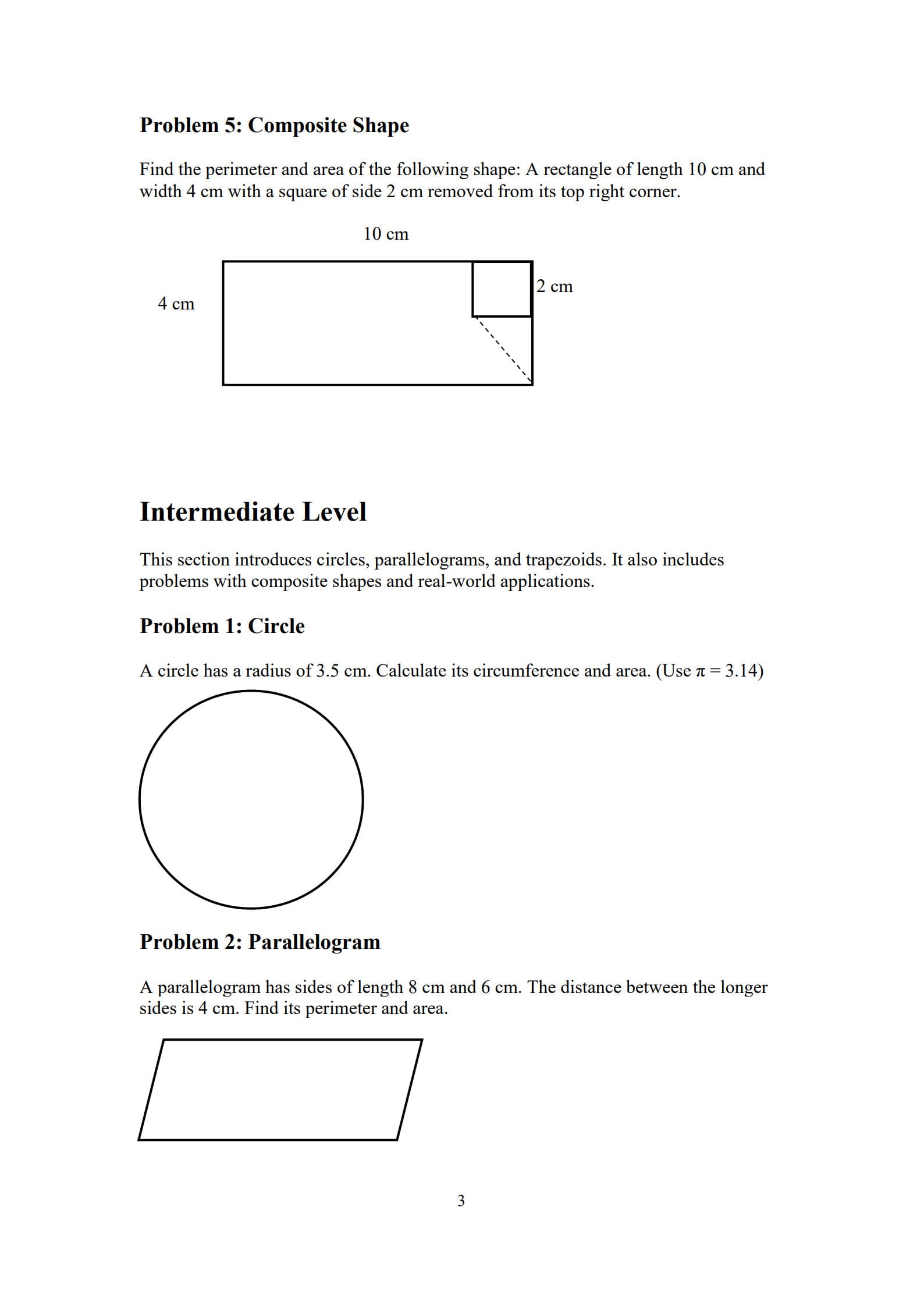
The questions also incorporate composite shapes, such as Problem 5 in the Beginner Level, where a rectangle has a square removed from one corner. Students must adjust their calculations, subtracting the square’s area (4 cm²) from the rectangle’s (40 cm²) to get 36 cm², while the perimeter requires accounting for removed sides. This challenges learners to think critically rather than rely on rote memorization. PDF Agile’s template supports this by allowing users to highlight different sections of the shape, making it easier to visualize composite parts. By gradually increasing difficulty, the worksheet ensures that students develop a deep, flexible understanding of geometry concepts.
What Makes This Area and Perimeter Worksheet Ideal for Class 5?
Designed with young learners in mind, this area and perimeter worksheet for class balances simplicity and engagement. It focuses on shapes familiar to children, like squares and triangles, with clear visuals. Problem 2, for instance, asks students to find the perimeter and area of a square with 7 cm sides, resulting in 28 cm and 49 cm²—calculations that reinforce multiplication skills.
Additionally, problems like the triangle in Problem 3 (sides 3 cm, 4 cm, 5 cm; area 6 cm²) introduce geometry without overwhelming students, making the template a trusted tool for teachers aiming to meet curriculum standards. PDF Agile’s digital format lets children zoom in on diagrams or check answers instantly, turning practice into an interactive experience.
How Does an Area Perimeter Worksheet Foster Real-World Skills?
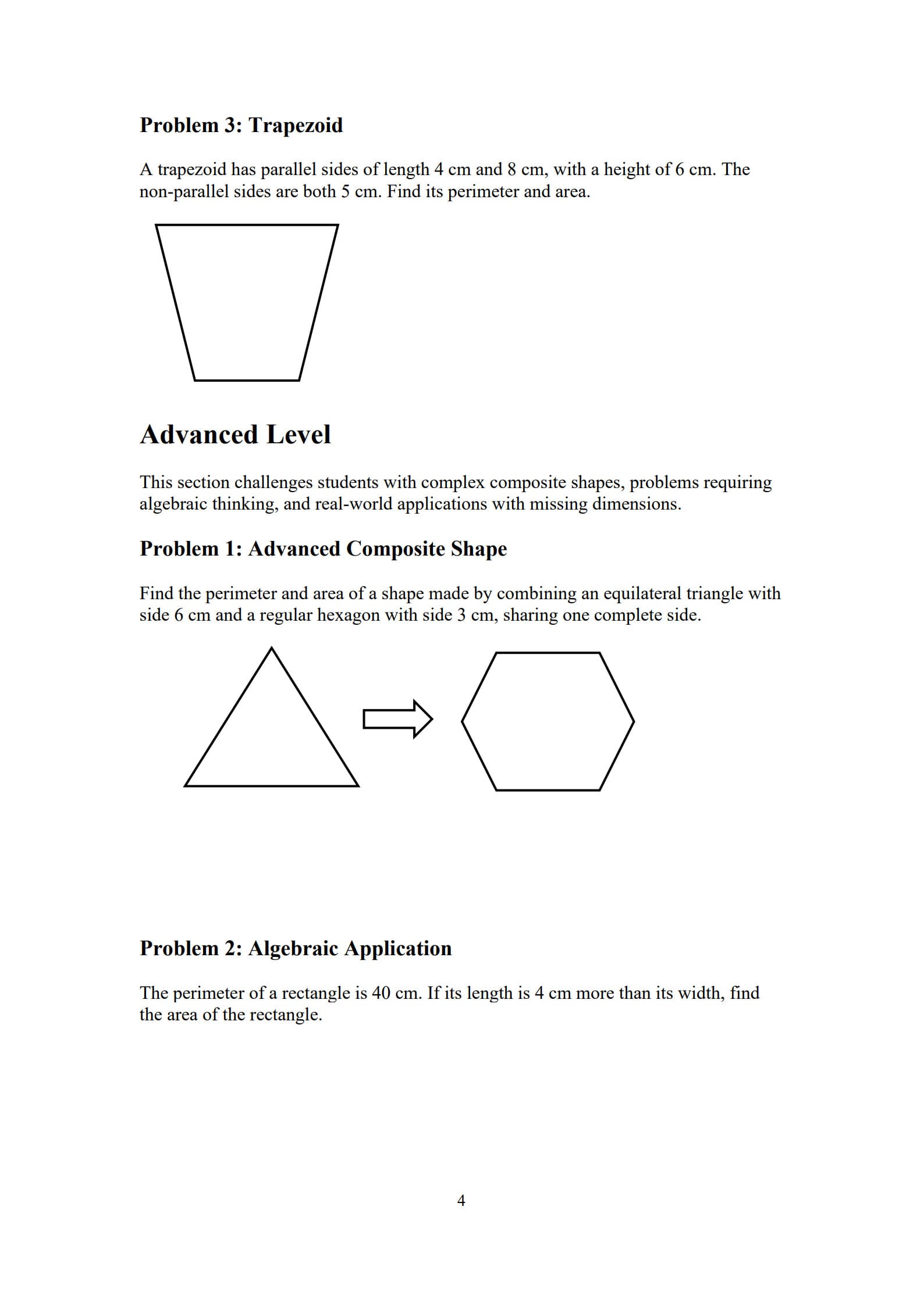
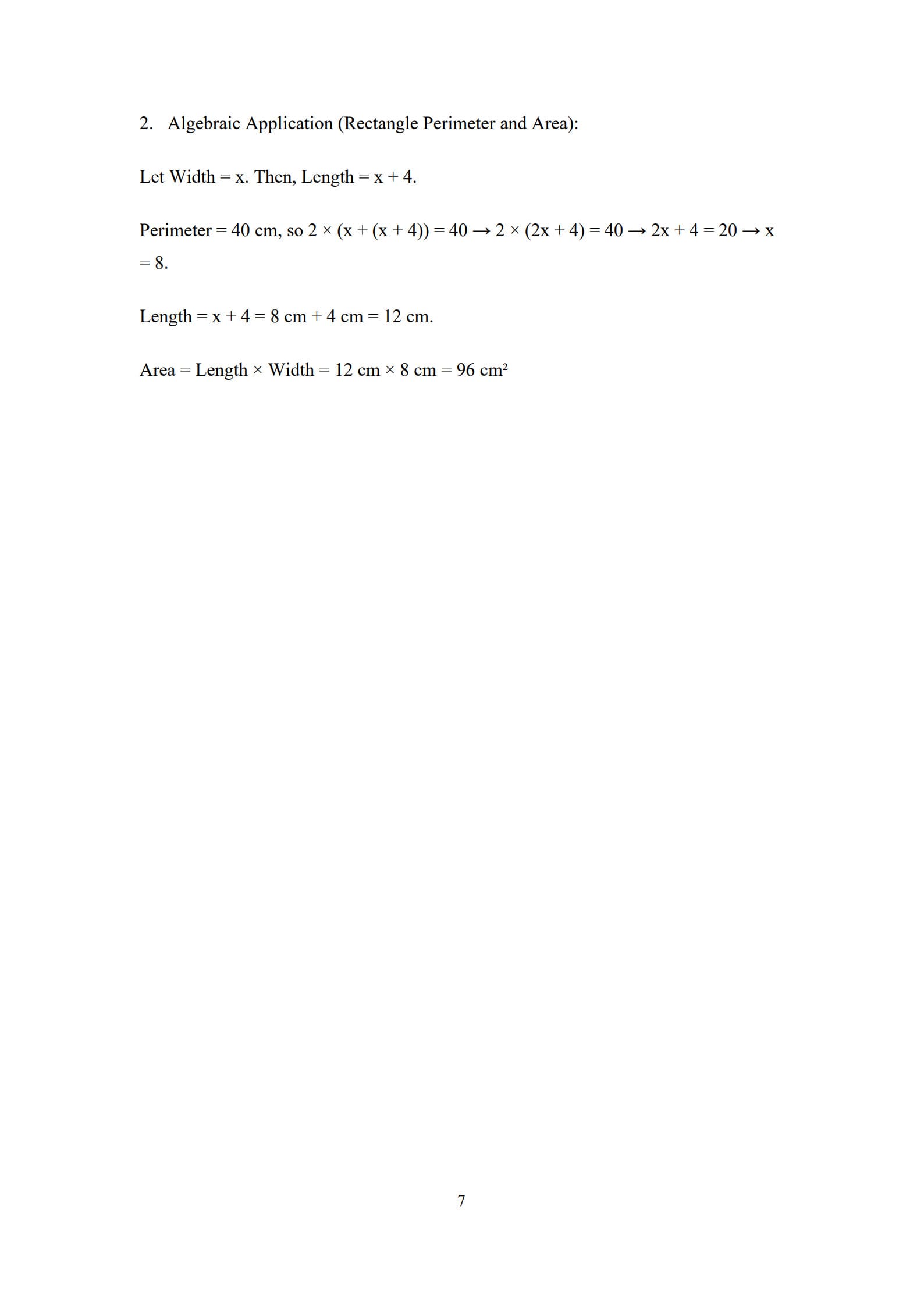
An effective area perimeter worksheet goes beyond academics, preparing learners for practical tasks like home renovation or crafting. The template’s Problem 4 (John’s garden) is a prime example, requiring students to calculate fencing—a real-life need. Similarly, the Advanced Level’s algebraic problem (Problem 2) challenges them to find a rectangle’s area when given the perimeter (40 cm) and a relationship between length and width (length = width + 4), yielding an area of 96 cm².
This emphasis on application develops problem-solving skills that extend to careers in engineering or design. PDF Agile enhances this by allowing users to add notes or measurements directly onto the worksheet, simulating project planning. For instance, when working on the trapezoid problem (Intermediate Level, Problem 3), learners can sketch alternate dimensions to see how area changes, fostering adaptability. By blending theory with practice, the math drills worksheet ensures that area and perimeter become useful tools, not just exam topics.
How to Use This Template on PDF Agile
Using the Area and Perimeter Worksheet template in PDF Agile is simple and efficient. Follow these steps to customize it for your needs:
Step 1: Access the Area and Perimeter Worksheet Template
Open the PDF Agile app and navigate to the Template Library. Search for "Area and Perimeter Worksheet" and select it. Click “Use Template” to create an editable copy instantly. The template comes with clear sections, from Beginner to Advanced Level, so you can start personalizing right away.
Step 2: Customize Problems and Values
Modify the existing problems to suit your lesson plan. For example, change the rectangle dimensions in Problem 1 from 8 cm × 5 cm to 10 cm × 6 cm, and watch the formulas auto-update if linked to interactive tools. You can also add new shapes or real-world scenarios using the drawing tools.
Step 3: Integrate Interactive Elements
Leverage PDF Agile’s features to make learning dynamic. Highlight key formulas, embed answer checkers, or use the comment function to provide hints. For instance, in the composite shape problem, use shading to distinguish the removed square, enhancing clarity.
Step 4: Save and Share
Once customized, save your worksheet as a PDF for printing or digital distribution. Share it via email or cloud storage, making it ideal for remote learning or classroom handouts.
Tips for Optimal Use
- Use Real-World Contexts: Adapt problems to include local landmarks or student interests.
- Encourage Collaboration: Have students work in groups using shared annotations.
- Review with Answer Key: The template includes a detailed answer key—use it for self-assessment or grading.
Conclusion
The Area and Perimeter Worksheet template in PDF Agile is more than just a practice sheet—it’s a comprehensive tool that adapts to various learning stages. From basic rectangles to algebraic challenges, it builds confidence through structured progression. By integrating this template into your teaching or study routine, you turn geometry into an engaging, interactive experience.
We encourage educators and learners to explore PDF Agile’s library for more resources that simplify complex subjects. With this template, mastering area and perimeter becomes not only achievable but enjoyable. Start customizing your worksheet today and witness how digital innovation can elevate math education!