

Welcome to PDF Agile’s innovative approach to mastering algebra! Our Factoring Polynomials Worksheet template transforms complex mathematical concepts into engaging, structured learning experiences. This professionally designed template covers everything from fundamental GCF factoring to advanced techniques like sum/difference of cubes—all formatted for optimal learning. Whether you’re struggling with basic polynomial practice problems or ready to tackle quadratic formula practice problems, this algebra worksheet template provides the perfect framework for building your skills systematically. The carefully sequenced exercises, complete with examples and answer keys, make it an invaluable resource for students, teachers, and lifelong learners seeking to conquer algebraic challenges.
Why Start with Polynomial Practice Problems? Building Your Foundation
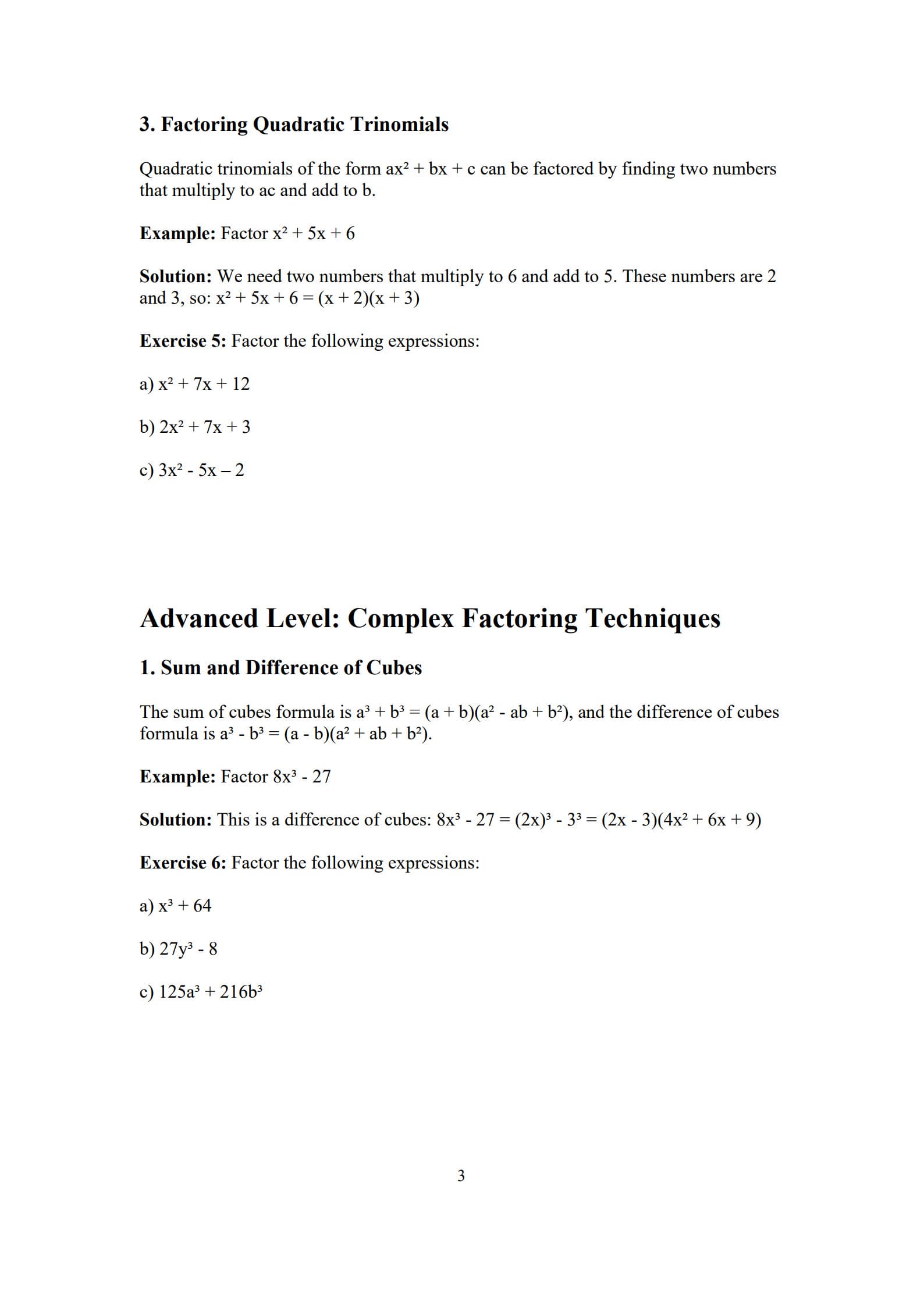
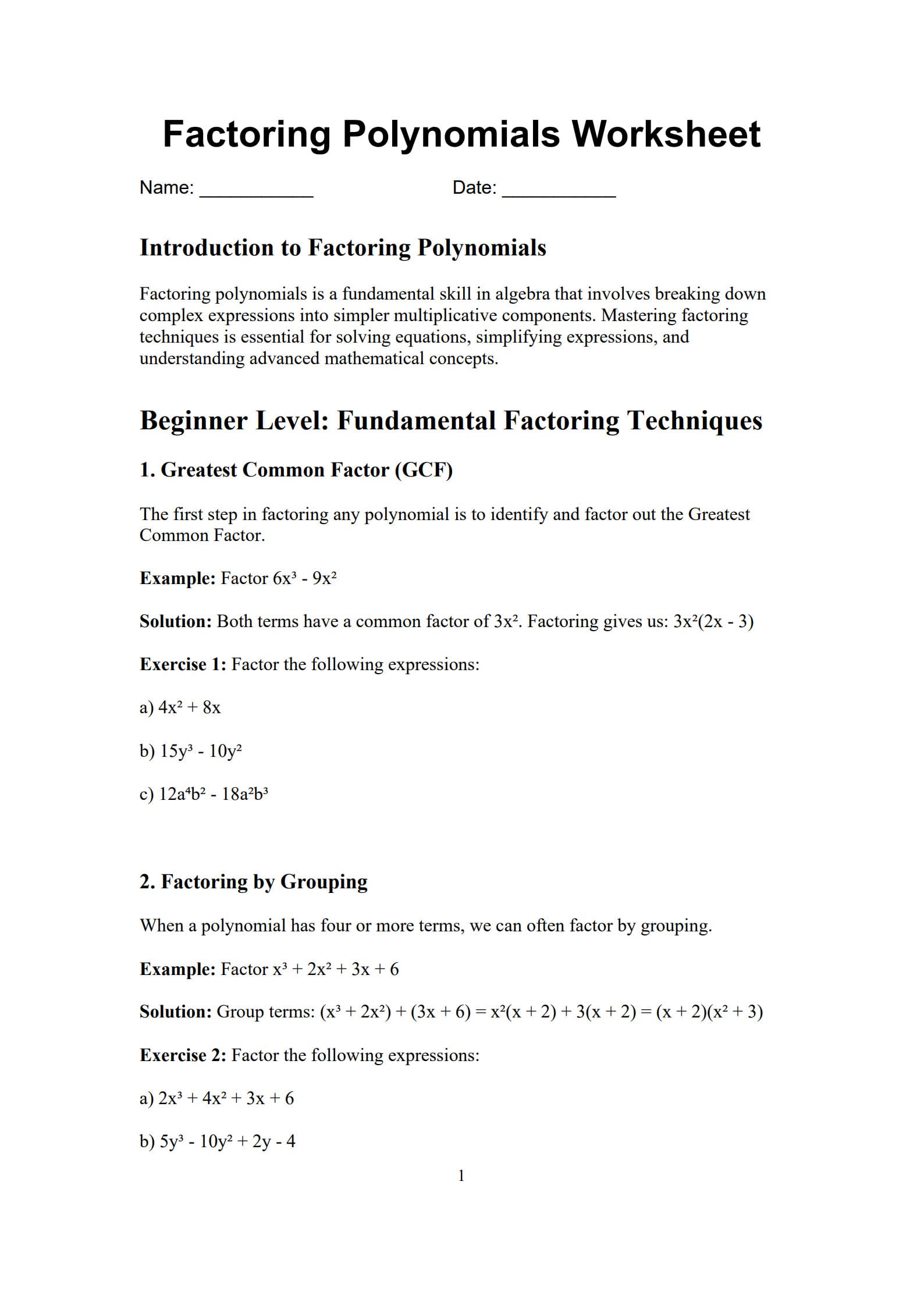
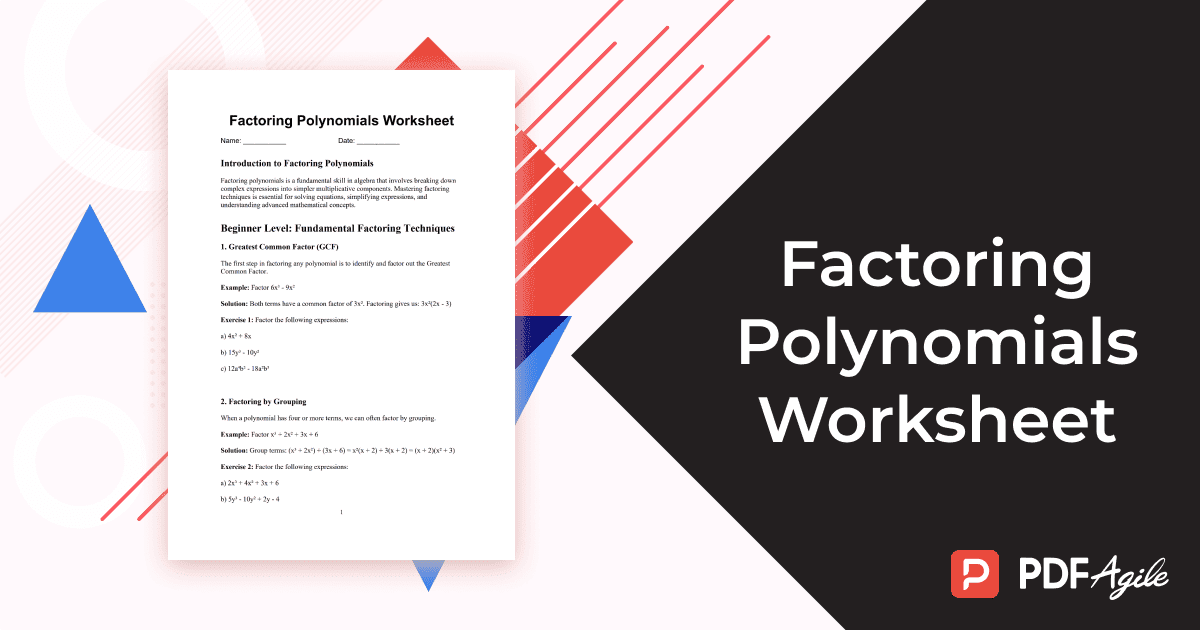
Have you ever wondered why factoring polynomials serves as the gateway to advanced mathematics? Our template begins with essential polynomial practice problems that establish the fundamental building blocks of algebraic thinking. The worksheet’s beginner level introduces Greatest Common Factor (GCF) factoring through practical examples like 4x² + 8x, guiding learners to recognize common patterns and develop systematic problem-solving approaches.
The template’s logical progression ensures you master each concept before advancing to more complex material. By starting with GCF exercises such as 15y³ - 10y², you build confidence while developing the analytical skills needed for higher-level mathematics. The grouping method section, featuring problems like 2x³ + 4x² + 3x + 6, teaches you to identify structural relationships within polynomials—a skill that translates to various mathematical disciplines.
Each section includes worked examples that demonstrate solution strategies step-by-step, followed by practice problems that reinforce learning through active application. This scaffolded approach ensures that even the most challenging polynomial practice problems become manageable through consistent practice and pattern recognition.
How Can Quadratic Formula Practice Problems Transform Your Algebra Skills?
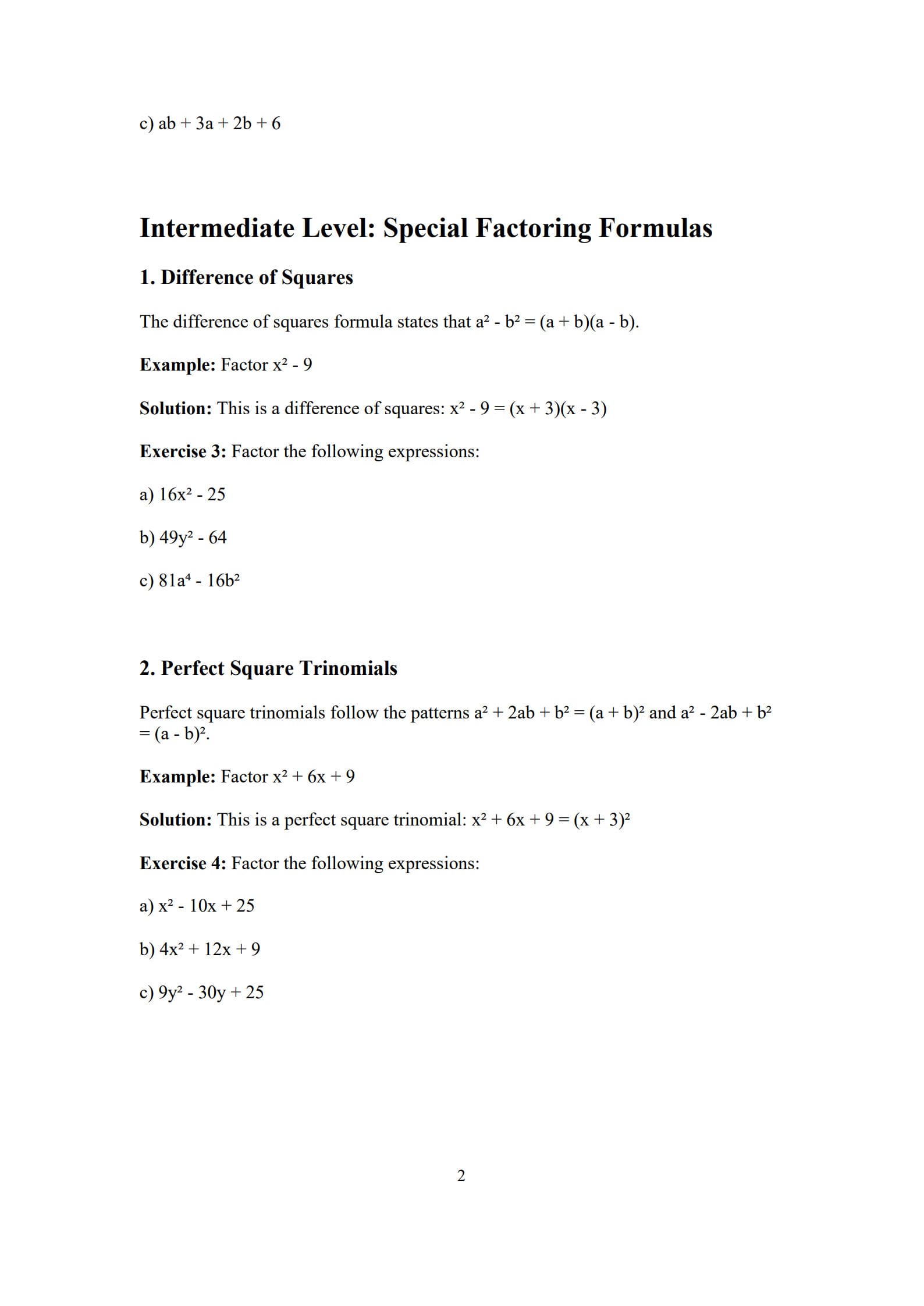
What makes quadratic formula practice problems so crucial for algebraic proficiency? Our template’s intermediate section addresses this through specialized exercises that bridge basic factoring and complex algebraic manipulation. The difference of squares problems, including examples like 16x² - 25, introduce learners to recognizing special patterns that simplify factoring processes.
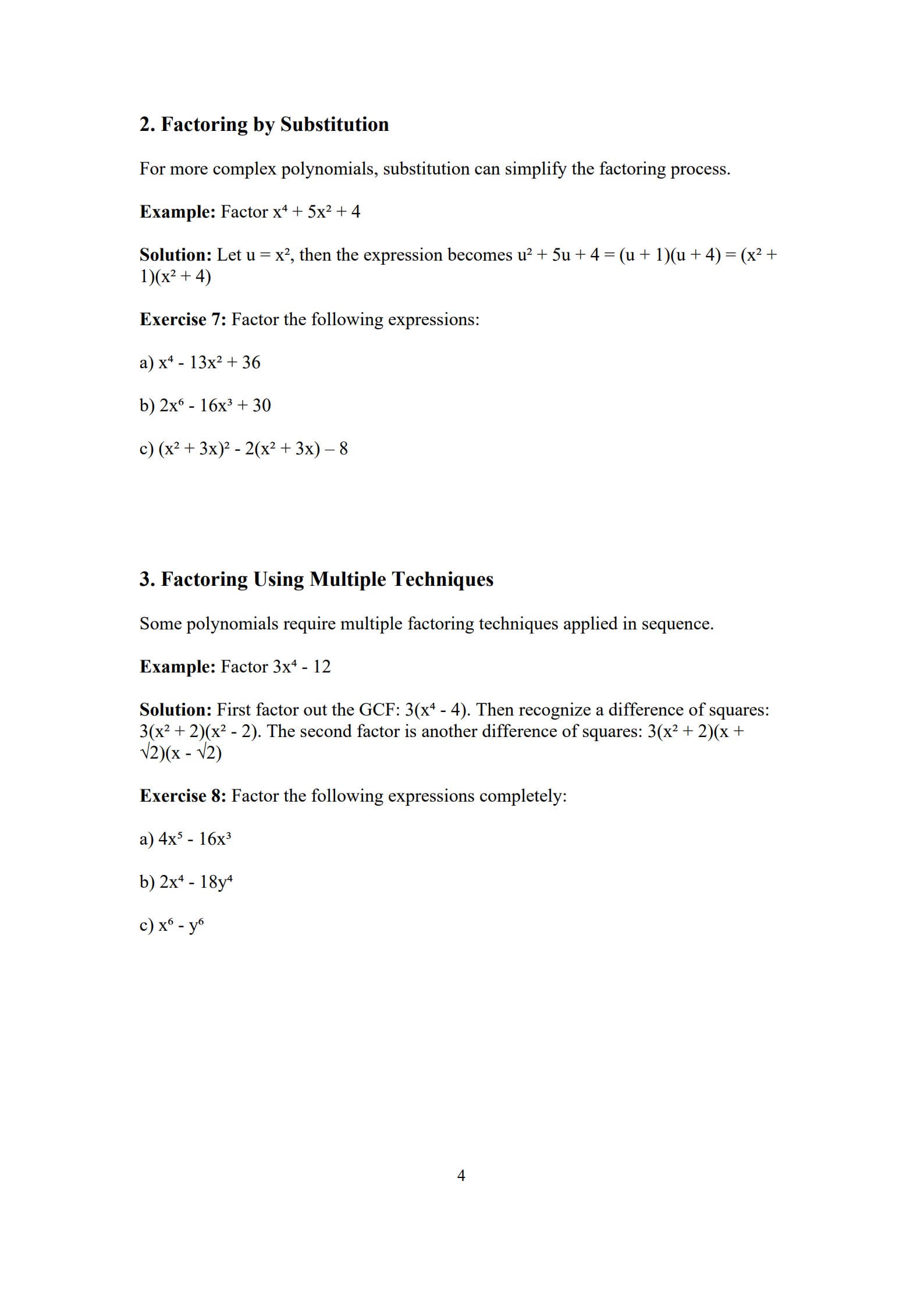
The perfect square trinomials section, featuring exercises such as x² - 10x + 25, demonstrates how specific polynomial structures yield predictable results. This knowledge becomes particularly valuable when progressing to quadratic trinomials like 2x² + 7x + 3, where the template teaches the critical skill of finding factors that multiply to ac while adding to b.
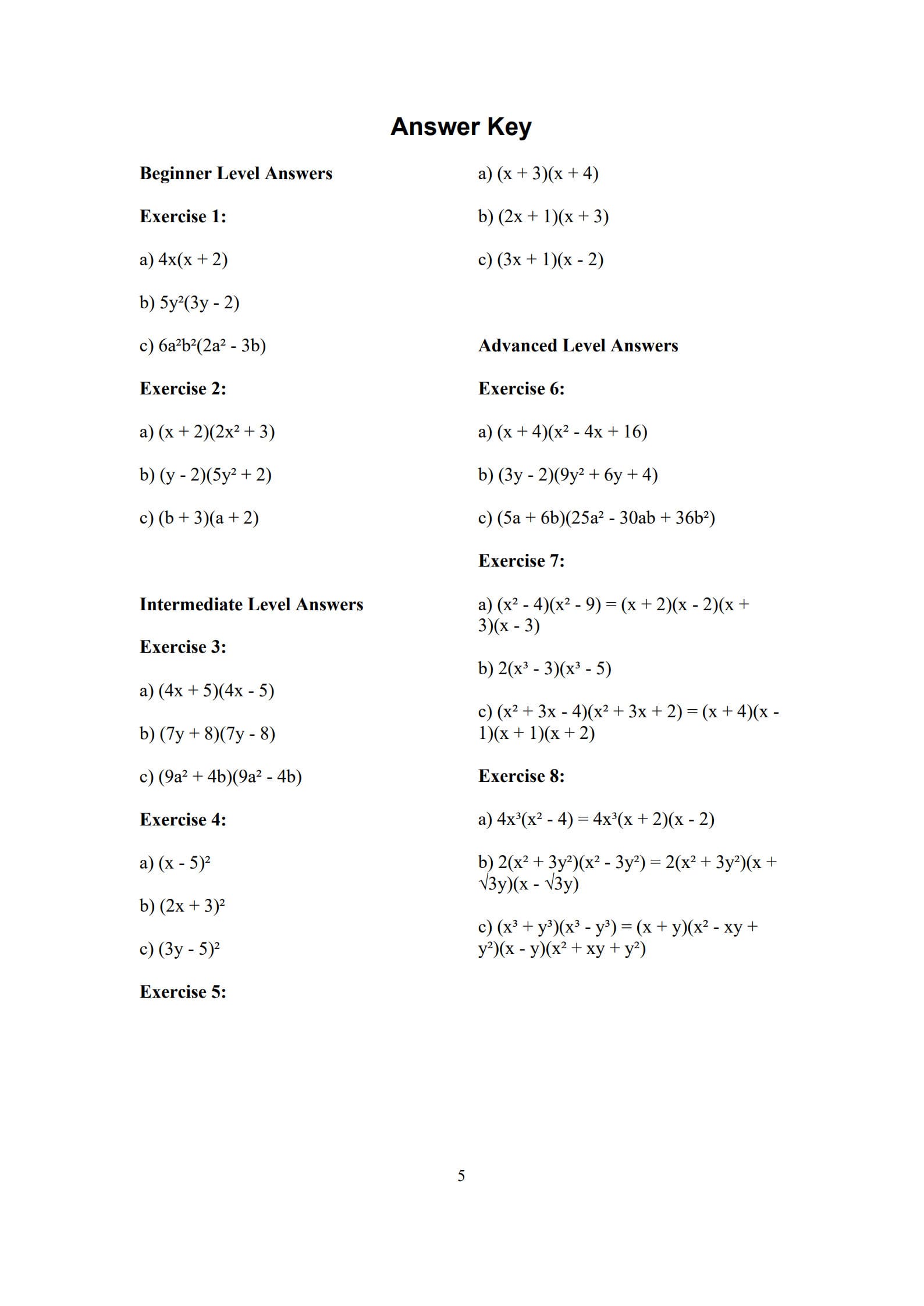
These quadratic formula practice problems do more than teach factoring—they develop mathematical intuition and problem-solving flexibility. By working through systematically arranged exercises, learners discover how different factoring techniques interconnect, creating a comprehensive understanding of quadratic relationships. The template’s answer key provides immediate feedback, allowing for self-assessment and targeted improvement in areas needing additional practice.
Simplifying Algebraic Expressions Worksheets: From Basic to Advanced Techniques
Our template excels at transforming complex expressions into manageable components through structured simplifying algebraic expressions worksheets. The advanced level introduces sophisticated factoring methods including sum/difference of cubes, with examples like x³ + 64 demonstrating how to apply specialized formulas to complex problems.
The substitution method section tackles higher-degree polynomials through strategic variable replacement, as shown in x⁴ - 13x² + 36. This technique teaches learners to recognize underlying patterns in seemingly complicated expressions, developing the ability to simplify algebraic expressions regardless of their initial complexity.
Factoring Technique Comparison Table
| Technique | Best For | Example from Template | Key Pattern |
|---|---|---|---|
| GCF Factoring | Terms with common factors | 12a⁴b² - 18a²b³ | Identify common variables and coefficients |
| Grouping | Four or more terms | ab + 3a + 2b + 6 | Group terms with common factors |
| Difference of Squares | Binomials with subtraction | 81a⁴ - 16b² | a² - b² = (a+b)(a-b) |
| Sum/Difference of Cubes | Cubic terms | 27y³ - 8 | a³ ± b³ = (a±b)(a²∓ab+b²) |
The multiple techniques section demonstrates how to combine factoring methods for comprehensive expression simplification. Problems like 4x⁵ - 16x³ show how to apply GCF factoring followed by difference of squares, teaching learners to approach complex problems through sequential simplification strategies.
Maximizing Learning Through Structured Practice and Immediate Feedback
The template’s carefully designed exercise progression ensures that each new concept builds upon previously mastered skills. Beginning with fundamental GCF factoring and advancing through substitution methods, the worksheet provides a complete learning pathway that accommodates various skill levels. Each exercise set includes problems of increasing difficulty, allowing learners to develop competence gradually while challenging themselves to advance.
The answer key serves as an essential learning tool, providing immediate verification of solutions and revealing patterns in problem-solving approaches. By comparing their work with the provided solutions for exercises like x⁶ - y⁶, learners can identify areas needing improvement and refine their techniques accordingly. This immediate feedback mechanism transforms practice into active learning, reinforcing correct methods and correcting misunderstandings before they become habitual.
The template’s organization into beginner, intermediate, and advanced sections allows for targeted practice based on individual needs. Learners can focus on specific techniques or work through the entire sequence to develop comprehensive factoring proficiency. This flexibility makes the worksheet equally valuable for classroom instruction, self-study, or review sessions.
How to Use This Template on PDF Agile: A Step-by-Step Guide
Step 1: Access the Factoring Polynomials Worksheet Template
Navigate to PDF Agile’s template library and select the Factoring Polynomials Worksheet. This professionally designed template comes pre-formatted with clear sections, examples, and exercises. Click “Use Template” to create your personal copy that you can customize according to your specific learning objectives.
Step 2: Customize for Your Learning Needs
Personalize the template by adding your name and date, and select the appropriate difficulty level for your current skills. The template’s modular design allows you to focus on specific techniques—whether you need polynomial practice problems or want to challenge yourself with advanced quadratic formula practice problems. Use PDF Agile’s editing tools to highlight key concepts or add notes to particularly challenging sections.
Step 3: Work Through Exercises and Check Solutions
Solve the problems directly within the PDF Agile interface using the annotation tools. The platform’s smooth writing and drawing features make it easy to show your work step-by-step. After completing each section, refer to the answer key to verify your solutions and identify any areas needing additional practice.
Step 4: Save and Track Your Progress
Save your completed worksheets to create a portfolio of your algebraic journey. The template’s structured format makes it easy to monitor your improvement over time as you progress from basic simplifying algebraic expressions worksheets to mastering complex factoring techniques.
Conclusion
Mastering polynomial factoring is not just an academic requirement—it’s a fundamental skill that opens doors to advanced mathematical thinking and problem-solving. PDF Agile’s Factoring Polynomials Worksheet template provides the structured practice necessary to develop this crucial competency through carefully sequenced polynomial practice problems and quadratic formula practice problems. The template’s comprehensive approach ensures that learners build confidence while developing the analytical skills needed for mathematical success.
Embrace the opportunity to conquer algebra with our expertly designed template. Download the Factoring Polynomials Worksheet today and discover how structured practice, immediate feedback, and portable accessibility can transform your mathematical journey. With PDF Agile, mastering algebra becomes an engaging, achievable goal that prepares you for success in higher mathematics and beyond.