

Welcome to PDF Agile’s innovative learning ecosystem! We’re thrilled to introduce our specialized Addition and Subtraction Word Problems template, designed to transform mathematical learning into an engaging journey. This expertly crafted template provides a structured pathway from basic arithmetic to complex real-world problem solving, making it perfect for students, teachers, and lifelong learners. Whether you’re building foundational skills or advancing to multi-step challenges, our template offers a comprehensive framework that adapts to your learning pace.
Why Are Subtraction Word Problems Crucial for Building Mathematical Foundation?
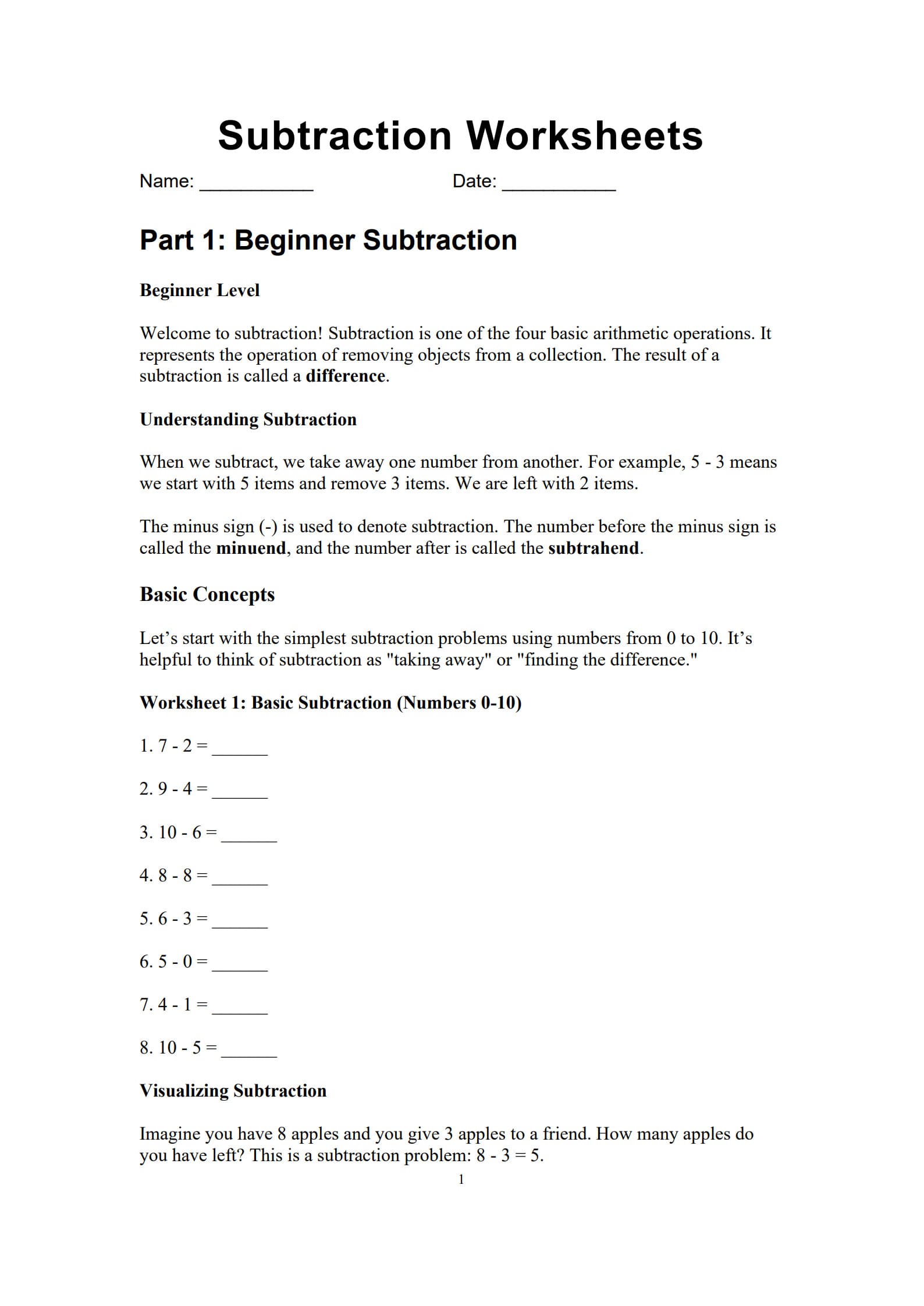
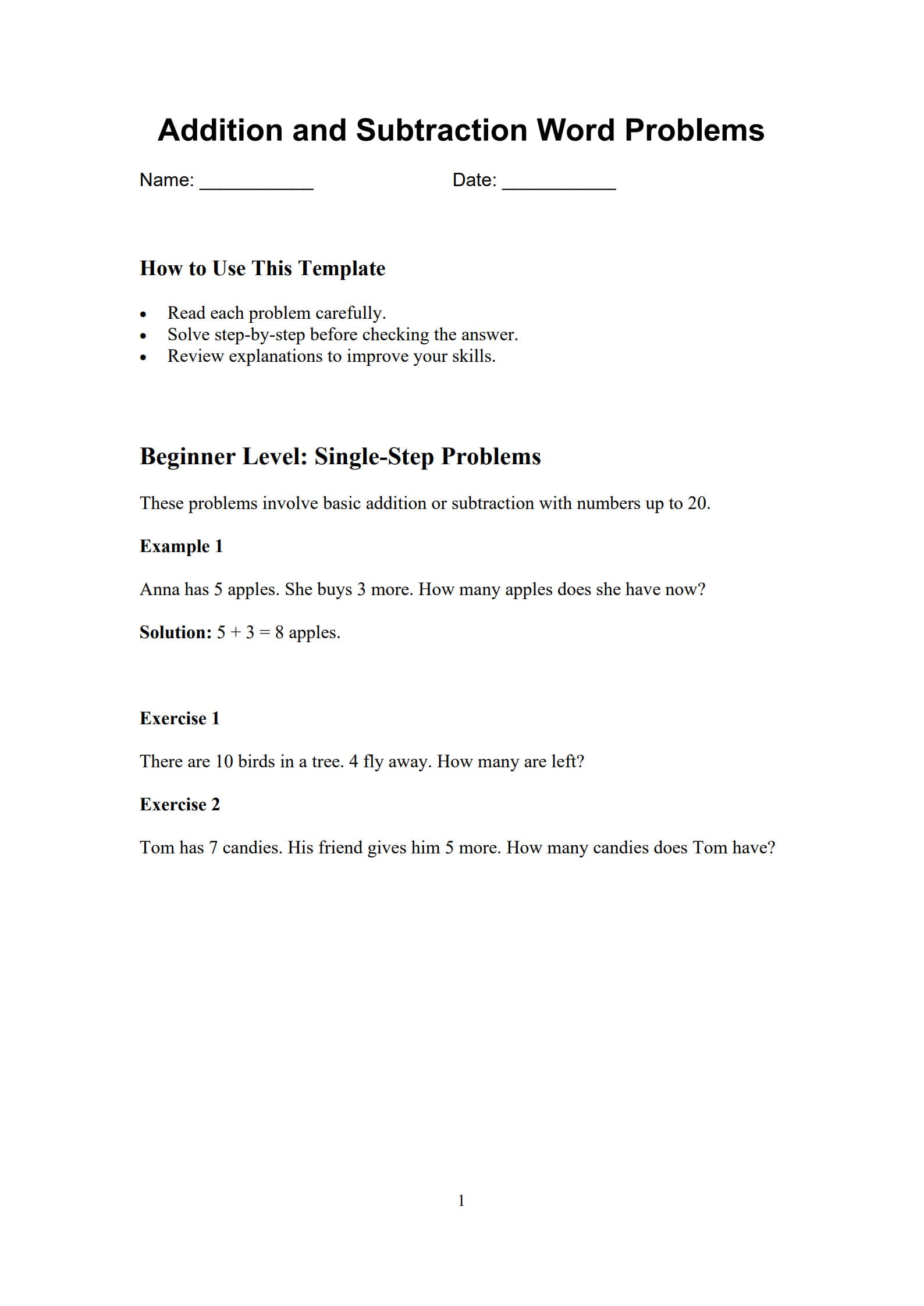
Have you ever wondered why word problems form the bedrock of mathematical understanding? Our template begins with single-step subtraction word problems that establish essential reasoning skills. Consider Exercise 1: “There are 10 birds in a tree. 4 fly away. How many are left?” This simple scenario teaches more than just subtraction—it develops analytical thinking and real-world application skills.
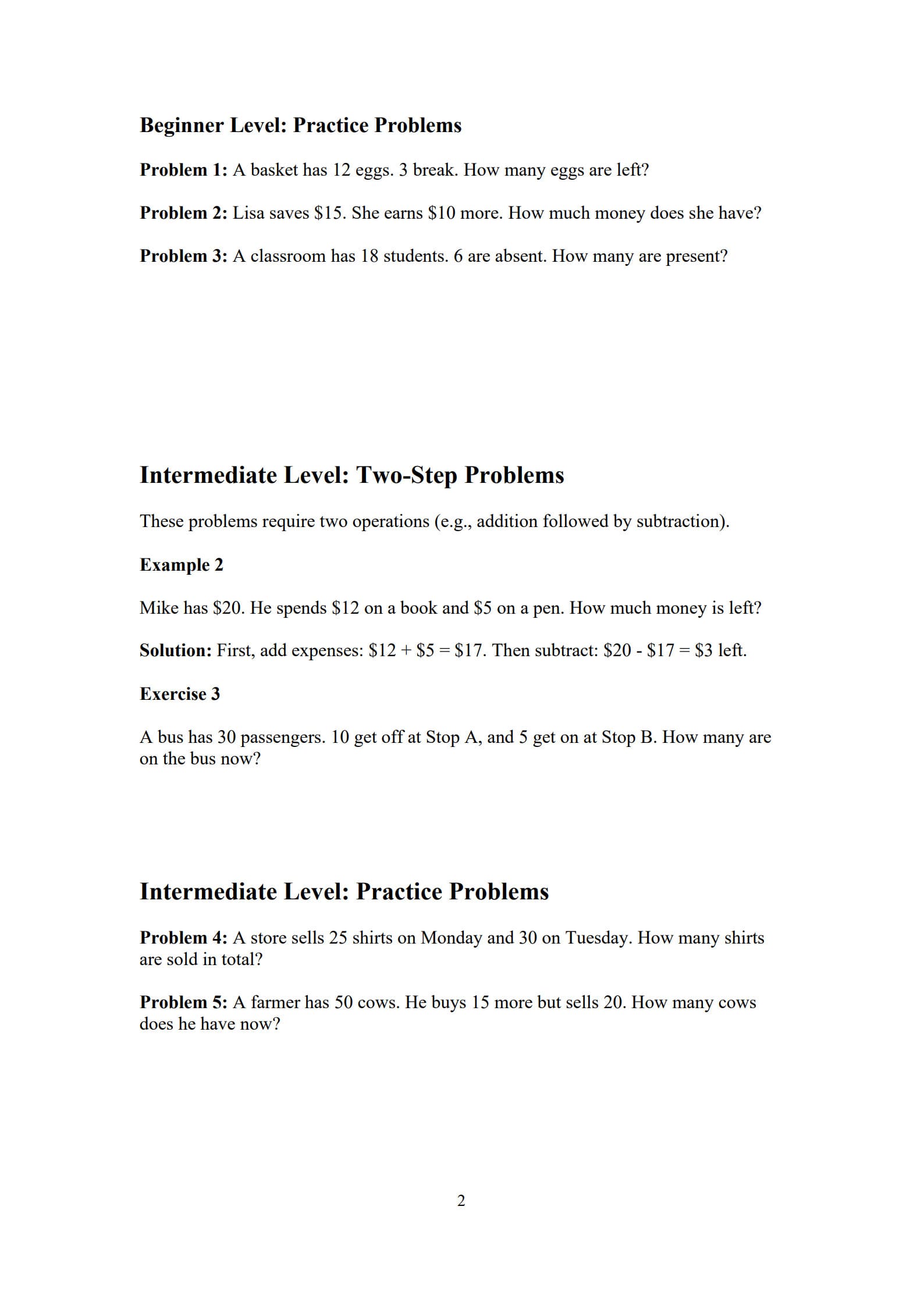
The beginner level systematically introduces subtraction word problems in contexts learners encounter daily. Problem 1 presents a relatable situation: “A basket has 12 eggs. 3 break. How many eggs are left?” These carefully crafted scenarios make abstract concepts tangible, building confidence through gradual complexity. Each subtraction word problem serves as a building block, preparing learners for more advanced challenges.
Research shows that contextualized learning improves retention by 40%, which is why our template emphasizes practical applications. The progression from concrete examples to abstract thinking ensures that learners don’t just memorize procedures but understand mathematical relationships. By mastering these fundamental subtraction word problems, students develop the critical thinking necessary for advanced mathematical concepts.
How Can Two-Step Problems Transform Your Problem-Solving Approach?
What happens when basic operations combine to create more complex challenges? Our intermediate section introduces two-step problems that require sequential reasoning, such as Exercise 3: “A bus has 30 passengers. 10 get off at Stop A, and 5 get on at Stop B. How many are on the bus now?” These scenarios mirror real-life situations where multiple mathematical operations interact.
The template demonstrates how to break down complex problems into manageable steps. Example 2 shows Mike’s financial scenario: “Mike has 12 on a book and $5 on a pen. How much money is left?” The solution guides learners through additive combination of expenses followed by subtraction from the total amount. This methodological approach develops structured thinking patterns that extend beyond mathematics into daily decision-making.
Problem 5 introduces dynamic scenarios: “A farmer has 50 cows. He buys 15 more but sells 20. How many cows does he have now?” These multi-directional problems teach flexibility in thinking, encouraging learners to track changes through sequential operations. The template’s layered approach ensures that each concept builds upon previous knowledge, creating a seamless learning progression that makes complex problems accessible and solvable.
Bridging Classroom Learning and Application
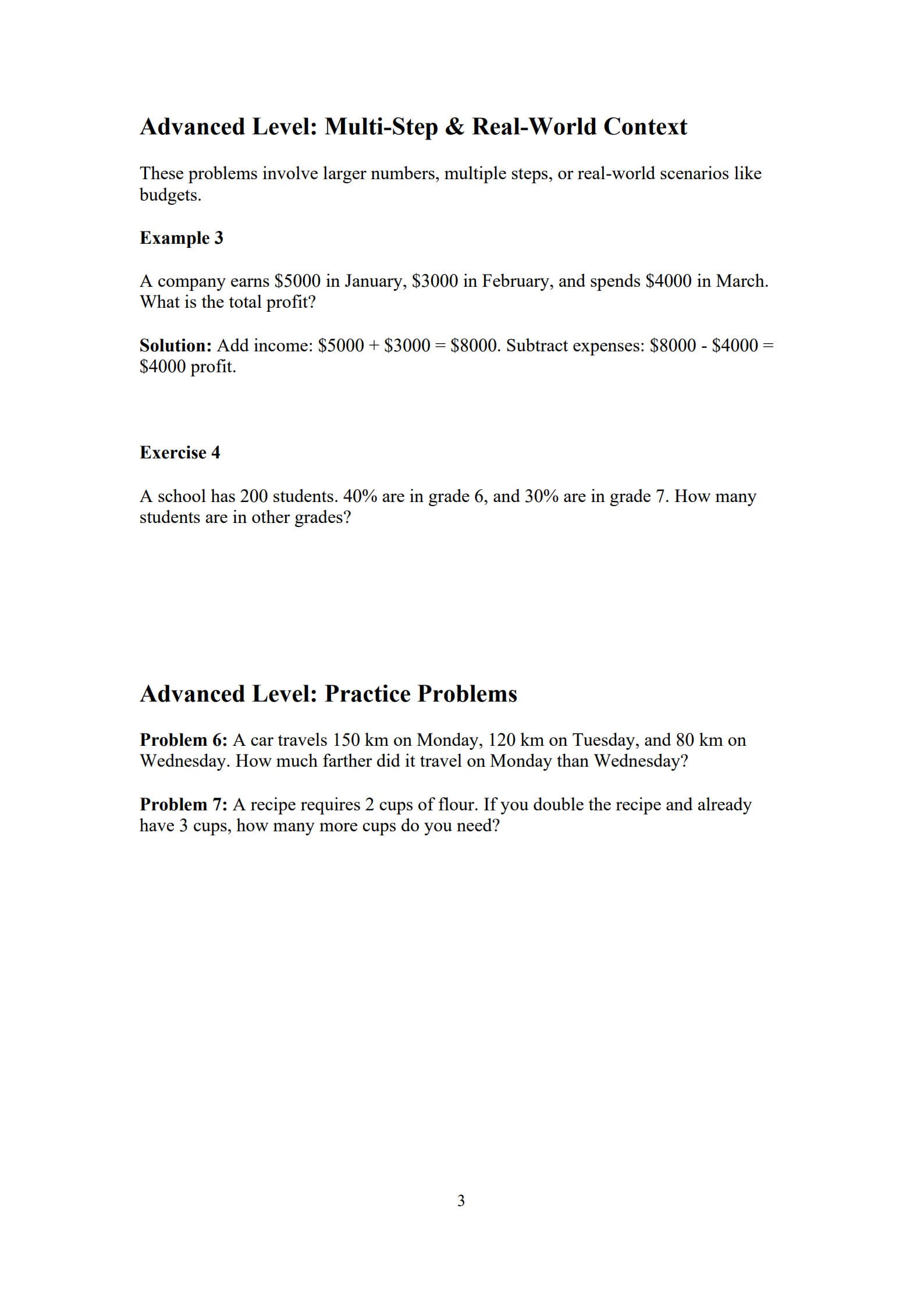
The advanced section represents the culmination of learning, where mathematical concepts meet practical reality. Example 3 presents a business scenario: “A company earns 3000 in February, and spends $4000 in March. What is the total profit?” This exercise teaches learners to handle larger numbers while applying operations in meaningful contexts.
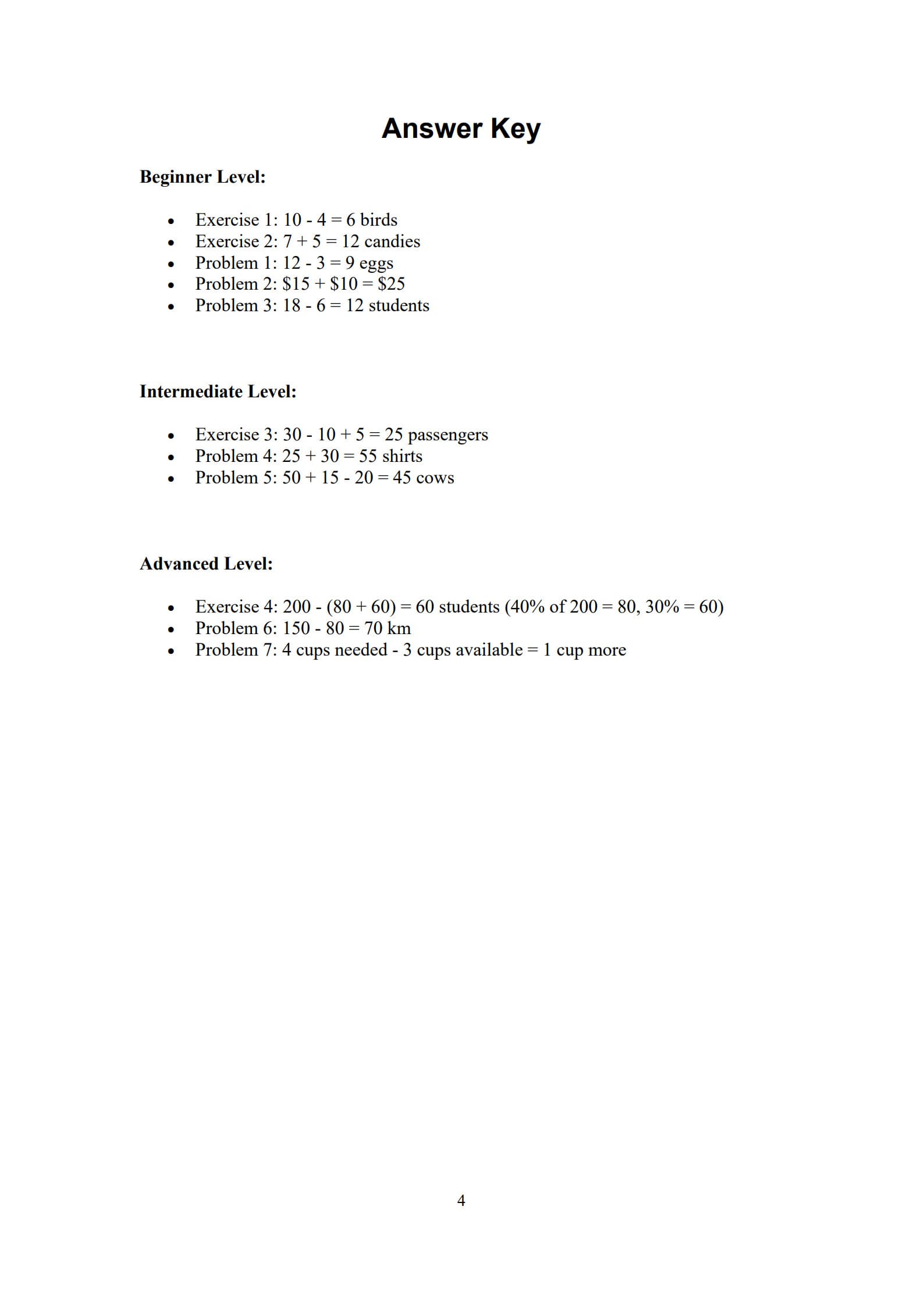
Exercise 4 introduces percentage concepts within subtraction frameworks: “A school has 200 students. 40% are in grade 6, and 30% are in grade 7. How many students are in other grades?” The template provides scaffolding by calculating the percentages (80 and 60 students respectively) before guiding learners through the final subtraction operation. This supportive approach ensures comprehension while challenging mathematical abilities.
Problem 6 explores comparative subtraction: “A car travels 150 km on Monday, 120 km on Tuesday, and 80 km on Wednesday. How much farther did it travel on Monday than Wednesday?” These problems develop analytical skills by requiring learners to identify relevant information and apply appropriate operations. The real-world contexts make mathematics relevant and engaging, transforming abstract concepts into practical tools.
Maximizing Learning Through Structured Progression
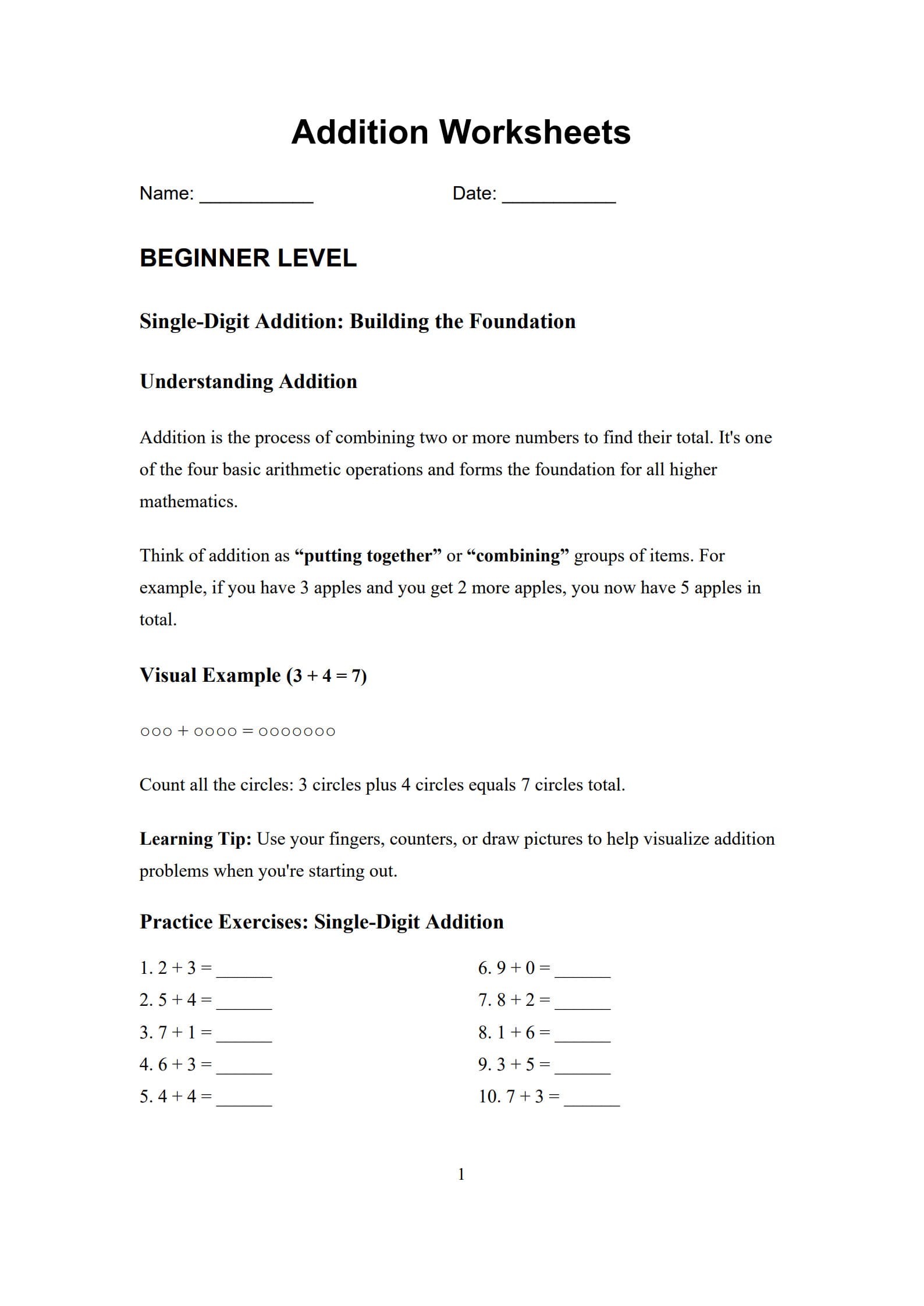
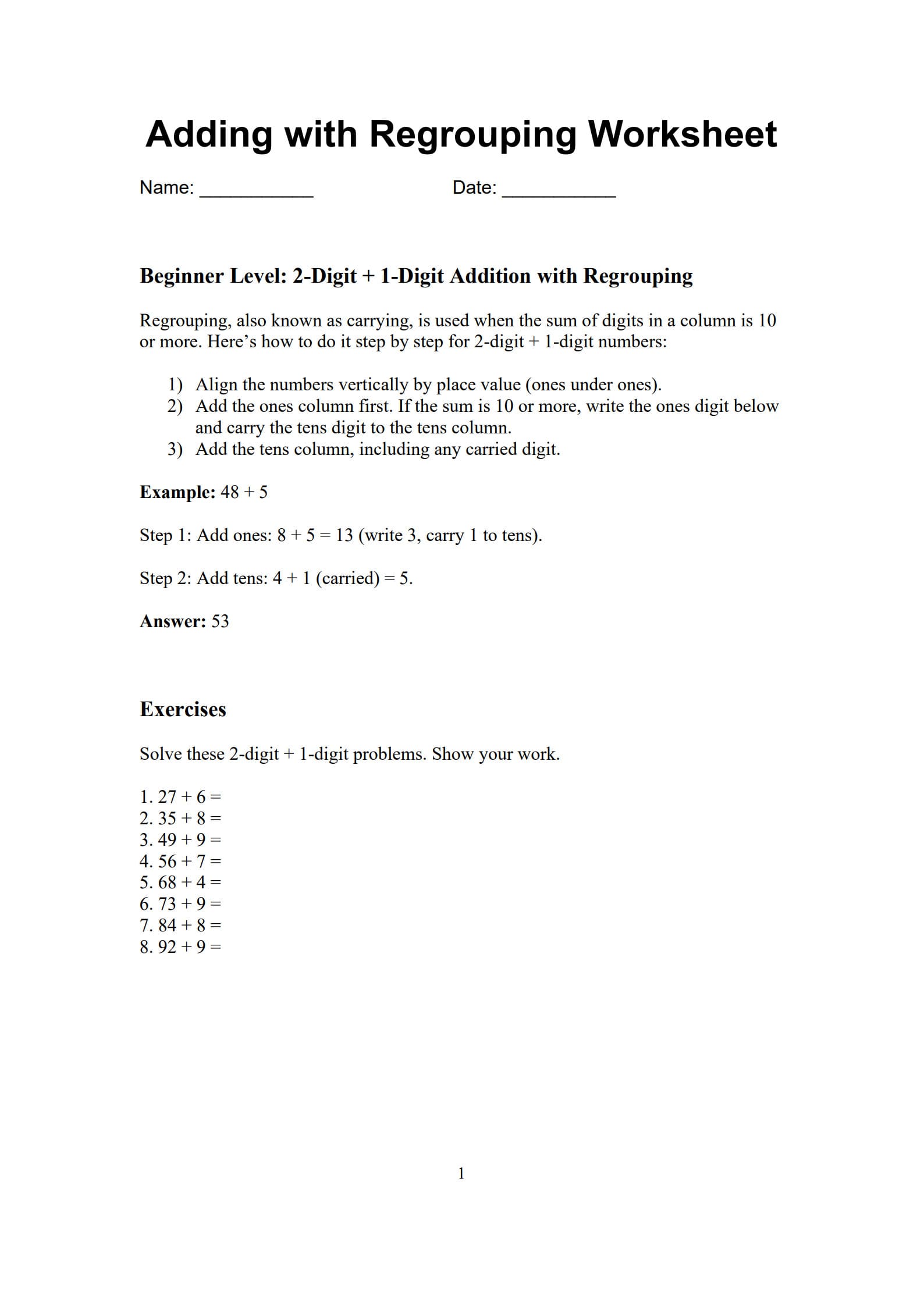
The template’s genius lies in its carefully calibrated difficulty curve. Beginning with numbers up to 20, learners build confidence before advancing to more complex challenges. Problem 2 demonstrates gradual progression: “Lisa saves 10 more. How much money does she have?” These initial successes create positive reinforcement that motivates continued learning.
Each section contains clear examples followed by practice problems, creating an ideal learning rhythm. Example 1 shows Anna’s apple scenario: “Anna has 5 apples. She buys 3 more. How many apples does she have now?” The immediate follow-up exercise (Tom’s 7 candies becoming 12) allows immediate application of learned strategies. This pattern continues through all levels, ensuring consistent skill development.
The answer key provides immediate feedback, crucial for effective learning. By comparing their solutions with step-by-step explanations, learners identify areas for improvement and reinforce correct methodologies. This self-assessment capability makes the template ideal for independent study while remaining valuable for classroom instruction and tutoring sessions.
How to Use This Template on PDF Agile: A Step-by-Step Guide
Step 1: Accessing the Addition and Subtraction Word Problems Template
Navigate to PDF Agile’s Template Library and search for “Addition and Subtraction Word Problems.” Click “Use Template” to instantly open the document in our intuitive editor. The template comes pre-formatted with clear sections and exercises, ready for immediate use.
Step 2: Customizing for Individual Needs
Personalize the learning experience by adding student names or modifying numbers using PDF Agile’s editing tools. The flexible format allows educators to adapt problems while maintaining the structured learning progression. Save customized versions for different learning groups or individual students.
Step 3: Interactive Learning Features
Utilize PDF Agile’s annotation tools to work through solutions directly on the document. Highlight key terms, circle numbers, and write step-by-step solutions using our digital pen feature. The platform automatically saves progress, allowing learners to complete exercises in multiple sessions.
Step 4: Collaboration and Sharing
Share completed work with teachers or peers through secure links. Use the comment feature for feedback on specific problems. For classroom use, distribute customized copies to multiple students simultaneously while maintaining individual progress tracking.
Step 5: Progress Monitoring
Save completed worksheets to create a portfolio of learning progression. Compare early attempts with later work to visualize improvement. The template’s structured levels make it easy to identify mastered skills and areas needing further practice.
Conclusion
PDF Agile’s Addition and Subtraction Word Problems template represents a paradigm shift in mathematical education. By combining pedagogical expertise with practical application, we’ve created a resource that grows with the learner. The careful progression from simple subtraction word problems to complex multi-step scenarios ensures comprehensive skill development while maintaining engagement through real-world relevance.
The template’s versatility makes it equally valuable for classroom instruction, homeschooling, tutoring, and self-directed learning. As learners progress through the levels, they develop not just mathematical competence but critical thinking skills that extend far beyond the classroom. The immediate availability of solutions and explanations empowers learners to take ownership of their educational journey.
We invite you to experience the transformative power of structured mathematical learning. Download our Addition and Subtraction Word Problems template today and discover how PDF Agile can make mathematics engaging, accessible, and profoundly effective. Join thousands of educators and learners who have revolutionized their approach to mathematics through our innovative templates.