


Stop guessing, start growing. The AARRR template, or "Pirate Metrics," cuts through the noise and provides a laser focus on the five stages that truly matter in your customer's journey. Acquisition, Activation, Retention, Referral, Revenue – these aren't just buzzwords. They're the pillars of sustainable growth for startups, SaaS companies, and small businesses alike. This comprehensive guide will show you how to use this unconventional yet powerful framework to transform your understanding of your customers into tangible results.
What is the AARRR Template?
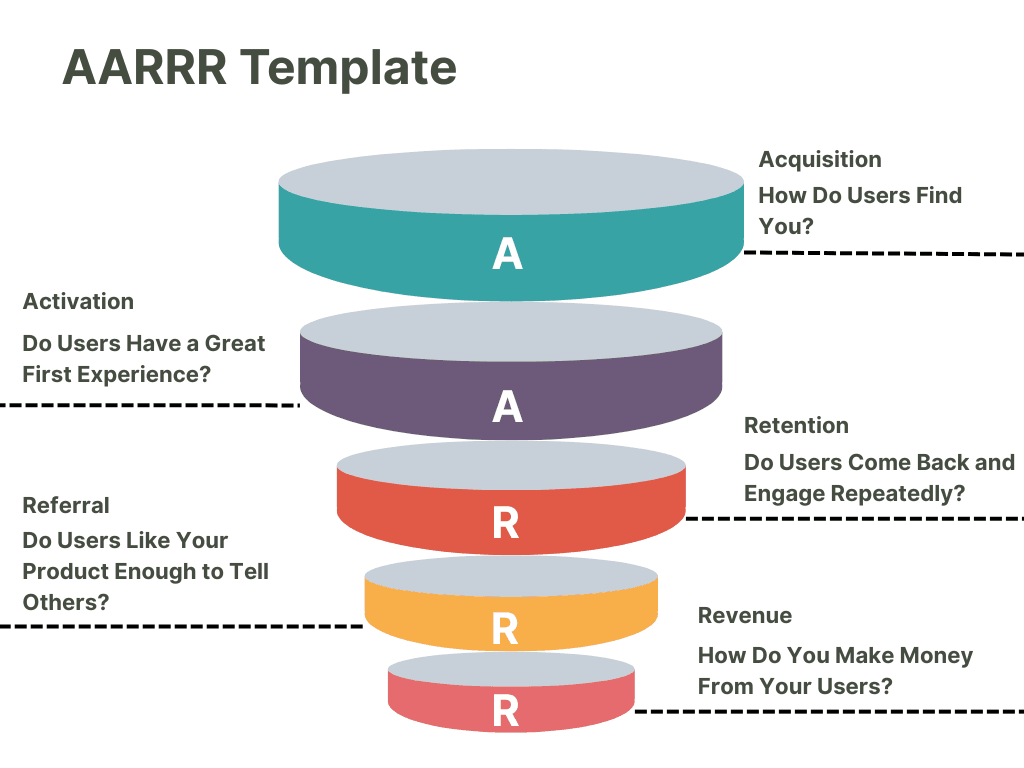
The AARRR template, often referred to as Pirate Metrics, is an acronym coined by Dave McClure, founder of 500 Startups. It represents the five key stages of the customer lifecycle that every business should track and optimize:
Acquisition: How do users find you?
Activation: Do users have a great first experience?
Retention: Do users come back and engage with your product or service repeatedly?
Referral: Do users like your product or service enough to tell others about it?
Revenue: How do you make money from your users?
The name "Pirate Metrics" stems from the way McClure would often pronounce the acronym with a pirate-like growl. This memorable name has helped the framework gain widespread popularity in the startup and growth hacking communities.
Why is the AARRR Template Important?
The AARRR template provides a structured approach to understanding and optimizing your customer journey. By breaking down the customer lifecycle into these five distinct stages, businesses can:
Gain a holistic view of customer behavior: The template helps you understand how customers interact with your business at every touchpoint, from initial discovery to becoming paying advocates.
Identify bottlenecks and areas for improvement: By tracking key metrics at each stage, you can pinpoint where you're losing potential customers or where engagement drops off. This allows you to focus your efforts on the areas that will have the biggest impact.
Set clear and measurable goals: Each stage of the AARRR framework has associated metrics that can be tracked and used to set achievable growth targets.
Optimize marketing and product development efforts: Understanding user behavior at each stage allows you to tailor your marketing messages, improve your onboarding process, and develop product features that enhance retention and drive referrals.
Make data-driven decisions: The AARRR template emphasizes the importance of tracking and analyzing data to inform your growth strategies, leading to more effective resource allocation and better outcomes.
Breaking Down the AARRR Framework: A Stage-by-Stage Guide
Let's explore each stage of the AARRR framework in detail:
1. Acquisition: How Do Users Find You?
The first step in the customer journey is attracting potential users to your product or service. This stage focuses on all the channels you use to gain visibility and bring in new leads. Key questions to consider at this stage include:
- What marketing channels are driving traffic to your website or app?
- Where are your ideal customers spending their time online?
- What keywords are they using to search for solutions like yours?
- What is your Cost Per Acquisition (CPA) for different channels?
Examples of Acquisition Metrics:
- Website traffic
- Social media followers
- Email list sign-ups
- App downloads
- Organic search rankings
- Referrals from other websites or partners
- Click-through rates (CTR) on ads
Strategies for Improving Acquisition:
- Optimize your website and content for search engines (SEO).
- Run targeted social media advertising campaigns.
- Implement content marketing strategies to attract and educate potential customers.
- Explore influencer marketing and partnerships.
- Utilize various online and offline advertising channels.
2. Activation: Do Users Have a Great First Experience?
Once you've acquired users, the next crucial step is ensuring they have a positive initial experience with your product or service. This involves guiding them through the onboarding process and helping them quickly realize the value you offer. Key questions to consider at this stage include:
- How easy is it for new users to sign up or get started?
- Are they able to quickly understand the core value proposition?
- Are there any points of friction in the initial user journey?
- What percentage of acquired users complete the desired first action?
Examples of Activation Metrics:
- Sign-up completion rate
- Time to first key action
- Completion rate of onboarding tutorials
- Number of users who successfully use a key feature for the first time
- Free trial activation rate
Strategies for Improving Activation:
- Streamline the sign-up and onboarding process.
- Provide clear and concise instructions or tutorials.
- Highlight the core benefits and value proposition early on.
- Offer personalized guidance or support.
- Ensure a smooth and intuitive user experience.
3. Retention: Do Users Come Back and Engage Repeatedly?
Acquiring and activating users is only half the battle. To build a sustainable business, you need to keep users engaged and coming back for more. This stage focuses on understanding why users stay and what makes them churn (stop using your product or service). Key questions to consider at this stage include:
- How often do users return to your website or app?
- How actively are they using key features?
- What is your user churn rate?
- Why are users leaving?
Examples of Retention Metrics:
- Daily/Weekly/Monthly Active Users (DAU/WAU/MAU)
- Customer Lifetime Value (CLTV)
- Churn rate (user attrition)
- Repeat purchase rate
- Time spent on the platform
- Feature usage frequency
Strategies for Improving Retention:
- Provide ongoing value and engagement through new content, features, or updates.
- Implement personalized communication and targeted email campaigns.
- Offer excellent customer support.
- Build a strong community around your product or service.
- Gather user feedback and iterate on your offerings based on their needs.
4. Referral: Do Users Like Your Product Enough to Tell Others?
Referrals are a powerful engine for growth, as they leverage the trust and influence of your existing users to acquire new ones. This stage focuses on encouraging satisfied users to spread the word about your product or service. Key questions to consider at this stage include:
- How many new users are acquired through referrals?
- What is your referral rate?
- How effective are your referral programs?
- Are users naturally talking about your product or service?
Examples of Referral Metrics:
- Number of referrals sent
- Number of successful referrals (users acquired through referrals)
- Referral conversion rate
- Social shares and mentions
- Net Promoter Score (NPS)
Strategies for Improving Referral:
- Implement a clear and rewarding referral program.
- Make it easy for users to share your product or service with their network.
- Encourage social sharing and engagement.
- Actively seek out and leverage user testimonials and reviews.
- Foster a sense of community and belonging among your users.
5. Revenue: How Do You Make Money From Your Users?
Ultimately, the goal of any business is to generate revenue. This final stage focuses on how you monetize your users and optimize your revenue streams. Key questions to consider at this stage include:
- What are your primary revenue models (e.g., subscription, freemium, one-time purchases)?
- What is your average revenue per user (ARPU)?
- What is your customer acquisition cost (CAC)?
- What is your customer lifetime value (CLTV)?
- How can you increase revenue from existing users?
Examples of Revenue Metrics:
- Total revenue
- Average Revenue Per User (ARPU)
- Customer Lifetime Value (CLTV)
- Conversion rate from free to paid users
- Upsell and cross-sell rates
- Monthly Recurring Revenue (MRR)
- Annual Recurring Revenue (ARR)
Strategies for Improving Revenue:
- Optimize your pricing strategy.
- Offer different pricing tiers or plans to cater to various customer segments.
- Implement upselling and cross-selling strategies.
- Explore opportunities to monetize free users (e.g., through advertising or premium features).
- Improve customer retention to increase CLTV.
Implementing the AARRR Template: Practical Steps
Here's a step-by-step guide to implementing the AARRR template in your business:
Define your own AARRR metrics: While the core framework remains the same, the specific metrics you track will depend on your business model, target audience, and product or service. Identify the key actions and milestones within each stage of your customer lifecycle.
Set up tracking and analytics: Implement the necessary tools and systems to collect data on your defined metrics. This could include website analytics platforms, in-app analytics, CRM systems, and marketing automation tools.
Establish benchmarks and goals: Once you have historical data, establish baseline metrics and set realistic growth targets for each stage of the AARRR funnel.
Analyze your data and identify bottlenecks: Regularly monitor your AARRR metrics to identify areas where you are underperforming or losing customers.
Develop and implement strategies for improvement: Based on your analysis, develop and test strategies to optimize each stage of the funnel. This might involve tweaking your marketing campaigns, improving your onboarding flow, or adding new features.
Continuously iterate and refine: The AARRR framework is an ongoing process. Continuously monitor your metrics, analyze the results of your experiments, and refine your strategies to drive continuous growth.
AARRR Template Example
To make the AARRR framework even more tangible, consider this practical example applied to a typical fitness tracking mobile app.
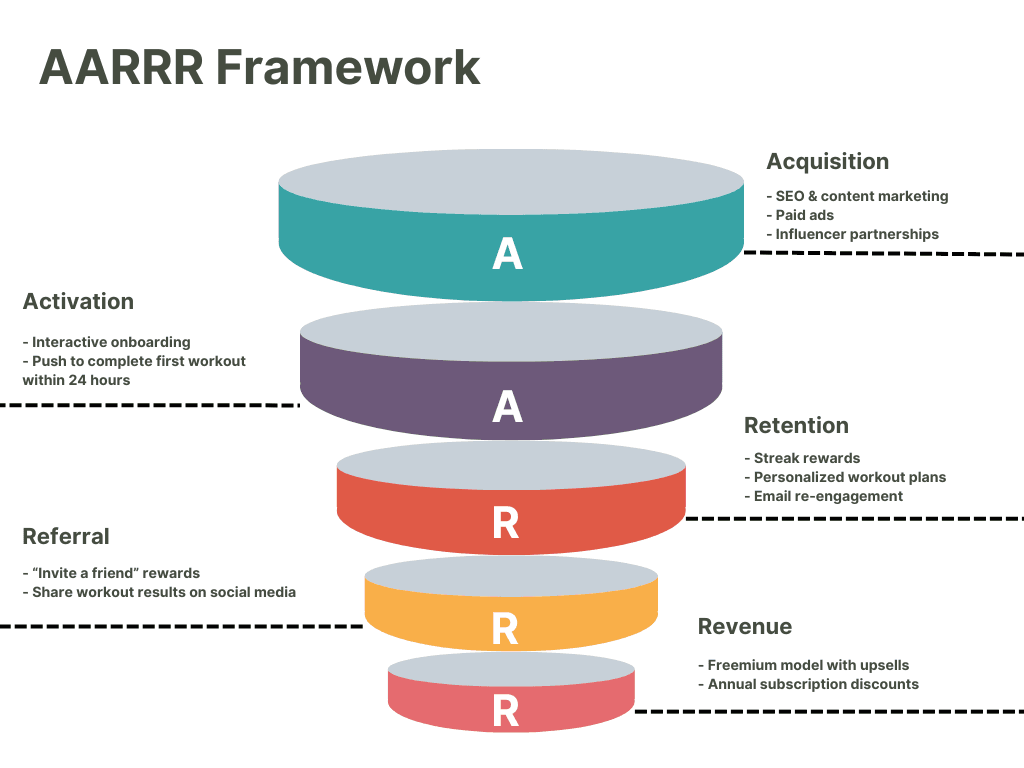
As you can see from this example, the AARRR template provides a clear and actionable roadmap for growth. By focusing on the fundamental questions at each stage, you can implement targeted tactics to optimize your customer journey and build a thriving business. Remember that this is just one example, and you can tailor the specific metrics and tactics to perfectly suit your unique product or service.
Free Download: AARRR Template
You can download the AARRR Template mentioned above by clicking Use Template button on this page. Customize it to fit your specific needs and preferences.