


For tenants, giving proper notice to their landlord before moving out is a critical step in ending a lease or rental agreement legally and professionally. The standard 30-Day Notice to Vacate is the most common requirement, ensuring a smooth transition for both parties and protecting the tenant's financial security (like the return of the security deposit).
This article explains the importance of the notice, details its necessary components, and provides best practices for formal delivery.
1. Why a Tenant Need 30-Day Notice to Vacate?
The requirement for a 30-day notice is fundamentally rooted in the rental agreement (lease) and state/local landlord-tenant laws. This notice period serves three primary functions:
- Legal Compliance: It fulfills the tenant’s contractual obligation under the lease. Most agreements, whether month-to-month or fixed-term, specify a mandatory notice period (often 30, 45, or 60 days) to terminate the tenancy. Failure to provide proper notice can result in the tenant being held liable for rent for the following month.
- Security Deposit Protection: Providing the required legal notice is often a precondition for receiving the full, timely return of the security deposit. A tenant who "skips out" or gives inadequate notice risks losing their deposit due to breach of contract.
- Landlord Preparation: It gives the landlord sufficient time to prepare the unit for turnover, market the property, and find a replacement tenant, minimizing their vacancy loss.
Important: Always check your specific lease agreement first, as it dictates the required notice period (which may be longer than 30 days).
2. What's Included in a 30-Day Notice Letter to Landlord?
A 30-day notice must be professional, unambiguous, and legally sufficient. It is a formal declaration of intent, not a casual letter.
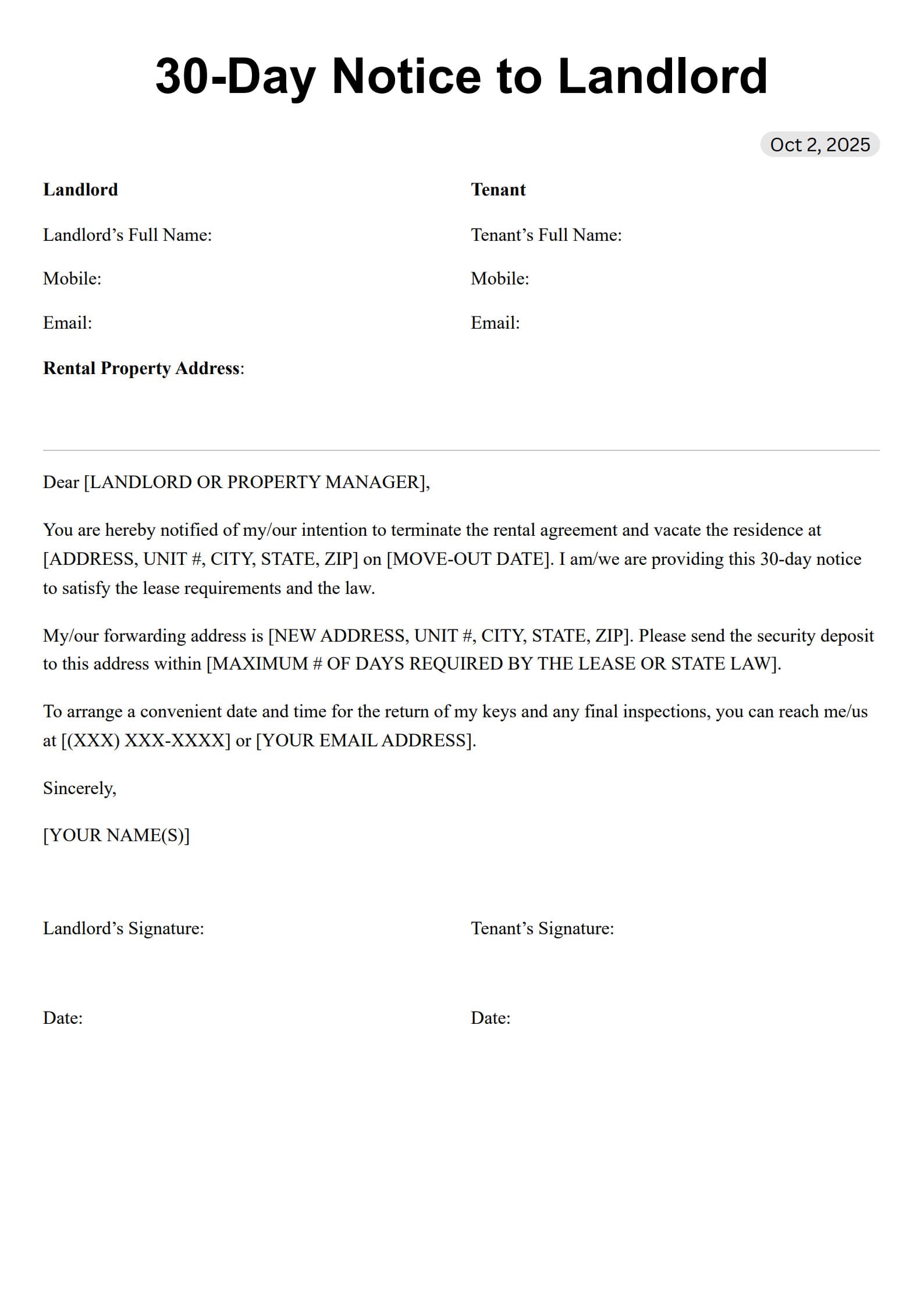
Mandatory Components of the 30-Day Notice to Move Out:
- Date of Letter: The date the notice is written and sent (this is distinct from the move-out date).
- Landlord/Recipient Information: The full name and address of the landlord or property management company as specified in the lease.
- Tenant Information: The full names of all tenants listed on the lease and the specific rental address (including unit number).
- Clear Statement of Intent: Explicitly state the purpose of the letter: "This letter serves as formal written notice of my/our intent to terminate the lease agreement and vacate the premises."
- Official Vacate Date: The exact date the tenant will move out and surrender the keys (e.g., "The official termination and move-out date will be October 31, 2025"). This date must be at least 30 days from the date the landlord receives the notice.
- Forwarding Address: A mandatory request for the security deposit return and any other necessary correspondence. This is critical for receiving the deposit.
- Signatures: The printed names and original signatures of all tenants listed on the lease.
3. How to Write a Professional 30-Day Notice to Landlord with Templates?
Using a printable template ensures that the letter maintains a professional tone and includes all required legal components.
Customization Steps for 30-Day Notice to Vacate:
- Header: Fill in the date of issue and the full name and address of the landlord/property management.
- Subject Line: Use a formal subject line for clarity (e.g., "30-Day Notice of Intent to Vacate – Unit 123 Main Street").
- Tenant Details: Input the names of all tenants on the lease and the rental property address.
- Vacate Date Calculation: Carefully count 30 days (or the required period) from the date you plan to send the letter to determine the official move-out date. In many cases, the tenancy must end on the last day of a rental period (e.g., the 30th or 31st of the month).
- Deposit Request: Include a line reiterating the expectation of receiving the security deposit return according to state law and providing the new forwarding address.
- Delivery Confirmation: Add a note stating how the notice was delivered (e.g., "Delivered via Certified Mail Return Receipt Requested").
4. Tips to Consider When Writing a 30-Day Notice from Tenant to Landlord
To ensure the notice is legally watertight and effective, tenants should follow these best practices:
- Check the Lease FIRST: The lease is the ultimate authority. If it says 60 days, then 30 days is insufficient. Adhere strictly to the required notice period.
- Time the Notice Correctly: In many states, the notice period must coincide with the end of a rental period. If rent is due on the 1st, your move-out date is usually the 30th or 31st. A notice submitted on, say, October 15th might not take effect until December 31st, depending on local law and the lease terms.
- Demand Proof of Receipt: Never rely on email or dropping the letter in a rent drop box without proof. The most secure methods are Certified Mail (Return Receipt Requested) or hand-delivery with a copy signed and dated by the landlord/agent.
- Keep a Copy: Always, without exception, keep a copy of the signed notice and the mailing receipt for your records. This is your evidence in case of a deposit dispute.
Conclusion
A properly executed 30-day notice to the landlord is the tenant’s final act of responsibility under the lease. By utilizing a clear, free template and ensuring formal, trackable delivery, tenants protect their legal standing and guarantee a professional, dispute-free termination of their rental agreement, paving the way for the timely return of their security deposit.
Free Download: Editable 30-Day Notice to Landlord Template
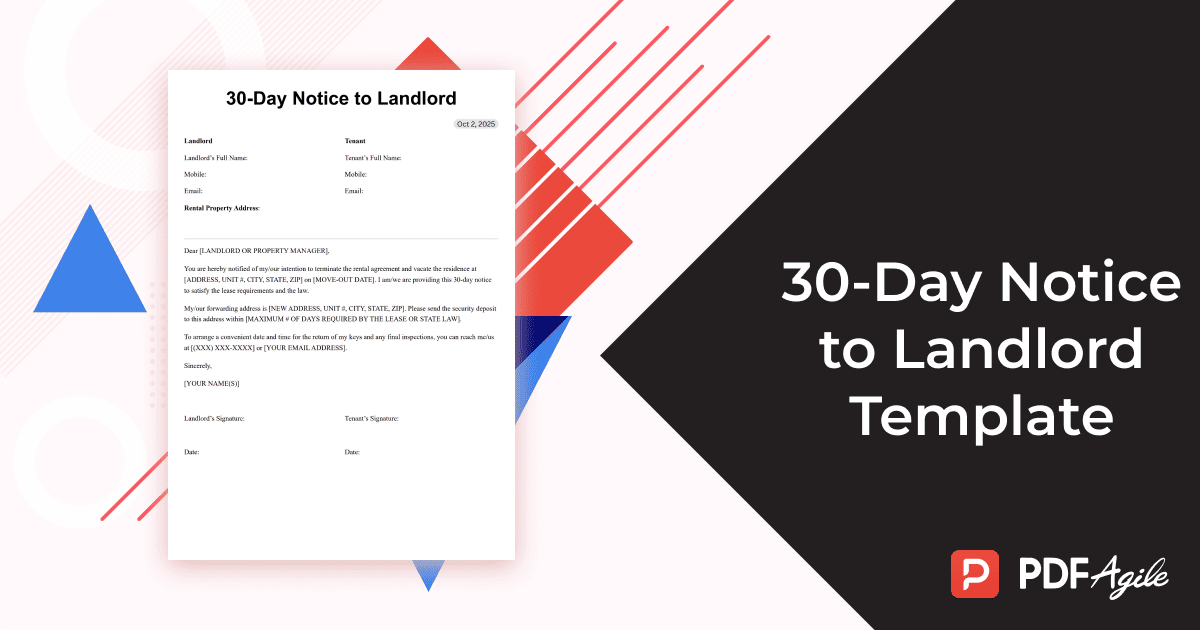
You can download the 30-day move-out notice template mentioned above by clicking Use Template button on this page. Customize it to fit your specific needs and preferences.
5. FAQs about 30-Day Notice Letter to Move Out
5.1 Can a landlord give notice via email?
Generally, No. Most state laws and lease agreements specify that formal legal notices (like eviction notices or notice of non-renewal) must be delivered via a method that provides a verifiable paper trail, such as Certified Mail, First Class Mail, or hand delivery by a process server. While email may be acceptable for routine communication, relying solely on email for a 30-day notice is risky and may be legally insufficient if a dispute arises. Always default to the method specified in the lease.
5.2 How to write a quit notice from landlord to tenant template?
A landlord’s notice to terminate a tenancy (often called a "Notice of Non-Renewal" or "Notice to Quit") is similar in format but requires additional strict compliance:
- Title: Clearly state the purpose (e.g., "Notice of Non-Renewal of Lease" or "30-Day Notice to Quit").
- Reason: For month-to-month tenancies, a reason is often not required (unless restricted by local law). For a for-cause eviction, the specific violation must be explicitly stated.
- Compliance: The landlord must adhere to the minimum statutory notice period for their location (which can range from 30 to 90 days).
- Delivery: Landlord notices often require the strictest delivery methods (e.g., certified mail or hand-posting/mailing combinations).
5.3 What is the minimum notice a tenant can give?
The minimum notice a tenant can give is determined by the lease agreement and local law.
- Fixed-Term Lease: If the lease has an end date, the notice period is usually 30 or 60 days before that end date.
- Month-to-Month: Most jurisdictions require a minimum of 30 days' notice to terminate a month-to-month tenancy.
- Always follow the stricter rule: If the law says 30 days but the lease says 60, the tenant must provide 60 days to avoid financial liability.
5.4 What is the best way to send a legal notice?
The absolute best way to send a legal notice, such as a 30-Day Notice to Landlord, is Certified Mail, Return Receipt Requested, combined with a standard First-Class mailing.
- Certified Mail: Provides a tracking number and confirmation that the post office delivered the mail.
- Return Receipt Requested: Provides a physical postcard signed by the recipient, proving they received the document and the exact date. This is the gold standard for court evidence.
Hand-delivery with the landlord's signature on the tenant's copy is also an excellent method.