


In the professional world, your reputation is your most valuable currency. While a resume or a website tells people what you can do, an endorsement letter tells them that you actually do it well. Whether you are a business owner seeking a partnership, a professional looking for a promotion, or a candidate for a public role, an endorsement letter provides the social proof necessary to close the deal.
What is an Endorsement Letter?
An endorsement letter is a formal document written by someone with authority or a strong reputation to "vouch" for the credibility, character, or professional abilities of another person, product, or business.
Unlike a standard recommendation letter—which is often private and directed toward a specific hiring manager—an endorsement letter is often more public-facing and broader in scope. It acts as an official "stamp of approval."
Why are Endorsement Letters Important?
- Builds Immediate Trust: If a respected leader or established brand supports you, their audience is more likely to trust you by extension.
- Shortens the Decision-Making Process: In sales or hiring, endorsements remove the "risk" factor for the decision-maker.
- Boosts Credibility: It highlights specific strengths and achievements that might otherwise seem like "self-promotion" if you said them yourself.
- Strengthens Relationships: Asking for and receiving an endorsement reinforces the professional bond between the endorser and the subject.
The Anatomy of a Perfect Endorsement Letter
A strong endorsement should be concise, professional, and evidence-based. It typically follows this structure:
- The Introduction: State who you are and who you are endorsing.
- The Relationship: Explain how you know the person or business.
- The "Why": Provide specific examples of their excellence.
- The Call to Action: Explicitly state your support and offer further contact if needed.
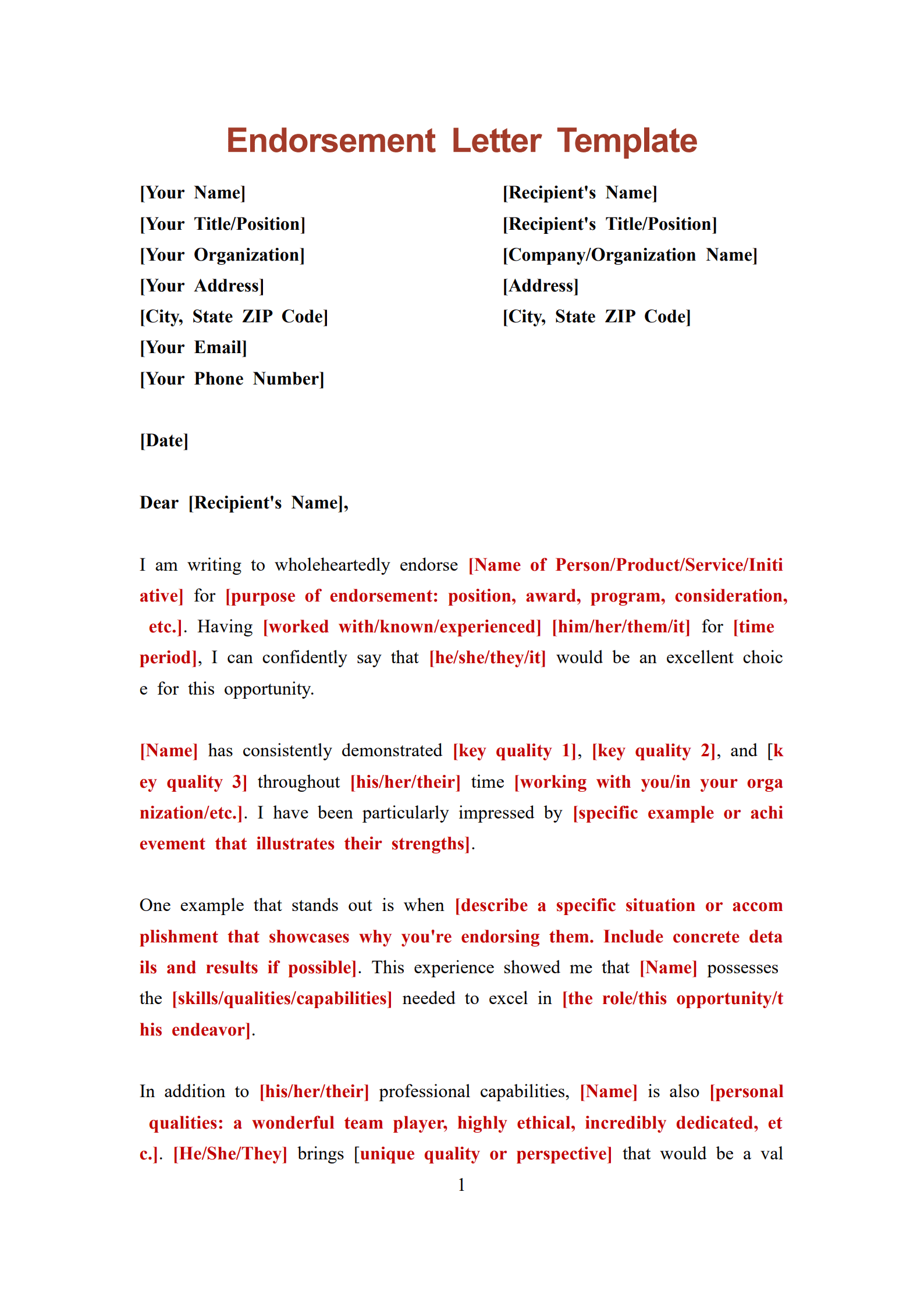
Professional Example Letter of Endorsement
Copy and customize the text below to suit your specific needs.
[Your Name/Organization Logo]
[Your Title]
[Your Address]
[Date]
[Recipient Name/To Whom It May Concern]
[Recipient Title/Organization]
[Recipient Address]
Subject: Letter of Endorsement for [Name of Person or Business]
Dear [Recipient Name],
It is with great pleasure and confidence that I write this letter to formally endorse [Name of Person/Business] for [mention the specific purpose, e.g., a partnership, a project, or a professional role].
As the [Your Job Title] at [Your Company], I have had the opportunity to work closely with [Subject Name] for the past [Time Period]. During this time, I have been consistently impressed by their [mention 2-3 key traits, e.g., integrity, technical expertise, and dedication].
In particular, I would like to highlight [Name]’s contribution to [mention a specific project or achievement]. Their ability to [mention a specific skill, e.g., manage complex workflows/deliver results under pressure] was instrumental in our success. I have found them to be [mention a personal quality, e.g., a reliable partner/a visionary leader] who consistently exceeds expectations.
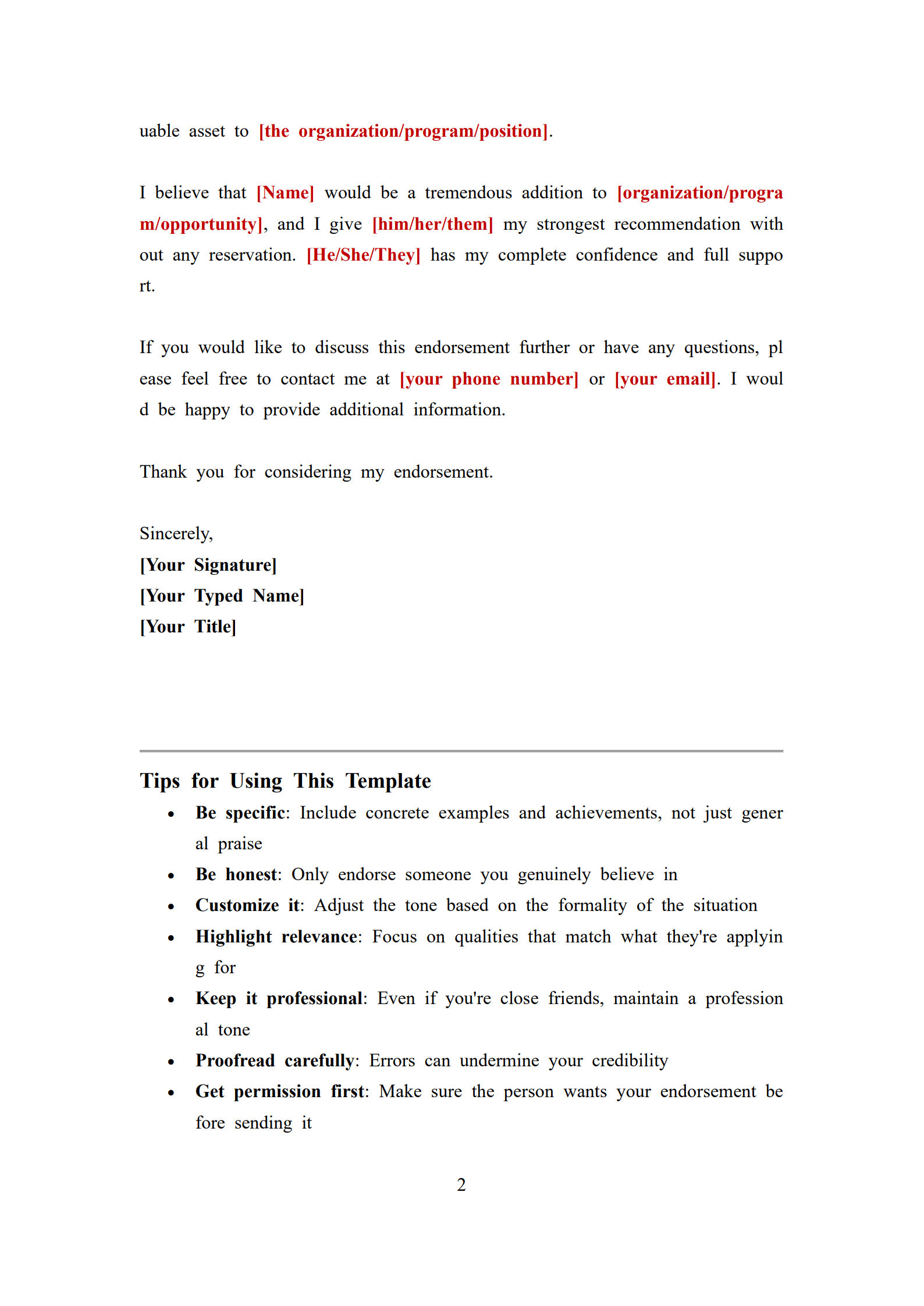
Because of their proven track record and high standards of excellence, I give [Name of Person/Business] my full and enthusiastic endorsement. I am confident that they will bring the same level of value to [Recipient’s Organization/Project] that they have brought to our collaborations.
Should you require any further information or wish to discuss my experiences with [Subject Name] in more detail, please do not hesitate to reach out to me at [Your Phone Number] or [Your Email Address].
Sincerely,
[Signature (if sending by mail)]
[Your Printed Name]
[Your Title]
Pro-Tips for Writing an Endorsement Letter
- Be Specific: Instead of saying "they are hard-working," say "they spearheaded a project that increased our efficiency by 20%."
- Keep it Concise: Busy professionals don't have time to read three pages. Keep your endorsement to one page or less.
- Be Honest: Only endorse people or products you truly believe in. Your own reputation is on the line when you sign your name.
- Request a Draft: If you are the one asking for an endorsement, offer to provide a "rough draft" to the endorser. This saves them time and ensures the key points you want highlighted are included.
Free Download: Your Editable Endorsement Letter Template
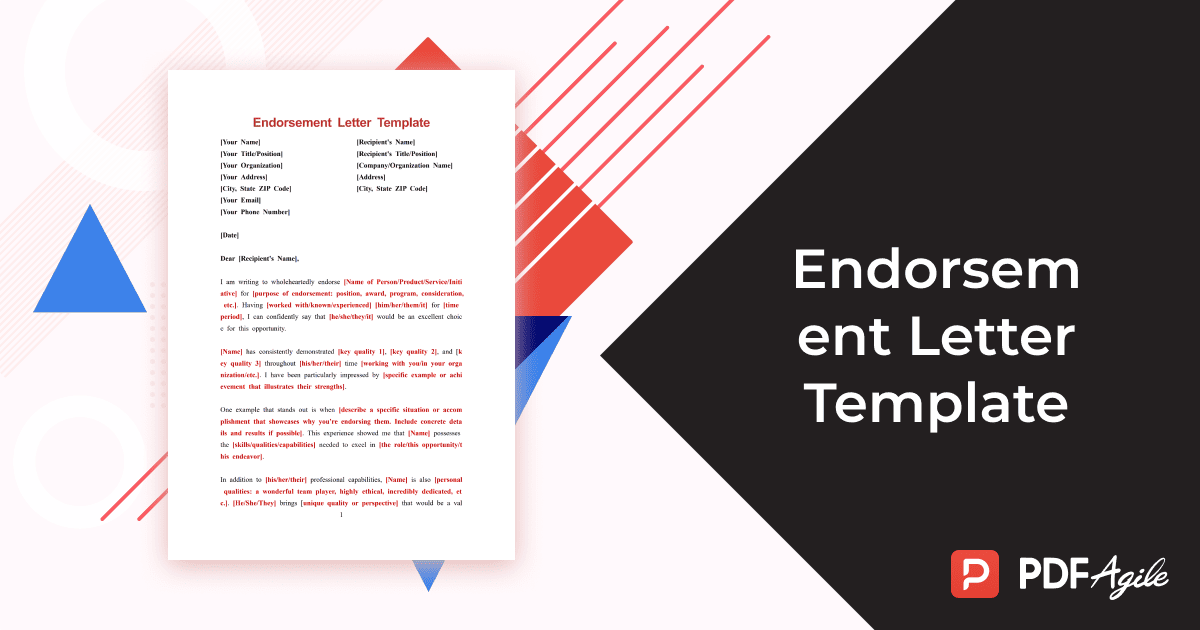
Need a quick and easy way to create a endorsement letter? Download our free, customizable templates by clicking the Use Template button on this page. Simply add your specific information and send them out effortlessly.
Frequently Asked Questions (FAQs)
1. What is the difference between a recommendation and an endorsement?
A recommendation is usually a private letter for a specific job application. An endorsement is often broader, more public, and focuses on "vouching" for a brand or person’s general reputation or a specific skill set.
2. Who should I ask for an endorsement?
Seek out individuals who have "weight" in your industry. This could be a former supervisor, a long-term client, or a recognized leader in your field.
3. Can I use an endorsement letter on my website?
Yes! With the author's permission, endorsement letters make excellent content for "Testimonials" pages or LinkedIn profiles.
4. How long should the letter be?
Ideally, between 250 and 400 words. It should be long enough to be meaningful but short enough to be read in under two minutes.
5. Is it okay to write my own endorsement letter for someone else to sign?
This is a common practice in the professional world to save the endorser time. However, the endorser must review, edit, and approve the content before signing to ensure it accurately reflects their views.