


In the history of cinema, few films have captured the human spirit’s yearning for freedom as poignantly as Dead Poets Society. Set against the rigid backdrop of Welton Academy, the film—led by the incomparable Robin Williams as John Keating—challenges us to look at life through a different lens.
1. What is Dead Poets Society About?
Released in 1989, Dead Poets Society tells the story of an unconventional English teacher, John Keating, who arrives at a strict, all-boys preparatory school. Through the study of poetry, he inspires his students to rebel against the crushing weight of "Tradition, Honor, Discipline, and Excellence."
The film is a celebration of Carpe Diem (Seize the Day) and a cautionary tale about the cost of conformity. It explores the tension between parental expectations and the burning desire to find one's own voice.
2. Are Poems Still Relevant in Modern Life?
In an era dominated by AI, rapid-fire social media, and data-driven results, poetry might seem like a relic of the past. However, it is more relevant today than ever.
- Mental Anchor: Poetry forces us to slow down and reflect, acting as a form of meditation.
- Human Connection: In a world of digital templates, poetry represents the raw, unedited human experience.
- Creative Agility: Reading and writing poetry trains the brain to see metaphors and connections that others miss—a vital skill for modern problem-solving.
As Keating famously says, “Medicine, law, business, engineering, these are noble pursuits and necessary to sustain life. But poetry, beauty, romance, love, these are what we stay alive for.”
3. Top 30 Dead Poets Society Quotes to Inspire You
The Most Iconic Lessons
1. "Carpe diem. Seize the day, boys. Make your lives extraordinary."
- When: Keating’s first lesson, standing before the photos of long-deceased students.
- Meaning: Life is fleeting. Don't wait for the "perfect moment" to start living; create it now.
2. "O Captain! My Captain!"
- When: Originally a Walt Whitman poem; famously shouted by Todd Anderson at the film's end.
- Meaning: A tribute to a leader who changed your world. It represents the ultimate act of loyalty and standing up for what you believe in.
3. "I went to the woods because I wanted to live deliberately... and not, when I came to die, discover that I had not lived."
- When: The opening invocation of the Dead Poets Society meetings (quoting Henry David Thoreau).
- Meaning: To live "deliberately" means to make choices based on your own values, not out of habit or social pressure.
4. "I sound my barbaric yawp over the roofs of the world."
- When: Keating forces the shy Todd Anderson to shout in front of the class.
- Meaning: Everyone has a unique voice. Finding it requires letting go of your fear of looking "silly."
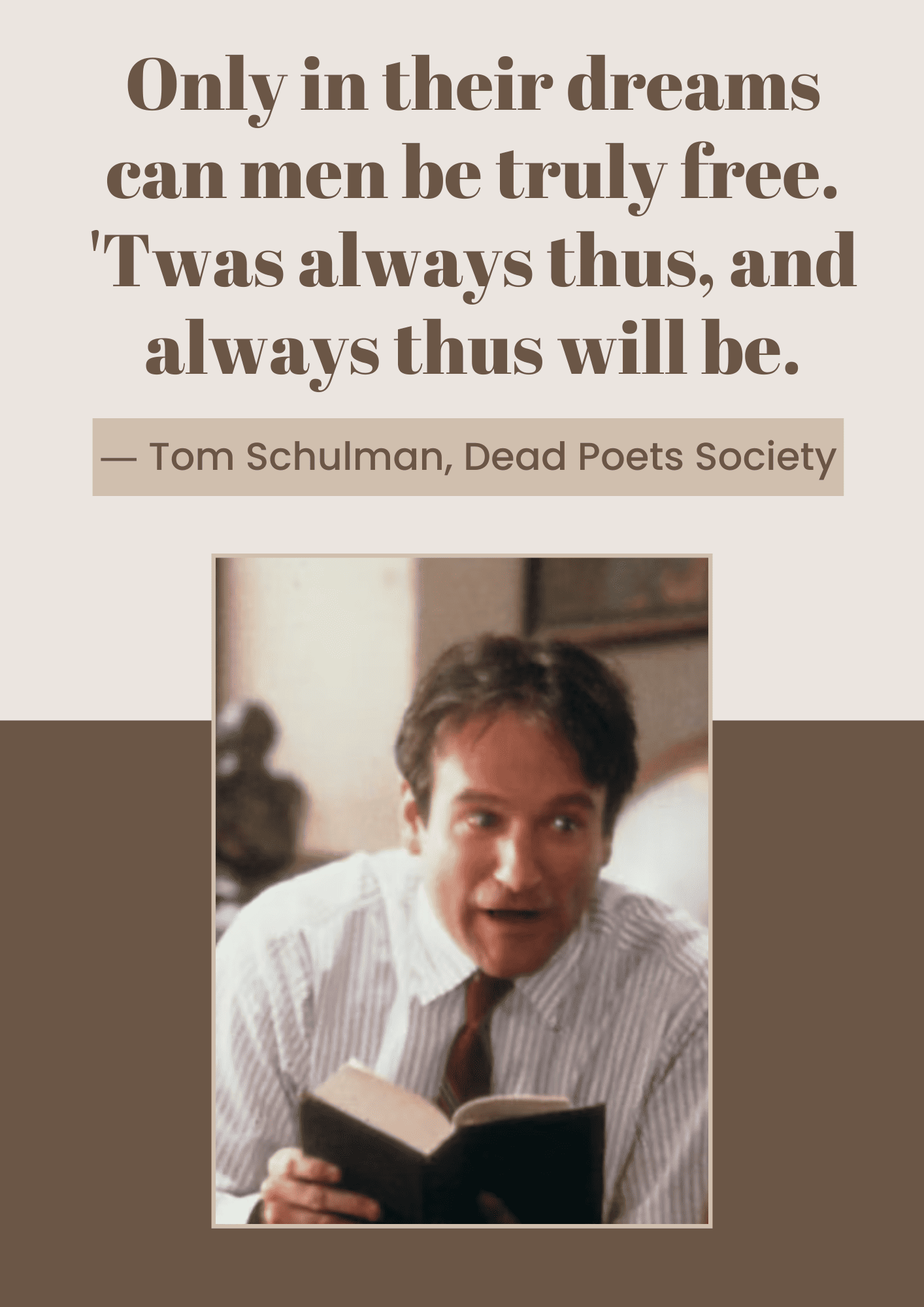
5. "But only in their dreams can men be truly free. 'Twas always thus, and always thus will be."
- When: Keating responding to a cynical comment from a colleague.
- Meaning: Imagination is the only place where society’s rules cannot reach you. Protect your inner world.
On Perspective and Thinking
6. "I stand upon my desk to remind myself that we must constantly look at things in a different way."
7. "Most men lead lives of quiet desperation. Don't be resigned to that. Break out!"
8. "Boys, you must strive to find your own voice. Because the longer you wait to begin, the less likely you are to find it at all."
9. "No matter what anybody tells you, words and ideas can change the world."
10. "Tradition is the illusion of permanence."

On Passion and Humanity
11. "We don't read and write poetry because it's cute. We read and write poetry because we are members of the human race."
12. "To quote from Whitman: 'O me! O life!... of the questions of these recurring... what good amid these, O me, O life?' Answer: That you are here—that life exists and identity, that the powerful play goes on, and you may contribute a verse."
13. "What will your verse be?"
14. "Show me the heart unfettered by foolish dreams, and I shall show you a happy man."
15. "Language was developed for one endeavor, and that is—to woo women." (Keating’s humorous take on the power of words).
Short Mantras for Inner Peace
16. "Gather ye rosebuds while ye may."
17. "Sucking the marrow out of life does not mean choking on the bone."
18. "There is a time for daring and there is a time for caution, and a wise man understands which is called for."
19. "Sucking the marrow out of life."
20. "Excellence. Discipline." (Used ironically to show what we must balance with heart).
21. "The human race is filled with passion."
22. "Go on, lean in."
23. "Listen, you hear it? Carpe... Carpe Diem..."
24. "Free thinkers at seventeen?"
25. "A person's word is their bond."
26. "Truth is like a blanket that always leaves your feet cold."
27. "Always look at things in a different way."
28. "Don't be resigned."
29. "Keep your own walk."
30. “Make your lives extraordinary.”
4. Tips for You Who Love Writing Poetry
If Dead Poets Society has inspired you to pick up a pen, here is how to start your own "barbaric yawp":
- Read Aloud: Poetry is meant to be heard. The rhythm and cadence are just as important as the words.
- Carry a "Verse Book": Whether it’s a physical notebook or a PDFAgile digitized file on your phone, jot down striking thoughts the moment they strike.
- Forget the Rules: Don't worry about rhyming or "sonnet structure" at first. Write for the feeling, not the grade.
- Find Your "Woods": Find a quiet place where you can be alone with your thoughts. This is where "deliberate living" begins.
- Be Vulnerable: Great poetry comes from honesty. If a thought scares you, that’s exactly what you should write about.
Summary: What Will Your Verse Be?
The wisdom of Dead Poets Society is a reminder that while the world demands efficiency, our souls demand expression. Inner peace isn't found in checking off a to-do list; it’s found in the moments where we choose to be ourselves despite the pressure to conform.
As you navigate your professional journey, use the tools that make you agile, but keep the spirit that makes you human.